
Francesco Mochi, lo scultore che liberò il marmo e il bronzo dal silenzio prima di Bernini
Quando Gian Lorenzo Bernini era ancora agli inizi, Francesco Mochi aveva già immaginato una scultura capace di torcersi, avanzare nello spazio e dare l’impressione di un movimento improvviso. Dall’Angelo di Orvieto ai celebri cavalli di Piacenza, la storia di un artista che contribuì a cambiare il volto della scultura europea.
I corpi si avvitano, i mantelli sembrano agitati dal vento, le figure conquistano lo spazio e la luce scivola sulle superfici come se la materia fosse diventata improvvisamente viva.
Nel primo Seicento, mentre Roma si prepara a diventare il grande palcoscenico del Barocco, Francesco Mochi (1580-1654) porta avanti una ricerca che anticipa molte delle soluzioni destinate a rendere celebre Gian Lorenzo Bernini.
Eppure il suo nome, oggi, è meno conosciuto di quello del grande protagonista del Barocco romano. È un peccato, perché Mochi fu uno degli scultori che contribuirono a trasformare la tradizione rinascimentale in una nuova arte fatta di energia, tensione e teatralità. Non si limitò a scolpire figure belle da osservare: cercò di farle sembrare sul punto di compiere un’azione.
La sua vicenda attraversa alcune delle città più importanti per la storia artistica italiana, da Orvieto a Piacenza fino a Roma, lasciando opere che ancora oggi raccontano quanto fosse precoce e personale la sua idea di scultura.
Chi era Francesco Mochi, lo scultore toscano che anticipò il Barocco
Francesco Mochi nacque a Montevarchi, in Toscana, nel 1580. La sua formazione si sviluppò in un ambiente artistico ancora profondamente legato all’eredità del Rinascimento e del Manierismo, ma attraversato da nuove sperimentazioni sul movimento, sull’espressività e sul rapporto tra l’opera e chi la osserva.
Tra i riferimenti della sua cultura figurativa figurano i grandi scultori del Cinquecento, in particolare Giambologna, maestro nel costruire figure dalle torsioni ardite e dalle pose complesse. Mochi raccolse quella lezione e la spinse verso risultati nuovi, dando alle sue opere una forza narrativa che sarebbe diventata una delle caratteristiche più riconoscibili del Barocco.
La sua carriera decollò grazie alla protezione di Mario Farnese, duca di Latera, che favorì la commissione destinata a segnare una svolta nella sua attività: l’Annunciazione per il Duomo di Orvieto.
Era il 1603. Gian Lorenzo Bernini era nato appena cinque anni prima.
Questa distanza anagrafica non significa che Mochi abbia inventato da solo il Barocco, né che Bernini si sia limitato a seguirlo. Aiuta però a comprendere quanto alcune delle innovazioni associate alla grande stagione berniniana fossero già oggetto di ricerca nei primi anni del Seicento
L’Annunciazione di Orvieto: quando il marmo sembra prendere il volo
Per capire davvero la portata innovativa di Mochi bisogna soffermarsi sull’Annunciazione, realizzata tra il 1603 e il 1608 e oggi conservata al Museo dell’Opera del Duomo di Orvieto.
Il gruppo è composto da due figure: l’Angelo annunciante e la Vergine annunciata. Il soggetto è antico e familiare alla tradizione cristiana, ma lo scultore lo affronta con un linguaggio sorprendentemente dinamico.
L’Angelo non appare come una presenza immobile, composta in una posa solenne. Il corpo è attraversato da una torsione, le ali partecipano alla tensione della figura e il panneggio si gonfia e si avvolge attorno alle membra, amplificando la sensazione di un arrivo improvviso. Il braccio teso sembra prolungare il movimento oltre i confini della composizione.
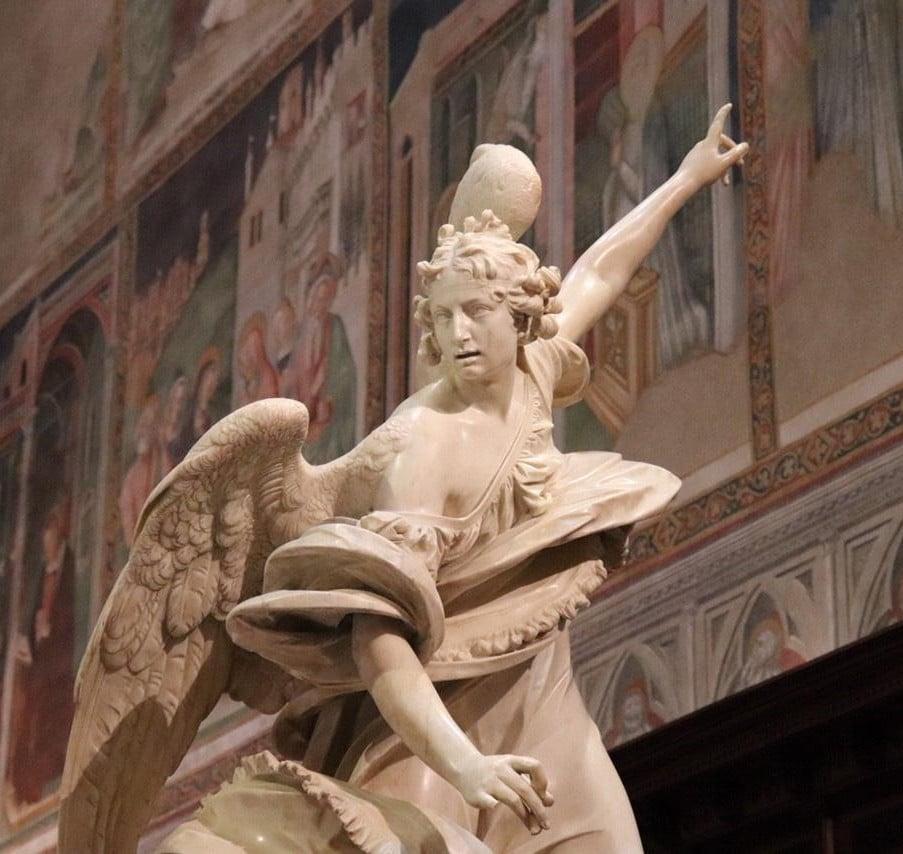
È come se la figura fosse stata fermata un istante prima di toccare terra.
La Vergine risponde con un atteggiamento differente. Il suo corpo è raccolto, il panneggio scende con un peso più stabile e la posa esprime sorpresa e raccoglimento. Al dinamismo dell’Angelo si contrappone così la compostezza di Maria, creando una tensione che si sviluppa tra le due figure.
Mochi costruisce un dialogo attraverso i corpi, le pieghe e le direzioni degli sguardi.
L’Annunciazione è considerata uno dei primi grandi esempi della nuova sensibilità barocca in scultura. La sua originalità sta anche nella capacità di superare una visione puramente frontale: le figure chiedono di essere osservate da più angolazioni, perché il movimento cambia e si rivela mentre lo spettatore si sposta.
I Cavalli di Piacenza: due monumenti che sembrano sul punto di partire
Se l’Annunciazione di Orvieto rivela la capacità di Mochi di imprimere movimento alla figura umana, sono i monumenti equestri di Piacenza a mostrare fino a che punto la sua ricerca potesse spingersi.
In Piazza Cavalli, nel cuore della città emiliana, si trovano due grandi sculture bronzee dedicate a Ranuccio Farnese e a suo padre Alessandro Farnese. Sono proprio loro ad aver dato alla piazza il nome con cui è conosciuta ancora oggi.
Mochi lavorò a Piacenza dal 1612 al 1629, impegnato nella realizzazione dei due monumenti commissionati nell’ambito della celebrazione dinastica dei Farnese. Le opere non nacquero contemporaneamente e questa distanza permette di leggere l’evoluzione del suo linguaggio.
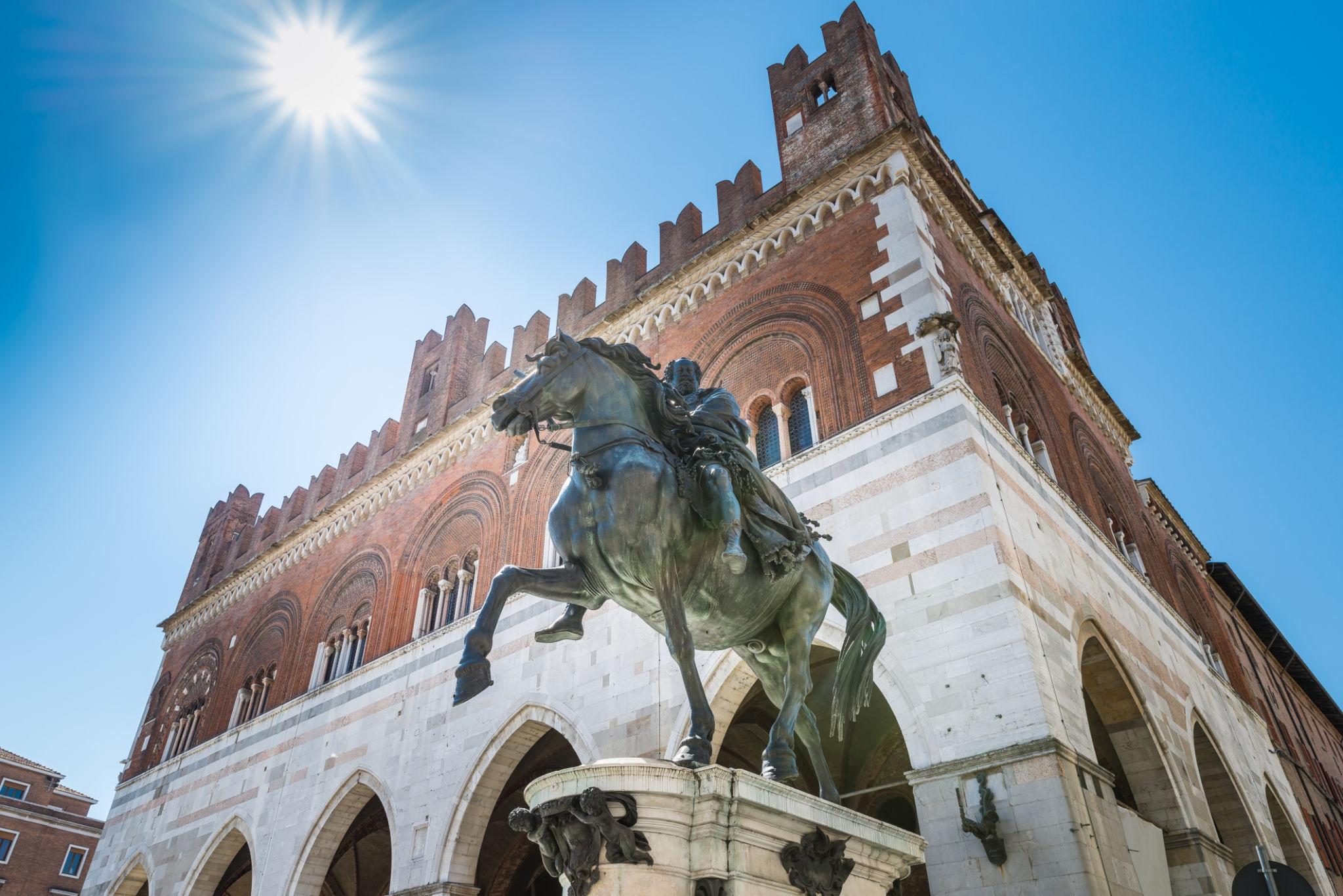
Nel monumento a Ranuccio Farnese è ancora riconoscibile il riferimento alla tradizione classica, con il ricordo del celebre Marco Aurelio a cavallo. La figura del principe mantiene una compostezza solenne, adatta a esprimere autorità e continuità dinastica.
Con il monumento ad Alessandro Farnese, invece, la composizione acquista una maggiore energia. Il cavallo avanza con impeto, il corpo dell’animale sembra attraversato da una tensione trattenuta e il mantello del condottiero si apre in un movimento che amplifica la sensazione di velocità.
Il bronzo, materiale associato alla celebrazione pubblica del potere, acquista una vitalità nuova. Le superfici riflettono la luce, le pieghe del mantello creano ombre profonde e la silhouette del cavaliere si intreccia con quella dell’animale.
Mochi aveva studiato anche i grandi monumenti equestri del Rinascimento, tra cui quelli di Donatello e Andrea del Verrocchio. Ma non si limitò a riprenderne i modelli: cercò una soluzione personale, capace di unire la solennità del monumento pubblico alla forza di un’azione che sembra svolgersi davanti ai nostri occhi.
Non è difficile capire perché queste opere siano considerate passaggi fondamentali verso il Barocco. In esse il movimento non è un dettaglio decorativo: è il principio che organizza l’intera composizione.
Francesco Mochi e Bernini: chi arrivò davvero prima?
Mettere a confronto Francesco Mochi e Gian Lorenzo Bernini significa affrontare una delle questioni più interessanti della nascita della scultura barocca: chi trasformò per primo la materia in un movimento capace di coinvolgere lo spettatore?
La risposta non può essere affidata a una gara tra due artisti. Mochi sviluppò una ricerca autonoma quando Bernini era ancora giovanissimo, sperimentando torsioni, panneggi agitati e composizioni che sembrano oltrepassare i limiti dello spazio fisico.
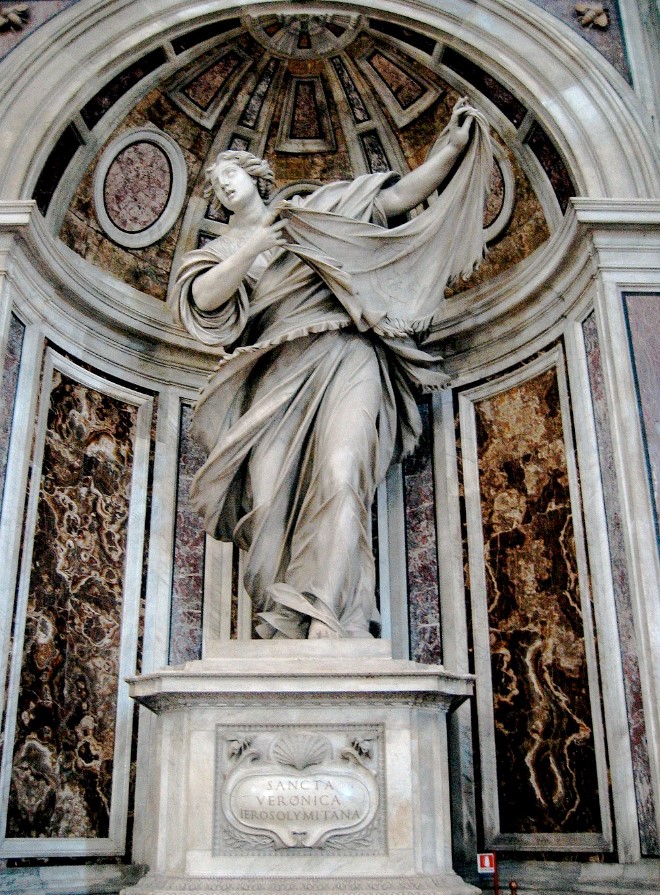
Bernini portò poi il linguaggio barocco a una potenza straordinaria, unendo movimento, espressione psicologica, luce e costruzione teatrale. Le sue opere trasformarono la scultura in un’esperienza capace di coinvolgere emotivamente chi guarda.
Mochi, tuttavia, aveva già dimostrato che il marmo poteva suggerire un gesto improvviso e che il bronzo poteva restituire la tensione di un corpo in azione.
La differenza emerge anche nel modo in cui i due artisti concepiscono la narrazione. Bernini tende a costruire momenti di forte intensità drammatica, nei quali l’azione e la reazione emotiva diventano inseparabili. Mochi ricerca spesso un movimento impetuoso, quasi autonomo, che nasce dalla torsione delle figure e dalla tensione dei panneggi.
La Santa Veronica in San Pietro: il velo, il vento e il volto di Cristo
Tra le opere più importanti della maturità di Mochi c’è la Santa Veronica, realizzata per uno dei grandi pilastri della crociera della Basilica di San Pietro in Vaticano e collocata nel 1640.
La commissione faceva parte del programma decorativo ideato per i pilastri che sostengono la cupola, destinati a ospitare quattro monumentali figure legate alle reliquie conservate nella basilica. Gli altri scultori coinvolti furono Gian Lorenzo Bernini, François Duquesnoy e Andrea Bolgi.
Il soggetto scelto per Mochi è Veronica, la donna che, secondo la tradizione cristiana, asciugò il volto di Cristo durante la salita al Calvario, lasciandone impressa l’immagine sul velo.
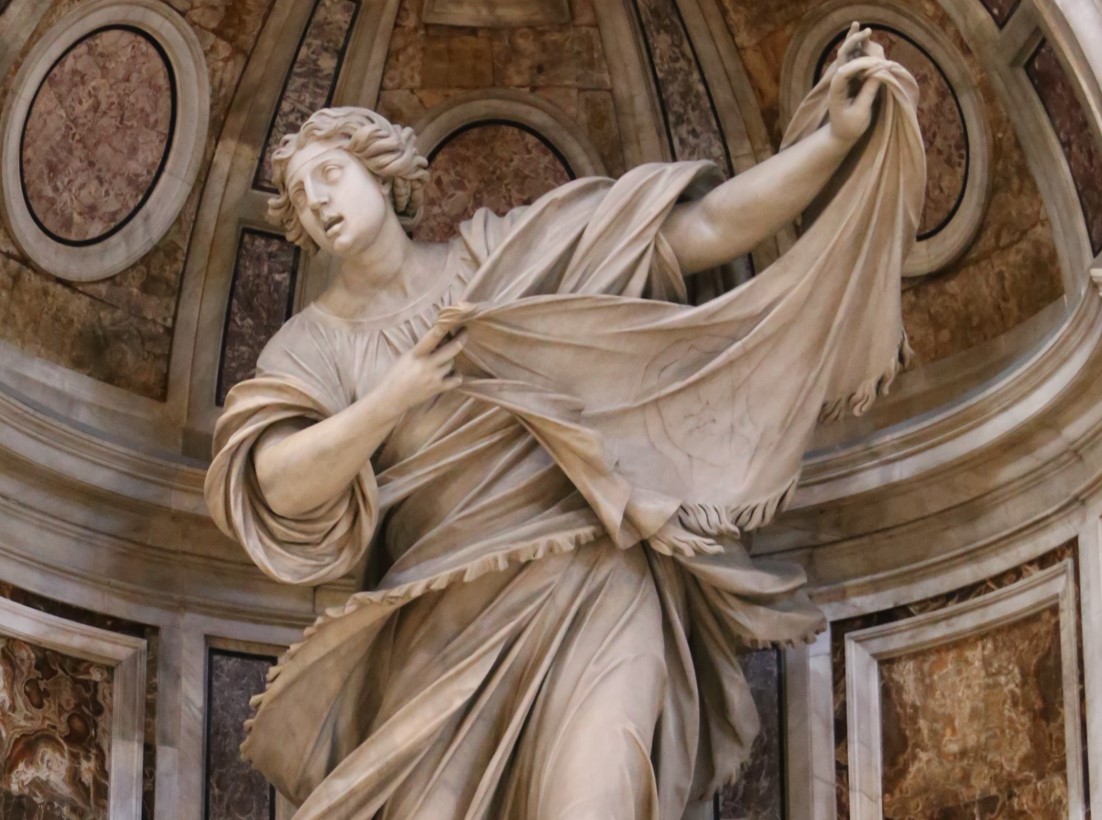
Ma anche in questo caso lo scultore evita una rappresentazione semplicemente solenne. La santa appare in movimento, con il corpo proteso in avanti e il tessuto che si apre attorno alla figura. Il velo viene mostrato come il fulcro dell’episodio, mentre le pieghe della veste sembrano rispondere a una folata di vento.
Veronica è come se fosse ancora immersa nell’urgenza dell’evento appena accaduto.
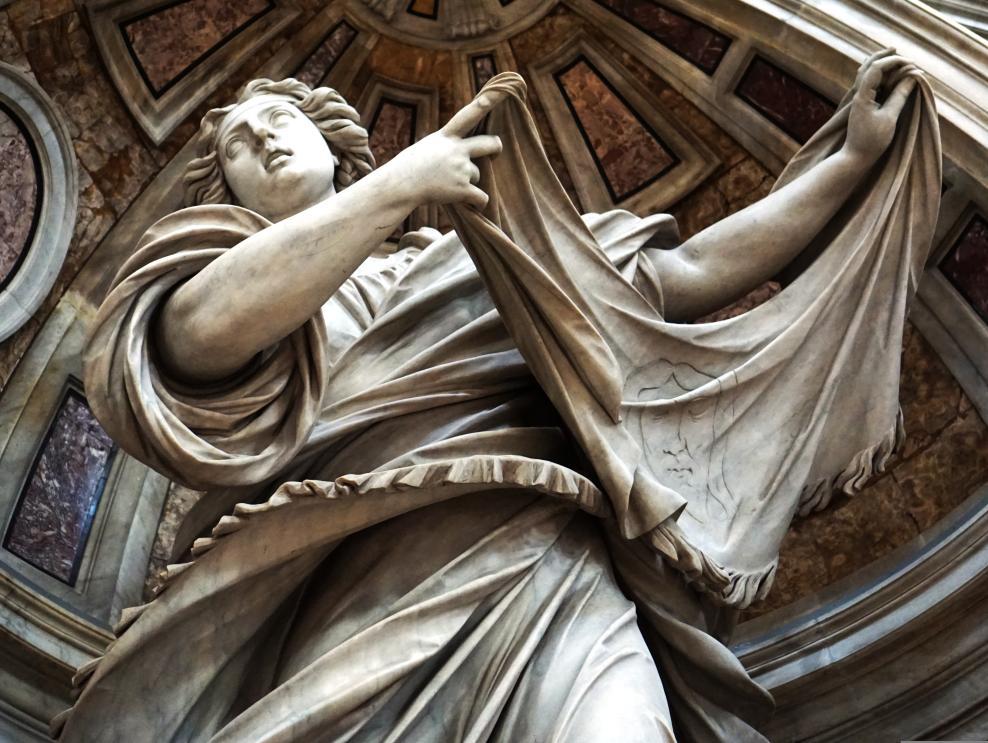
La lavorazione del marmo, con i tessuti sottili e le pieghe articolate, rivela una straordinaria attenzione alla resa della materia. Il velo, soprattutto, crea un contrasto tra la sua consistenza apparentemente leggera e il peso reale della pietra.
L’opera fu apprezzata da papa Urbano VIII, ma il rapporto tra Mochi e Bernini fu segnato anche da contrasti. Le ricostruzioni storico-artistiche ricordano le riserve espresse da Bernini nei confronti della Veronica, testimonianza delle divergenze che potevano emergere tra artisti chiamati a lavorare nello stesso grande cantiere romano.
Accanto ai grandi capolavori che hanno segnato la sua carriera, Francesco Mochi realizzò altre opere importanti per comprendere la varietà della sua ricerca.
La Santa Marta, destinata alla cappella Barberini nella chiesa romana di Sant’Andrea della Valle, testimonia la sua attenzione al rapporto tra la figura e lo spazio circostante. Il corpo, il gesto e il panneggio concorrono a costruire una presenza che non rimane chiusa in una posa rigida, ma suggerisce una tensione interna.
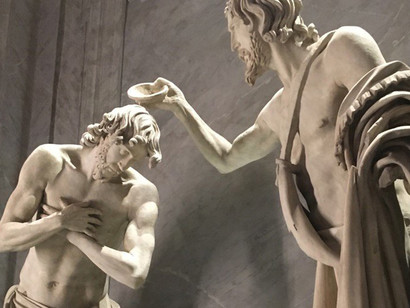
Un’altra opera significativa è il Battesimo di Cristo, realizzato nel 1634 per la chiesa di San Giovanni dei Fiorentini a Roma. Il gruppo non venne collocato nella destinazione originaria ed è oggi conservato a Palazzo Braschi, sede del Museo di Roma.
La sua carriera, tuttavia, si svolse in un contesto sempre più dominato dal successo di Bernini. Tornato stabilmente a Roma nel 1629, Mochi si trovò a operare in una città in cui il linguaggio del giovane maestro stava conquistando un ruolo centrale. La sua personalità artistica rimase riconoscibile, ma non sempre incontrò il favore dei committenti.
Morì a Roma il 6 febbraio 1654. Lasciò una produzione che oggi consente di rileggere la nascita del Barocco non come il risultato del genio di un solo artista, ma come una trasformazione alla quale contribuirono diverse personalità, ciascuna con le proprie intuizioni.
Prima che il Barocco diventasse il linguaggio dominante della Roma seicentesca, Mochi aveva già trovato un modo per dare alla pietra e al bronzo l’apparenza della vita.
Per il momento il sempre vostro Michelangelo Buonarroti vi saluta dandovi appuntamento ai prossimi post e sui social.

Francesco Mochi, the sculptor who liberated marble and bronze from silence—long before Bernini
While Gian Lorenzo Bernini was still in the early stages of his career, Francesco Mochi had already envisioned a form of sculpture capable of twisting, thrusting into space, and conveying the impression of sudden movement. From his Angel in Orvieto to his celebrated horses in Piacenza, the story of an artist who helped change the face of European sculpture.
Bodies coil, cloaks appear to be stirred by the wind, figures claim the surrounding space, and light glides across surfaces as if the material itself had suddenly come to life.
In the early 17th century—as Rome prepared to become the grand stage for the Baroque—Francesco Mochi (1580–1654) pursued an artistic vision that anticipated many of the techniques that would later bring fame to Gian Lorenzo Bernini.
Yet today, his name is less well-known than that of the great protagonist of the Roman Baroque. This is a pity, for Mochi was one of the sculptors who helped transform the Renaissance tradition into a new art form defined by energy, tension, and theatricality. He did not merely carve figures that were beautiful to behold; he sought to make them appear as though they were on the verge of taking action.
His career spanned some of the most significant cities in the history of Italian art—from Orvieto and Piacenza to Rome—leaving behind works that, even today, reveal just how precocious and distinctive his approach to sculpture truly was.
Who was Francesco Mochi, the Tuscan sculptor who anticipated the Baroque?
Francesco Mochi was born in Montevarchi, Tuscany, in 1580. His artistic training took place in an environment still deeply rooted in the legacy of the Renaissance and Mannerism—yet one that was also beginning to explore new ideas regarding movement, expressiveness, and the relationship between a work of art and its viewer.
Among the influences on his visual vocabulary were the great sculptors of the 16th century—most notably Giambologna, a master of crafting figures with daring twists and complex poses. Mochi took this lesson further, pushing it toward new outcomes and imbuing his works with a narrative power that would eventually become one of the most recognizable hallmarks of the Baroque style.
His career took off thanks to the patronage of Mario Farnese, Duke of Latera, who helped secure a commission that would prove to be a turning point in Mochi’s work: the Annunciation for the Cathedral of Orvieto.
The year was 1603. Gian Lorenzo Bernini had been born just five years earlier.
This age gap does not mean that Mochi invented the Baroque single-handedly, nor that Bernini merely followed in his footsteps. It does, however, help us understand how certain innovations—often associated with the great era of Bernini—were already being explored during the early 17th century.
The Annunciation of Orvieto: when marble seems to take flight
To truly grasp the innovative significance of Mochi’s work, one must look closely at his Annunciation—created between 1603 and 1608 and now housed in the Museo dell’Opera del Duomo in Orvieto.
The sculptural group consists of two figures: the Angel of the Annunciation and the Virgin Mary. While the subject is ancient and deeply familiar within the Christian tradition, the sculptor approaches it using a remarkably dynamic visual language. The Angel does not appear as a static presence, fixed in a solemn pose. A torsion runs through the body; the wings contribute to the figure’s overall tension, while the drapery billows and wraps around the limbs, heightening the impression of a sudden arrival. The outstretched arm seems to extend the movement beyond the boundaries of the composition.
It is as if the figure had been captured a split second before touching the ground.
The Virgin responds with a different demeanor. Her body is composed and gathered; her drapery falls with a greater sense of weight, and her posture conveys both surprise and inward reflection. The dynamism of the Angel is thus contrasted by the composure of the Virgin, creating a tension that unfolds between the two figures.
Mochi constructs a dialogue through their bodies, the folds of their garments, and the direction of their gazes.
The Annunciation is considered one of the first great examples of the new Baroque sensibility in sculpture. Its originality also lies in its ability to transcend a purely frontal perspective: the figures invite the viewer to observe them from multiple angles, as the movement shifts and reveals itself anew with every change in the viewer’s position.
The Horses of Piacenza: two monuments that seem on the verge of setting off.
If the Annunciation in Orvieto demonstrates Mochi’s capacity to imbue the human figure with movement, it is his equestrian monuments in Piacenza that reveal the full extent of his artistic exploration.
In Piazza Cavalli—the “Square of the Horses”—located in the heart of this Emilian city, stand two large bronze sculptures dedicated to Ranuccio Farnese and his father, Alessandro Farnese. It is precisely these works that gave the square the name by which it is still known today.
Mochi worked in Piacenza from 1612 to 1629, occupied with the creation of these two monuments, which were commissioned as part of the dynastic celebration of the Farnese family. These works were not created at the same time, and this chronological gap allows us to trace the evolution of the artist’s visual language.
In the monument to Ranuccio Farnese, one can still discern references to the classical tradition—most notably an echo of the famous equestrian statue of Marcus Aurelius. The figure of the prince retains a solemn composure, well-suited to conveying authority and dynastic continuity.
In the monument to Alessandro Farnese, by contrast, the composition gains a greater sense of energy. The horse surges forward; its body appears charged with pent-up tension, while the commander’s cloak unfurls in a way that amplifies the impression of speed.
Bronze—a material traditionally associated with the public glorification of power—takes on a new vitality here. Surfaces catch the light, the folds of the cloak cast deep shadows, and the silhouette of the rider becomes inextricably intertwined with that of his mount.
Mochi had studied the great equestrian monuments of the Renaissance, including those by Donatello and Andrea del Verrocchio. Yet, he did not merely replicate these earlier models; instead, he sought a unique, personal approach—one that could marry the solemnity of a public monument with the raw power of an action unfolding before the viewer’s very eyes.
It is easy to see why these works are regarded as pivotal steps toward the Baroque. In them, movement is not merely a decorative detail; it is the fundamental principle that shapes the entire composition.
Francesco Mochi and Bernini: who truly got there first?
Comparing Francesco Mochi and Gian Lorenzo Bernini means confronting one of the most compelling questions surrounding the birth of Baroque sculpture: who was the first to transform inert material into a form of movement capable of engaging the spectator?
The answer cannot be reduced to a race between two artists. Mochi developed an independent artistic approach while Bernini was still very young, experimenting with torsions, agitated drapery, and compositions that seem to transcend the boundaries of physical space.
Bernini later elevated the Baroque idiom to extraordinary power, synthesizing movement, psychological expression, light, and theatrical staging. His works transformed sculpture into an experience capable of emotionally engaging the viewer.
Mochi, however, had already demonstrated that marble could evoke a sudden gesture and that bronze could capture the tension of a body in action.
The distinction is also evident in how the two artists conceive of narrative. Bernini tends to construct moments of intense drama, in which action and emotional reaction become inseparable. Mochi, by contrast, often pursues an impetuous, almost autonomous movement, born from the twisting of figures and the tension of their drapery.
Saint Veronica in St. Peter’s: The Veil, the Wind, and the Face of Christ
Among the most significant works from Mochi’s maturity is his Saint Veronica, created for one of the great piers supporting the dome of St. Peter’s Basilica in the Vatican, where it was installed in 1640.
The commission was part of a decorative program for the piers supporting the dome, designed to house four monumental figures associated with relics held within the basilica. The other sculptors involved were Gian Lorenzo Bernini, François Duquesnoy, and Andrea Bolgi.
The subject assigned to Mochi was Saint Veronica—the woman who, according to Christian tradition, wiped the face of Christ as He ascended to Calvary, leaving His image imprinted upon her veil.
Yet, here too, the sculptor avoids a merely solemn representation. The saint appears in motion, her body leaning forward, with fabric unfurling around her figure. The veil is presented as the focal point of the episode, while the folds of the garment appear to react to a gust of wind.
Veronica seems as though she is still immersed in the urgency of the event that has just unfolded.
The marble craftsmanship—with its delicate fabrics and intricate folds—reveals an extraordinary attention to the rendering of material. The veil, in particular, creates a contrast between its seemingly lightweight texture and the actual weight of the stone.
The work was admired by Pope Urban VIII, yet the relationship between Mochi and Bernini was also marked by conflict. Art-historical accounts note the reservations Bernini expressed regarding the Veronica—a testament to the disagreements that could arise between artists tasked with working on the same major Roman project.
Alongside the great masterpieces that defined his career, Francesco Mochi created other significant works that shed light on the breadth of his artistic exploration.
His Saint Martha, intended for the Barberini Chapel in the Roman church of Sant’Andrea della Valle, demonstrates his focus on the relationship between a figure and the surrounding space. The body, the gesture, and the drapery all contribute to a presence that is not confined to a rigid pose, but rather suggests an internal tension.
One significant work is the Baptism of Christ, created in 1634 for the church of San Giovanni dei Fiorentini in Rome. The sculptural group was never placed in its intended location and is now housed at Palazzo Braschi, home to the Museum of Rome.
His career, however, unfolded within a context increasingly dominated by the success of Bernini. Having returned to Rome permanently in 1629, Mochi found himself working in a city where the artistic language of the younger master was taking center stage. While his own artistic identity remained distinct, it did not always find favor with his patrons.
He died in Rome on February 6, 1654. He left behind a body of work that allows us today to reinterpret the birth of the Baroque—not as the product of a single artist’s genius, but as a transformation to which various figures contributed, each with their own unique insights.
Long before the Baroque became the dominant language of seventeenth-century Rome, Mochi had already discovered a way to imbue stone and bronze with the appearance of life.
For now, yours truly, Michelangelo Buonarroti, bids you farewell—until the next posts and over on social media.
Sostienici – Support Us
Se questo blog ti piace e ti appassiona, puoi aiutarci a farlo crescere sempre più sostenendoci in modo concreto condividendo i post, seguendo le pagine social e con un contributo che ci aiuta ad andare avanti con il nostro lavoro di divulgazione. . ENGLISH: If you like and are passionate about this blog, you can help us make it grow more and more by supporting us in a concrete way by sharing posts, following social pages and with a contribution that helps us to move forward with our dissemination work.
10,00 €
Condividi:


Questo sono io



sostienici

Sostienici – Support Us
Se questo blog ti piace e ti appassiona, puoi aiutarci a farlo crescere sempre più sostenendoci in modo concreto condividendo i post, seguendo le pagine social e con un contributo che ci aiuta ad andare avanti con il nostro lavoro di divulgazione. . ENGLISH: If you like and are passionate about this blog, you can help us make it grow more and more by supporting us in a concrete way by sharing posts, following social pages and with a contribution that helps us to move forward with our dissemination work.
€10,00


