
La Natività di Nicola Pisano con la capretta che si gratta
Una capra che si gratta un orecchio, Maria distesa dopo il parto e una mangiatoia che sembra anticipare una bara. Nel pulpito del Battistero di Pisa, Nicola Pisano racconta la nascita di Cristo con una ricchezza di particolari e una forza espressiva che ancora oggi sorprendono.
Nel pulpito del Battistero di San Giovanni a Pisa, Nicola Pisano ha scolpito uno dei più importanti cicli narrativi della scultura medievale italiana.
Con l’approssimarsi del Natale voglio soffermarmi su uno dei suoi rilievi più affascinanti, quello che riunisce l’Annunciazione e la Natività, due momenti fondamentali della vita di Cristo. Nicola Pisano li mette in relazione all’interno dello stesso spazio, accompagnando chi guarda dal momento in cui Maria riceve l’annuncio dell’arcangelo Gabriele fino alla nascita del Bambino.

È una scena ricca di personaggi, gesti e dettagli naturalistici, nella quale la solennità dell’evento sacro convive con una sorprendente attenzione alla vita quotidiana.
L’Annunciazione: Maria riceve l’annuncio dell’arcangelo Gabriele
La narrazione comincia con l’Annunciazione. L’arcangelo Gabriele si presenta davanti a Maria per comunicarle che diventerà la madre del Figlio di Dio.
La Vergine appare ritratta in un atteggiamento di sorpresa e incredulità. Il suo corpo sembra arretrare leggermente davanti alle parole dell’angelo, mentre il gesto e la postura restituiscono tutta la delicatezza di un momento destinato a cambiare il corso della storia cristiana.
Nicola Pisano cerca di dare forma alle emozioni dei protagonisti. Maria non è una figura distante e immobile: reagisce all’annuncio, manifesta il proprio stupore e diventa parte attiva della narrazione.
Accanto a questo primo episodio si sviluppa la scena della Natività, che occupa gran parte del rilievo.

La Natività: Maria, il Bambino e gli animali della mangiatoia
Al centro della composizione troviamo Maria distesa dopo aver dato alla luce Gesù. La Vergine riposa, con un’espressione serena che contrasta con il movimento e la presenza degli altri personaggi.
La sua figura domina la scena e costituisce il punto di riferimento visivo dell’intera composizione. Poco distante, il Bambino è deposto nella mangiatoia, mentre angeli e pastori partecipano all’evento della nascita.
C’è però un particolare sul quale vi invito a soffermarvi: la mangiatoia nella quale è adagiato Gesù ha una forma che ricorda quella di una bara.
Questa scelta iconografica può essere letta come un richiamo al destino futuro di Cristo e al sacrificio che attende il Bambino appena nato. La Natività porta già con sé, simbolicamente, il racconto della Passione.
Stessa cosa vale per il catino in cui viene fatto il primo bagnetto a Gesù bambino che, purtroppo, nel corso dei secoli, ha perso il capo. La sua forma richiama palesemente il calice contenente il sangue di Cristo.
La nascita e la morte di Gesù vengono accostate attraverso un elemento apparentemente semplice, ma carico di significati.
Osservando attentamente la parte inferiore del rilievo, si scopre una rappresentazione del mondo animale di una naturalezza sorprendente. Le figure non sono semplici presenze decorative, ma partecipano alla scena con atteggiamenti e movimenti riconoscibili.
Guardate in particolare nell’angolo in basso a destra: c’è una capra intenta a grattarsi un orecchio.
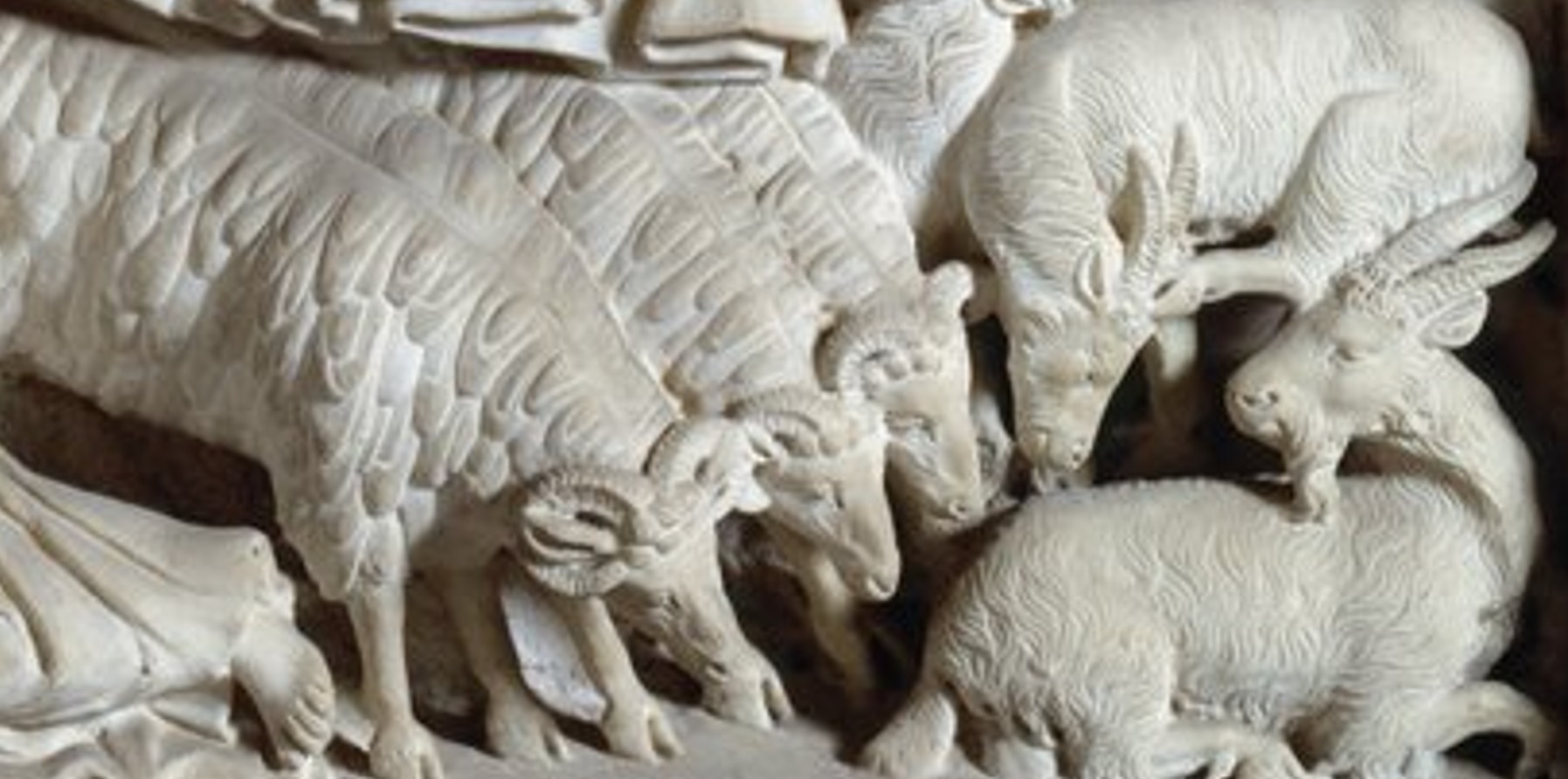
È un gesto quotidiano, spontaneo, quasi buffo nella sua naturalezza. Un particolare che che rivela quanto Nicola Pisano fosse attento all’osservazione della realtà e quanto gli interessasse restituire la vita anche nei dettagli più piccoli.
Davanti a questa capra viene spontaneo sorridere. In mezzo a una rappresentazione così solenne, l’animale compie un gesto familiare, che sembra appartenere più a una scena di vita contadina che a un episodio sacro.
Il pulpito di Nicola Pisano: una rivoluzione nella scultura medievale
Il rilievo dell’Annunciazione e della Natività è uno dei sei grandi pannelli che compongono il pulpito esagonale del Battistero di Pisa, generalmente considerato la prima opera attribuibile con certezza a Nicola Pisano.
Realizzato in marmo e completato nel 1259, o comunque entro il 24 marzo 1260 secondo la datazione pisana riportata dall’iscrizione, il pulpito rappresenta un passaggio fondamentale nella storia della scultura italiana.
La sua stessa struttura costituisce un elemento di grande innovazione. A differenza dei pergami toscani precedenti, generalmente rettangolari e addossati a una parete, quello di Pisa si presenta come un prisma esagonale libero nello spazio, sostenuto da colonne e concepito per essere osservato da più punti di vista.

Anche i rilievi del parapetto si distinguono per la loro impostazione. Le scene occupano interamente i campi marmorei e le figure sembrano talvolta oltrepassarne i confini, creando una maggiore continuità tra lo spazio rappresentato e quello reale.
Il ciclo iconografico racconta la missione salvifica di Cristo attraverso cinque grandi scene: l’Annunciazione e la Natività, l’Adorazione dei Magi, la Presentazione di Gesù al Tempio, la Crocifissione e il Giudizio Universale.
I pannelli sono separati da fasci di colonnine, mentre gli archi trilobati presentano figure di profeti ed evangelisti. Agli angoli del registro intermedio trovano posto le Virtù, San Giovanni Battista e l’arcangelo Gabriele.
La struttura poggia su sette colonne di marmi differenti. Alcune sono sostenute da leoni, mentre quella centrale poggia su un alto piedistallo decorato con figure umane e animali, allusive al mondo terreno riscattato dal sacrificio di Cristo.
Nicola Pisano tra classicismo antico e gotico francese
Nei rilievi di Nicola Pisano convivono il recupero della classicità antica e la sensibilità del gotico francese. Il primo emerge nella monumentalità delle figure, nella solidità dei corpi e nell’attenzione alla resa anatomica, mentre il secondo contribuisce alla ricchezza narrativa e alla complessità delle composizioni.
L’interesse per la scultura romana antica è particolarmente evidente nel modo in cui vengono costruiti i personaggi, dotati di una presenza fisica e di una consistenza che sembrano riportare in vita modelli classici.
Le figure non si limitano a occupare lo spazio: interagiscono, si sovrappongono e partecipano a una narrazione articolata, nella quale ogni gesto contribuisce a rendere comprensibile l’episodio rappresentato.
È una ricerca che anticipa importanti sviluppi della scultura italiana e che troverà una significativa continuazione nell’opera del figlio Giovanni Pisano.
La firma di Nicola Pisano sul pulpito del Battistero
A testimoniare l’importanza dell’opera è anche l’iscrizione latina incisa alla base dell’ultimo rilievo, quello dedicato al Giudizio Universale:
Anno milleno bis centum bisq(ue) triceno h(oc) op(us) insingne sculpsit Nicola Pisan(us) laudetur dingne ta(m) bene docta manus.
L’iscrizione celebra Nicola Pisano e la sua mano sapiente, ricordando la realizzazione di questa straordinaria opera nel 1260 secondo il computo pisano.
Il pulpito del Battistero di Pisa è un’opera nella quale la storia sacra incontra l’osservazione della natura, il recupero dell’antico e una nuova concezione dello spazio narrativo.
Per il momento il sempre vostro Michelangelo Buonarroti vi saluta dandovi appuntamento ai prossimi post e sui social.
The Nativity by Nicola Pisano, featuring a little goat scratching itself
A goat scratching its ear, Mary reclining after childbirth, and a manger that seems to foreshadow a coffin—in the pulpit of the Baptistery of Pisa, Nicola Pisano recounts the birth of Christ with a wealth of detail and an expressive power that remain striking even today.
On the pulpit of the Baptistery of San Giovanni in Pisa, Nicola Pisano carved one of the most significant narrative cycles in Italian medieval sculpture.
As Christmas approaches, I would like to focus on one of his most fascinating reliefs: the one that brings together the Annunciation and the Nativity—two pivotal moments in the life of Christ. Nicola Pisano places them within the same space, guiding the viewer from the moment Mary receives the announcement from the Archangel Gabriel to the birth of the Child.
It is a scene rich in figures, gestures, and naturalistic details, where the solemnity of the sacred event coexists with a remarkable attention to everyday life.
The Annunciation: Mary receives the announcement from the Archangel Gabriel
The narrative begins with the Annunciation. The Archangel Gabriel appears before Mary to inform her that she will become the mother of the Son of God.
The Virgin is portrayed with an expression of surprise and disbelief. Her body seems to recoil slightly at the angel’s words, while her gestures and posture convey the full delicacy of a moment destined to change the course of Christian history.
Nicola Pisano seeks to give form to the emotions of the protagonists. Mary is not a distant, static figure; she reacts to the announcement, expresses her astonishment, and becomes an active participant in the narrative.
Alongside this first episode unfolds the scene of the Nativity, which occupies the greater part of the relief.
The Nativity: Mary, the Child, and the animals of the manger
At the center of the composition, we find Mary, resting after giving birth to Jesus. The Virgin lies there with a serene expression that contrasts with the movement and presence of the other figures.
Her figure dominates the scene, serving as the visual focal point for the entire composition. Nearby, the Child lies in the manger, while angels and shepherds take part in the event of the birth.
There is, however, a detail I invite you to consider: the manger in which Jesus is laid has a shape that recalls a coffin.
This iconographic choice can be interpreted as an allusion to Christ’s future destiny and the sacrifice that awaits the newborn Child. Symbolically, the Nativity already carries within it the narrative of the Passion.
The same is true for the basin used for the infant Jesus’s first bath—a figure that, unfortunately, has lost its head over the centuries. Its shape clearly evokes the chalice containing the blood of Christ.
The birth and death of Jesus are brought together through an element that appears simple, yet is laden with meaning.
Looking closely at the lower part of the relief, one discovers a depiction of the animal world rendered with surprising naturalism. These figures are not merely decorative; they participate in the scene through recognizable postures and movements.
Observe, in particular, the bottom right corner: there is a goat, intent on scratching its ear.
It is an everyday, spontaneous gesture—almost amusing in its naturalness. This detail reveals just how attentive Nicola Pisano was to observing reality, and how committed he was to imbuing even the smallest details with life.
One cannot help but smile when looking at this goat. Amidst such a solemn depiction, the animal performs a familiar gesture—one that seems to belong more to a scene of rural life than to a sacred episode.
Nicola Pisano’s Pulpit: A Revolution in Medieval Sculpture
The relief of the Annunciation and the Nativity is one of six large panels that make up the hexagonal pulpit in the Baptistery of Pisa—generally considered the first work that can be attributed with certainty to Nicola Pisano.
Crafted from marble and completed in 1259—or, at the latest, by March 24, 1260, according to the Pisan dating system cited in the inscription—the pulpit represents a pivotal moment in the history of Italian sculpture.
Its very structure is a highly innovative feature. Unlike earlier Tuscan pulpits, which were typically rectangular and attached to a wall, the one in Pisa stands as a free-standing hexagonal prism, supported by columns and designed to be viewed from multiple perspectives.
The reliefs on the parapet are also notable for their composition. The scenes fill the entire marble surface, and the figures sometimes appear to extend beyond the boundaries of the panels, creating a greater sense of continuity between the depicted space and the actual physical space.
The iconographic cycle recounts the salvific mission of Christ through five major scenes: the Annunciation and the Nativity, the Adoration of the Magi, the Presentation of Jesus in the Temple, the Crucifixion, and the Last Judgment.
The panels are separated by clusters of small columns, while the trefoil arches feature figures of prophets and evangelists. At the corners of the middle tier are the Virtues, Saint John the Baptist, and the Archangel Gabriel.
The structure rests on seven columns made of different types of marble. Some are supported by lions, while the central column stands on a tall pedestal decorated with human and animal figures—allusions to the earthly realm, redeemed by the sacrifice of Christ.
Nicola Pisano: Between Ancient Classicism and French Gothic
In the reliefs of Nicola Pisano, the revival of ancient classicism coexists with the sensibilities of the French Gothic style. The former is evident in the monumentality of the figures, the solidity of their bodies, and the careful attention to anatomical detail, while the latter contributes to the narrative richness and complexity of the compositions.
His interest in ancient Roman sculpture is particularly apparent in the way the figures are constructed; they possess a physical presence and substance that seem to bring classical models back to life.
The figures do more than simply occupy space—they interact, overlap, and take part in a complex narrative, where every gesture helps to clarify the episode being depicted.
This approach anticipates significant developments in Italian sculpture and would later find a meaningful continuation in the work of his son, Giovanni Pisano.
Nicola Pisano’s Signature on the Baptistery Pulpit
The importance of this work is further attested to by a Latin inscription carved at the base of the final relief, which depicts the Last Judgment:
Anno milleno bis centum bisq(ue) triceno h(oc) op(us) insingne sculpsit Nicola Pisan(us) laudetur dingne ta(m) bene docta manus.
The inscription celebrates Nicola Pisano and his skillful hand, noting that this extraordinary work was completed in 1260 (according to the Pisan calendar).
The pulpit in the Pisa Baptistery is a work in which sacred history meets the observation of nature, the revival of the classical past, and a new conception of narrative space.
For now, yours truly, Michelangelo Buonarroti, bids you farewell—until the next post! You can also find me on social media.
Sostienici – Support Us
Se questo blog ti piace e ti appassiona, puoi aiutarci a farlo crescere sempre più sostenendoci in modo concreto condividendo i post, seguendo le pagine social e con un contributo che ci aiuta ad andare avanti con il nostro lavoro di divulgazione. . ENGLISH: If you like and are passionate about this blog, you can help us make it grow more and more by supporting us in a concrete way by sharing posts, following social pages and with a contribution that helps us to move forward with our dissemination work.
10,00 €
Condividi:


Questo sono io



sostienici

Sostienici - Support Us
Se questo blog ti piace e ti appassiona, puoi aiutarci a farlo crescere sempre più sostenendoci in modo concreto condividendo i post, seguendo le pagine social e con un contributo che ci aiuta ad andare avanti con il nostro lavoro di divulgazione. . ENGLISH: If you like and are passionate about this blog, you can help us make it grow more and more by supporting us in a concrete way by sharing posts, following social pages and with a contribution that helps us to move forward with our dissemination work.
€10,00


