
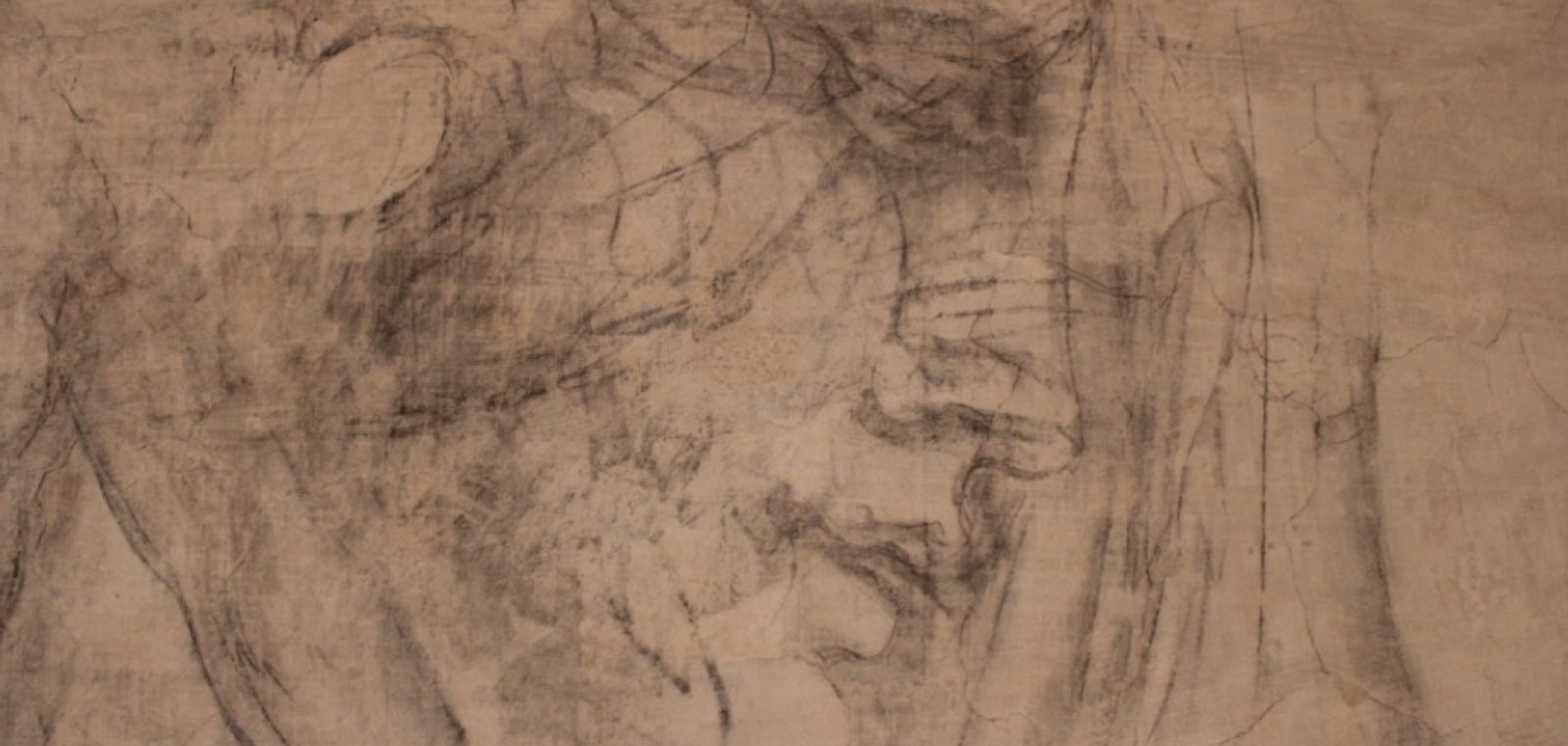
Il Campanile di Giotto si mette a nudo: completato il ponteggio di 86 metri, inizia il grande restauro
Il Campanile di Giotto entra nella fase più importante del suo primo restauro integrale. Il ponteggio raggiunge circa 86 metri e il cantiere procederà dall’alto verso il basso, restituendo progressivamente alla vista le superfici già restaurate. Ma a Firenze c’è anche un altro ospite da proteggere: il falco pellegrino.
A Firenze anche i monumenti, ogni tanto, hanno bisogno di fermarsi. Non per smettere di raccontare la propria storia, ma per continuare a farlo ancora a lungo.
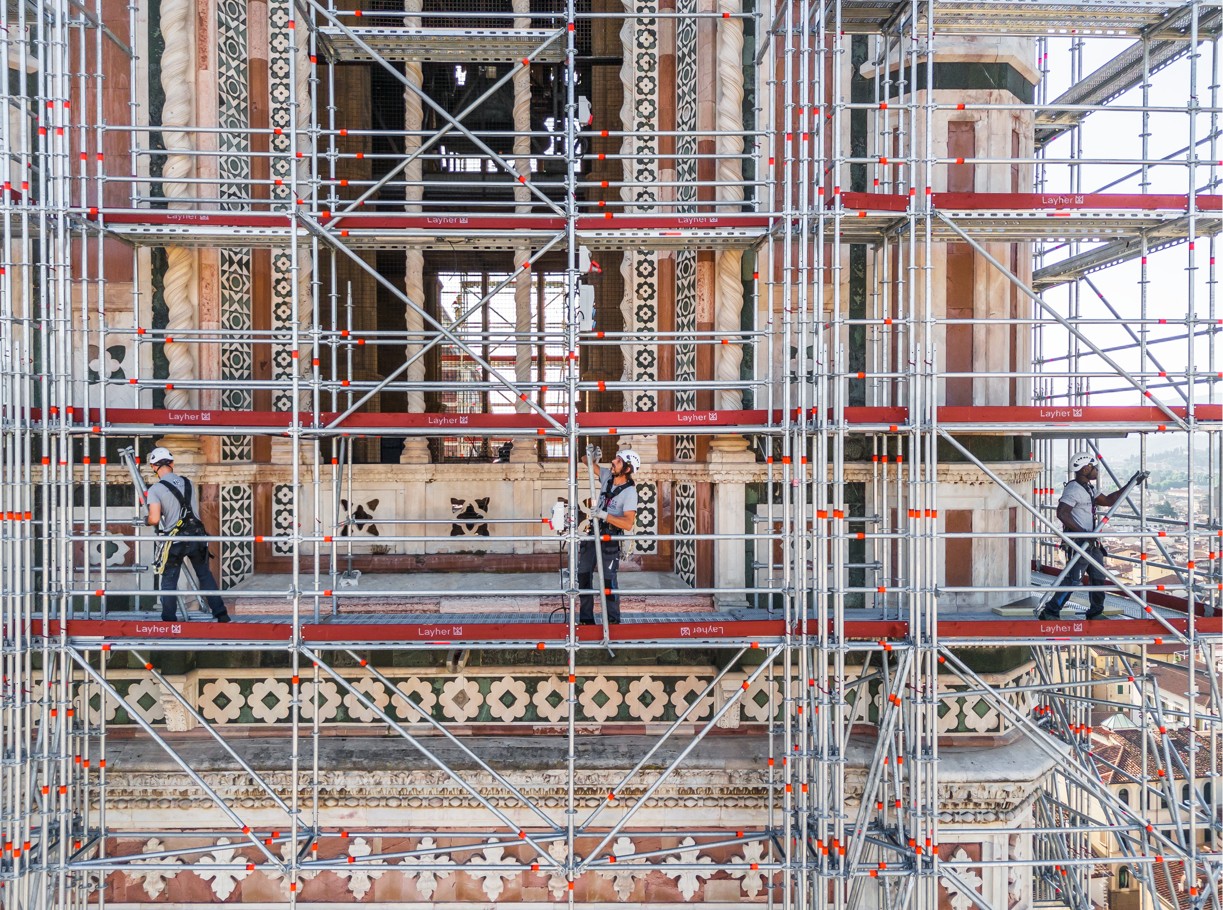
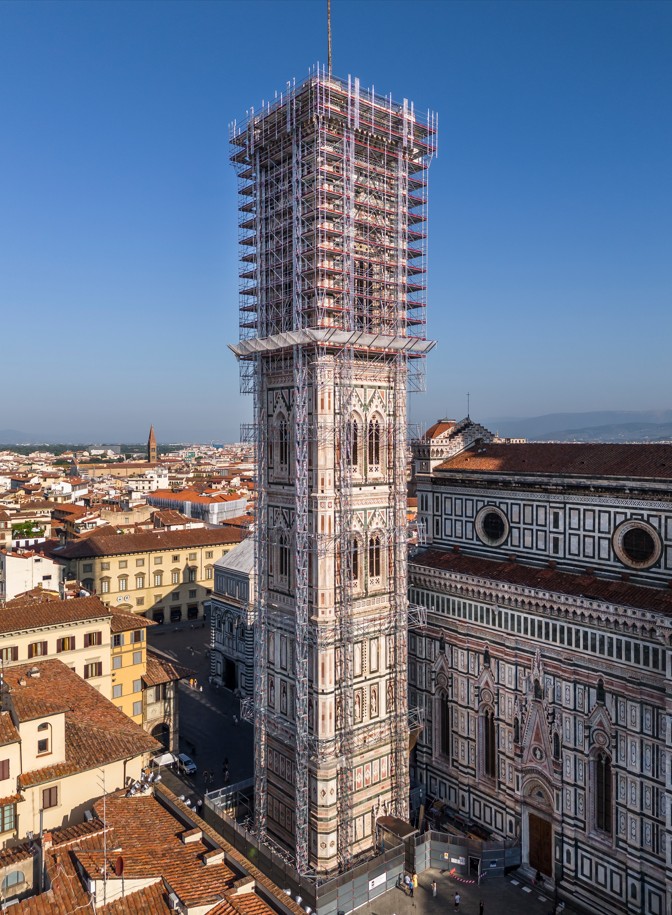
È arrivato a una nuova fase il grande cantiere di restauro del Campanile di Giotto, uno dei simboli assoluti di Firenze e una delle architetture gotiche più riconoscibili d’Italia. Il ponteggio, alto circa 86 metri, è stato completato e può ora entrare nel vivo l’intervento sulle superfici esterne della torre.
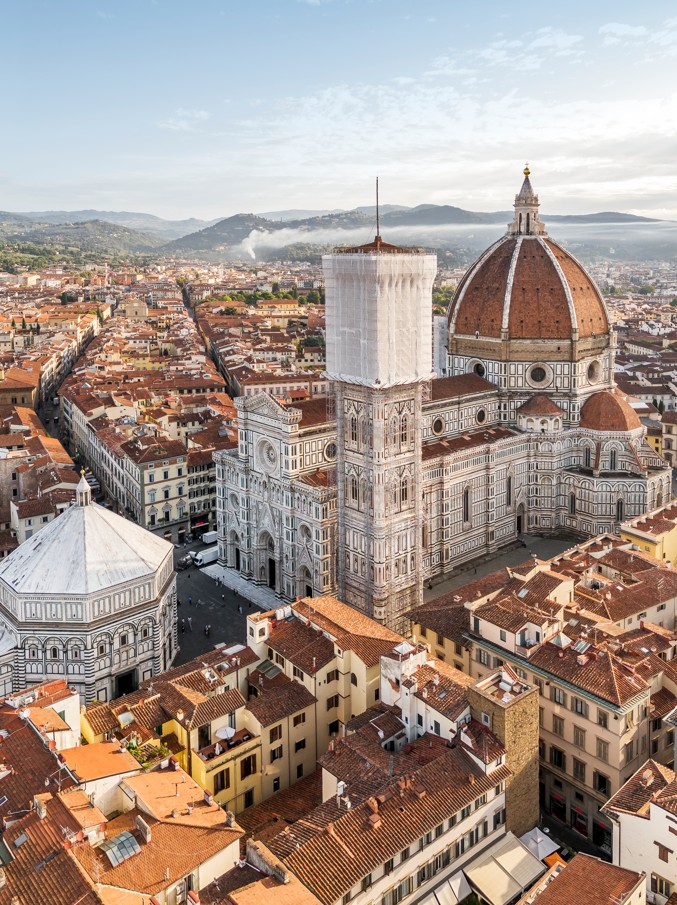
Courtesy: Opera di Santa del Fiore/foto Fabio Muzzi
Non sarà però il classico cantiere destinato a nascondere completamente un monumento per anni. Al contrario, il progetto è stato studiato proprio per permettere al Campanile di tornare progressivamente visibile, mano a mano che il restauro avanzerà.
E c’è un dettaglio che rende questa storia ancora più particolare: durante le operazioni sono state adottate attenzioni specifiche anche per la presenza della fauna che da anni abita i monumenti del Duomo, compreso il falco pellegrino.
Un ponteggio alto 86 metri che non nasconderà completamente il Campanile
Il Campanile di Giotto raggiunge 89,20 metri sopra i tetti di Firenze ed è uno degli edifici che definiscono lo skyline della città insieme alla Cupola di Brunelleschi e alla Torre di Palazzo Vecchio.
Per restaurarlo è stato progettato un sistema di ponteggio particolarmente complesso, pensato per ridurre l’impatto visivo e consentire di mantenere fruibile il monumento durante il lungo intervento.
Il principio è semplice quanto ingegnoso: il cantiere non resterà fermo nella stessa posizione.
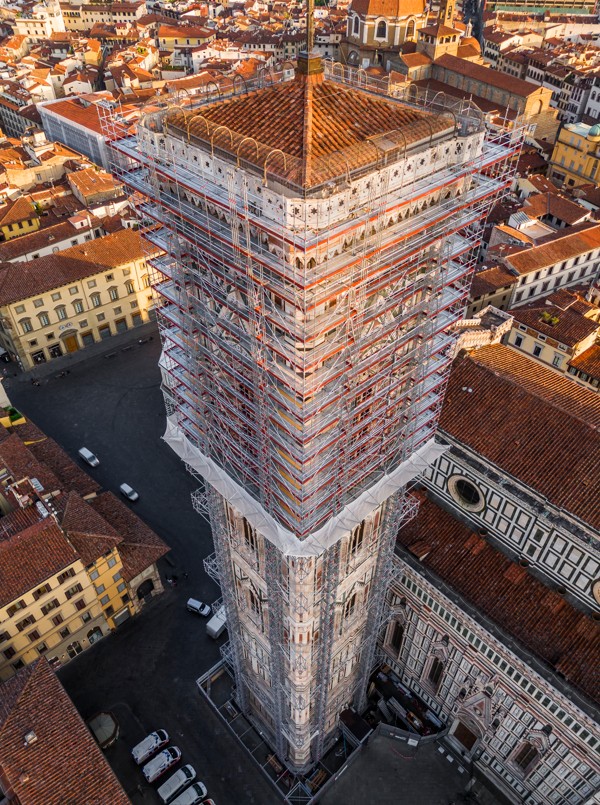
Il restauro procederà infatti dall’alto verso il basso. Una volta completata una porzione del Campanile, il ponteggio verrà traslato verso il basso e i restauratori potranno concentrarsi sulla sezione successiva.
La parte già restaurata verrà così progressivamente liberata. Di fatto Campanile non sparirà dietro una gigantesca impalcatura fino alla fine dei lavori: si mostrerà nuovamente alla città un pezzo alla volta.
Una sorta di cantiere “a scorrimento”, progettato anche per non interrompere il percorso di visita interno e la possibilità di raggiungere la terrazza panoramica.
La necessità del restauro del Campanile di Giotto
La necessità dell’intervento non nasce semplicemente dal desiderio di restituire maggiore brillantezza ai marmi.
Le superfici esterne mostrano infatti fenomeni di degrado che interessano il rivestimento in marmo bianco, Verde di Prato e rosso di Cintoia, con criticità particolarmente evidenti negli elementi aggettanti della terrazza sommitale e negli apparati decorativi.
Per la prima volta viene affrontato un restauro dell’intero Campanile.
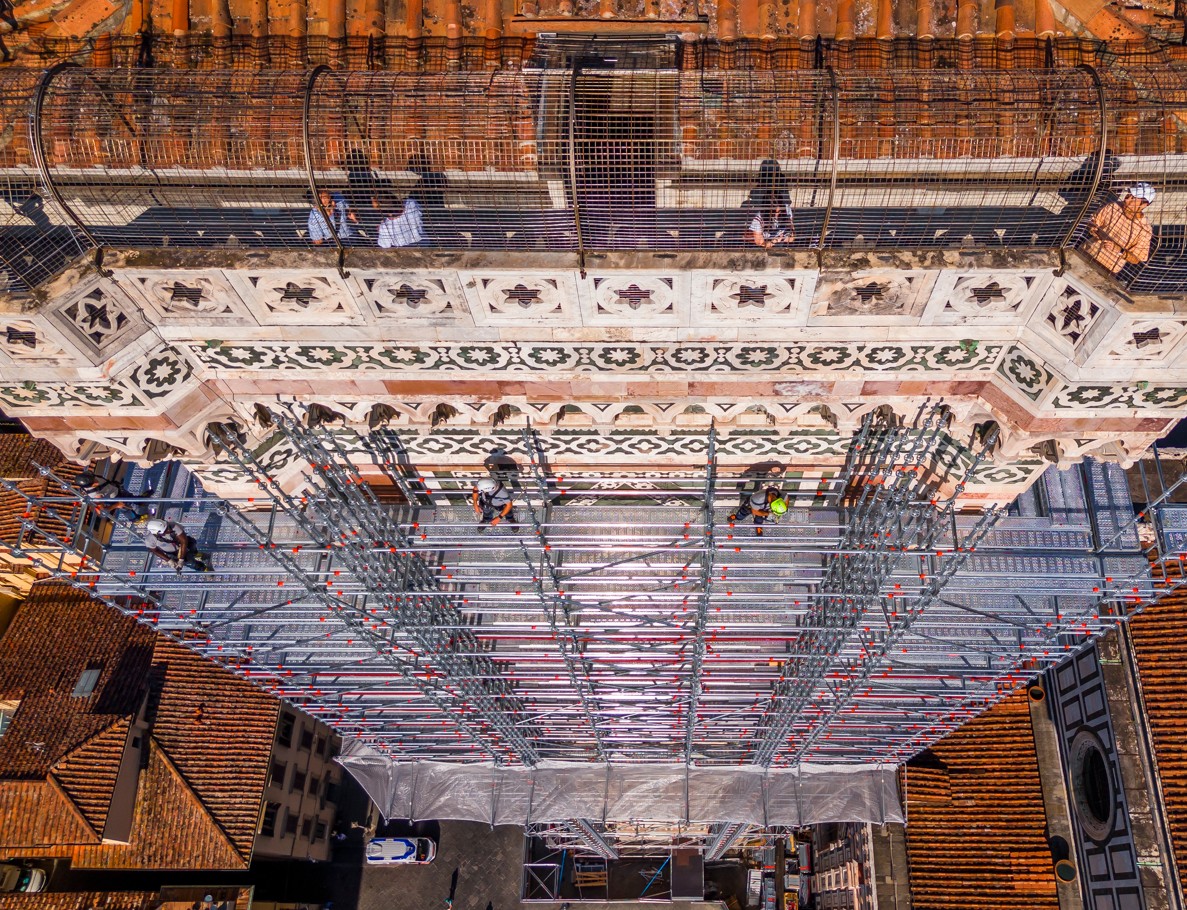
In passato erano già stati eseguiti numerosi interventi di manutenzione e restauro, documentati almeno dal 1939, ma riguardavano singole parti del monumento e non la sua totalità.
Il nuovo intervento rappresenta dunque un passaggio importante nella storia conservativa della torre.
Il programma prevede circa quattro anni di lavori, con un investimento superiore ai 7 milioni di euro, sostenuto dall’Opera di Santa Maria del Fiore.
Giotto lo iniziò nel 1334, ma non vide il Campanile finito
Per capire cosa si sta restaurando bisogna tornare indietro di quasi sette secoli.
La sua morte, avvenuta nel 1337, impedì però all’artista di vedere completata la propria opera.
A raccogliere l’eredità del progetto fu Andrea Pisano, che portò avanti la costruzione e completò il terzo livello, arricchendolo con un apparato straordinario di rilievi e sculture.
Successivamente intervenne Francesco Talenti, al quale si deve il completamento dell’edificio nel 1359 e, in particolare, la definizione dell’aspetto che ancora oggi riconosciamo.
Il risultato è una torre alta quasi 90 metri, con una base quadrata di circa 15 metri per lato e murature che raggiungono uno spessore considerevole.
414 scalini per salire dentro il capolavoro
Il Campanile non è soltanto un monumento da osservare dalla piazza.
È anche un edificio da attraversare.
Per raggiungere la sommità bisogna affrontare 414 scalini, mentre nella parte superiore il percorso attraversa tre logge sovrapposte, caratterizzate da eleganti bifore e grandi trifore.
Dalla terrazza sommitale Firenze cambia prospettiva: la Cupola di Brunelleschi, le architetture del centro storico, i tetti e le strade sembrano ricomporsi in una sorta di grande mappa tridimensionale della città.
Il progetto del nuovo cantiere è stato concepito proprio per permettere ai visitatori di continuare a vivere questa esperienza durante il lungo restauro.
I marmi bianchi, verdi e rossi tornano sotto osservazione
Uno degli elementi più riconoscibili del Campanile è il suo rivestimento policromo.
Bianco, verde e rosso costruiscono una geometria che trasforma la torre in una gigantesca superficie decorata.
Ma il Campanile non è soltanto marmo. Nei livelli inferiori conserva infatti un complesso apparato di sculture e rilievi realizzati tra XIV e XV secolo.
Gli originali delle sculture, per ragioni di conservazione, sono oggi custoditi nel Museo dell’Opera del Duomo di Firenze, mentre sul monumento sono presenti copie.
Il restauro delle superfici esterne dovrà quindi confrontarsi con un’architettura nella quale struttura, rivestimento e decorazione sono strettamente legati.
E poi ci sono loro: i falchi pellegrini
Ma mentre gli uomini progettano ponteggi, studiano i marmi e organizzano il cantiere, il Campanile continua a essere abitato da altri esseri viventi.
I monumenti del complesso del Duomo sono infatti da tempo frequentati da numerose specie di uccelli.
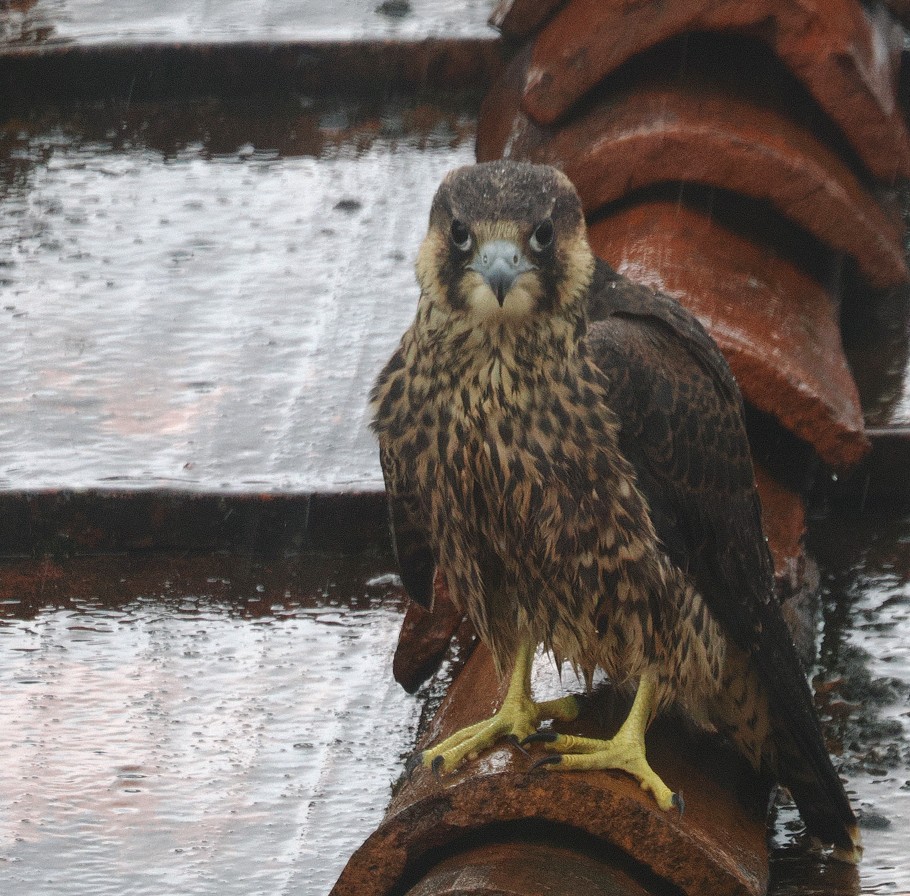
Tra queste c’è il falco pellegrino, uno dei rapaci più spettacolari che abbiano scelto Firenze come territorio urbano.
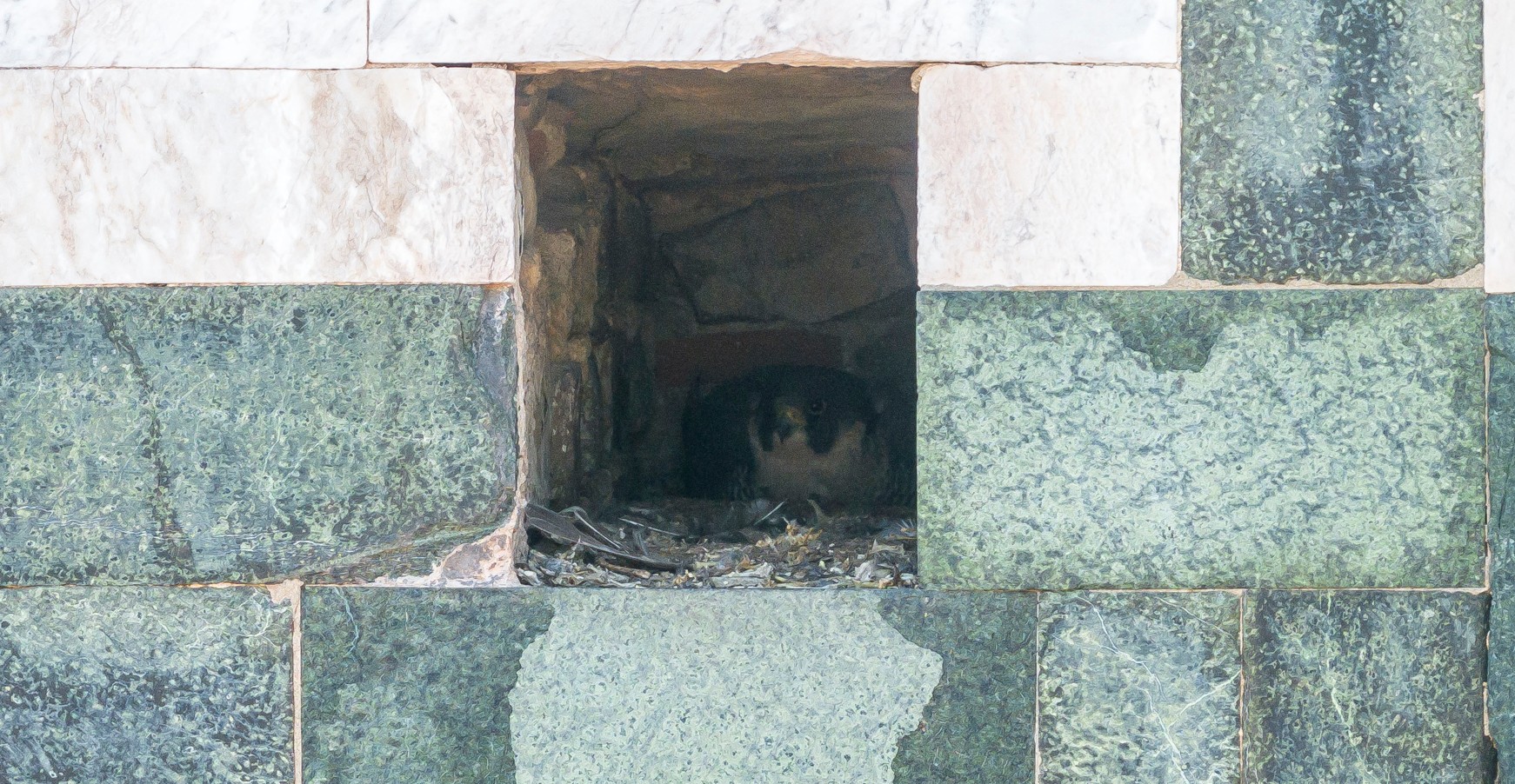
La sua presenza sui monumenti fiorentini è documentata da anni. Nel 2018, durante un monitoraggio delle superfici marmoree, fu individuato un nido con tre pulli di falco pellegrino in una buca pontaia del Campanile di Giotto, a oltre 50 metri di altezza.
Le buche pontaie sono particolari aperture presenti negli edifici storici, nate anche in relazione alle esigenze dei ponteggi utilizzati durante la costruzione e le manutenzioni.
Per il falco pellegrino possono trasformarsi in rifugi perfetti. Negli anni la specie ha utilizzato diverse zone del complesso monumentale, compresa la Cupola del Brunelleschi. L’Opera di Santa Maria del Fiore monitora quindi la presenza degli uccelli e, in occasione dei lavori, deve tenere conto anche delle loro esigenze.
Campanile di Giotto
Opera di Santa del Fiore, foto con drone Fabio Muzzi
Il falco pellegrino, padrone dei cieli di Firenze
Il Falco peregrinus è famoso per una caratteristica che lo ha reso celebre in tutto il mondo: la velocità.
Durante la picchiata può raggiungere velocità elevatissime, diventando uno dei più straordinari predatori aerei del pianeta.
Il suo volo è fatto di precisione, accelerazioni improvvise, cambi di direzione e una capacità di sfruttare gli spazi verticali che sembra quasi perfetta per una città costruita di torri, campanili e cupole.
Firenze, insomma, gli offre qualcosa che in natura sarebbe rappresentato dalle pareti rocciose e dalle alte falesie. Solo che qui, al posto delle montagne, ci sono sette secoli di architettura.
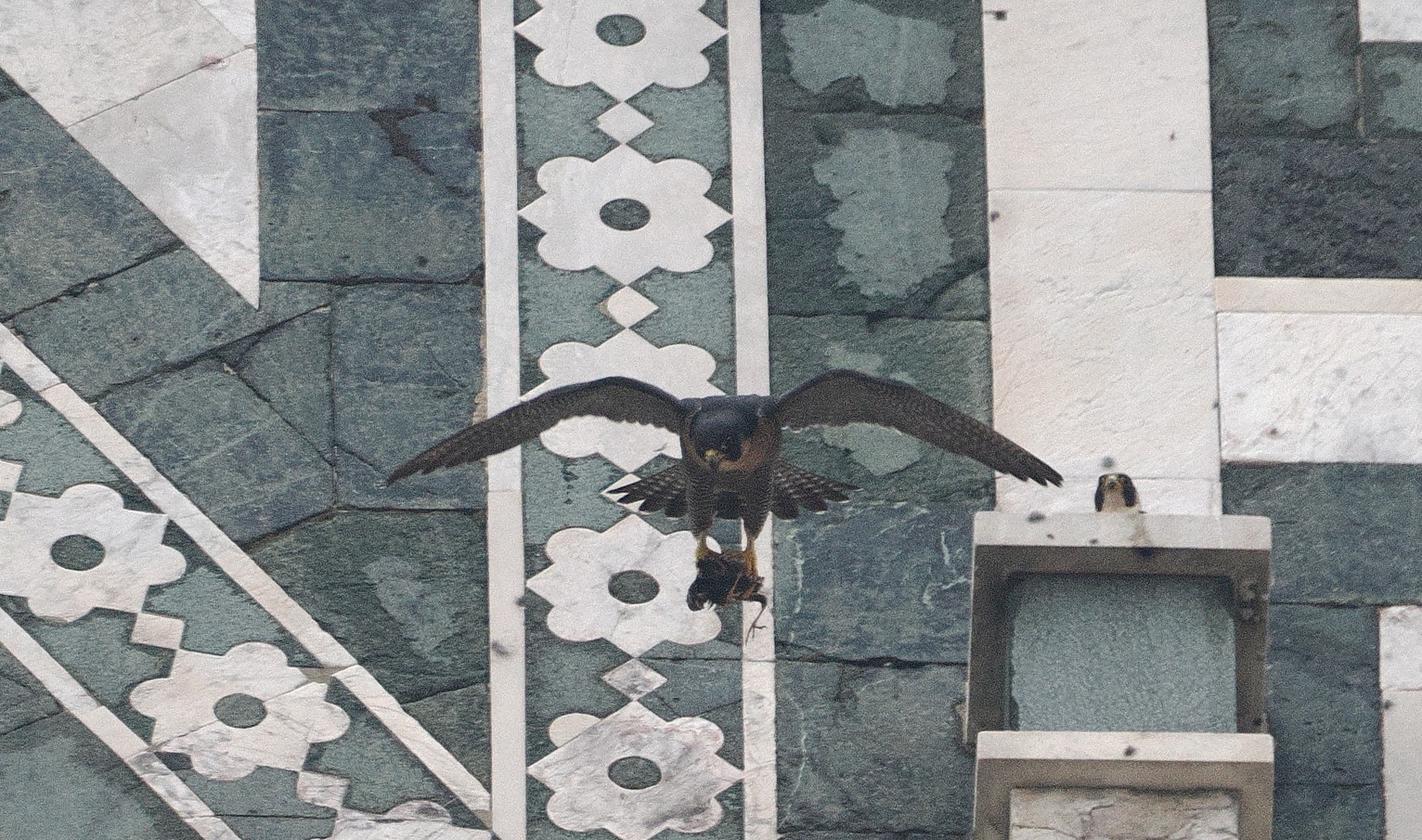
portando al nido
Courtesy e foto: Giovanni Ciattini
Il restauro dovrà convivere con la nidificazione
La presenza degli uccelli non è un elemento secondario. Durante l’allestimento e lo sviluppo del cantiere sono previste attività di monitoraggio per individuare eventuali nidi e garantire la tutela delle specie che utilizzano i monumenti.
Le informazioni disponibili sul cantiere indicano infatti che il monitoraggio della fauna rientra tra le attenzioni necessarie durante le diverse fasi dei lavori. In particolare, l’Opera ha previsto una mappatura delle buche pontaie e l’adozione di accorgimenti per consentire agli uccelli di continuare a utilizzare gli spazi idonei alla nidificazione.
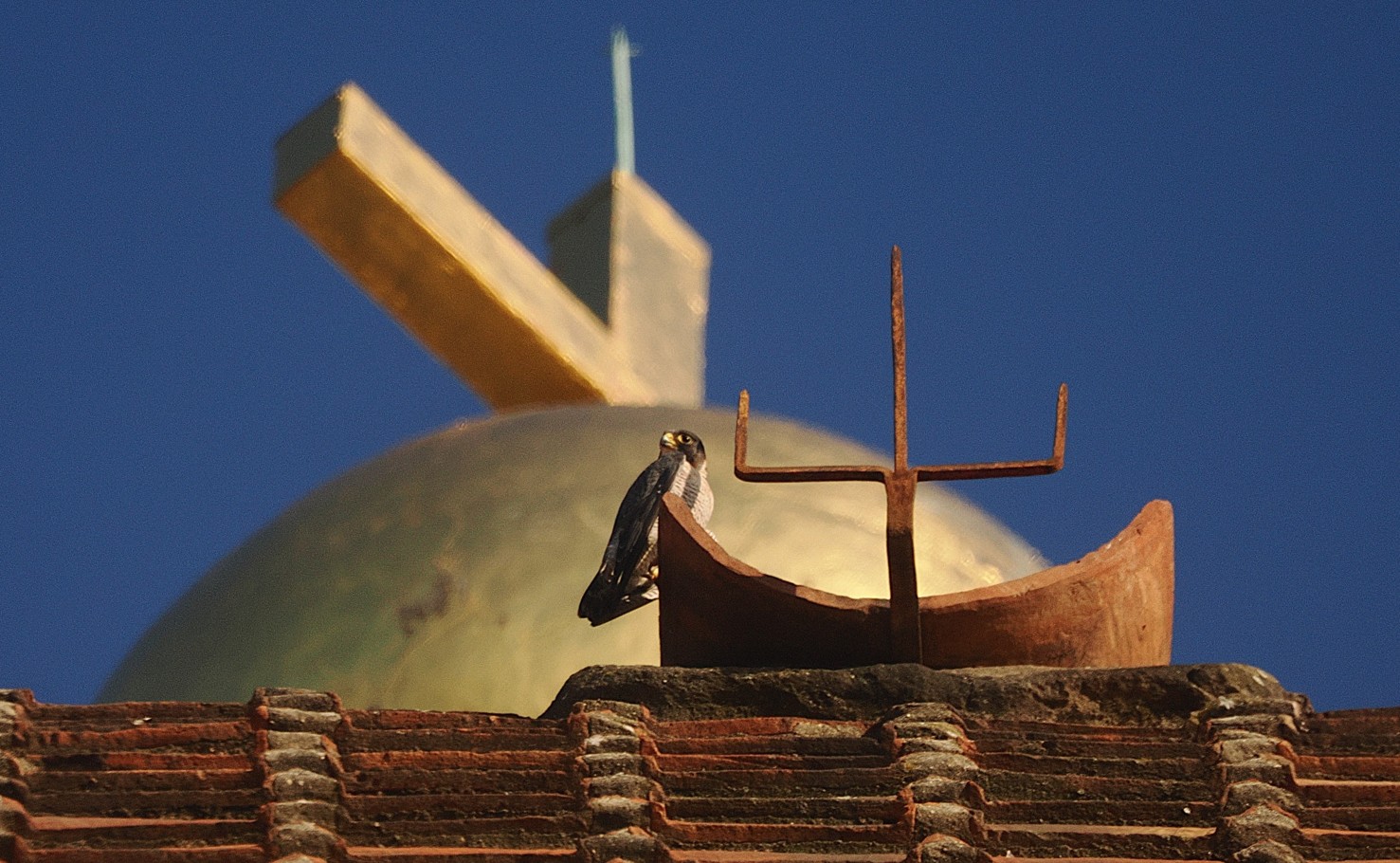
Duomo dove i genitori lo continuano a seguire portandogli del cibo
Un cantiere che durerà fino al 2030
Il restauro del Campanile di Giotto accompagnerà Firenze per circa quattro anni e dovrebbe concludersi intorno al 2030.
Nel frattempo, il monumento continuerà a essere visitabile secondo le modalità previste dall’Opera del Duomo e il cantiere avanzerà progressivamente verso il basso.
Sarà quindi possibile assistere a qualcosa di piuttosto raro: vedere un monumento medievale restaurarsi davanti agli occhi della città.
Per il momento il sempre vostro Michelangelo Buonarroti vi saluta dandovi appuntamento ai prossimi post e sui social.

Giotto’s Campanile stripped bare: 86-meter scaffolding complete, major restoration begins
Giotto’s Campanile is entering the most critical phase of its first comprehensive restoration. The scaffolding reaches a height of approximately 86 meters, and work will proceed from the top down, gradually revealing the restored surfaces to view. Yet, there is another resident in Florence that needs protecting: the peregrine falcon.
In Florence, even monuments sometimes need to pause—not to stop telling their story, but to ensure they can keep telling it for a long time to come.
The major restoration project for Giotto’s Campanile—one of Florence’s ultimate symbols and among Italy’s most recognizable Gothic structures—has reached a new stage. The scaffolding, standing about 86 meters tall, is now complete, allowing work on the tower’s exterior surfaces to get fully underway.
However, this will not be a typical construction site that completely hides a monument for years. On the contrary, the project was specifically designed to allow the Campanile to become visible again gradually as the restoration progresses.
There is also a detail that makes this story even more unique: specific measures have been taken during the operations to accommodate the wildlife that has inhabited the Duomo complex for years—including the peregrine falcon.
An 86-meter-high scaffolding structure that won’t completely hide the Campanile
Giotto’s Campanile rises 89.20 meters above the rooftops of Florence; it is one of the buildings that define the city’s skyline, alongside Brunelleschi’s Dome and the tower of Palazzo Vecchio.
A particularly complex scaffolding system was designed for the restoration, intended to minimize visual impact and allow the monument to remain accessible to the public throughout the lengthy project. The principle is as simple as it is ingenious: the work site will not remain fixed in a single location.
Restoration work will proceed from the top down. Once a section of the Bell Tower is complete, the scaffolding will be shifted downwards, allowing restorers to focus on the next section.
The area already restored will thus be progressively revealed. In effect, the Bell Tower will not disappear behind a massive scaffolding structure until the project ends; instead, it will be unveiled to the city one section at a time.
It is a sort of “moving” work site, designed to avoid disrupting the internal visitor route or access to the panoramic terrace.
The need to restore Giotto’s Bell Tower
The need for this intervention stems from more than just a desire to restore the marble’s luster.
The exterior surfaces show signs of deterioration affecting the white, Verde di Prato (green), and Rosso di Cintoia (red) marble cladding; issues are particularly evident in the projecting elements of the top terrace and in the decorative features.
This marks the first time the entire Bell Tower is undergoing restoration.
While numerous maintenance and restoration projects have been carried out in the past—documented as far back as 1939—they focused on specific parts of the monument rather than the structure as a whole.
This new project therefore represents a significant milestone in the tower’s conservation history.
The program entails approximately four years of work and an investment exceeding 7 million euros, funded by the Opera di Santa Maria del Fiore.
Giotto began it in 1334 but did not live to see the Bell Tower completed
To understand what is being restored, one must look back nearly seven centuries.
In 1334, Giotto was commissioned to design and begin construction of the Bell Tower for the Cathedral of Santa Maria del Fiore. However, his death in 1337 prevented the artist from seeing his work completed.
Andrea Pisano took up the project, continuing construction and completing the third level, which he enriched with an extraordinary array of reliefs and sculptures.
Francesco Talenti subsequently stepped in; he is responsible for completing the building in 1359 and, in particular, for defining the appearance we recognize today.
The result is a tower nearly 90 meters tall, with a square base measuring approximately 15 meters on each side and walls of considerable thickness.
414 steps to ascend the masterpiece
The Campanile is not merely a monument to be viewed from the square.
It is also a building to be traversed.
Reaching the top requires climbing 414 steps; along the upper section, the path passes through three superimposed loggias, featuring elegant double-arched windows and large triple-arched windows.
From the top terrace, the perspective of Florence shifts: Brunelleschi’s Dome, the architecture of the historic center, the rooftops, and the streets seem to reassemble into a vast, three-dimensional map of the city.
The design of the new construction project was conceived specifically to allow visitors to continue experiencing this site during the lengthy restoration.
The white, green, and red marbles are once again under scrutiny
One of the Campanile’s most recognizable features is its polychrome cladding.
White, green, and red form a geometric pattern that transforms the tower into a vast, decorated surface.
Yet the Campanile is more than just marble; its lower levels house a complex array of sculptures and reliefs created between the 14th and 15th centuries.
For conservation reasons, the original sculptures are now housed in Florence’s Museo dell’Opera del Duomo, while copies remain on the monument itself.
Restoring the exterior surfaces therefore requires addressing an architectural structure where the framework, cladding, and ornamentation are inextricably linked.
And then there are the peregrine falcons
While humans design scaffolding, study the marble, and organize the work site, the Campanile remains home to other living creatures.
Indeed, the monuments of the Duomo complex have long been frequented by numerous bird species.
Among them is the peregrine falcon, one of the most spectacular birds of prey to have adopted Florence as its urban territory.
Its presence on Florentine monuments has been documented for years. In 2018, during an inspection of the marble surfaces, a nest containing three peregrine falcon chicks was discovered in a putlog hole—an opening for scaffolding—on Giotto’s Campanile, more than 50 meters above the ground.
Putlog holes are distinctive openings found in historic buildings, originally created to accommodate the scaffolding used during construction and maintenance.
For the peregrine falcon, they can serve as perfect shelters. Over the years, the species has utilized various parts of the monumental complex, including Brunelleschi’s Dome. The Opera di Santa Maria del Fiore therefore monitors the presence of birds and must take their needs into account during the restoration work.
The Peregrine Falcon: Master of Florence’s Skies
Falco peregrinus is renowned for a characteristic that has made it famous worldwide: its speed.
During a dive, it can reach extraordinary speeds, making it one of the planet’s most remarkable aerial predators.
Its flight is defined by precision, sudden bursts of acceleration, rapid changes of direction, and an ability to utilize vertical spaces that seems perfectly suited to a city built of towers, bell towers, and domes.
In short, Florence offers the bird an environment analogous to the rocky cliffs and high crags found in nature—except that here, instead of mountains, there are seven centuries of architecture.
Restoration Work Must Coexist with Nesting
The presence of birds is not a minor detail. Monitoring activities are planned during the setup and execution of the project to identify any nests and ensure the protection of the species that inhabit the monuments.
Information regarding the project indicates that monitoring local wildlife is a key priority throughout the various phases of the work. Specifically, the Opera has planned to map the buche pontaie (historic scaffolding holes) and implement measures allowing birds to continue using these spaces for nesting.
A Project Spanning Until 2030
The restoration of Giotto’s Bell Tower will be a fixture of life in Florence for about four years, with completion expected around 2030.
In the meantime, the monument will remain open to visitors in accordance with the Opera del Duomo’s regulations, while the restoration work progresses gradually downwards. It will therefore be possible to witness something quite rare: seeing a medieval monument being restored right before the city’s eyes.
For now, yours truly, Michelangelo Buonarroti, bids you farewell and looks forward to seeing you in future posts and on social media.

Sostienici – Support Us
Se questo blog ti piace e ti appassiona, puoi aiutarci a farlo crescere sempre più sostenendoci in modo concreto condividendo i post, seguendo le pagine social e con un contributo che ci aiuta ad andare avanti con il nostro lavoro di divulgazione. . ENGLISH: If you like and are passionate about this blog, you can help us make it grow more and more by supporting us in a concrete way by sharing posts, following social pages and with a contribution that helps us to move forward with our dissemination work.
10,00 €
-

21 ottobre 1816: nasce Pietro Magni, lo scultore che trasformò una giovane lettrice in un capolavoro
🇮🇹Il 21 ottobre 1816 nasceva Pietro Magni, lo scultore della Giovane leggitrice. Scopri la storia dell’opera ignorata a Brera e diventata un successo nel 1861… 🇬🇧On October 21, 1816, Pietro Magni—the sculptor behind The Young Reader was born. Discover the story of this work, which was initially overlooked at the Brera Academy before becoming a…
-

21 ottobre 1556: muore Pietro Aretino, il ‘flagello dei principi’ che attaccò il mio Giudizio Universale
🇮🇹Il 21 ottobre 1556 moriva Pietro Aretino, poeta e polemista rinascimentale. Dopo aver chiesto invano un mio disegno, si scagliò contro il Giudizio Universale… 🇬🇧On October 21, 1556, Pietro Aretino—a Renaissance poet and polemicist—died. After having asked me in vain for a drawing, he lashed out against The Last Judgment…
-
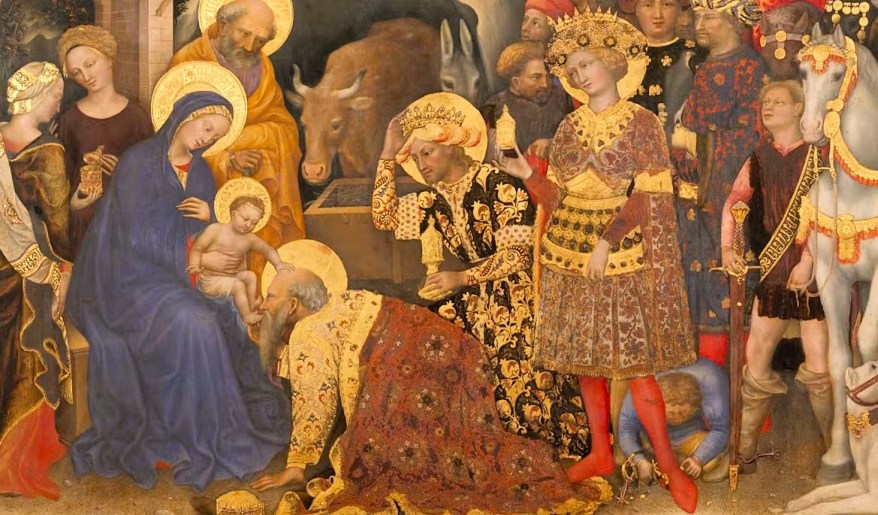
L’Adorazione dei Magi di Gentile da Fabriano: il Natale più ricco e spettacolare del Rinascimento
🇮🇹Oro, mantelli ricamati e un corteo di sovrani: scopri l’Adorazione dei Magi di Gentile da Fabriano, capolavoro del 1423 agli Uffizi… 🇬🇧Gold, embroidered cloaks, and a procession of sovereigns: discover the Adoration of the Magi by Gentile da Fabriano, a 1423 masterpiece housed at the Uffizi…
Condividi:


Questo sono io




sostienici

Sostienici – Support Us
Se questo blog ti piace e ti appassiona, puoi aiutarci a farlo crescere sempre più sostenendoci in modo concreto condividendo i post, seguendo le pagine social e con un contributo che ci aiuta ad andare avanti con il nostro lavoro di divulgazione. . ENGLISH: If you like and are passionate about this blog, you can help us make it grow more and more by supporting us in a concrete way by sharing posts, following social pages and with a contribution that helps us to move forward with our dissemination work.
€10,00


