
Marianne Stokes, la Madonna si addormenta e due angeli suonano per Gesù Bambino
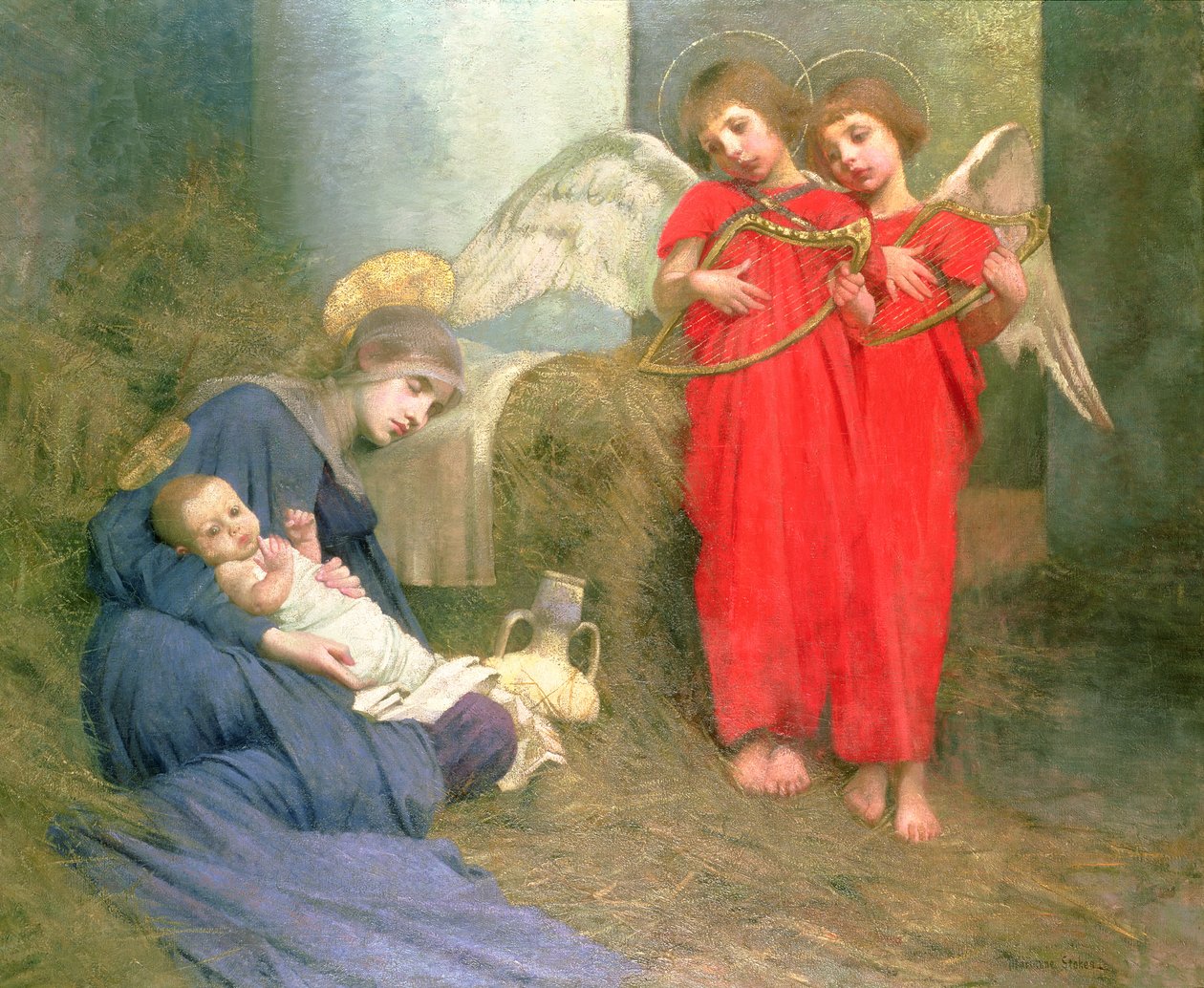
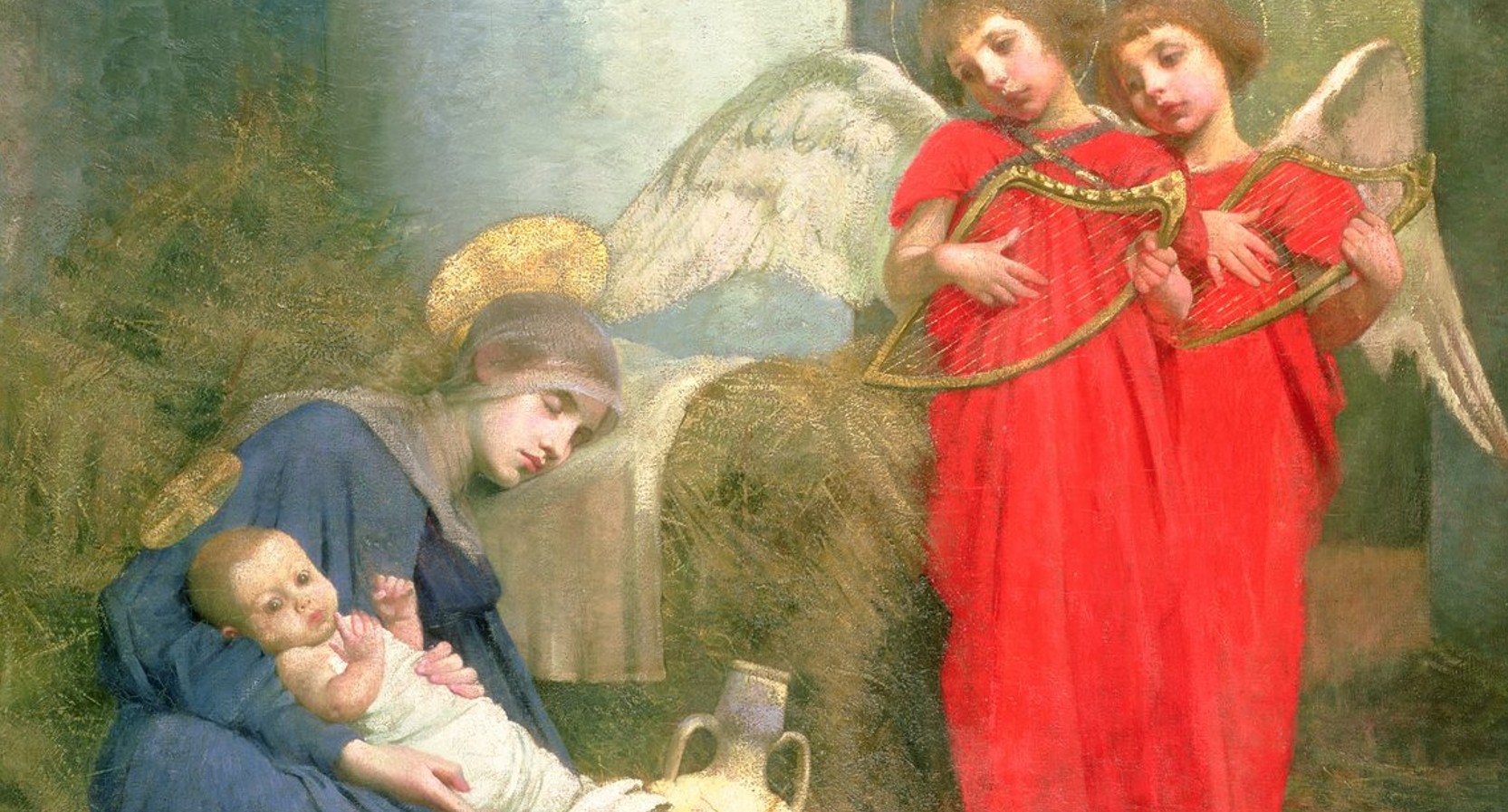
La pittrice austriaca Marianne Stokes, nel 1893 sceglie di raccontare un momento assai singolare della natività. Maria tiene il piccolo Gesù tra le braccia, mentre due angeli vestiti di rosso, suonano per lui strumenti a corda.
Non c’è la concitazione di una grande scena sacra o la folla di personaggi accorsi per accogliere il Salvatore. Siamo invece in presenza di un’atmosfera raccolta, quasi silenziosa, e la musica diventa un gesto d’amore.
Una scena che invita a fermarsi davanti alla tela e a osservare i dettagli, a partire dagli sguardi dei due angeli fino alla posizione del Bambino, che sembra rivolgere la propria attenzione proprio a loro.
Una Madonna stanca e un Bambino che non vuole dormire
Maria si è addormentata, mentre Gesù è ancora sveglio.
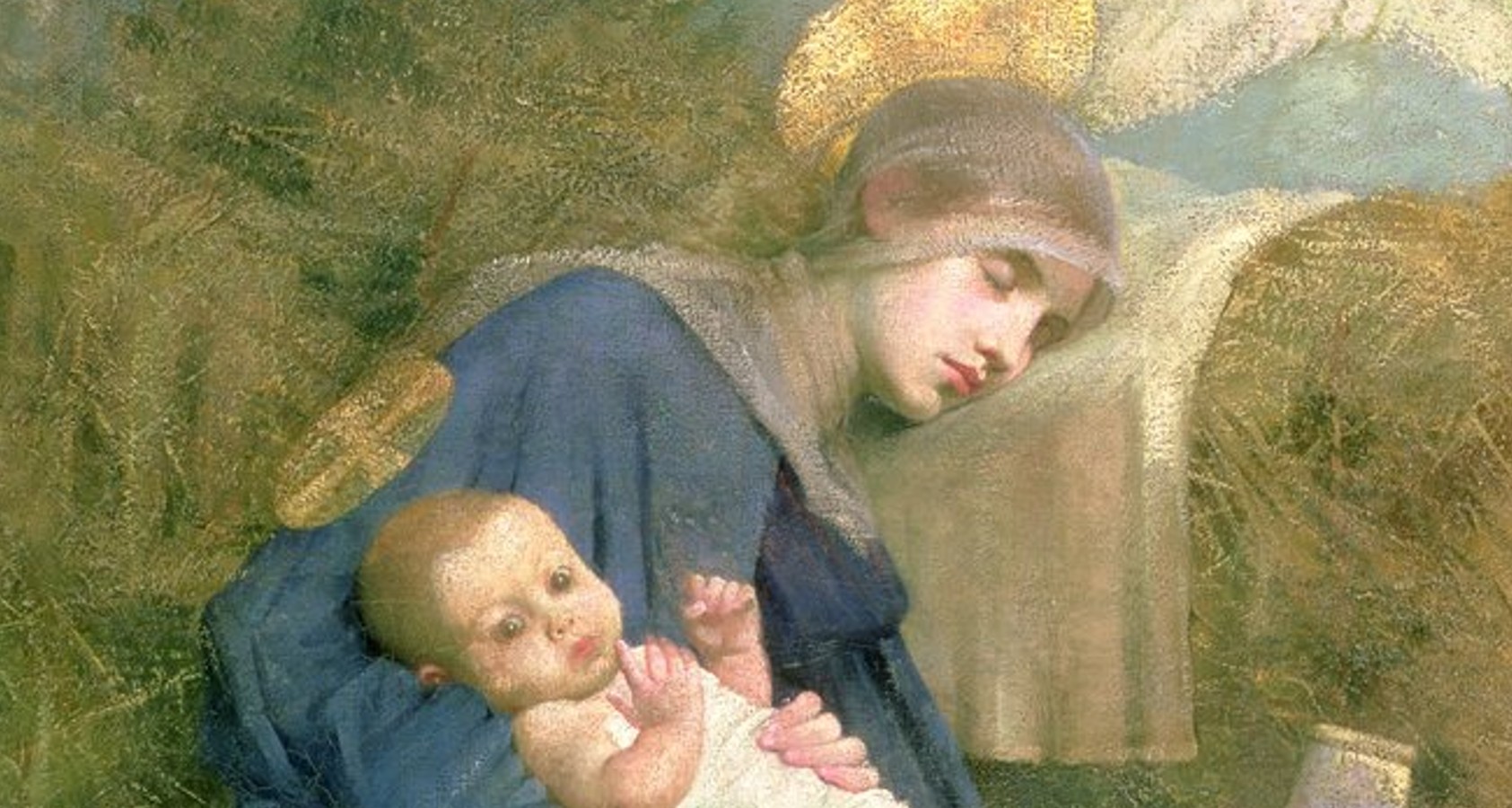
La Madonna è seduta su un giaciglio di paglia, con il corpo raccolto nell’ampio mantello blu e il capo appoggiato alla superficie che le fa da sostegno. Tiene il Bambino tra le braccia, ma il suo volto tradisce tutta la stanchezza di una giovane madre che ha bisogno di riposare.
Gesù, invece, ha gli occhi aperti e guarda verso chi osserva il dipinto. Le manine sono sollevate, in un gesto che sembra quasi anticipare una benedizione.
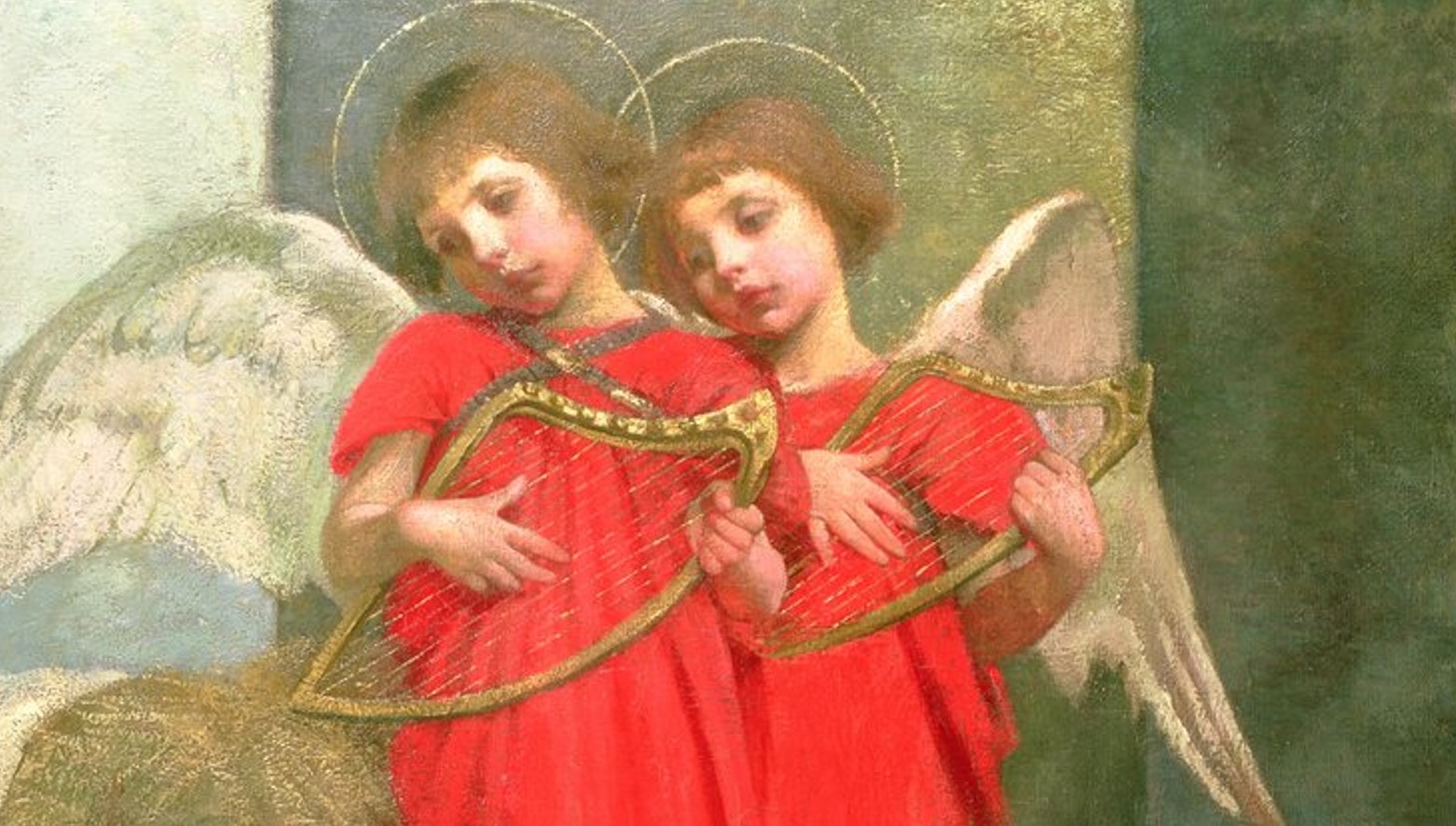
A prendersi cura di lui ci sono due angeli. Indossano lunghe vesti rosse, hanno grandi ali bianche e aureole sottilissime che circondano i loro volti. Entrambi tengono strumenti musicali a corda, simili a piccole arpe o cetre, e sembrano impegnati a suonare una dolce melodia per intrattenere il Bambino mentre Maria riposa.
È un’inversione delicata rispetto a tante altre Natività: qui non sono gli angeli a osservare il sonno di Gesù, ma sono loro a vegliare su di lui, quasi fossero due piccoli custodi.
Anche le loro espressioni meritano attenzione. Non hanno l’aspetto di creature trionfanti o solenni, ma quello di giovani presenze pensose, con una lieve malinconia negli occhi. Questo dettaglio conferisce alla scena una dolcezza particolare, senza trasformarla in un’immagine eccessivamente sentimentale.
Il significato della musica e dei colori
La musica assume un ruolo centrale nella composizione. I due angeli non portano doni ma gli offrono qualcosa di diverso ovvero la melodia che accompagna il suo riposo e rende meno solitario quel momento.
Anche il contrasto cromatico contribuisce alla costruzione della scena. Il blu profondo del mantello di Maria avvolge la figura materna e crea una zona di raccoglimento, mentre il rosso acceso delle vesti angeliche cattura immediatamente lo sguardo.
Le ali bianche, le aureole appena accennate e la luce che arriva dal fondo contribuiscono a rendere l’atmosfera sospesa tra realtà quotidiana e dimensione spirituale.
Stokes non rinuncia ai particolari concreti: la paglia, i tessuti, gli oggetti accanto alla Madonna e il giaciglio restituiscono la semplicità di un ambiente povero. La dimensione divina non cancella quella umana. Al contrario, convive con essa.
Marianne Stokes, una pittrice tra spiritualità e Preraffaelliti
Marianne Stokes, nata Marianne Preindlsberger a Graz nel 1855, è stata una pittrice austriaca che trascorse gran parte della propria carriera in Inghilterra. Studiò a Monaco di Baviera e si avvicinò progressivamente a temi religiosi, medievali e letterari.
Nel 1884 sposò il pittore inglese Adrian Stokes e, a partire dal 1887, la coppia si stabilì a St Ives, in Cornovaglia, dove entrambi entrarono in contatto con la vivace comunità artistica locale.
La sua pittura presenta affinità con il mondo preraffaellita, soprattutto nella cura dei dettagli, nell’attenzione per la spiritualità e nella scelta di soggetti carichi di significati simbolici. La sua formazione, tuttavia, fu più ampia e non si esaurisce nell’influenza di quel movimento.
La fede cattolica ebbe un ruolo importante nella sua produzione. Le immagini sacre occupano infatti uno spazio significativo nella sua carriera, accanto ai ritratti e alle opere ispirate alle fiabe e alla letteratura.
Negli anni successivi Stokes si dedicò sempre più alla tempera, tecnica alla quale si avvicinò intorno al 1895, entrando poi nella Society of Painters in Tempera nel 1905. Morì a Londra nel 1927.
Un’opera presentata alla Royal Academy nel 1893
Il dipinto fu realizzato a olio su tela e misura 144,2 × 174,6 centimetri. Marianne Stokes lo presentò alla Royal Academy di Londra nel 1893. Nello stesso anno fu esposto anche alla mostra autunnale di Liverpool e successivamente a Monaco di Baviera, con il titolo tedesco Schlummerlied, traducibile come «Ninnananna».
La sua storia espositiva proseguì anche nel Novecento, quando fu presentato alla mostra The Last Romantics alla Barbican Art Gallery di Londra nel 1989.
Dopo essere passato sul mercato antiquario, il dipinto è stato acquistato nel 2015 dal Brigham Young University Museum of Art, a Provo, nello Utah, grazie al sostegno di Roy e Carol Christensen.
Per il momento il sempre vostro Michelangelo Buonarroti vi saluta dandovi appuntamento ai prossimi post e sui social.

Marianne Stokes: The Madonna Falls Asleep, and Two Angels Play for the Baby Jesus
In 1893, the Austrian painter Marianne Stokes chose to depict a very unique moment from the Nativity. Mary holds the infant Jesus in her arms, while two angels, dressed in red, play stringed instruments for Him.
There is none of the commotion typical of a grand sacred scene, nor any crowd of figures gathered to welcome the Savior. Instead, we find an intimate, almost silent atmosphere, where music becomes an act of love.
The scene invites the viewer to pause before the canvas and observe the details—from the expressions of the two angels to the posture of the Child, who seems to be focusing His attention precisely on them.
A Weary Madonna and a Child Who Will Not Sleep
Mary has fallen asleep, while Jesus remains wide awake.
The Madonna sits on a bed of straw, her body wrapped in a voluminous blue cloak, her head resting against a support. She holds the Child in her arms, yet her face reveals the profound exhaustion of a young mother in need of rest.
Jesus, by contrast, has His eyes open and is looking toward the viewer. His tiny hands are raised in a gesture that almost seems to anticipate a blessing.
Two angels are there to look after Him. They wear long red robes and possess large white wings, with delicate, slender halos encircling their faces. Both hold stringed instruments—resembling small harps or zithers—and appear to be playing a gentle melody to keep the Child entertained while Mary rests. This is a subtle departure from many other Nativity scenes: here, the angels do not merely observe the sleeping Jesus; rather, they keep watch over Him, acting almost like two small guardians.
Their expressions, too, are noteworthy. They do not appear as triumphant or solemn beings, but rather as pensive, youthful figures, with a faint touch of melancholy in their eyes. This detail lends a unique sweetness to the scene, without veering into excessive sentimentality.
The significance of music and color
Music plays a central role in the composition. The two angels bring no material gifts; instead, they offer something else—a melody that accompanies the Child’s rest, ensuring He is not alone in that moment.
The contrast in color also helps shape the scene. The deep blue of the Virgin Mary’s mantle envelops her maternal form, creating a space of quiet reflection, while the vibrant red of the angels’ robes immediately draws the eye.
The white wings, the barely perceptible halos, and the light emanating from the background create an atmosphere that hovers between everyday reality and the spiritual realm.
Stokes does not forgo tangible details: the straw, the fabrics, the objects beside the Virgin, and the makeshift bed all convey the simplicity of a humble setting. The divine dimension does not erase the human one; on the contrary, it coexists with it.
Marianne Stokes: A painter between spirituality and the Pre-Raphaelites
Marianne Stokes—born Marianne Preindlsberger in Graz in 1855—was an Austrian painter who spent the greater part of her career in England. She studied in Munich and gradually gravitated toward religious, medieval, and literary themes. In 1884, she married the English painter Adrian Stokes, and from 1887 onwards, the couple settled in St Ives, Cornwall, where they both became involved with the vibrant local artistic community.
Her painting shows affinities with the Pre-Raphaelite movement—notably in her meticulous attention to detail, her focus on spirituality, and her choice of subjects imbued with symbolic meaning. Her artistic background, however, was broader and not limited to the influence of that movement alone.
The Catholic faith played an important role in her body of work; sacred imagery occupies a significant place in her career, alongside portraits and pieces inspired by fairy tales and literature.
In later years, Stokes increasingly turned to tempera—a technique she began exploring around 1895—and in 1905, she became a member of the Society of Painters in Tempera. She passed away in London in 1927.
A work presented at the Royal Academy in 1893
The painting is an oil on canvas, measuring 144.2 × 174.6 centimeters. Marianne Stokes exhibited it at the Royal Academy in London in 1893. That same year, it was also shown at the autumn exhibition in Liverpool and later in Munich, under the German title Schlummerlied, which translates as “Lullaby.”
Its exhibition history continued into the 20th century, when it was featured in the 1989 The Last Romantics exhibition at the Barbican Art Gallery in London.
After appearing on the art market, the painting was acquired in 2015 by the Brigham Young University Museum of Art in Provo, Utah, with the support of Roy and Carol Christensen.Yours truly, Michelangelo Buonarroti, bids you farewell—see you in future posts and on social media.

Sostienici – Support Us
Se questo blog ti piace e ti appassiona, puoi aiutarci a farlo crescere sempre più sostenendoci in modo concreto condividendo i post, seguendo le pagine social e con un contributo che ci aiuta ad andare avanti con il nostro lavoro di divulgazione. . ENGLISH: If you like and are passionate about this blog, you can help us make it grow more and more by supporting us in a concrete way by sharing posts, following social pages and with a contribution that helps us to move forward with our dissemination work.
10,00 €

Condividi:


Questo sono io





sostienici

Sostienici - Support Us
Se questo blog ti piace e ti appassiona, puoi aiutarci a farlo crescere sempre più sostenendoci in modo concreto condividendo i post, seguendo le pagine social e con un contributo che ci aiuta ad andare avanti con il nostro lavoro di divulgazione. . ENGLISH: If you like and are passionate about this blog, you can help us make it grow more and more by supporting us in a concrete way by sharing posts, following social pages and with a contribution that helps us to move forward with our dissemination work.
€10,00


