
Il Bambino Gesù che illumina la notte: il segreto delle Natività più belle della storia dell’arte
In alcune alcune delle più belle Natività della storia dell’arte il Bambino Gesù diventa una vera e propria sorgente di luce. Il suo piccolo corpo illumina i volti di Maria, Giuseppe, dei pastori e degli angeli, mentre tutto intorno sembra sprofondare nell’oscurità della notte.
Per secoli i pittori hanno utilizzato la luce per raccontare uno dei misteri più importanti della cristianità: la nascita di Cristo come venuta della luce nel mondo.
La notte della Natività viene rappresentata come il luogo nel quale si manifesta una presenza divina, capace di trasformare il buio in speranza.
Attraverso il chiaroscuro, i colori e i contrasti luminosi, alcuni artisti sono riusciti a dare forma a questa idea con risultati straordinari.

Quando il Bambino Gesù diventa una sorgente di luce
L’idea di rappresentare il Bambino come una sorgente luminosa affonda le proprie radici nella tradizione religiosa medievale.
La luce è da sempre uno dei simboli più potenti della spiritualità cristiana. Cristo è la luce del mondo, colui che viene a rischiarare le tenebre e a portare la salvezza agli uomini.
Questa interpretazione trovò una particolare fortuna nella pittura tra il Quattrocento e il Seicento, quando gli artisti cominciarono a sperimentare effetti luminosi sempre più suggestivi.
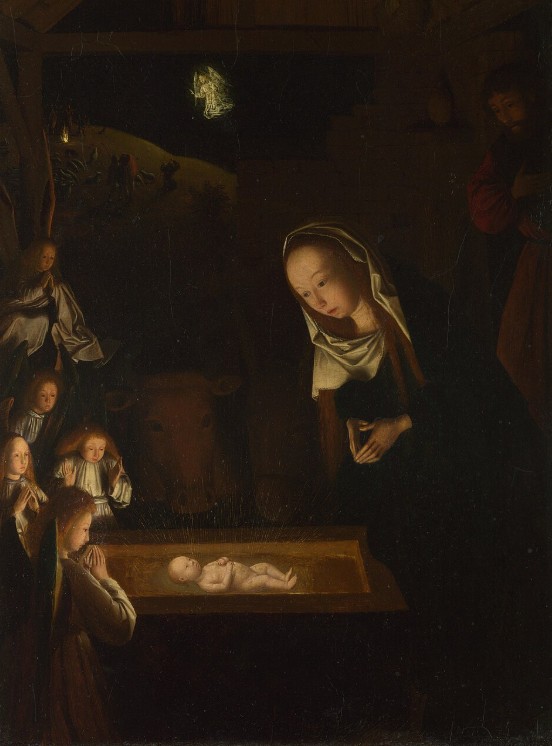
Una delle opere più interessanti in questo senso è la Natività di notte di Geertgen tot Sint Jans, realizzata intorno al 1490.
In questa piccola tavola, il Bambino Gesù è disteso nella mangiatoia e il suo corpo emana una luce intensa, che raggiunge il volto della Madonna e quello degli angeli raccolti intorno a lui. Sullo sfondo, attraverso una finestra, si intravede un secondo episodio: l’annuncio ai pastori, accompagnato da una luce celeste.
Il contrasto tra la luminosità del neonato e l’oscurità circostante rende la scena particolarmente intensa. La luce non proviene da una torcia o da una lampada: è il Bambino stesso a illuminare la notte.
Correggio e la notte che si accende davanti alla Natività
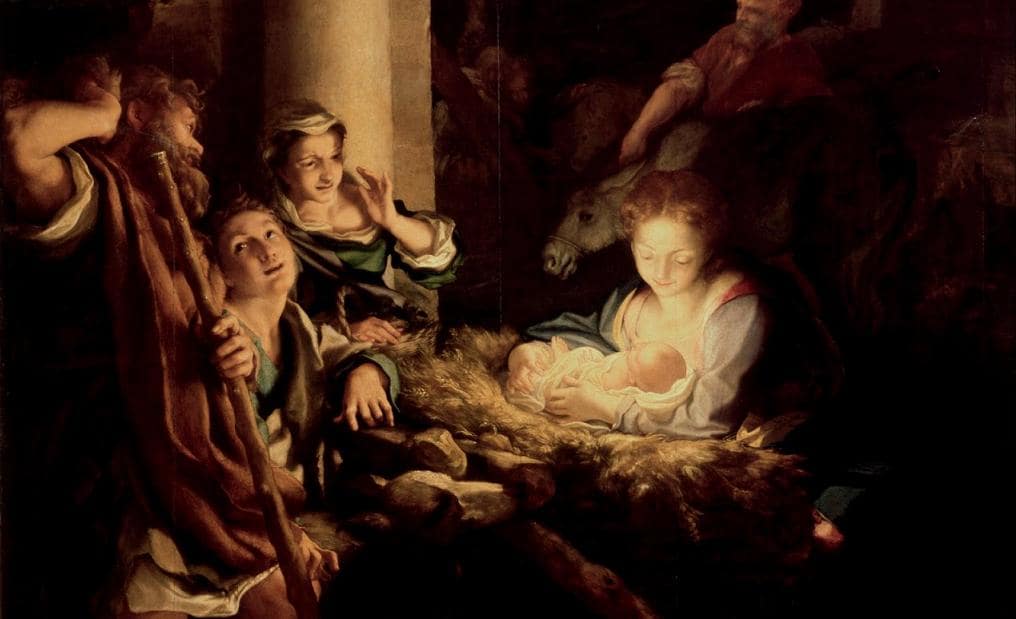
Tra i capolavori che hanno trasformato la nascita di Gesù in un’esperienza luminosa c’è senza dubbio la celebre Adorazione dei pastori, conosciuta anche come La Notte, dipinta da Antonio Allegri più noto come il Correggio tra il 1522 e il 1530 circa.
Conservata oggi alla Gemäldegalerie di Dresda, l’opera rappresenta uno dei risultati più affascinanti della pittura rinascimentale.
Il Bambino è adagiato nella mangiatoia e dal suo corpo si sprigiona una luce intensa, quasi abbagliante. Il chiarore raggiunge il volto di Maria, che lo osserva con un’espressione tenerissima, e si diffonde sui personaggi che si avvicinano per adorarlo.
La Madonna, inginocchiata accanto al figlio, sembra quasi sorpresa da quella luminosità soprannaturale. Una delle figure femminili presenti nella scena si protegge gli occhi con la mano, come se la luce fosse davvero troppo forte per essere guardata direttamente.
Correggio costruisce l’intera composizione attorno a questa fonte luminosa, facendo della luce un elemento narrativo e spirituale allo stesso tempo.
Il bambino appena nato è il Salvatore che entra nel mondo.
La luce di Cristo nelle Natività del Barocco
Con l’arrivo del Seicento, la luce diventa uno strumento ancora più potente per coinvolgere emotivamente chi osserva un dipinto.
Gli artisti barocchi amano le scene notturne, gli ambienti immersi nell’ombra e i contrasti improvvisi tra zone illuminate e zone scure.
Un esempio significativo è l’Adorazione dei pastori del pittore olandese Gerrit van Honthorst, conosciuto in Italia come Gherardo delle Notti proprio per la sua predilezione per le ambientazioni notturne.
Nelle sue composizioni la luce assume un ruolo fondamentale. Il Bambino, spesso collocato al centro del gruppo, diventa il punto verso il quale convergono gli sguardi e dal quale sembra partire il chiarore che raggiunge i presenti.
Il risultato è una scena raccolta, intima, nella quale la spiritualità non viene raccontata attraverso gesti solenni, ma attraverso la meraviglia dipinta sui volti.
È una luce che invita ad avvicinarsi, a partecipare silenziosamente a quell’istante.

Il chiaroscuro e il mistero della nascita
La rappresentazione della Natività come evento luminoso non riguarda soltanto i pittori nordici o quelli più legati alla pittura notturna.
Anche in Italia numerosi artisti hanno utilizzato la luce per sottolineare la natura divina del Bambino.
Tra questi merita attenzione Federico Barocci con la sua sensibilità cromatica e la capacità di costruire atmosfere delicate, nelle quali la luce sembra accarezzare le figure.
La sua pittura si distingue per i colori morbidi, le sfumature e una particolare attenzione alla dimensione affettiva delle scene sacre.
Nelle Natività, il rapporto tra madre e figlio diventa così anche un racconto visivo della rivelazione divina.
La luce suggerisce qualcosa che non può essere descritto completamente con le parole.

Una luce per l’eternità
La luce della Natività racconta la speranza, la salvezza e la possibilità di un nuovo inizio. In quella luce gli artisti hanno cercato di racchiudere il significato più profondo del Natale.
Per il momento il sempre vostro Michelangelo Buonarroti vi saluta dandovi appuntamento ai prossimi post e sui social.

The Christ Child Who Illuminates the Night: The Secret Behind the Most Beautiful Nativities in Art History
In some of the most beautiful Nativity scenes in the history of art, the Christ Child becomes a true source of light. His small body illuminates the faces of Mary, Joseph, the shepherds, and the angels, while everything else seems to sink into the darkness of the night.
For centuries, painters have used light to tell the story of one of the most significant mysteries of Christianity: the birth of Christ as the arrival of light into the world.
The night of the Nativity is depicted as a setting where a divine presence manifests—a presence capable of transforming darkness into hope.
Through the use of chiaroscuro (light and shadow), color, and luminous contrasts, certain artists have managed to give form to this concept with extraordinary results.
When the Christ Child Becomes a Source of Light
The idea of portraying the Christ Child as a source of light is rooted in medieval religious tradition.
Light has always been one of the most powerful symbols in Christian spirituality. Christ is the “light of the world”—the One who comes to illuminate the darkness and bring salvation to humanity.
This interpretation gained particular prominence in painting between the 15th and 17th centuries, a period when artists began to experiment with increasingly evocative lighting effects.
One of the most compelling works in this regard is the Nativity at Night by Geertgen tot Sint Jans, created around 1490.
In this small panel painting, the Christ Child lies in the manger, his body radiating an intense light that falls upon the faces of the Virgin Mary and the angels gathered around him. In the background, visible through a window, a second scene unfolds: the announcement to the shepherds, accompanied by a celestial light. The contrast between the radiance of the newborn and the surrounding darkness makes the scene particularly intense. The light does not come from a torch or a lamp: it is the Child himself who illuminates the night.
Correggio and the Night Illuminated by the Nativity
Among the masterpieces that have transformed the birth of Jesus into a luminous experience is, without a doubt, the celebrated Adoration of the Shepherds—also known as The Night (La Notte)—painted by Antonio Allegri, better known as Correggio, between approximately 1522 and 1530.
Now housed in the Gemäldegalerie in Dresden, this work stands as one of the most fascinating achievements of Renaissance painting.
The Christ Child lies in the manger, and an intense, almost blinding light radiates from his body. This radiance illuminates the face of the Virgin Mary—who gazes upon him with an expression of profound tenderness—and spreads across the figures gathering to adore him.
The Madonna, kneeling beside her son, appears almost taken aback by this supernatural brilliance. One of the women in the scene shields her eyes with her hand, as if the light were too intense to look at directly.
Correggio centers the entire composition around this source of illumination, transforming light into an element that is simultaneously narrative and spiritual.
What we see is not merely a newborn child; it is the Savior entering the world.
The Light of Christ in Baroque Nativities
With the arrival of the 17th century, light became an even more potent tool for emotionally engaging the viewer.
Baroque artists favored nocturnal scenes, settings steeped in shadow, and sharp contrasts between illuminated areas and darkness.
A striking example is the Adoration of the Shepherds by the Dutch painter Gerrit van Honthorst—known in Italy as “Gherardo delle Notti” (Gerard of the Nights) precisely because of his predilection for nocturnal settings.
In his compositions, light plays a fundamental role. The Child, often placed at the center of the group, becomes the focal point toward which all gazes converge—and from which a radiance seems to emanate, reaching those present.
The result is an intimate, gathered scene, in which spirituality is conveyed not through solemn gestures, but through the wonder painted upon the faces of the figures.
It is a light that invites the viewer to draw near, to participate in that moment in silence.
Chiaroscuro and the mystery of the Nativity
The depiction of the Nativity as a luminous event is not limited to Northern European painters or those who specialized in nocturnal scenes.
In Italy, too, many artists employed light to underscore the divine nature of the Child.
Among them, Federico Barocci stands out for his chromatic sensitivity and his ability to craft delicate atmospheres, in which light seems to caress the figures.
His painting is distinguished by soft colors, subtle gradations, and a particular focus on the emotional dimension of sacred scenes.
In his Nativities, the bond between mother and child thus becomes a visual narrative of divine revelation.
Light serves a purpose beyond merely making the figures recognizable; it suggests something that cannot be fully captured in words.
A light that still speaks today
Looking at these works centuries later, it is striking how a simple artistic device has evolved into a universal language.
The image of the infant Jesus illuminated in the manger requires no complex explanation. One need only look at the faces of those surrounding Him to understand that something extraordinary has just taken place.
Mary leans over her son, the shepherds approach in awe, the angels join in the celebration—and the night, which until a moment before had enshrouded everything, seems to lose its darkness. The light of the Nativity is a light that illuminates more than just a room or a manger: it speaks of hope, salvation, and the possibility of a new beginning.
Perhaps this is precisely why, even today, when we stand before a painted Nativity, our gaze is inevitably drawn back to that small, luminous body.
For in that light, artists have sought to encapsulate the deepest meaning of Christmas.
For now, yours truly, Michelangelo Buonarroti, bids you farewell—until the next posts and over on social media.

Sostienici – Support Us
Se questo blog ti piace e ti appassiona, puoi aiutarci a farlo crescere sempre più sostenendoci in modo concreto condividendo i post, seguendo le pagine social e con un contributo che ci aiuta ad andare avanti con il nostro lavoro di divulgazione. . ENGLISH: If you like and are passionate about this blog, you can help us make it grow more and more by supporting us in a concrete way by sharing posts, following social pages and with a contribution that helps us to move forward with our dissemination work.
10,00 €

Condividi:


Questo sono io





sostienici

Sostienici - Support Us
Se questo blog ti piace e ti appassiona, puoi aiutarci a farlo crescere sempre più sostenendoci in modo concreto condividendo i post, seguendo le pagine social e con un contributo che ci aiuta ad andare avanti con il nostro lavoro di divulgazione. . ENGLISH: If you like and are passionate about this blog, you can help us make it grow more and more by supporting us in a concrete way by sharing posts, following social pages and with a contribution that helps us to move forward with our dissemination work.
€10,00


