
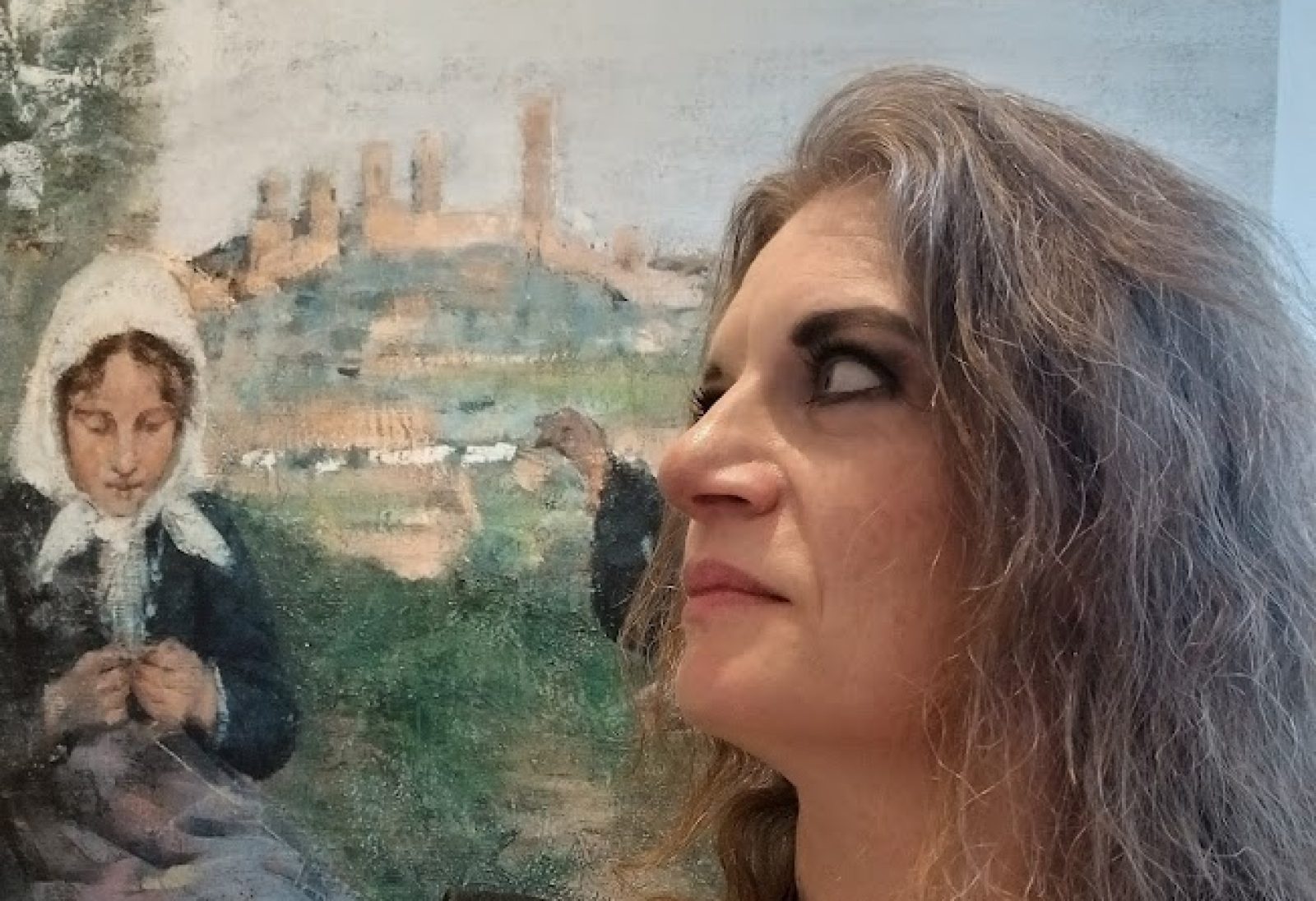
Alphonse Mucha, ad Asti oltre 110 opere in mostra: a Palazzo Mazzetti i capolavori dell’Art Nouveau
Asti si prepara a diventare una delle capitali italiane dell’Art Nouveau. Dall’11 novembre 2026 al 2 maggio 2027, Palazzo Mazzetti ospita una grande retrospettiva dedicata ad Alphonse Mucha, il maestro ceco che ha trasformato la bellezza femminile, le linee sinuose della natura e il linguaggio della pubblicità in uno degli immaginari artistici più riconoscibili tra Ottocento e Novecento.
Oltre 110 opere accompagneranno i visitatori alla scoperta di un artista che non si è limitato a creare manifesti eleganti e figure femminili dai lunghi capelli fluenti. Mucha ha inventato un linguaggio visivo capace di entrare nelle strade, nelle case, nei teatri e nella vita quotidiana, anticipando intuizioni che ritroviamo ancora oggi nella grafica, nella moda, nel design e nella comunicazione commerciale.

La mostra promette anche una sorpresa di particolare rilievo: un grande bozzetto preparatorio per l’Epopea Slava, alto ben tre metri, che sarà esposto nel Salone d’Onore di Palazzo Mazzetti.
Sarà l’occasione per conoscere più da vicino le diverse anime di un artista che ha saputo passare dalla seduzione dei manifesti parigini alla celebrazione della storia e dell’identità del proprio popolo.
Alphonse Mucha, l’artista che ha inventato un nuovo modo di rappresentare la donna
Nato il 24 luglio 1860 a Ivančice, in Moravia, e morto a Praga il 14 luglio 1939, Alphonse Mucha è considerato uno dei massimi protagonisti dell’Art Nouveau, conosciuta in Italia anche come Liberty.
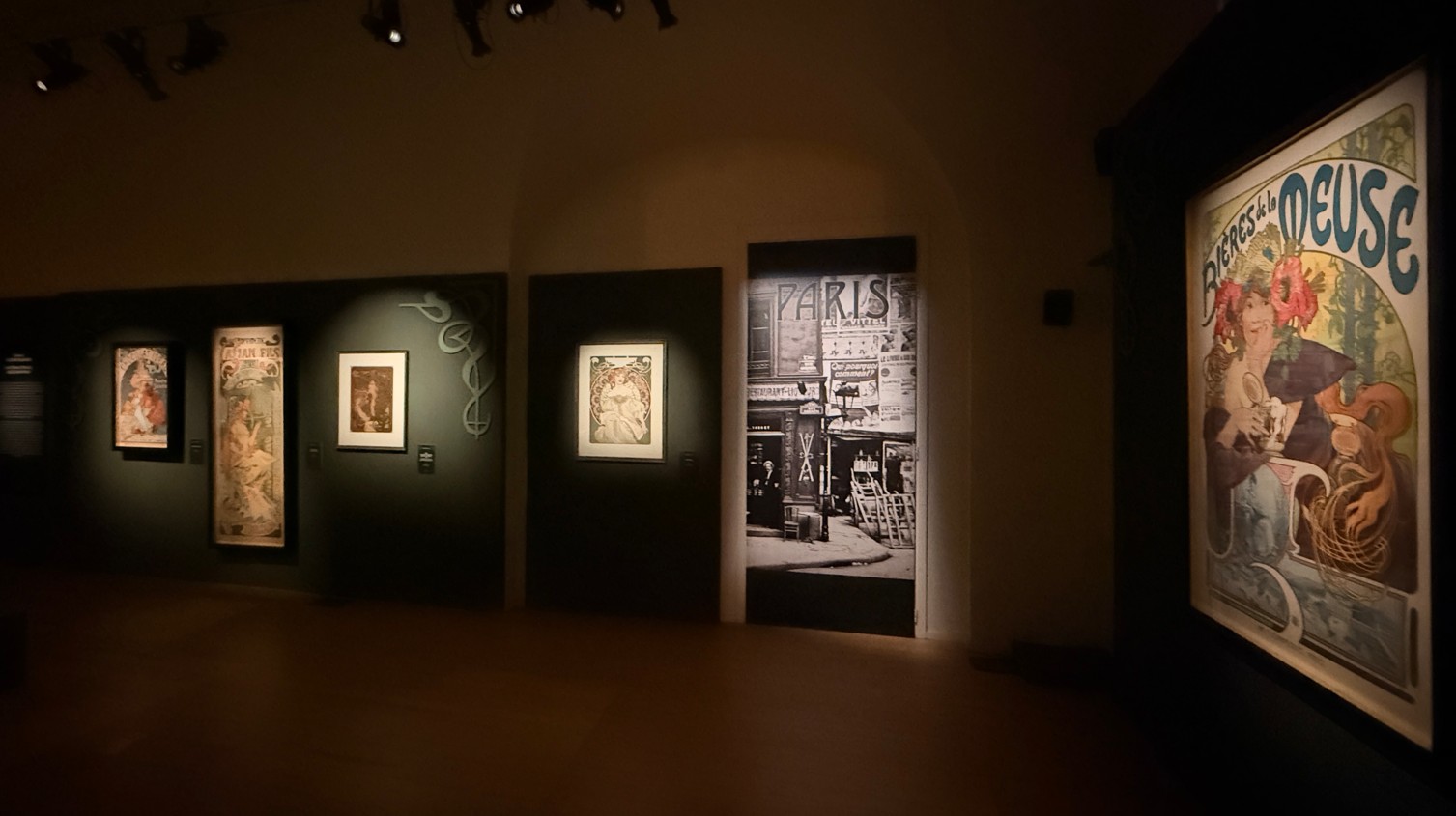
La sua vicenda artistica prende una svolta decisiva quando, nel 1887, arriva a Parigi. La capitale francese è allora un laboratorio straordinario di modernità: i boulevard sono animati da caffè e locali, i teatri attirano il pubblico più elegante e i manifesti pubblicitari cominciano a trasformare il volto delle città.
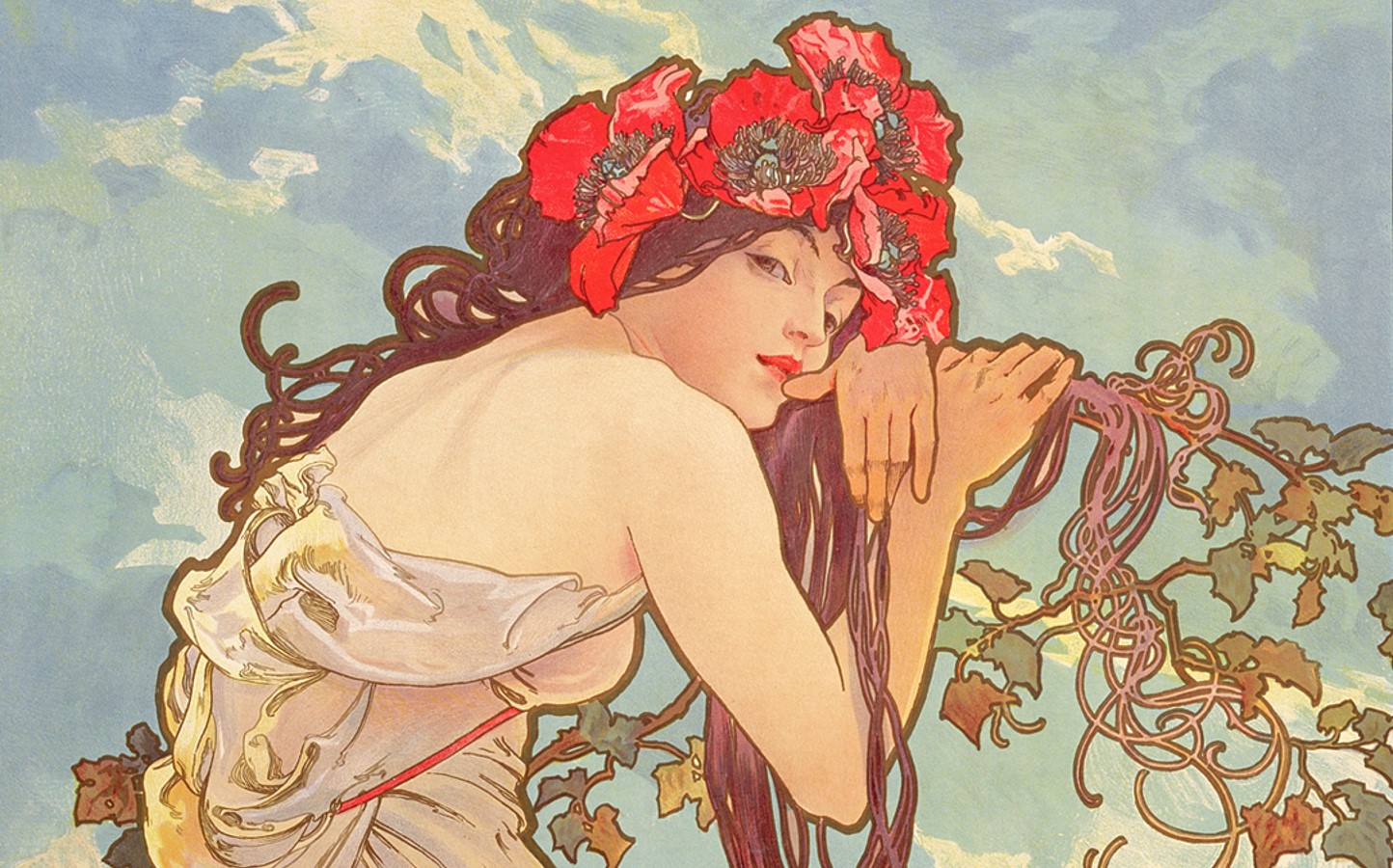
Mucha arriva con una formazione maturata tra Vienna, Monaco e l’Italia, ma è proprio a Parigi che trova il terreno ideale per sviluppare il proprio linguaggio.
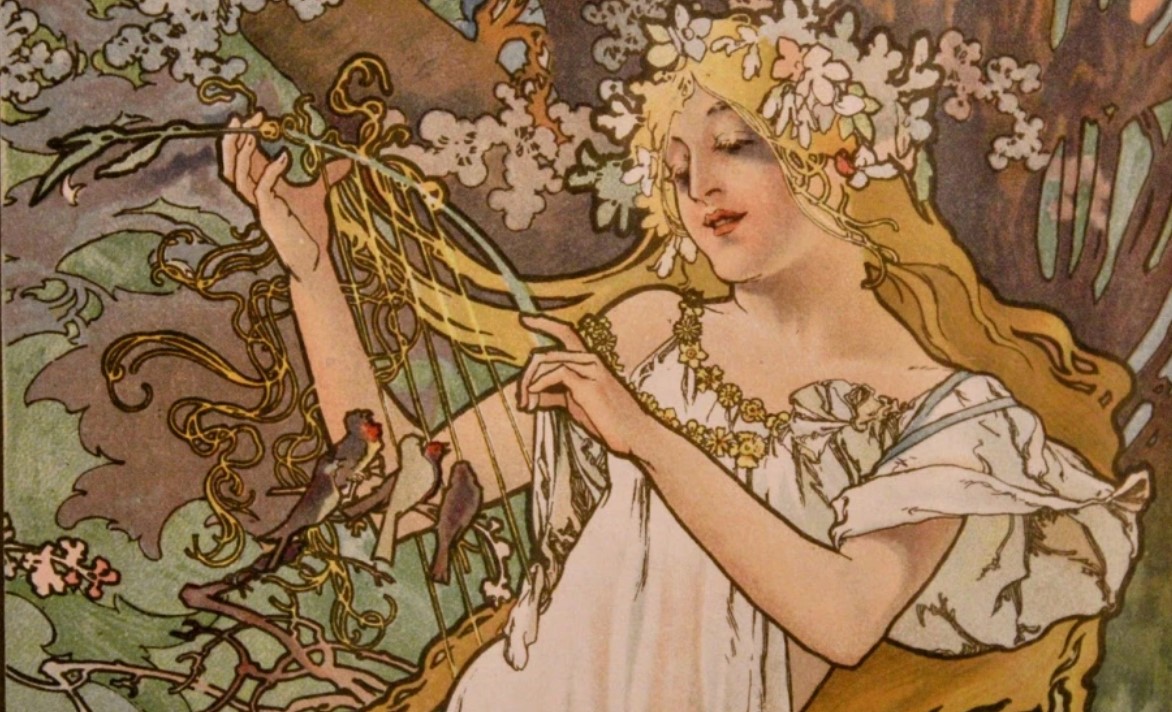
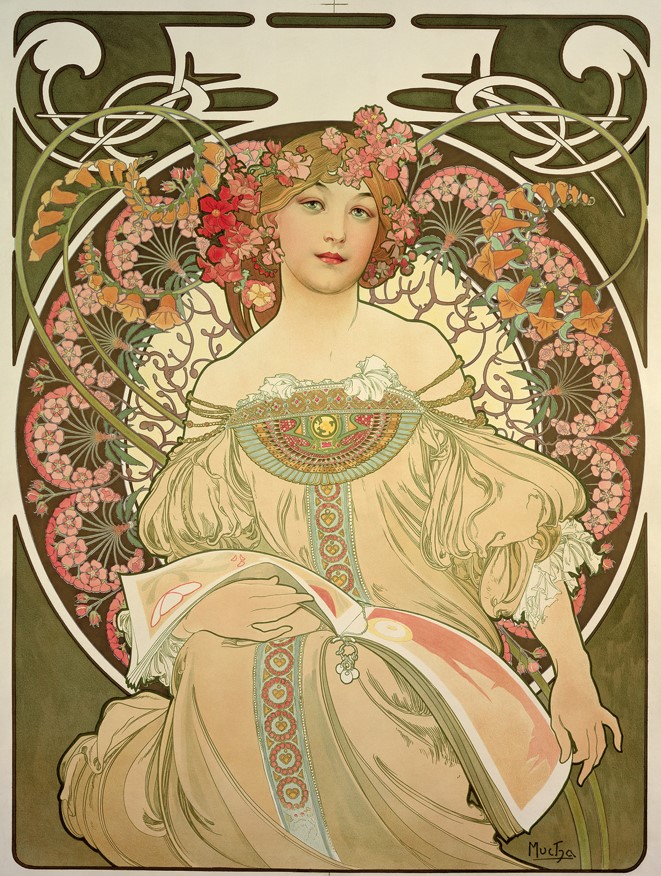
Le sue composizioni si distinguono per le linee morbide e sinuose, i motivi floreali, le cornici ornamentali e soprattutto per le figure femminili, spesso circondate da aureole decorative e da una ricchezza di dettagli che sembra non avere fine.
Le donne di Mucha guardano lo spettatore, occupano la scena e diventano protagoniste di un nuovo immaginario visivo. Sono eleganti, sensuali, ma anche consapevoli della propria presenza.
È proprio questa centralità della figura femminile a rappresentare uno degli aspetti più interessanti della sua produzione.
Sarah Bernhardt e Gismonda: il manifesto che cambiò la sua vita
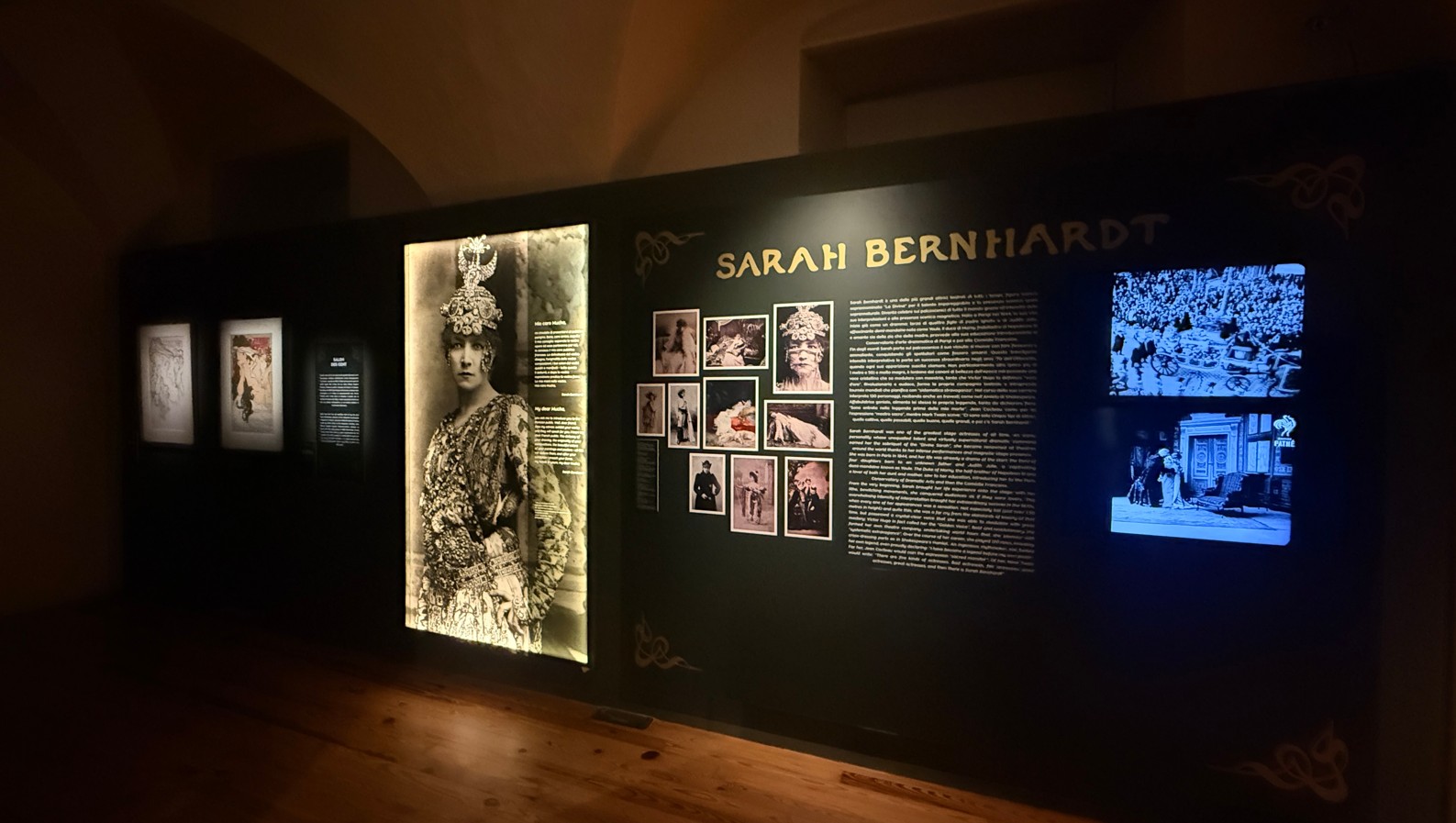
Per Mucha fu fondamentale l’incontro con Sarah Bernhardt, la celebre attrice francese soprannominata la Divina.
Siamo alla fine del 1894. Mucha lavora come illustratore, ma non ha ancora raggiunto la notorietà che lo renderà uno degli artisti più richiesti di Parigi.
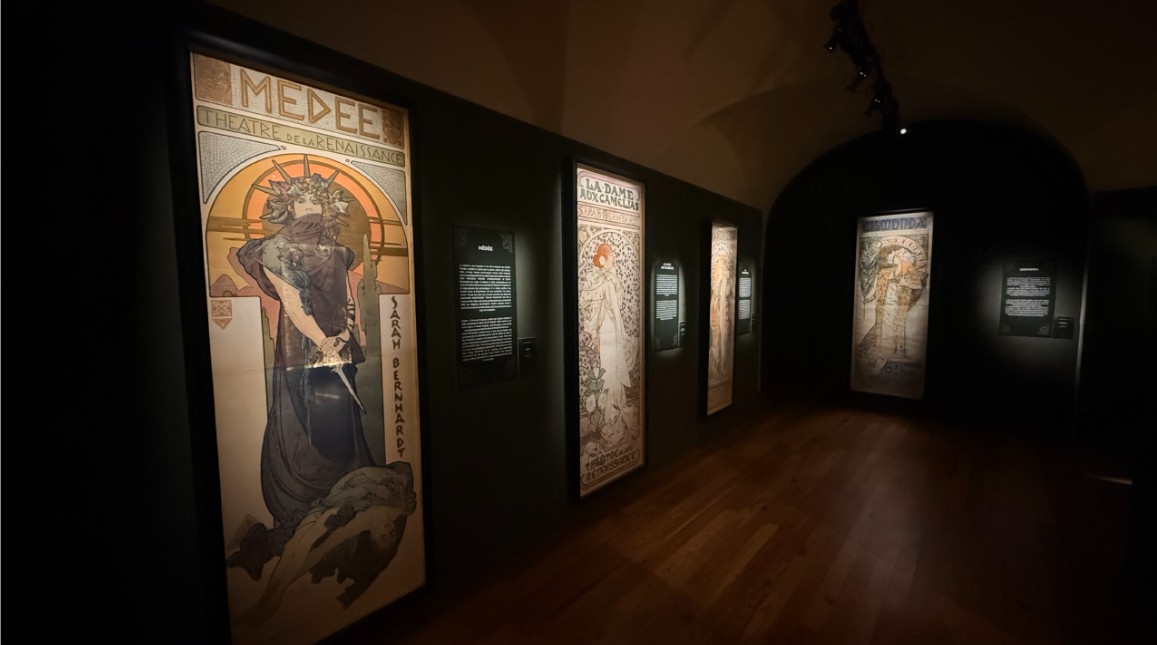
Durante le festività natalizie riceve un incarico destinato a cambiargli la carriera: realizzare il manifesto per Gismonda, lo spettacolo teatrale interpretato dalla Bernhardt. Il risultato sorprende tutti.
Mucha sceglie un formato verticale particolarmente allungato, una composizione elegante e una figura dell’attrice rappresentata con una presenza scenica straordinaria. Il manifesto viene affisso a Parigi il primo gennaio 1895 e conquista immediatamente il pubblico.
La Bernhardt rimane talmente colpita dal lavoro da offrirgli un contratto di sei anni. Da quel momento Mucha non si occupa soltanto dei manifesti, ma contribuisce a costruire l’immagine complessiva dell’attrice, lavorando anche a costumi, gioielli e scenografie.
Nasce così una collaborazione che consegna entrambi alla storia.
Tra le opere più celebri di questa stagione figurano anche Médée del 1898 e gli altri manifesti teatrali realizzati per la grande interprete.

Le Stagioni, le Pietre Preziose e la nascita dello Stile Mucha
Dopo il successo di Gismonda, Mucha diventa uno degli illustratori più ricercati d’Europa.
Nel 1896 firma un contratto in esclusiva con lo stampatore Champenois, per il quale realizzerà nel corso degli anni circa 120 manifesti.
Tra i suoi lavori più conosciuti ci sono le serie decorative che hanno contribuito a rendere immediatamente riconoscibile il suo stile.
Con Le Stagioni, realizzata nel 1896, Mucha rappresenta primavera, estate, autunno e inverno attraverso quattro figure femminili immerse in paesaggi e atmosfere differenti. Ogni stagione possiede una propria personalità, espressa attraverso colori, fiori, abiti e gesti.
Nel 1900 arriva invece la serie Le Pietre Preziose, nella quale le donne diventano personificazioni delle gemme, con composizioni ricche di riferimenti simbolici e decorativi.
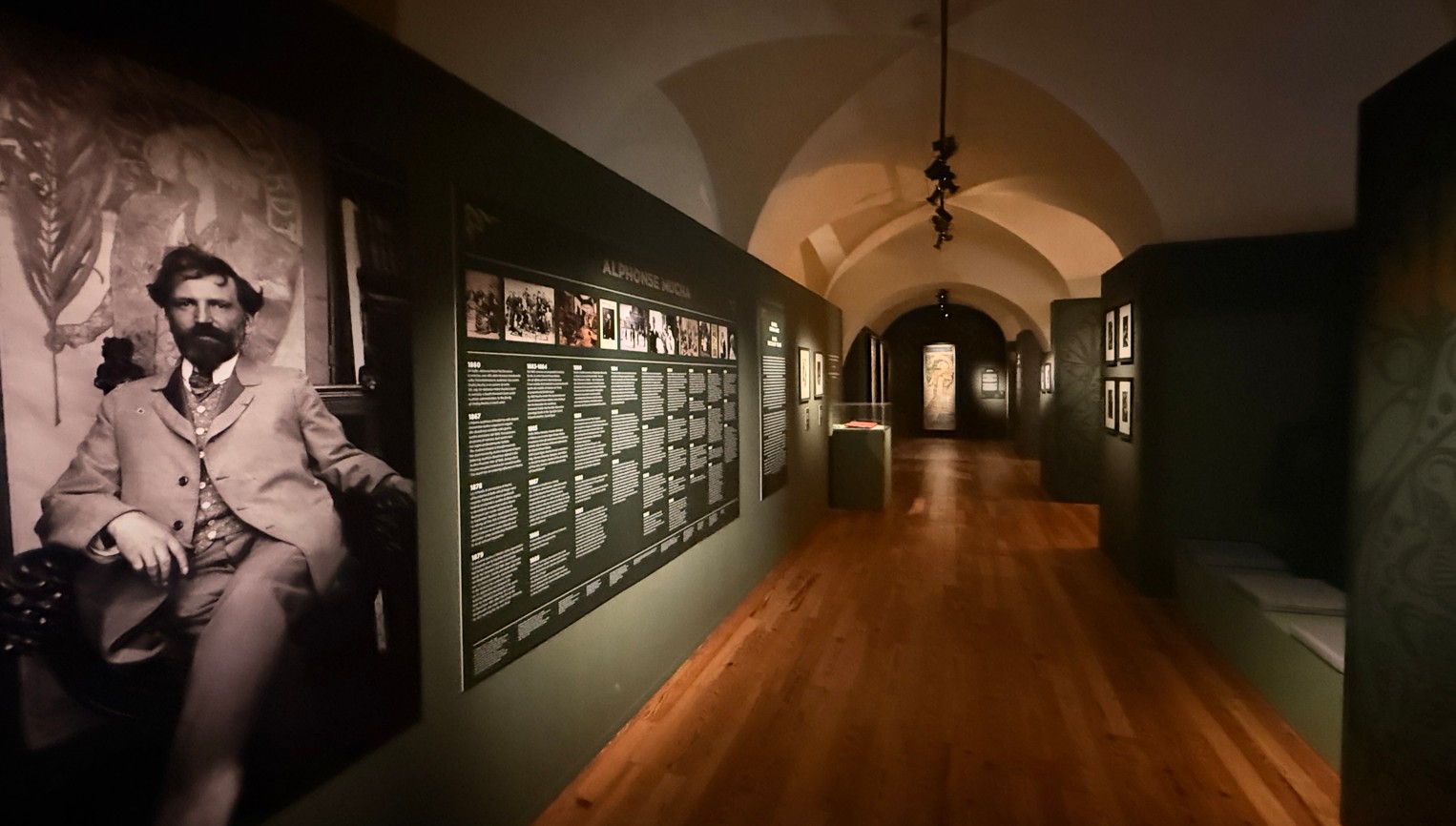
A queste opere si affiancano JOB del 1896, uno dei manifesti pubblicitari più celebri dell’artista, e numerose illustrazioni, calendari e pannelli decorativi.
C’è un aspetto particolarmente moderno nella sua produzione: nei manifesti pubblicitari il prodotto non è quasi mai il vero protagonista. Il profumo, la sigaretta o la bevanda diventano parte di un universo estetico più ampio, nel quale è l’immagine a creare desiderio e riconoscibilità.
Mucha comprende prima di molti altri che la pubblicità può essere qualcosa di più di un semplice messaggio commerciale. Può diventare un’esperienza visiva, un’immagine capace di rimanere impressa nella memoria.
Dalla Parigi della Belle Époque all’Esposizione Universale del 1900
Il successo internazionale di Mucha cresce rapidamente e nel 1900 l’artista viene coinvolto in uno degli appuntamenti più importanti del suo tempo: l’Esposizione Universale di Parigi.
Gli viene affidato il progetto decorativo del padiglione della Bosnia-Erzegovina per conto dell’Impero austro-ungarico. Per questa occasione studia la storia, il folklore e le tradizioni locali, traducendoli in un apparato decorativo di grande ricchezza.
Parallelamente collabora con importanti realtà francesi, tra cui la profumeria Houbigant e il gioielliere Georges Fouquet.
Mucha dimostra di essere un artista capace di lavorare su ambiti differenti, mettendo in relazione pittura, arti applicate, gioielleria e decorazione d’interni.
Il lato spirituale di Mucha: il misticismo e Le Pater
Dietro le immagini raffinate e apparentemente leggere si nasconde una personalità attraversata da profonde inquietudini spirituali.
Negli anni Novanta dell’Ottocento Mucha si interessa al misticismo, all’occultismo e alla teosofia. Nel 1898 viene accolto nella massoneria, entrando nella loggia parigina del Grande Oriente di Francia.
Questa dimensione interiore trova una delle sue espressioni più interessanti in Le Pater, volume illustrato pubblicato a Parigi il 20 dicembre 1899 in un’edizione di 510 copie numerate.
L’artista affronta il Padre Nostro attraverso sette parti, ciascuna accompagnata da tavole decorative che ne esplorano il significato simbolico e spirituale.
Per Mucha si tratta di un lavoro particolarmente importante, nel quale la decorazione diventa uno strumento per comunicare idee filosofiche e interrogativi sul destino dell’umanità.
È un volto meno conosciuto dell’artista, ma fondamentale per comprendere quanto la sua ricerca andasse oltre la bellezza delle forme.

L’Epopea Slava, il grande sogno della sua vita
Se i manifesti parigini gli avevano regalato fama e successo, il progetto al quale Mucha desiderava davvero dedicare la propria esistenza era un altro.
Dopo numerosi viaggi negli Stati Uniti, tra il 1904 e il 1909, l’artista sente sempre più forte il richiamo della propria terra d’origine.
In America incontra Charles Richard Crane, imprenditore e appassionato della cultura slava, che decide di sostenere economicamente il suo progetto più ambizioso.
Nasce così l’Epopea Slava, un ciclo monumentale composto da venti grandi tele dedicate alla storia, alle tradizioni e all’identità dei popoli slavi.
Le dimensioni sono impressionanti: alcune tele superano i sei metri di altezza per otto di larghezza.
Mucha lavora a questa impresa per molti anni, raccontando vicende storiche, momenti di persecuzione, conquiste culturali e aspirazioni alla libertà.
La figura femminile, così presente nei manifesti della Belle Époque, assume qui un significato completamente diverso. Non è più soltanto musa o personificazione della bellezza, ma diventa allegoria della patria, della memoria e della coscienza collettiva.
Il ciclo viene presentato a Praga nel 1928, in occasione del decimo anniversario dell’indipendenza cecoslovacca.
È proprio questa parte della sua carriera a offrire una chiave di lettura fondamentale per comprendere Mucha: dietro l’artista delle immagini decorative si nascondeva un uomo profondamente legato alle proprie radici e convinto che l’arte potesse contribuire alla crescita morale e culturale di un popolo.
Ad Asti sarà possibile avvicinarsi a questo capitolo attraverso uno straordinario bozzetto preparatorio per l’Epopea Slava, alto tre metri, collocato nel Salone d’Onore di Palazzo Mazzetti.
Una presenza di grande rilievo che permette di entrare idealmente nel processo creativo di un’impresa artistica fuori dal comune.
Mucha incontra l’arte italiana: da Canova a Bistolfi
A Palazzo Mazzetti, Mucha verrà messo in dialogo anche con alcuni protagonisti dell’arte italiana.
Una sezione speciale, curata da Annamaria Bava, mette in relazione le opere dell’artista ceco con capolavori provenienti da collezioni pubbliche e private piemontesi, attraversando un arco temporale che va dal Seicento al Novecento.
Tra le opere presenti figura la Musa Polimnia di Antiveduto Gramatica, realizzata intorno al 1620 e conservata ai Musei Reali di Torino.
Ci saranno inoltre le Tre Grazie intagliate da Giuseppe Maria Bonzanigo, le danzatrici di Antonio Canova e il celebre ritratto di Virginia Oldoini, contessa di Castiglione, dipinto da Michele Gordigiani nel 1862.
Il percorso comprende anche La Sirena (Abisso verde) di Giulio Aristide Sartorio, La Sfinge di Leonardo Bistolfi e il Nudo di donna di Giacomo Grosso, oltre ad altre opere che permettono di osservare come la figura femminile sia stata interpretata in modi diversi tra simbolismo, classicismo e modernità.
Il confronto è particolarmente significativo perché mostra quanto la ricerca di Mucha si inserisca in una tradizione molto più antica di quella dell’Art Nouveau.
Le sue donne, con i loro sguardi diretti e le pose eleganti, dialogano con muse, dee e personificazioni della tradizione artistica europea, ma introducono una nuova consapevolezza dell’immagine femminile.
Il Liberty astigiano: la mostra continua anche nei sotterranei del museo
Una sezione speciale, allestita negli spazi sotterranei del museo, è dedicata al Liberty astigiano, con l’obiettivo di riscoprire le tracce lasciate da questo movimento nella città.
Tra la fine dell’Ottocento e i primi decenni del Novecento, il nuovo gusto decorativo attraversa anche Asti, influenzando architetture, arredi e arti applicate.
Le linee sinuose, i motivi floreali e la ricerca di eleganza che caratterizzano l’Art Nouveau europea vengono reinterpretati da architetti e artigiani locali, dando vita a un linguaggio riconoscibile ancora oggi in diversi edifici e dimore storiche.
A completare l’esperienza contribuiscono arredi, oggetti d’arte applicata e fotografie d’epoca.
L’allestimento è pensato come un percorso immersivo, nel quale luci, colori, profumi e sonorità restituiscono l’atmosfera della Belle Époque.
Informazioni sulla mostra Alphonse Mucha a Palazzo Mazzettiede
Palazzo Mazzetti
Corso Vittorio Alfieri, 357, 14100 – Asti
Date al pubblico
11 novembre 2026 – 2 maggio 2027
Orario di apertura
Lunedì – domenica 10.00 – 19.00
(la biglietteria chiude un’ora prima)
Biglietti
Intero € 14,00
Ridotto € 10,00
Informazioni e prenotazioni
T. +39 0141 530 403
M. +39 388 164 09 15
info@fondazioneastimusei.it
prenotazioni@fondazioneastimusei.it
Per il omento il sempre vostro Michelangelo Buonarroti vi saluta dandovi appuntamento ai prossimi post e sui social.
Alphonse Mucha: Over 110 Works on Display in Asti – Art Nouveau Masterpieces at Palazzo Mazzetti
Asti is set to become one of Italy’s capitals of Art Nouveau. From November 11, 2026, to May 2, 2027, Palazzo Mazzetti will host a major retrospective dedicated to Alphonse Mucha—the Czech master who transformed feminine beauty, the sinuous lines of nature, and the language of advertising into one of the most recognizable artistic visions of the 19th and 20th centuries.
More than 110 works will guide visitors through the world of an artist who did far more than create elegant posters and depictions of women with long, flowing hair. Mucha developed a visual language that permeated streets, homes, theaters, and everyday life—anticipating concepts that remain relevant today in graphic design, fashion, and commercial communication.
The exhibition also features a particularly significant highlight: a large preparatory sketch for The Slav Epic, standing three meters tall, which will be displayed in the Salone d’Onore (Hall of Honor) at Palazzo Mazzetti.
This exhibition offers an opportunity to explore the many facets of an artist who transitioned seamlessly from the allure of Parisian posters to the celebration of his own people’s history and identity.
Alphonse Mucha: The Artist Who Invented a New Way to Represent Women
Born on July 24, 1860, in Ivančice, Moravia, and passing away in Prague on July 14, 1939, Alphonse Mucha is regarded as one of the foremost figures of the Art Nouveau movement—known in Italy as the Liberty style.
His artistic career took a decisive turn when he arrived in Paris in 1887. At that time, the French capital was an extraordinary laboratory of modernity: its boulevards were enlivened by cafés and entertainment venues, its theaters drew the most elegant audiences, and advertising posters began to transform the face of the city.
Mucha arrived with a background shaped in Vienna, Munich, and Italy, but it was in Paris that he found the ideal environment to develop his own artistic language.
His compositions are distinguished by soft, sinuous lines, floral motifs, ornamental frames, and, above all, by female figures—often surrounded by decorative halos and an inexhaustible wealth of detail.
Mucha’s women gaze at the viewer, command the scene, and take center stage in a new visual imagination. They are elegant and sensual, yet also fully conscious of their own presence.
It is precisely this centrality of the female figure that represents one of the most compelling aspects of his work.
Sarah Bernhardt and Gismonda: The Poster That Changed His Life
For Mucha, his encounter with Sarah Bernhardt—the celebrated French actress known as “The Divine”—proved to be a pivotal moment.
It was late 1894. Mucha was working as an illustrator, but he had not yet achieved the fame that would eventually make him one of the most sought-after artists in Paris.
During the Christmas season, he received a commission that would transform his career: to create a poster for Gismonda, a theatrical production starring Bernhardt. The result took everyone by surprise.
Mucha opted for an unusually elongated vertical format, an elegant composition, and a depiction of the actress that captured an extraordinary stage presence. The poster appeared on the streets of Paris on January 1, 1895, and immediately captivated the public.
Bernhardt was so impressed by the work that she offered him a six-year contract. From that point on, Mucha did more than just design posters; he helped shape the actress’s entire public persona, working on her costumes, jewelry, and stage sets.
Thus began a collaboration that would secure a place for both of them in history.
Other notable works from this period include his 1898 poster for Médée and various other theatrical posters created for the great performer.
The Seasons, The Precious Stones, and the Birth of the “Mucha Style”
Following the success of Gismonda, Mucha became one of the most in-demand illustrators in Europe.
In 1896, he signed an exclusive contract with the printer Champenois, for whom he would go on to produce approximately 120 posters over the years.
Among his best-known works are the decorative series that helped make his signature style instantly recognizable. In The Seasons, created in 1896, Mucha depicts spring, summer, autumn, and winter through four female figures, each immersed in a distinct landscape and atmosphere. Every season possesses its own unique personality, expressed through colors, flowers, attire, and gestures.
Then, in 1900, came the series The Precious Stones, in which the women serve as personifications of various gems, featuring compositions rich in symbolic and decorative references.
Alongside these works are pieces such as JOB (1896)—one of the artist’s most celebrated advertising posters—as well as numerous illustrations, calendars, and decorative panels.
There is a notably modern aspect to his body of work: in his advertising posters, the product itself is rarely the true focal point. Whether it is a perfume, a cigarette, or a beverage, the item becomes part of a broader aesthetic universe, where the image itself generates desire and ensures brand recognition.
Mucha understood, well before many others, that advertising could be more than just a simple commercial message; it could become a visual experience—an image capable of leaving a lasting impression on the memory.
From Belle Époque Paris to the 1900 Universal Exposition
Mucha’s international success grew rapidly, and in 1900, the artist became involved in one of the most significant events of his time: the Universal Exposition in Paris.
He was commissioned to design the decor for the Bosnia-Herzegovina pavilion on behalf of the Austro-Hungarian Empire. For this project, he researched local history, folklore, and traditions, translating them into a richly elaborate decorative scheme.
At the same time, he collaborated with prominent French firms, including the perfume house Houbigant and the jeweler Georges Fouquet.
Mucha proved himself an artist capable of working across diverse fields, bridging the worlds of painting, applied arts, jewelry design, and interior decoration.
Mucha’s Spiritual Side: Mysticism and Le Pater
Beneath his refined and seemingly lighthearted imagery lay a personality stirred by profound spiritual restlessness.
During the 1890s, Mucha took an interest in mysticism, occultism, and theosophy. In 1898, he was initiated into Freemasonry, joining the Grand Orient de France lodge in Paris.
This inner dimension found one of its most compelling expressions in Le Pater—an illustrated volume published in Paris on December 20, 1899, in a limited edition of 510 numbered copies.
In this work, the artist explores the Lord’s Prayer through seven sections, each accompanied by decorative plates that delve into its symbolic and spiritual significance.
For Mucha, this was a particularly meaningful project, in which decoration served as a vehicle for conveying philosophical ideas and posing questions about the destiny of humanity. This is a lesser-known side of the artist, yet it is essential for understanding how his creative inquiry extended far beyond the mere beauty of form.
The Slav Epic: The Great Dream of His Life
While his Parisian posters brought him fame and success, there was another project to which Mucha truly wished to dedicate his life.
Following several trips to the United States between 1904 and 1909, the artist felt an increasingly strong pull toward his homeland.
In America, he met Charles Richard Crane—an entrepreneur with a deep passion for Slavic culture—who agreed to provide the financial backing for his most ambitious undertaking.
Thus, the Slav Epic was born: a monumental cycle consisting of twenty large-scale canvases dedicated to the history, traditions, and identity of the Slavic peoples.
The dimensions are staggering; some canvases exceed six meters in height and eight meters in width.
Mucha labored on this endeavor for many years, depicting historical events, episodes of persecution, cultural achievements, and aspirations for freedom.
The female figure—so prominent in his Belle Époque posters—takes on an entirely different meaning here. She is no longer merely a muse or an embodiment of beauty; she becomes an allegory for the homeland, for memory, and for the collective consciousness.
The cycle was unveiled in Prague in 1928, coinciding with the tenth anniversary of Czechoslovak independence.
It is precisely this phase of his career that offers a vital key to understanding Mucha: behind the creator of decorative imagery lay a man deeply connected to his roots—a man convinced that art could contribute to the moral and cultural growth of a people.
In Asti, visitors can explore this chapter through an extraordinary three-meter-tall preparatory sketch for the Slav Epic, currently housed in the Salone d’Onore (Hall of Honor) of Palazzo Mazzetti. A highly significant presence that offers an ideal way to gain insight into the creative process of an extraordinary artistic venture.
Mucha Encounters Italian Art: From Canova to Bistolfi
At Palazzo Mazzetti, the work of Mucha is placed in dialogue with key figures from the Italian art world.
A special section, curated by Annamaria Bava, connects the Czech artist’s works with masterpieces from public and private collections in Piedmont, spanning a period from the 17th to the 20th century.
Featured works include The Muse Polyhymnia by Antiveduto Gramatica, created around 1620 and held by the Royal Museums of Turin.
Also on display are the Three Graces carved by Giuseppe Maria Bonzanigo, dancers by Antonio Canova, and the famous portrait of Virginia Oldoini, Countess of Castiglione, painted by Michele Gordigiani in 1862.
The exhibition further includes The Mermaid (Green Abyss) by Giulio Aristide Sartorio, The Sphinx by Leonardo Bistolfi, and Nude Woman by Giacomo Grosso—alongside other pieces that reveal the diverse ways the female figure has been interpreted across Symbolism, Classicism, and Modernity.
This juxtaposition is particularly significant, as it demonstrates how Mucha’s artistic exploration is rooted in a tradition far older than Art Nouveau itself.
His women—with their direct gazes and elegant poses—engage with the muses, goddesses, and personifications found throughout the European artistic tradition, while simultaneously introducing a new awareness of the female image.
Art Nouveau in Asti: The Exhibition Extends into the Museum’s Underground
A special section, set up in the museum’s underground spaces, is dedicated to the Art Nouveau style in Asti, aiming to rediscover the traces left by this movement throughout the city.
Between the late 19th century and the early decades of the 20th century, this new decorative aesthetic reached Asti, leaving its mark on architecture, furnishings, and the applied arts. The sinuous lines, floral motifs, and pursuit of elegance that characterize European Art Nouveau were reinterpreted by local architects and artisans, giving rise to a distinct style still recognizable today in various historic buildings and residences.
The experience is further enriched by furnishings, decorative art objects, and vintage photographs.
The exhibition is designed as an immersive journey, where lighting, colors, scents, and sounds evoke the atmosphere of the Belle Époque.
Information on the Alphonse Mucha exhibition at Palazzo Mazzetti
Palazzo Mazzetti
Corso Vittorio Alfieri, 357, 14100 – Asti
Public dates
November 11, 2026 – May 2, 2027
Opening hours
Monday – Sunday, 10:00 AM – 7:00 PM
(The ticket office closes one hour earlier)
Tickets
Full price: €14.00
Reduced price: €10.00
Information and reservations
T. +39 0141 530 403
M. +39 388 164 09 15
info@fondazioneastimusei.it
prenotazioni@fondazioneastimusei.it
For now, yours truly, Michelangelo Buonarroti, bids you farewell—until the next posts and on social media.

Sostienici – Support Us
Se questo blog ti piace e ti appassiona, puoi aiutarci a farlo crescere sempre più sostenendoci in modo concreto condividendo i post, seguendo le pagine social e con un contributo che ci aiuta ad andare avanti con il nostro lavoro di divulgazione. . ENGLISH: If you like and are passionate about this blog, you can help us make it grow more and more by supporting us in a concrete way by sharing posts, following social pages and with a contribution that helps us to move forward with our dissemination work.
10,00 €

Condividi:


Questo sono io





sostienici

Sostienici - Support Us
Se questo blog ti piace e ti appassiona, puoi aiutarci a farlo crescere sempre più sostenendoci in modo concreto condividendo i post, seguendo le pagine social e con un contributo che ci aiuta ad andare avanti con il nostro lavoro di divulgazione. . ENGLISH: If you like and are passionate about this blog, you can help us make it grow more and more by supporting us in a concrete way by sharing posts, following social pages and with a contribution that helps us to move forward with our dissemination work.
€10,00


