La Galleria dei Carracci a Palazzo Farnese: le nuove scoperte sugli affreschi
Un piccolo chiodo rimasto al suo posto per oltre quattro secoli. Una corda tesa come un grande compasso per tracciare le geometrie di una volta affrescata. E poi finiture a pastello, sottili ritocchi di colore, iscrizioni e caricature lasciate da visitatori vissuti molto tempo dopo gli artisti.
La Galleria dei Carracci a Palazzo Farnese, a Roma, continua a raccontare i propri segreti. Questa volta non sono soltanto le figure mitologiche, le prospettive illusionistiche o la straordinaria bellezza degli affreschi a catturare l’attenzione, ma i dettagli materiali che hanno permesso di realizzarli e le tracce lasciate dal tempo.
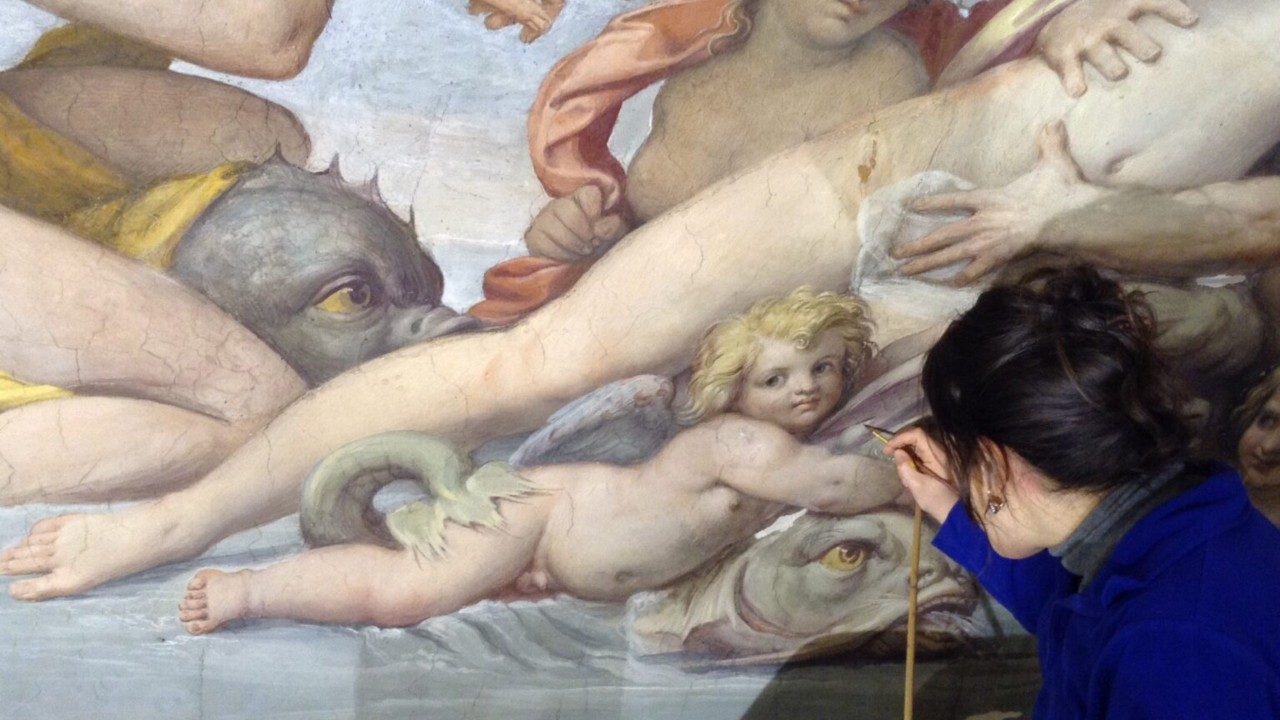
Un progetto di ricerca franco-italiano durato cinque anni e condotto da circa quaranta studiosi ha approfondito la conoscenza di uno dei più importanti complessi decorativi del primo Seicento. Si chiama Carracci ConservArt ed è nato per studiare e valorizzare una grande quantità di documentazione raccolta durante i restauri e le indagini scientifiche.
I risultati offrono uno sguardo nuovo sul lavoro di Annibale e Agostino Carracci, sulle tecniche utilizzate per dipingere la Galleria e sulle trasformazioni che questo ambiente ha attraversato nel corso dei secoli.
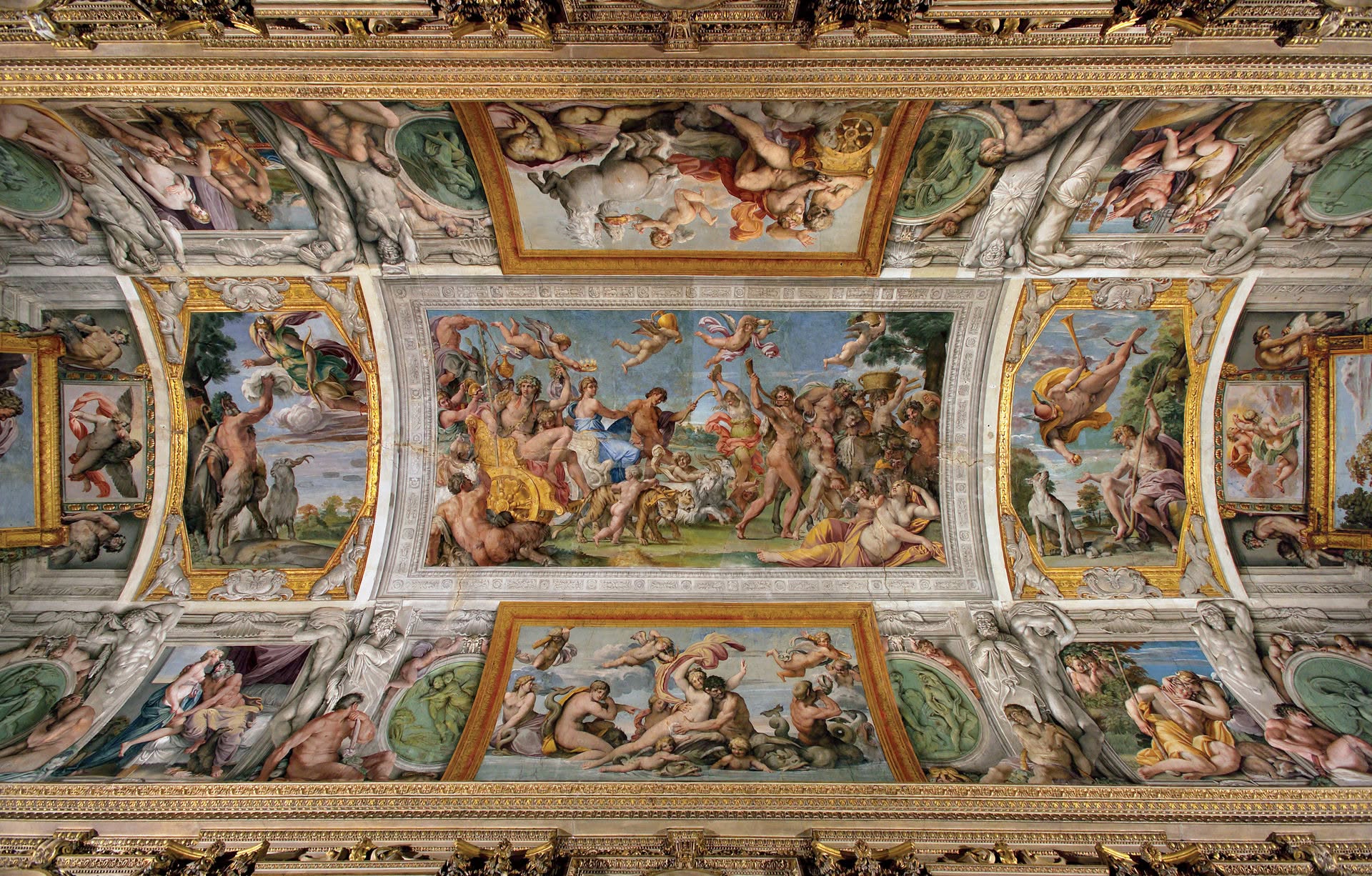
La Galleria dei Carracci a Palazzo Farnese: un capolavoro della pittura europea
Quando Annibale Carracci arrivò a Roma nel 1595, chiamato dal cardinale Odoardo Farnese, portò con sé l’esperienza della scuola bolognese. Insieme al fratello Agostino e al cugino Ludovico aveva contribuito a rinnovare profondamente la pittura italiana, recuperando lo studio della natura e dei grandi maestri del Rinascimento.
Nella capitale il confronto con l’antico, con Raffaello e con me diventò decisivo. Il risultato più celebre di quella stagione è proprio la decorazione della Galleria di Palazzo Farnese, realizzata tra la fine del Cinquecento e i primi anni del Seicento.
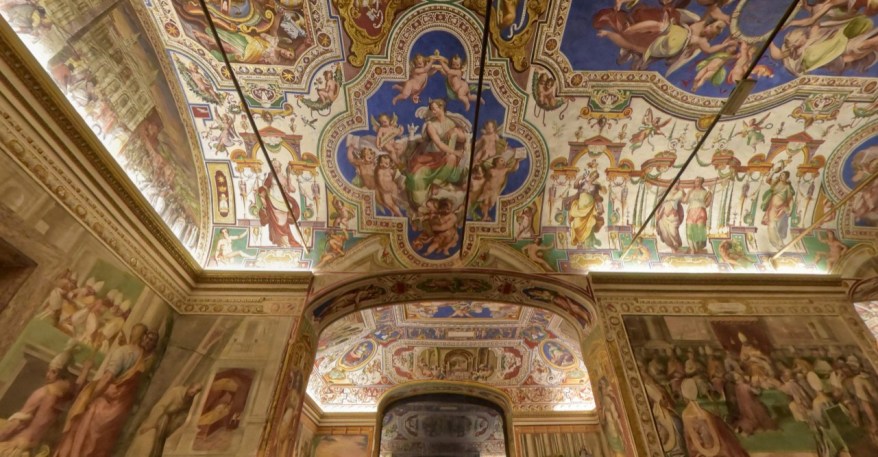
Sulla volta si sviluppa il celebre Trionfo di Bacco e Arianna, circondato da episodi mitologici, figure nude, personaggi che sembrano emergere dalla superficie e finte cornici architettoniche. Le immagini sono organizzate in una complessa costruzione illusionistica nella quale pittura, architettura e scultura sembrano fondersi.
La Galleria è uno dei capolavori che hanno contribuito a definire il linguaggio della pittura barocca. Eppure, dietro quella straordinaria apparizione, si nascondeva un cantiere molto più articolato di quanto si potesse intuire osservando semplicemente la volta.
Le nuove indagini permettono oggi di avvicinarsi proprio a quel lavoro: alle scelte degli artisti, ai procedimenti tecnici e agli strumenti impiegati per organizzare una decorazione di tale complessità.
Carracci ConservArt: cinque anni di ricerche e quaranta studiosi al lavoro
Il progetto Carracci ConservArt è stato avviato nel 2022 dall’École française de Rome, con il sostegno dell’Agence nationale de la recherche. Il suo obiettivo era mettere a disposizione della comunità scientifica le informazioni raccolte durante i restauri e le indagini diagnostiche, ricostruendo la storia artistica e materiale della Galleria.
Il lavoro ha coinvolto circa quaranta ricercatori tra storici dell’arte, restauratori, diagnostici e specialisti delle tecniche artistiche. Il coordinamento scientifico è stato affidato ad Alessandra Acconci, Francesca Alberti, Rachel George e Michel Hochmann.
Un punto di partenza fondamentale è stata la documentazione prodotta durante il restauro del 2014-2015, sostenuto dal World Monuments Fund, insieme alle testimonianze dei precedenti interventi conservativi e alle fonti storiche.
Rachel George, ricercatrice e coordinatrice del progetto, ha spiegato che spesso i dati prodotti durante i restauri rimangono inutilizzati, conservati negli archivi dei cantieri senza trovare una successiva elaborazione scientifica. Da qui l’idea di trasformare una prima giornata di studi in un programma di ricerca molto più ampio.

Il finanziamento, superiore ai 300 mila euro, ha permesso di mettere in dialogo competenze differenti e di confrontare le osservazioni sulle superfici dipinte con le analisi scientifiche e i documenti storici, compresi quelli conservati nell’Archivio di Stato di Napoli nel fondo Farnese.
Il chiodo nascosto nella volta: il trucco geometrico di Annibale Carracci
Tra le scoperte più curiose c’è un elemento che potrebbe passare completamente inosservato a chi visita la Galleria: un piccolo chiodo originale, rimasto nella sua posizione per oltre quattrocento anni.
Serviva come punto fisso per tracciare le geometrie dell’architettura dipinta. A partire da quel riferimento veniva tesa una corda, utilizzata come una sorta di grande compasso per individuare linee e proporzioni necessarie alla costruzione dello spazio illusionistico.
È un dettaglio che permette di immaginare il lavoro di Annibale Carracci mentre organizzava la decorazione della volta, studiando le prospettive e le architetture dipinte affinché dialogassero con lo spazio reale.
Dietro l’effetto di leggerezza e naturalezza che oggi ammiriamo si nascondeva, dunque, un’attenta progettazione geometrica. Le finte cornici, le aperture illusionistiche e le figure che sembrano affacciarsi sullo spettatore non erano frutto dell’improvvisazione, ma di un lavoro preparatorio accurato.
Oltre 300 giornate d’intonaco: come venne dipinta la Galleria
Sulla volta sono state individuate oltre 300 giornate d’intonaco. Nella tecnica dell’affresco, il pittore stende l’intonaco fresco su una porzione limitata della superficie e deve completare la pittura prima che asciughi. Ogni giornata corrisponde quindi a una parte del lavoro preparata e dipinta in una determinata fase.
La lettura delle giornate permette di ricostruire la successione degli interventi e di comprendere meglio come fosse organizzato il cantiere, quali porzioni venissero affrontate per prime e come si articolasse il lavoro sulle grandi superfici della volta.
Le ricerche hanno inoltre permesso di approfondire le tecniche utilizzate dai Carracci, mostrando che la decorazione non fu realizzata esclusivamente con il buon fresco.
Accanto alla pittura eseguita sull’intonaco ancora umido compaiono infatti velature, tratteggi, riprese a secco e rialzi di colore. Procedimenti diversi, utilizzati per ottenere particolari effetti di luce, volume e profondità.
Le finiture a pastello: i ritocchi che raccontano la ricerca della perfezione
Tra gli aspetti più sorprendenti emersi dalle indagini ci sono le finiture a pastello, approfondite dagli studi di Michela Cardinali, Tiziana Cavaleri e Federica Pozzi.
Si tratta di interventi che arricchiscono ulteriormente la superficie dipinta e testimoniano quanto fosse articolato il procedimento seguito dagli artisti. Non bastava realizzare le figure e organizzare la composizione: occorreva tornare sui particolari, perfezionare i passaggi cromatici e ottenere effetti sempre più raffinati.
Le analisi hanno permesso di riconoscere ritocchi e finiture che contribuiscono alla resa dei volumi e della luce. Sono dettagli che difficilmente si colgono osservando la Galleria da lontano, ma che diventano fondamentali quando si studia da vicino la materia pittorica.
Rachel George ha sottolineato proprio la qualità sorprendente di queste finiture, che mostrano quanto Annibale fosse attento alla ricerca del risultato finale.
La distinzione tra il contributo dei due fratelli costituisce un altro importante campo di ricerca. Silvia Ginzburg ha riesaminato le fasi iniziali della decorazione, mentre Michel Hochmann si è occupato delle questioni relative alla committenza e alla cronologia, ancora oggetto di approfondimento da parte degli studiosi.
Graffiti, caricature e iscrizioni: le pareti conservano le tracce di chi venne dopo i Carracci
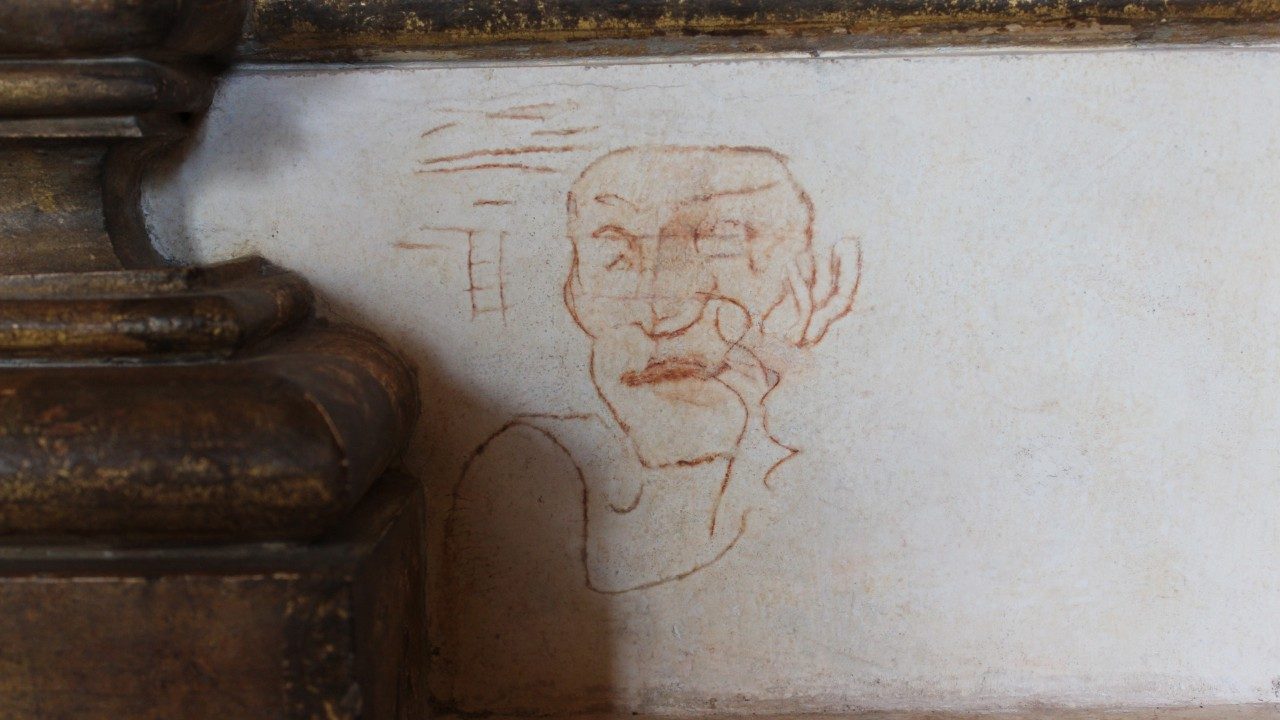
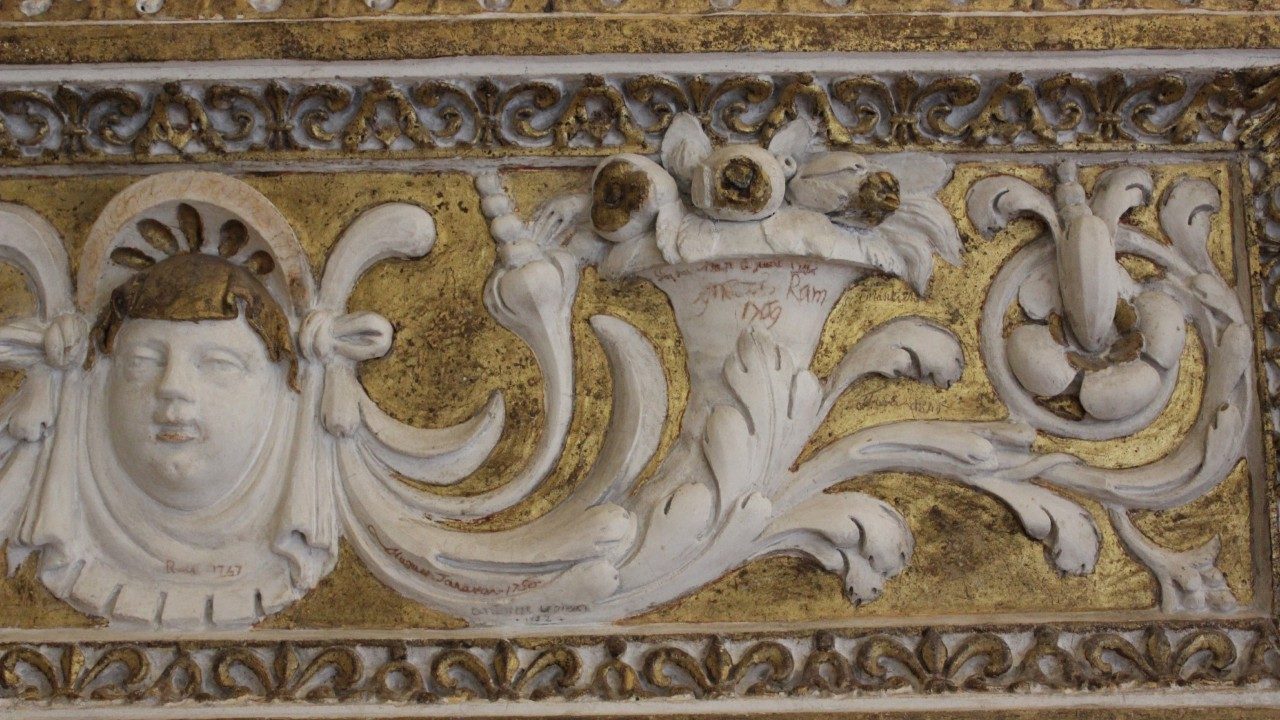
Durante la pulitura degli stucchi sono riemerse numerose tracce lasciate da persone vissute molto tempo dopo la realizzazione della Galleria.
Iscrizioni, disegni, caricature e segni incisi sono stati individuati soprattutto nelle parti inferiori degli ambienti e negli imbotti delle finestre, le superfici interne che raccordano il vano alla parete.
Alcuni sono stati realizzati a grafite, altri con sanguigna o attraverso incisioni. Non sono disegni preparatori degli artisti, ma testimonianze della lunga frequentazione di questi spazi e delle trasformazioni che Palazzo Farnese ha attraversato nei secoli.
Le indagini hanno permesso anche di approfondire gli interventi conservativi successivi alla realizzazione della Galleria. Tra questi ha un ruolo importante quello di Carlo Maratti alla fine del Seicento, al quale sono riconducibili numerosi consolidamenti della volta.
Per il momento il sempre vostro Michelangelo Buonarroti vi saluta dandovi appuntamento ai prossimi post e sui social.
The Carracci Gallery at Palazzo Farnese: New Discoveries Regarding the Frescoes
A small nail, left in place for over four centuries. A cord, stretched taut like a giant compass to map out the geometric patterns of a frescoed vault. And then, pastel-like finishing touches, subtle color adjustments, inscriptions, and caricatures left by visitors who lived long after the artists themselves.
The Carracci Gallery at Palazzo Farnese in Rome continues to reveal its secrets. This time, it is not merely the mythological figures, the illusionistic perspectives, or the extraordinary beauty of the frescoes that command attention, but rather the material details that made their creation possible—along with the traces left by the passage of time.
A five-year Franco-Italian research project, involving some forty scholars, has deepened our understanding of one of the most significant decorative schemes of the early 17th century. Known as “Carracci ConservArt,” the initiative was established to study and highlight the vast body of documentation gathered during restoration work and scientific investigations.
The findings offer a fresh perspective on the work of Annibale and Agostino Carracci, the techniques employed to paint the Gallery, and the transformations the space has undergone over the centuries.
The Carracci Gallery at Palazzo Farnese: A Masterpiece of European Painting
When Annibale Carracci arrived in Rome in 1595—summoned by Cardinal Odoardo Farnese—he brought with him the expertise of the Bolognese school. Together with his brother Agostino and his cousin Ludovico, he had played a pivotal role in profoundly renewing Italian painting, reviving the study of nature and the great masters of the Renaissance.
In the capital, his engagement with antiquity, the work of Raphael, and other great masters proved to be a decisive influence. The most celebrated achievement of that period is the decoration of the Gallery in Palazzo Farnese, created between the late 16th and early 17th centuries.
Across the vaulted ceiling unfolds the famous Triumph of Bacchus and Ariadne, surrounded by mythological episodes, nude figures, characters that appear to emerge from the surface, and trompe-l’œil architectural frames. The imagery is organized within a complex illusionistic structure in which painting, architecture, and sculpture seem to merge.
The Gallery stands as one of the masterpieces that helped define the language of Baroque painting. Yet, behind this extraordinary spectacle lay a project far more intricate than what one might perceive simply by looking at the ceiling.
New investigations now offer a closer look at that undertaking—revealing the artists’ choices, the technical processes, and the tools employed to orchestrate a decorative scheme of such complexity.
Carracci ConservArt: Five Years of Research and Forty Scholars at Work
The Carracci ConservArt project was launched in 2022 by the École française de Rome, with support from the Agence nationale de la recherche. Its objective was to make the information gathered during restoration work and diagnostic analyses available to the scientific community, thereby reconstructing the artistic and material history of the Gallery.
The project involved approximately forty researchers, including art historians, conservators, diagnostic experts, and specialists in artistic techniques. Scientific coordination was led by Alessandra Acconci, Francesca Alberti, Rachel George, and Michel Hochmann.
A fundamental starting point was the documentation produced during the 2014–2015 restoration—supported by the World Monuments Fund—alongside records of earlier conservation efforts and various historical sources. Rachel George, a researcher and project coordinator, explained that data generated during restoration work often goes unused, remaining in site archives without ever undergoing further scientific analysis. This realization sparked the idea to expand what was initially intended as a one-day study session into a much broader research program.
With funding exceeding 300,000 euros, the project has brought together diverse areas of expertise, allowing for a synthesis of observations on painted surfaces, scientific analyses, and historical documents—including those held in the Farnese collection at the State Archives of Naples.
A nail hidden in the vault: Annibale Carracci’s geometric trick
Among the most intriguing discoveries is an element that might go entirely unnoticed by visitors to the Gallery: a small, original nail that has remained in place for over four hundred years.
It served as a fixed point for plotting the geometry of the painted architecture. A string was attached to this reference point and used like a large compass to determine the lines and proportions necessary for constructing the illusionistic space.
This detail offers a glimpse into Annibale Carracci’s creative process as he organized the decoration of the vault, carefully planning its perspectives and architectural elements painted in such a way as to engage in a dialogue with the actual physical space.
Behind the sense of lightness and naturalness that we admire today lay a carefully devised geometric plan. The faux frames, the illusionistic openings, and the figures that appear to lean out toward the viewer were not the result of improvisation, but rather of meticulous preparatory work.
Over 300 giornate (days’ work) of plaster: how the Gallery was painted
More than 300 giornate—distinct sections of plaster—have been identified on the vault. In the buon fresco (true fresco) technique, the painter applies fresh plaster to a limited area of the surface and must complete the painting before it dries. Each giornata therefore corresponds to a portion of the work prepared and painted during a specific phase.
Analyzing these giornate makes it possible to reconstruct the sequence of the work, gain a better understanding of how the construction site was organized, determine which areas were addressed first, and see how the labor was structured across the vast surfaces of the vault.
Research has also shed light on the techniques employed by the Carracci family, revealing that the decoration was not executed solely using the buon fresco method.
Alongside the painting done on damp plaster, one can also find glazes, hatching, a secco (dry) retouching, and added highlights—various techniques used to achieve specific effects of light, volume, and depth.
Pastel-like finishes: the refinements that reveal a pursuit of perfection
Among the most surprising findings to emerge from the investigations are the pastel-like finishes, which have been examined in depth by researchers Michela Cardinali, Tiziana Cavaleri, and Federica Pozzi.
These interventions further enrich the painted surface and bear witness to the highly complex process followed by the artists. It was not enough to simply create the figures and organize the composition; it was necessary to revisit the details, refine the transitions between colors, and achieve increasingly sophisticated effects.
Analyses have revealed various retouches and finishing touches that contribute to the rendering of volume and light—details that are difficult to discern when viewing the Gallery from a distance, but which become essential when examining the paint surface up close.
Rachel George has highlighted the remarkable quality of these finishing touches, which demonstrate just how attentive Annibale was in his pursuit of the final result.
Distinguishing between the contributions of the two brothers is another significant area of research. Silvia Ginzburg has re-examined the initial stages of the decoration, while Michel Hochmann has addressed questions regarding the patronage and chronology—topics that remain subjects of ongoing scholarly investigation.
Graffiti, caricatures, and inscriptions: the walls bear traces of those who came after the Carracci.
During the cleaning of the stucco work, numerous traces left by individuals who lived long after the Gallery’s creation were brought to light.
Inscriptions, drawings, caricatures, and incised marks have been identified, primarily in the lower sections of the rooms and within the window reveals—the inner surfaces that connect the window opening to the wall.
Some were executed in graphite, others in red chalk (sanguine), or through incisions. These are not preparatory sketches by the artists, but rather evidence of the long-term use of these spaces and the transformations that Palazzo Farnese has undergone over the centuries.
Investigations have also shed light on conservation efforts carried out after the Gallery’s completion. Among these, the work of Carlo Maratti in the late 17th century plays a significant role, as he was responsible for various structural reinforcements to the vault.
For now, yours truly, Michelangelo Buonarroti, bids you farewell—until the next posts and on social media.
Sostienici – Support Us
Se questo blog ti piace e ti appassiona, puoi aiutarci a farlo crescere sempre più sostenendoci in modo concreto condividendo i post, seguendo le pagine social e con un contributo che ci aiuta ad andare avanti con il nostro lavoro di divulgazione. . ENGLISH: If you like and are passionate about this blog, you can help us make it grow more and more by supporting us in a concrete way by sharing posts, following social pages and with a contribution that helps us to move forward with our dissemination work.
10,00 €
Condividi:


Questo sono io



sostienici

Sostienici - Support Us
Se questo blog ti piace e ti appassiona, puoi aiutarci a farlo crescere sempre più sostenendoci in modo concreto condividendo i post, seguendo le pagine social e con un contributo che ci aiuta ad andare avanti con il nostro lavoro di divulgazione. . ENGLISH: If you like and are passionate about this blog, you can help us make it grow more and more by supporting us in a concrete way by sharing posts, following social pages and with a contribution that helps us to move forward with our dissemination work.
€10,00