San Francesco e il primo presepe di Greccio: la notte del 1223 che cambiò per sempre il Natale
Il Natale, prima ancora di diventare un susseguirsi di luci, addobbi, regali e tavole imbandite, era il racconto di una nascita. Quella di un bambino venuto al mondo in una mangiatoia, al freddo, lontano dai palazzi e dalle ricchezze dei potenti. Fu quest’immagine, umile e potente, a conquistare il cuore di San Francesco d’Assisi.
Nella notte del 24 dicembre 1223, a Greccio, un piccolo borgo arroccato tra le montagne della Valle Santa reatina, Francesco volle far rivivere ai fedeli la nascita di Gesù attraverso una rappresentazione concreta della Natività. Non si accontentava di raccontare l’episodio evangelico: desiderava che le persone potessero quasi toccarlo, sentirne la povertà, respirare l’atmosfera di quella notte a Betlemme.
Quell’iniziativa, nata dal desiderio di avvicinare il popolo al mistero dell’Incarnazione, è considerata l’origine della tradizione del presepe. Una tradizione che, nei secoli, avrebbe ispirato artisti, scultori, pittori, artigiani e intere comunità, trasformando una piccola rappresentazione in una delle immagini più amate del Natale.
Ma cosa accadde davvero quella notte a Greccio? In che modo quell’esperienza ha lasciato una traccia così profonda nella storia dell’arte?
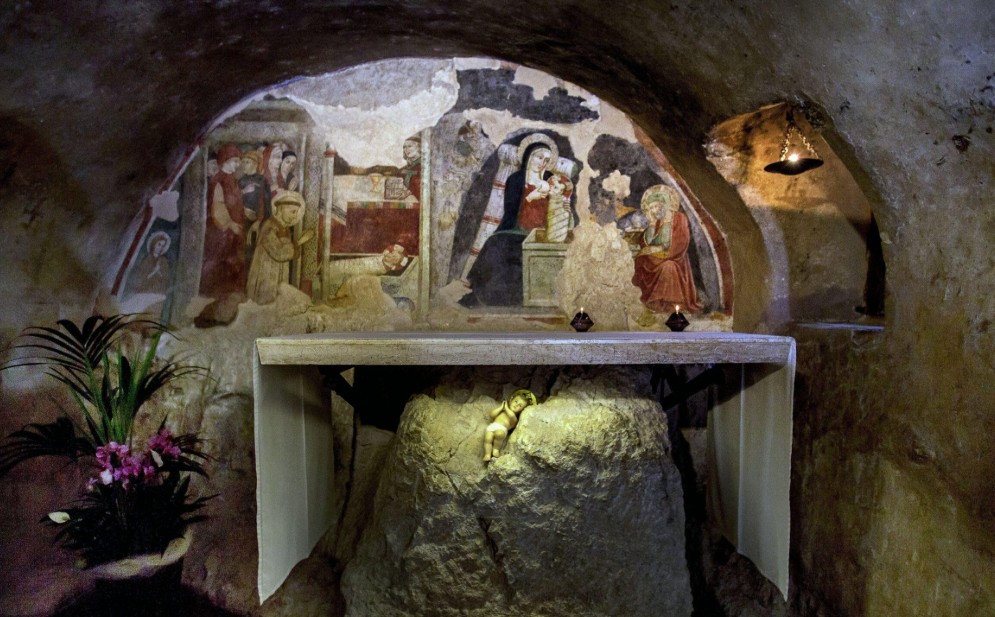
La notte di Natale del 1223: perché San Francesco scelse Greccio
Il santo aveva da poco compiuto un viaggio in Terra Santa e aveva visitato i luoghi legati alla vita di Gesù. L’esperienza lo aveva profondamente segnato. Il suo desiderio era quello di far comprendere anche a chi non aveva la possibilità di recarsi a Betlemme, quanto fosse straordinario il mistero di un Dio che aveva scelto di nascere nella povertà.
Per realizzare questo progetto scelse Greccio, un luogo che gli ricordava, per la sua conformazione e il suo paesaggio, proprio la terra di Betlemme.
Francesco si rivolse a un nobile del posto, Giovanni Velita, chiedendogli di preparare quanto necessario per una celebrazione speciale. Voleva una mangiatoia, il fieno e un bue e un asinello. Non desiderava costruire una scenografia ricca, ma ricreare la semplicità della stalla nella quale, secondo la tradizione, era nato Gesù.
La notte di Natale del 1223 arrivarono al luogo scelto frati e fedeli provenienti dai dintorni. Le montagne erano illuminate dalle fiaccole, mentre nella grotta si celebrava la Messa. Francesco, che non era sacerdote, proclamò il Vangelo e parlò della nascita di Cristo con una partecipazione così intensa da commuovere i presenti.
Era una celebrazione religiosa, un’esperienza collettiva nella quale il racconto della Natività diventava vicino e tangibile.
Il primo presepe non aveva ancora le statuine
Il presepe di Greccio non era ancora quello che oggi siamo abituati ad allestire nelle nostre case. Non statuine della Madonna, di San Giuseppe, dei pastori e dei Re Magi, né villaggi in miniatura, casette, ruscelli e paesaggi innevati.
La rappresentazione voluta da Francesco era essenziale. Al centro c’era una mangiatoia con il fieno, accanto agli animali, mentre la celebrazione eucaristica riportava i presenti al significato più profondo della nascita di Gesù.
A raccontarci l’episodio è Tommaso da Celano, il primo biografo di San Francesco, che descrisse l’evento nella Vita prima, scritta pochi anni dopo la morte del santo.
Nel suo racconto emerge un Francesco profondamente commosso, che desiderava vedere con i propri occhi la povertà nella quale era nato il Salvatore. La tradizione vuole che, durante la celebrazione, un uomo presente abbia avuto la visione di un bambino addormentato nella mangiatoia, che Francesco avrebbe poi risvegliato con il suo affetto.
Un episodio narrato nella biografia francescana che ha contribuito ad alimentare la devozione intorno alla nascita del presepe.
Da Greccio alla storia dell’arte: il presepe raccontato dai grandi artisti
L’intuizione di Francesco non rimase confinata alla piccola comunità di Greccio. Nei secoli successivi, la Natività diventò uno dei soggetti più rappresentati nella storia dell’arte occidentale.
Pittori e scultori si confrontarono con quel momento, interpretandolo secondo la sensibilità del proprio tempo. La mangiatoia diventò uno spazio nel quale raccontare la tenerezza materna, la povertà, la luce divina e lo stupore davanti a un bambino appena nato.
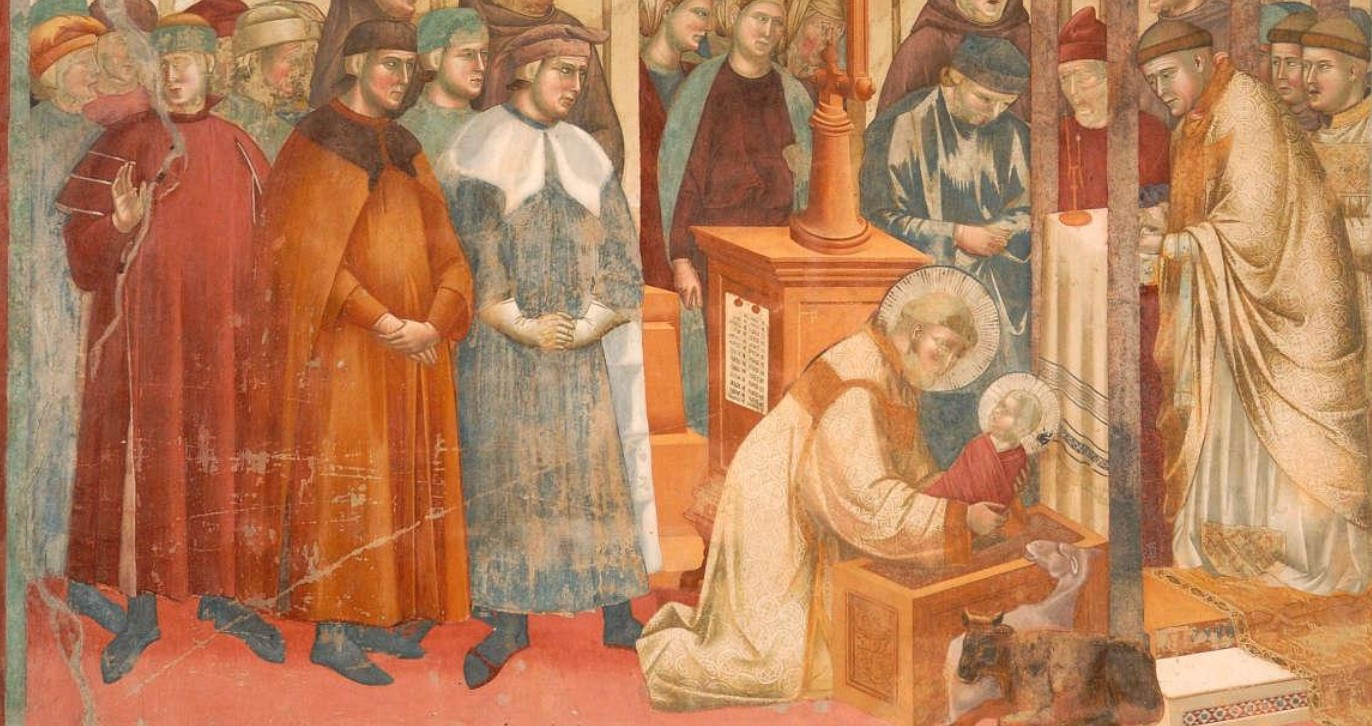
Giotto, Il presepe di Greccio: Francesco davanti al Bambino
È probabilmente l’immagine più significativa per raccontare questa vicenda. Giotto dedicò all’episodio uno degli affreschi del ciclo delle Storie di San Francesco, nella Basilica superiore di Assisi.
L’opera mostra il santo inginocchiato davanti alla mangiatoia, mentre il sacerdote celebra la Messa. Intorno si raccolgono i frati e i fedeli, testimoni di un momento straordinario.
Giotto scelse di ambientare la scena all’interno di una chiesa, anziché nella grotta descritta dalle fonti francescane. È una scelta interessante perché trasforma l’episodio storico in una celebrazione liturgica, mettendo in relazione la nascita di Cristo con il sacramento dell’Eucaristia.
Osservando l’affresco, lo sguardo viene attirato verso Francesco e il Bambino. Il loro incontro diventa il cuore emotivo dell’intera composizione.
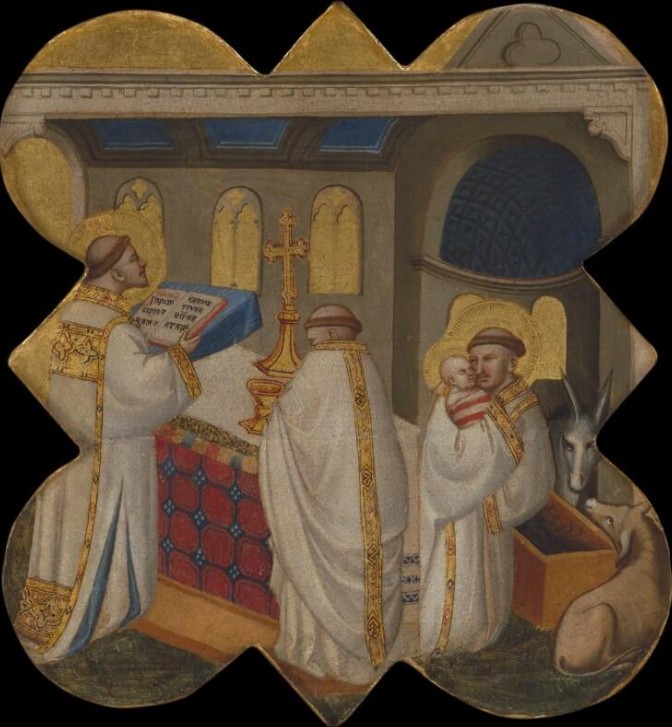
Taddeo Gaddi, il presepe di Greccio nella pittura fiorentina
L’episodio di Greccio continuò a essere rappresentato anche dopo Giotto. Una testimonianza particolarmente interessante si trova nella produzione di Taddeo Gaddi, artista che raccolse e sviluppò l’eredità giottesca.
Anche in questa interpretazione la vicenda francescana diventa un’occasione per raccontare la partecipazione emotiva alla nascita di Gesù.
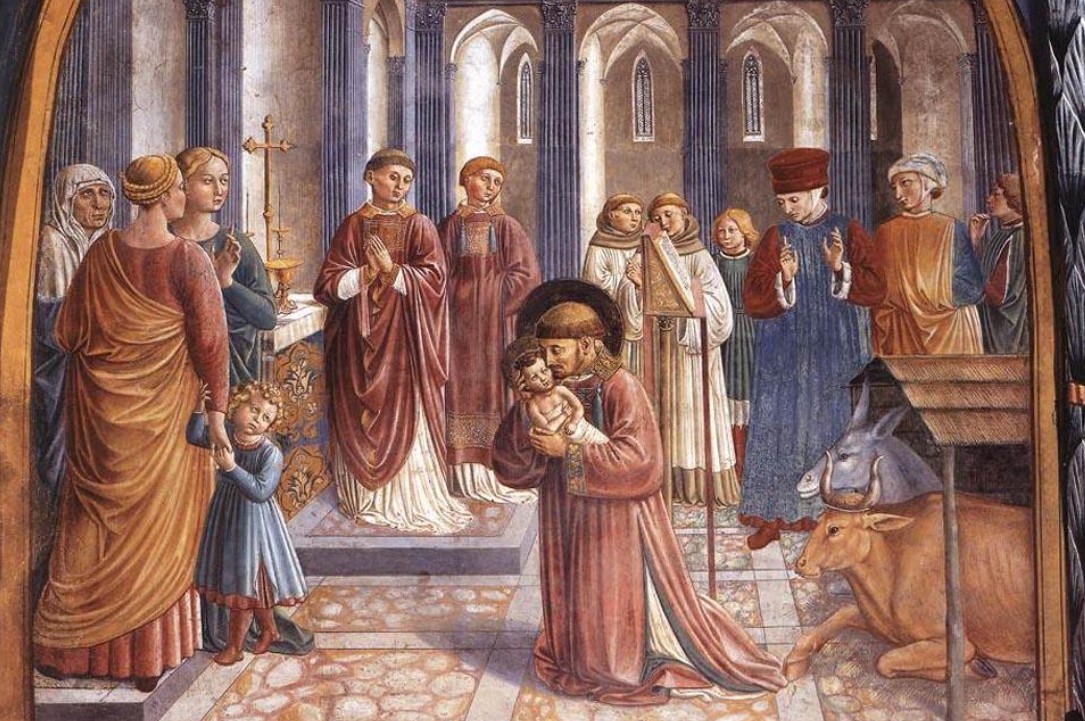
Benozzo Gozzoli, il presepe di Greccio a Montefalco
Un’altra importante testimonianza si trova in Umbria, nella chiesa di San Francesco a Montefalco, dove Benozzo Gozzoli realizzò un ciclo di affreschi dedicato alla vita del santo.
Anche qui compare l’episodio di Greccio. La sua presenza dimostra quanto fosse importante, nel Quattrocento, il ricordo di quella notte e quanto il messaggio francescano fosse penetrato nella cultura figurativa italiana.
La scena del primo presepe era diventata un soggetto autonomo della narrazione artistica della vita di Francesco.
Il presepe di Arnolfo di Cambio: quando la Natività diventa scultura
Se Giotto raccontò il presepe attraverso la pittura, Arnolfo di Cambio contribuì a dare forma tridimensionale alla Natività.
Il gruppo scultoreo conservato nella Basilica di Santa Maria Maggiore a Roma è una delle più antiche testimonianze monumentali della tradizione presepiale italiana.
Realizzato nel 1291, per volontà di papa Niccolò IV, il complesso è particolarmente importante perché testimonia come la rappresentazione della nascita di Gesù stesse assumendo forme sempre più articolate e monumentali.
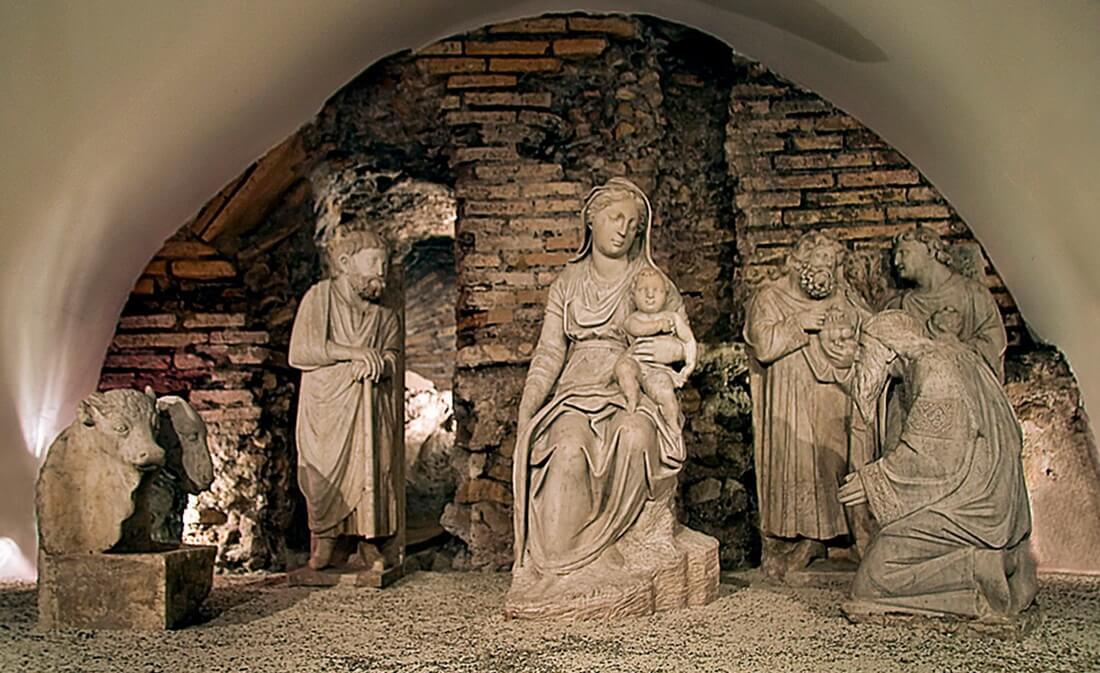
Il Santuario di Greccio: dove tutto ebbe inizio
Ancora oggi è possibile visitare il luogo legato a quella notte straordinaria. Il Santuario di Greccio è conosciuto come la Betlemme francescana. Il suo nucleo più antico è la Cappella del Presepio, costruita nel 1228, proprio nel luogo legato alla rappresentazione voluta da Francesco.
All’interno si conserva un affresco che racconta due episodi: la nascita di Gesù a Betlemme e il presepe di Greccio. Le due scene dialogano tra loro, mettendo in relazione l’evento evangelico con la sua rievocazione da parte del santo.
È un luogo raccolto, essenziale, nel quale la storia sembra ancora vicina. Visitandolo si comprende meglio perché Francesco avesse scelto proprio quella grotta per dare forma al suo desiderio.
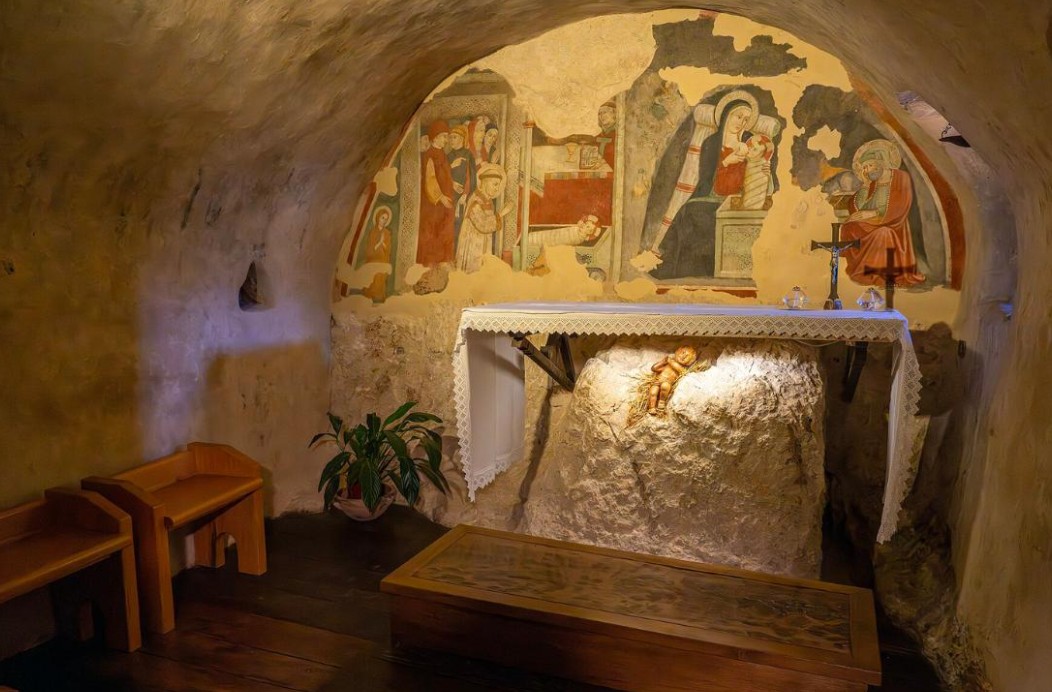
Da una mangiatoia al presepe nelle nostre case
Dopo Greccio, la rappresentazione della Natività si diffuse progressivamente nelle chiese e nei luoghi di culto, assumendo forme sempre più elaborate.
Nel corso dei secoli entrarono nella scena nuovi personaggi: Maria, Giuseppe, gli angeli, i pastori, i Re Magi e gli abitanti dei villaggi. La rappresentazione si arricchì di paesaggi, architetture, animali e dettagli della vita quotidiana.
Il presepe napoletano del Settecento avrebbe portato questa tradizione a una straordinaria ricchezza scenografica, trasformando la nascita di Gesù in un racconto popolato di personaggi, mestieri e ambientazioni ispirate alla società del tempo.
Dietro tutte queste trasformazioni, è rimasta intatta l’intuizione di Francesco: rendere visibile una storia che altrimenti sarebbe rimasta soltanto nelle parole.
Per il momento il sempre vostro Michelangelo Buonarroti vi saluta dandovi appuntamento ai prossimi post e sui social.

Saint Francis and the First Nativity Scene in Greccio: The Night in 1223 That Changed Christmas Forever
Before Christmas became a succession of lights, decorations, gifts, and lavishly set tables, it was, first and foremost, the story of a birth—the birth of a child who came into the world in a manger, in the cold, far removed from the palaces and riches of the powerful. It was this image—at once humble and profound—that captured the heart of Saint Francis of Assisi.
On the night of December 24, 1223, in Greccio—a small village perched in the mountains of the Rieti Valley—Francis sought to bring the birth of Jesus to life for the faithful through a tangible representation of the Nativity. He was not content with merely recounting the Gospel account; he wanted people to be able to almost touch the scene, to sense its poverty, and to breathe in the atmosphere of that night in Bethlehem.
This initiative, born from a desire to draw the people closer to the mystery of the Incarnation, is considered the origin of the Nativity scene tradition. Over the centuries, this tradition has inspired artists, sculptors, painters, craftspeople, and entire communities, transforming a modest depiction into one of the most cherished symbols of Christmas.
But what truly happened that night in Greccio? And how did that experience leave such a profound mark on the history of art?
Christmas Eve, 1223: Why Saint Francis Chose Greccio
The saint had recently returned from a journey to the Holy Land, where he had visited sites associated with the life of Jesus. The experience had left a deep impression on him. His desire was to help those who could not travel to Bethlehem understand the extraordinary nature of the mystery of a God who chose to be born in poverty. To carry out this project, he chose Greccio—a place whose topography and landscape reminded him of the land of Bethlehem itself.
Francis turned to a local nobleman, Giovanni Velita, asking him to prepare what was needed for a special celebration. He requested a manger, some hay, an ox, and a donkey. He did not wish to construct an elaborate stage set, but rather to recreate the simplicity of the stable where, according to tradition, Jesus was born.
On Christmas Eve in 1223, friars and the faithful from the surrounding area arrived at the chosen site. The mountains were illuminated by torches, while Mass was celebrated inside the grotto. Francis, who was not a priest, proclaimed the Gospel and spoke of the birth of Christ with such intense devotion that he moved those present to tears.
It was a religious celebration—a collective experience in which the story of the Nativity became immediate and tangible.
The first Nativity scene did not yet feature figurines
The Nativity scene at Greccio was not like the ones we are accustomed to setting up in our homes today. There were no figurines of the Virgin Mary, Saint Joseph, shepherds, or the Three Wise Men—nor were there miniature villages, tiny houses, streams, or snowy landscapes.
The representation envisioned by Francis was stark and essential. At its center stood a manger filled with hay, accompanied by the animals, while the Eucharistic celebration drew those present toward the deepest meaning of Jesus’s birth.
This episode is recounted by Thomas of Celano, Saint Francis’s first biographer, who described the event in his Vita Prima (First Life), written just a few years after the saint’s death.
His account reveals a deeply moved Francis, who longed to see with his own eyes the poverty into which the Savior had been born. According to tradition, during the celebration, a man present had a vision of a child asleep in the manger—a child whom Francis then awakened with his affection.
This episode, recounted in Franciscan biography, helped fuel the devotion surrounding the origin of the Nativity scene.
From Greccio to the history of art: the Nativity scene as depicted by great artists
Francis’s inspiration did not remain confined to the small community of Greccio. In the centuries that followed, the Nativity became one of the most frequently represented subjects in the history of Western art.
Painters and sculptors engaged with this moment, interpreting it through the sensibilities of their own eras. The manger became a space in which to express maternal tenderness, poverty, divine light, and the wonder felt in the presence of a newborn child.
Giotto, The Nativity at Greccio: Francis before the Child
This is arguably the most significant image for illustrating this event. Giotto dedicated one of the frescoes in his cycle of the Stories of Saint Francis, located in the Upper Basilica of Assisi, to this episode.
The work shows the saint kneeling before the manger while a priest celebrates Mass. Gathered around are friars and the faithful, all witnesses to an extraordinary moment.
Giotto chose to set the scene inside a church, rather than in the cave described in Franciscan sources. This is a compelling choice, as it transforms the historical episode into a liturgical celebration, linking the birth of Christ to the sacrament of the Eucharist.
Upon observing the fresco, one’s gaze is drawn toward Francis and the Child. Their encounter becomes the emotional heart of the entire composition.
Taddeo Gaddi: The Nativity Scene at Greccio in Florentine Painting
The episode at Greccio continued to be depicted even after Giotto. A particularly interesting example can be found in the work of Taddeo Gaddi, an artist who embraced and further developed the legacy of Giotto.
In this interpretation, too, the Franciscan narrative serves as an opportunity to convey an emotional engagement with the birth of Jesus.
Benozzo Gozzoli: The Nativity Scene at Greccio in Montefalco
Another significant example is found in Umbria, in the Church of San Francesco in Montefalco, where Benozzo Gozzoli created a cycle of frescoes dedicated to the life of the saint.
The episode at Greccio appears here as well. Its inclusion demonstrates the importance—during the 15th century—of the memory of that night, and shows how deeply the Franciscan message had permeated Italian visual culture.
The scene of the first Nativity had become an independent subject within the artistic narrative of the life of Francis.
The Nativity by Arnolfo di Cambio: When the Nativity Becomes Sculpture
While Giotto depicted the Nativity scene through painting, Arnolfo di Cambio helped give the Nativity a three-dimensional form.
The sculptural group housed in the Basilica of Santa Maria Maggiore in Rome is one of the oldest monumental examples of the Italian Nativity tradition.
Created in 1291 at the behest of Pope Nicholas IV, this complex is particularly significant, as it bears witness to how the representation of the birth of Jesus was evolving into increasingly elaborate and monumental forms.
The Sanctuary of Greccio: Where It All Began
To this day, it is possible to visit the site linked to that extraordinary night. The Sanctuary of Greccio is known as the “Franciscan Bethlehem.” Its oldest core is the Chapel of the Nativity (Cappella del Presepio), built in 1228 on the very spot associated with the reenactment commissioned by Francis.
Inside, there is a fresco depicting two episodes: the birth of Jesus in Bethlehem and the Nativity scene at Greccio. The two scenes engage in a dialogue, connecting the Gospel event with its reenactment by the saint.
It is an intimate, austere space where history still feels close at hand. Visiting it, one better understands why Francis chose that particular grotto to give form to his vision.
From a Manger to the Nativity Scenes in Our Homes
Following Greccio, the depiction of the Nativity gradually spread to churches and places of worship, taking on increasingly elaborate forms.
Over the centuries, new figures were added to the scene: Mary, Joseph, angels, shepherds, the Three Wise Men, and villagers. The representation became enriched with landscapes, architecture, animals, and details of everyday life.
The 18th-century Neapolitan Nativity scene brought this tradition to an extraordinary level of scenographic richness, transforming the birth of Jesus into a narrative populated by characters, trades, and settings inspired by the society of the time.
Beneath all these transformations, the original insight of Francis remains intact: to make visible a story that otherwise would have existed only in words.
For now, yours truly, Michelangelo Buonarroti, bids you farewell—until the next posts and on social media.

Sostienici – Support Us
Se questo blog ti piace e ti appassiona, puoi aiutarci a farlo crescere sempre più sostenendoci in modo concreto condividendo i post, seguendo le pagine social e con un contributo che ci aiuta ad andare avanti con il nostro lavoro di divulgazione. . ENGLISH: If you like and are passionate about this blog, you can help us make it grow more and more by supporting us in a concrete way by sharing posts, following social pages and with a contribution that helps us to move forward with our dissemination work.
10,00 €
Condividi:


Questo sono io





sostienici

Sostienici - Support Us
Se questo blog ti piace e ti appassiona, puoi aiutarci a farlo crescere sempre più sostenendoci in modo concreto condividendo i post, seguendo le pagine social e con un contributo che ci aiuta ad andare avanti con il nostro lavoro di divulgazione. . ENGLISH: If you like and are passionate about this blog, you can help us make it grow more and more by supporting us in a concrete way by sharing posts, following social pages and with a contribution that helps us to move forward with our dissemination work.
€10,00