Firenze e la Seconda Guerra Mondiale: così vennero protette le mie sculture nella Sagrestia Nuova
Quando la guerra arrivò a Firenze, anche le mie sculture dovettero essere messe al riparo. Nella Sagrestia Nuova di San Lorenzo, dove avevo immaginato e realizzato alcune delle opere più importanti della mia vita, si prepararono protezioni speciali per difendere i marmi dai bombardamenti.
Una vicenda drammatica che ebbe però anche un risvolto positivo. Per la prima volta infatti, le mie sculture vennero fotografate da ogni angolazione, rivelando particolari che normalmente rimanevano nascosti agli occhi dei visitatori.
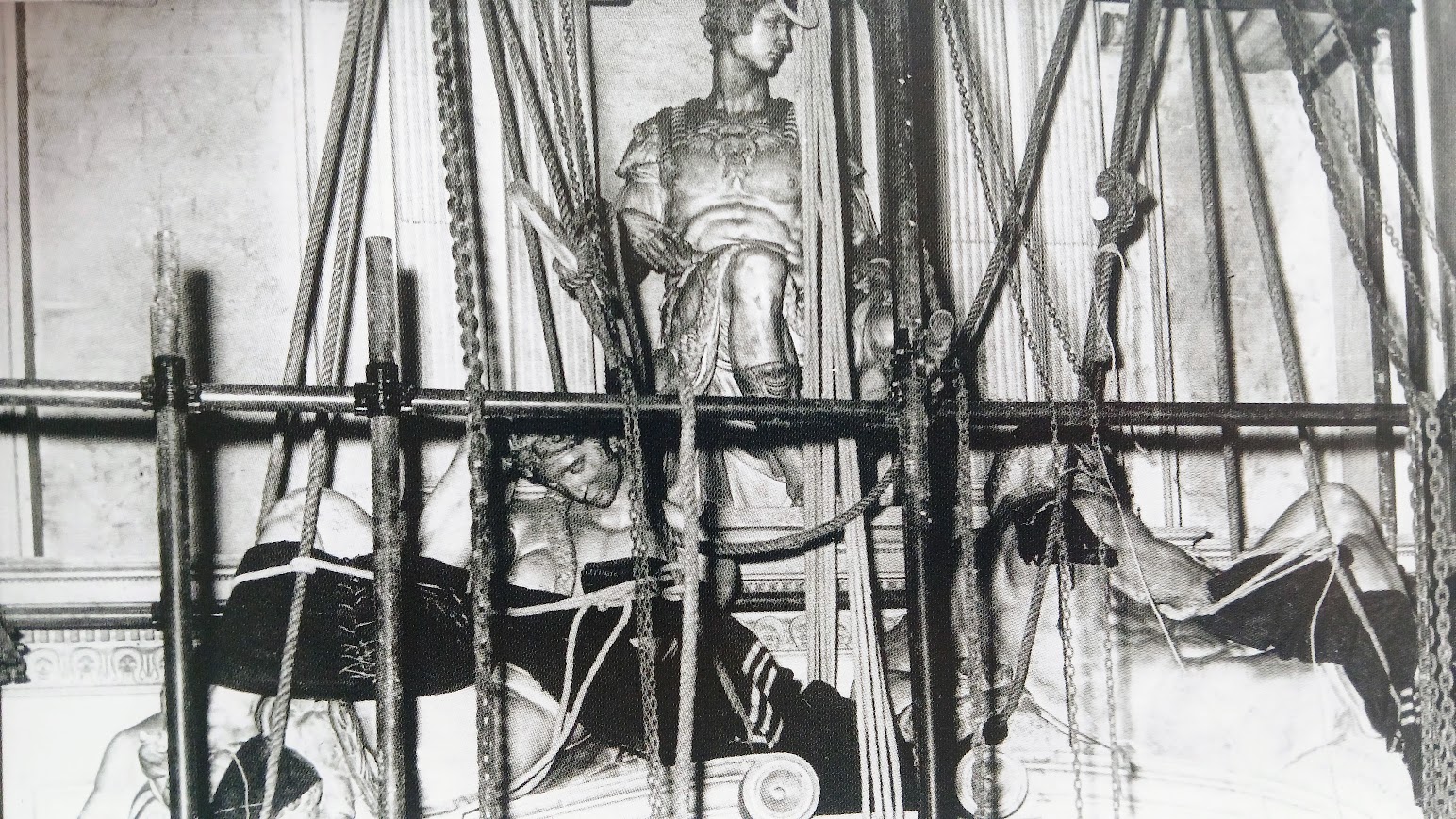
per realizzare la protezione ei sarcofagi e lo smontaggio delle sculture della Sagrestia Nuova nel 1940, con l’inizio della Seconda Guerra Mondiale

Firenze si prepara alla guerra: le prime protezioni per le opere d’arte
Nel 1938 Firenze aveva accolto per la prima volta Adolf Hitler. La città era stata preparata per l’occasione e le architetture del regime erano state affiancate ai monumenti restaurati, presentati come testimonianze di una rinnovata identità cittadina.
Tra gli interventi più recenti figurava proprio il complesso di San Lorenzo.
Ma il 10 giugno 1940 tutto cambiò. L’Italia entrò in guerra e a Firenze cominciarono immediatamente i preparativi per proteggere il patrimonio artistico dai possibili attacchi aerei.
Le autorità si organizzarono seguendo le indicazioni contenute in un manuale francese dedicato alla salvaguardia delle opere d’arte e le disposizioni del Ministero dell’Educazione Nazionale. Bisognava trovare il modo di difendere anche le grandi opere monumentali, quelle che non potevano essere semplicemente trasferite altrove.
A San Lorenzo furono adottate diverse misure di protezione. Le vetrate della Biblioteca Medicea Laurenziana vennero portate al riparo, mentre i pulpiti di Donatello furono protetti con sacchi di sabbia e strutture di legno.
Anche la Sagrestia Vecchia e la Sagrestia Nuova vennero interessate da questi interventi.

Le mie sculture nascoste dietro sacchi di sabbia e gabbie di legno
Fu proprio nella Sagrestia Nuova che fu adottata una misura particolarmente importante per la salvaguardia delle mie opere.
Le sculture vennero tolte dai sarcofagi, protette con sacchi di sabbia e sistemate all’interno di apposite gabbie di legno. Un sistema pensato per attutire eventuali urti e limitare i danni che un bombardamento avrebbe potuto provocare.
Immaginate per un momento la scena: la Notte, il Giorno, l’Aurora e il Crepuscolo, che avevo concepito come presenze destinate a dialogare con l’architettura della cappella e con le tombe dei Medici, venivano temporaneamente allontanati dalla loro collocazione.
La guerra minacciava ciò che generazioni di artisti, artigiani e uomini avevano costruito.

Le fotografie del 1939 e 1940: per la prima volta le sculture furono documentate da ogni angolazione
Lo smontaggio delle sculture offrì l’occasione per realizzare una campagna fotografica particolarmente completa.
Gli operatori degli Stabilimenti Brogi documentarono i marmi da ogni punto di vista, mentre Niccolò Cipriani, arrivato da poco al Gabinetto Fotografico della Soprintendenza, realizzò nell’agosto del 1939 due preziose autocromie, fotografie a colori ottenute attraverso un procedimento fotografico dell’epoca.
Cipriani sarebbe diventato il capo fotografo dell’istituzione e, tra il 1945 e il 1946, avrebbe realizzato una delle campagne fotografiche più importanti mai dedicate alla Sagrestia Nuova.
Quelle immagini hanno un valore enorme. Permettono di osservare dettagli normalmente difficili da raggiungere, documentano lo stato di conservazione dei marmi e degli apparati architettonici e costituiscono una testimonianza fondamentale della cappella prima dei restauri del Novecento.
Si tratta della documentazione fotografica più completa disponibile prima degli interventi di restauro degli anni successivi. Non a caso, queste fotografie furono utilizzate anche da Charles de Tolnay per i suoi fondamentali studi dedicati a San Lorenzo e alla mia opera.
Oggi le testimonianze fotografiche delle protezioni antiaeree sono conservate nel fondo fotografico delle Gallerie degli Uffizi, presso l’Archivio fotografico della Soprintendenza Archeologia, Belle Arti e Paesaggio a Palazzo Pitti.

Il 28 ottobre 1940 Hitler e Mussolini a Firenze
La guerra continuava ad avanzare e Firenze si trovò nuovamente al centro di una grande manifestazione politica. Il 28 ottobre 1940 Hitler e Mussolini arrivarono in città. Il Duce tenne un discorso in piazza della Signoria, davanti a una folla radunata per l’occasione.
Firenze appariva profondamente diversa dal solito. Monumenti, edifici e luoghi simbolo erano protetti e ingabbiati. La città aveva assunto un aspetto quasi irriconoscibile.
Nel frattempo proseguivano le operazioni per mettere al sicuro le opere d’arte mobili e proteggere quelle che non potevano essere spostate. Ma il pericolo sarebbe diventato sempre più concreto.

I bombardamenti del 1943 e del 1944: Firenze sotto attacco
L’11 settembre 1943 le truppe tedesche invasero Firenze. Pochi giorni dopo, il 25 settembre, un violento bombardamento alleato colpì la zona di Campo di Marte, seminando morte e distruzione.
La città avrebbe continuato a essere investita dai bombardamenti per tutto il 1944. Il 3 agosto di quell’anno le truppe tedesche si ritirarono, ma prima di lasciare Firenze minarono i ponti sull’Arno. Soltanto Ponte Vecchio venne risparmiato, mentre gli edifici e le strade che lo circondavano furono in gran parte distrutti per impedire l’avanzata degli Alleati.
Il 1° settembre 1944 il Comitato Toscano di Liberazione Nazionale assunse i poteri del governo provvisorio. Furono quindi eletti il sindaco Gaetano Pieraccini e il presidente della Deputazione provinciale Enzo Donatini.
Firenze cominciava lentamente a rialzarsi, ma il lavoro da compiere era immenso. C’era la necessità di ricostruire abitazioni, strade e ponti e occorreva restituire alla città i suoi monumenti.

San Lorenzo durante la guerra: la manutenzione non si fermò
Nonostante le difficoltà, anche durante il conflitto si cercò di proseguire con gli interventi di manutenzione del complesso laurenziano.
Una testimonianza particolarmente interessante è emersa durante gli ultimi restauri, quando sono state individuate alcune scritte sull’intonaco interno. Una di queste ricorda un intervento di spolveratura eseguito il 29 marzo 1940 da Ugo Campigli, Giulio Barbanti e Bertino Berti.
Non sappiamo con certezza se quell’operazione avesse interessato anche le sculture oppure soltanto gli apparati architettonici, ma la testimonianza dimostra che, nonostante la situazione internazionale, si continuava a occuparsi della conservazione del complesso.
Nel 1941, durante una riunione del Consiglio dell’Opera Medicea Laurenziana, l’ingegnere Piero Sanpaolesi comunicò inoltre che la Soprintendenza ai Monumenti aveva ricevuto un nuovo finanziamento per proseguire i lavori di restauro della parte esterna della cupola della Sagrestia Nuova.
Erano interventi importanti, che avrebbero però dovuto attendere la conclusione della guerra per essere portati avanti.
Il contrasto fra Opera Medicea Laurenziana e Soprintendenza
Durante il conflitto emerse anche una questione istituzionale relativa alla gestione dei restauri e alla tutela del complesso.
Nel 1942 si verificò infatti un contrasto tra il soprintendente Carlo Calzecchi Onesti e l’Opera Medicea Laurenziana, in particolare sulle competenze e sulle responsabilità riguardanti gli interventi di conservazione.
A ricomporre la situazione intervenne Giovanni Poggi, che ricordò le ragioni per le quali era nata l’Opera e il ruolo che aveva sempre svolto nella salvaguardia del complesso monumentale.
L’Opera Medicea Laurenziana era stata istituita con uno scopo preciso: restituire unità e decoro all’antico complesso, garantirne la conservazione e completare le parti rimaste incompiute.
Fin dalla sua istituzione si era avvalsa di un proprio architetto. Prima Giuseppe Castellucci e, dopo la sua morte, Guido Morozzi.Poggi sottolineò inoltre che l’Opera aveva sempre cercato di mantenere una collaborazione con la Soprintendenza, sottoponendo alla sua approvazione i progetti di restauro più importanti.
Alla fine si raggiunse un nuovo accordo. Guido Morozzi venne confermato architetto dell’Opera e suo padre, Ettore Morozzi, fu nominato assistente.

La ricostruzione dopo la guerra: i danni alla basilica di San Lorenzo
Terminata la guerra, Guido Morozzi fu tra i protagonisti della ricognizione dei danni subiti dal patrimonio monumentale fiorentino.
Redasse infatti l’elenco completo dei monumenti danneggiati dal conflitto, sulla base degli accertamenti effettuati fino al 30 giugno 1946. Per la basilica di San Lorenzo vennero registrati danni provocati da diverse cannonate durante la ritirata delle truppe tedesche, con conseguenze sulle coperture e sulle finestre.
È proprio in questo periodo che devono essere collocati gli infissi metallici presenti nelle finestre della Sagrestia Nuova e in altre parti della basilica.
I lavori di ripristino furono diretti dallo stesso Morozzi, che in seguito avrebbe assunto incarichi sempre più importanti nella Soprintendenza ai Monumenti, diventandone soprintendente dal 1964 al 1975.
La ricostruzione non riguardò soltanto le parti danneggiate dai combattimenti ma si cercò anche di completare gli interventi rimasti sospesi prima della guerra.
Tra questi vi era il pavimento della Cappella dei Principi, per il quale il Comune di Firenze stanziò diversi contributi a favore dell’Opera Medicea Laurenziana. Il progetto, avviato da Marchionni, arrivò a conclusione soltanto nel 1962.
Ognuno intervenne secondo le proprie possibilità e competenze, affrontando difficoltà economiche, questioni amministrative e un periodo storico estremamente complesso. Non fu un percorso semplice, ma questa collaborazione permise di mantenere in vita un patrimonio che appartiene non soltanto a Firenze, ma alla storia artistica dell’umanità.
Le mie sculture nella Sagrestia Nuova superarono così uno dei momenti più pericolosi della loro esistenza.
Dopotutto le opere d’arte attraversano i secoli, ma non sono invulnerabili. Hanno bisogno di uomini capaci di proteggerle, studiarle e prendersene cura.
Per il momento il sempre vostro Michelangelo Buonarroti vi saluta dandovi appuntamento ai prossimi post e sui social.
Florence and the Second World War: How My Sculptures in the New Sacristy Were Protected
When the war reached Florence, my sculptures, too, had to be brought to safety. In the New Sacristy of San Lorenzo—the very place where I had conceived and created some of the most significant works of my life—special protective measures were put in place to shield the marble from the threat of bombardment.
It was a dramatic episode, yet one that brought an unexpected positive outcome: for the first time, my sculptures were photographed from every angle, revealing details that usually remained hidden from the eyes of visitors.
Florence Prepares for War: Initial Protective Measures for Works of Art
In 1938, Florence hosted Adolf Hitler for the first time. The city had been prepared for the occasion, with the regime’s own architectural additions placed alongside restored monuments—all presented as symbols of a renewed civic identity.
Among the most recent restoration projects was the San Lorenzo complex itself.
But on June 10, 1940, everything changed. Italy entered the war, and preparations began immediately in Florence to safeguard the city’s artistic heritage against potential air raids.
The authorities organized their efforts by following guidelines from a French manual on the preservation of artworks, as well as directives issued by the Ministry of National Education. A way had to be found to protect even the great monumental works—those that could not simply be moved elsewhere.
At San Lorenzo, several protective measures were adopted. The stained-glass windows of the Laurentian Library were taken to safety, while Donatello’s pulpits were shielded with sandbags and wooden structures.
The Old Sacristy and the New Sacristy were also included in these protective efforts.
My sculptures hidden behind sandbags and wooden crates
It was in the New Sacristy (Sagrestia Nuova) that a particularly significant measure was taken to safeguard my works.
The sculptures were removed from their sarcophagi, protected with sandbags, and placed inside specially constructed wooden crates—a system designed to cushion against impacts and limit the damage that might be caused by a bombing.
Imagine the scene for a moment: Night, Day, Dawn, and Twilight—figures I had conceived to engage in a dialogue with the chapel’s architecture and the tombs of the Medici—were temporarily displaced from their original settings.
The war threatened everything that generations of artists, craftsmen, and people had built.
Photographs from 1939 and 1940: the sculptures documented from every angle for the first time
The dismantling of the sculptures provided an opportunity for a remarkably comprehensive photographic project.
Technicians from the Brogi firm documented the marbles from every perspective, while Niccolò Cipriani—who had recently joined the Superintendency’s Photographic Department—captured two invaluable autochromes in August 1939; these were early color photographs produced using a specific period technique.
Cipriani would go on to become the institution’s chief photographer, and between 1945 and 1946, he carried out one of the most significant photographic campaigns ever dedicated to the New Sacristy.
These images are of immense value. They allow for the observation of details that are otherwise difficult to access, document the state of preservation of the marbles and architectural elements, and serve as a vital record of the chapel as it appeared before the restorations of the 20th century. This constitutes the most complete photographic documentation available from before the restoration work carried out in subsequent years. It is no coincidence that these photographs were also used by Charles de Tolnay for his seminal studies on San Lorenzo and my own work.
Today, the photographic records of these anti-aircraft protective measures are held within the photographic collection of the Uffizi Galleries, housed at the Photographic Archive of the Superintendency for Archaeology, Fine Arts and Landscape at Palazzo Pitti.
October 28, 1940: Hitler and Mussolini in Florence
As the war pressed on, Florence once again found itself at the center of a major political event. On October 28, 1940, Hitler and Mussolini arrived in the city. The Duce delivered a speech in Piazza della Signoria before a crowd gathered for the occasion.
Florence appeared profoundly different from its usual self. Monuments, buildings, and iconic landmarks were shielded and encased in protective structures; the city had taken on an almost unrecognizable appearance.
Meanwhile, efforts continued to secure movable artworks and protect those that could not be relocated. Yet, the danger was destined to become increasingly real.
The Bombings of 1943 and 1944: Florence Under Attack
On September 11, 1943, German troops invaded Florence. A few days later, on September 25, a violent Allied bombing struck the Campo di Marte area, sowing death and destruction.
The city continued to be subjected to air raids throughout 1944. On August 3rd of that year, German troops withdrew, but before leaving Florence, they mined the bridges across the Arno. Only the Ponte Vecchio was spared, while the surrounding buildings and streets were largely destroyed to hinder the Allied advance.
On September 1, 1944, the Tuscan Committee of National Liberation assumed the powers of a provisional government. Gaetano Pieraccini was elected mayor, and Enzo Donatini was appointed president of the Provincial Deputation.
Florence began a slow recovery, but the task ahead was immense. Homes, roads, and bridges had to be rebuilt, and the city’s monuments had to be restored.
San Lorenzo during the war: maintenance continued
Despite the difficulties, efforts to carry out maintenance work on the San Lorenzo complex persisted even during the conflict.
A particularly interesting piece of evidence emerged during recent restoration work, when inscriptions were discovered on the interior plaster. One of these records a dusting operation carried out on March 29, 1940, by Ugo Campigli, Giulio Barbanti, and Bertino Berti.
While it is not certain whether this work included the sculptures or was limited to the architectural elements, the evidence shows that, despite the international situation, the preservation of the complex remained a priority. In 1941, during a meeting of the Council of the Opera Medicea Laurenziana, the engineer Piero Sanpaolesi announced that the Soprintendenza ai Monumenti (Superintendency for Monuments) had received new funding to continue restoration work on the exterior of the dome of the Sagrestia Nuova (New Sacristy).
These were significant interventions, though their execution would have to wait until the end of the war.
The conflict between the Opera Medicea Laurenziana and the Soprintendenza
During the conflict, an institutional issue also arose regarding the management of restoration work and the preservation of the complex.
In 1942, a dispute broke out between the Superintendent, Carlo Calzecchi Onesti, and the Opera Medicea Laurenziana, specifically concerning the scope of authority and responsibilities for conservation projects.
Giovanni Poggi intervened to resolve the situation, recalling the reasons for the Opera‘s founding and the role it had always played in safeguarding the monumental complex.
The Opera Medicea Laurenziana had been established with a precise purpose: to restore unity and decorum to the historic complex, ensure its preservation, and complete any unfinished sections.
From its inception, the Opera had employed its own architect—first Giuseppe Castellucci, and following his death, Guido Morozzi. Poggi further emphasized that the Opera had always sought to maintain a collaborative relationship with the Soprintendenza, submitting major restoration projects for its approval.
Ultimately, a new agreement was reached: Guido Morozzi was confirmed as the Opera‘s architect, and his father, Ettore Morozzi, was appointed as his assistant.
Post-war reconstruction: damage to the Basilica of San Lorenzo
Following the end of the war, Guido Morozzi played a key role in assessing the damage sustained by Florence’s monumental heritage. He compiled a comprehensive list of monuments damaged during the conflict, based on assessments conducted up to June 30, 1946. In the case of the Basilica of San Lorenzo, damage was recorded from several cannon blasts during the retreat of German troops, which affected the roof and the windows.
It is precisely to this period that the metal window frames found in the New Sacristy and other parts of the basilica can be dated.
The restoration work was directed by Morozzi himself, who would later go on to hold increasingly significant positions within the Superintendency for Monuments, serving as its superintendent from 1964 to 1975.
The reconstruction efforts addressed not only the areas damaged by the fighting but also sought to complete projects that had been left unfinished before the war.
Among these was the floor of the Chapel of the Princes, for which the Municipality of Florence provided various grants to the Opera Medicea Laurenziana. The project, initiated by Marchionni, was not brought to completion until 1962.
Everyone involved contributed according to their own means and expertise, navigating economic hardships, administrative challenges, and an exceptionally complex historical period. It was not an easy path, yet this collaboration ensured the survival of a heritage that belongs not only to Florence but to the artistic history of humanity.
Thus, my sculptures in the New Sacristy managed to survive one of their most perilous moments.

Sostienici – Support Us
Se questo blog ti piace e ti appassiona, puoi aiutarci a farlo crescere sempre più sostenendoci in modo concreto condividendo i post, seguendo le pagine social e con un contributo che ci aiuta ad andare avanti con il nostro lavoro di divulgazione. . ENGLISH: If you like and are passionate about this blog, you can help us make it grow more and more by supporting us in a concrete way by sharing posts, following social pages and with a contribution that helps us to move forward with our dissemination work.
10,00 €
Condividi:


Questo sono io





sostienici

Sostienici - Support Us
Se questo blog ti piace e ti appassiona, puoi aiutarci a farlo crescere sempre più sostenendoci in modo concreto condividendo i post, seguendo le pagine social e con un contributo che ci aiuta ad andare avanti con il nostro lavoro di divulgazione. . ENGLISH: If you like and are passionate about this blog, you can help us make it grow more and more by supporting us in a concrete way by sharing posts, following social pages and with a contribution that helps us to move forward with our dissemination work.
€10,00