
Il Carnevale di Viareggio porta il suo presepe in Vaticano: la Natività sulla spiaggia sarà inaugurata da Papa Leone XIV
Il Natale 2026 porterà in Vaticano un po’ di mare, di tradizione viareggina e soprattutto di quell’ingegno creativo che da generazioni anima i laboratori del Carnevale di Viareggio. Quest’anno, infatti, sarà proprio l’arte della cartapesta a raccontare la Natività nell’Aula Paolo VI, con un presepe che si allontana dalle ambientazioni più consuete per guardare verso il mare.
Si intitola ‘Custodire la luce‘ ed è l’opera realizzata da Edoardo Ceragioli, maestro carrista del Carnevale di Viareggio, che la Città di Viareggio donerà al Vaticano in occasione delle festività natalizie. Sarà Papa Leone XIV a inaugurare il presepe lunedì 7 dicembre 2026, durante l’Udienza Pontificia.
Il progetto è stato presentato alla Cittadella del Carnevale alla presenza di S.E.R. mons. Paolo Giulietti, Arcivescovo di Lucca, Alessandro Meciani, assessore alla Cultura della Città di Viareggio, e Riccardo Maria Monti, presidente della Fondazione Carnevale di Viareggio.
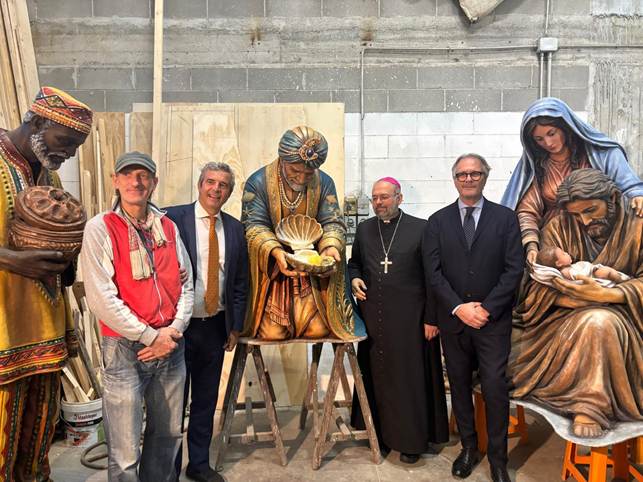
Una Natività sulla spiaggia, con la Sacra Famiglia in una vecchia barca
Nessuna capanna né un paesaggio agreste ispirato alla tradizione dei presepi italiani. La Natività immaginata da Ceragioli si svolge sulla spiaggia, in un paesaggio marino che racconta l’identità di Viareggio e il rapporto profondo della città con il mare.
Il riparo della Sacra Famiglia è un vecchio natante dismesso, una barca che ha probabilmente conosciuto tante stagioni e tante traversate e che, nella rappresentazione, si trasforma in un rifugio inatteso per Maria, Giuseppe e il Bambino.
Un’imbarcazione che ha terminato il proprio servizio diventa il luogo in cui nasce una nuova speranza. La fragilità di un riparo di fortuna incontra la forza di una luce destinata a non spegnersi.
Giuseppe, Maria e il Bambino: il significato di «Custodire la luce»
Al centro della composizione c’è Giuseppe, al quale l’artista affida un ruolo particolarmente importante. Rappresenta l’uomo contemporaneo chiamato a custodire, proteggere e sostenere ciò che è fragile.
La sua paternità viene raccontata come una presenza concreta e consapevole, fatta di cura, relazione e sacrificio. È l’uomo che si assume la responsabilità di proteggere la vita, anche quando le condizioni non sono semplici.
Maria si trova alle spalle di Giuseppe. Non domina la composizione, ma ne costituisce il cuore emotivo, sostenendo e accompagnando la famiglia con una presenza silenziosa e fondamentale.
I Re Magi diventano pescatori: i doni arrivano dal mare
I Re Magi vengono reinterpretati come pescatori e calafati, uomini che conoscono il mare e ne condividono fatiche, ritmi e risorse.
Anche i loro doni cambiano forma e significato. Non sono più soltanto oro, incenso e mirra, ma oggetti legati alla vita quotidiana di una comunità marinara.
La rete da pesca rappresenta la Comunità, la conchiglia richiama l’Accudimento, mentre i pesci diventano simbolo di Fertilità e Abbondanza.
Il mare diventa parte integrante del racconto e offre un linguaggio attraverso il quale parlare di solidarietà, cura e condivisione.
“La luce splende nelle tenebre”: il messaggio del presepe in Vaticano
La nascita di Gesù viene presentata come un invito a prendersi cura degli altri, a riconoscere la fragilità e a non sottrarsi alla responsabilità verso chi ha bisogno di protezione.
Ad accompagnare il presepe sono le parole del Vangelo di Giovanni: «La luce splende nelle tenebre e le tenebre non l’hanno vinta» (Gv 1,5).
Un messaggio che acquista un significato particolare in un momento storico nel quale le immagini di guerre, divisioni e sofferenze continuano a entrare quotidianamente nelle nostre case. La luce evocata dall’opera non è qualcosa da contemplare passivamente, ma una presenza da custodire attraverso gesti concreti.
Il presepe è realizzato con il contributo della Fondazione Cassa di Risparmio di Lucca.
Viareggio e Lucca, un legame che passa anche attraverso l’arte
La presenza del presepe in Vaticano assume un significato ulteriore perché si inserisce in un rapporto ormai consolidato tra l’Arcidiocesi di Lucca e il Carnevale di Viareggio. Un legame che quest’anno si intreccia anche con una ricorrenza importante: i trecento anni dell’Arcidiocesi di Lucca.
Negli ultimi anni la Cittadella del Carnevale ha ospitato anche la Via Crucis, un percorso di riflessione che ha riletto i temi affrontati dai maestri costruttori nelle loro opere allegoriche, mettendoli in relazione con le contraddizioni e le questioni del mondo contemporaneo.
Così, per il Natale 2026, sarà una barca sulla spiaggia a raccontare la nascita di Gesù. Un’immagine che porta con sé il mare di Viareggio, il lavoro dei suoi uomini e la creatività dei suoi maestri della cartapesta, dimostrando ancora una volta come un linguaggio artistico nato per il Carnevale possa farsi interprete di temi universali.
Per il momento il sempre vostro Michelangelo Buonarroti vi saluta dandovi appuntamento ai prossimi post e sui social.
The Viareggio Carnival brings its nativity scene to the Vatican: a Nativity on the beach to be inaugurated by Pope Leo XIV
Christmas 2026 will bring a touch of the seaside and the traditions of Viareggio to the Vatican—infused with the creative ingenuity that has fueled the workshops of the Viareggio Carnival for generations. This year, the art of papier-mâché will be used to depict the Nativity in the Paul VI Audience Hall, featuring a nativity scene that departs from conventional settings to look toward the sea.
Titled “Guarding the Light” (Custodire la luce), the work was created by Edoardo Ceragioli, a master float builder for the Viareggio Carnival. It will be gifted to the Vatican by the City of Viareggio for the Christmas season. Pope Leo XIV will inaugurate the nativity scene on Monday, December 7, 2026, during the Papal Audience.
The project was unveiled at the Cittadella del Carnevale (Carnival Citadel) in the presence of His Excellency Monsignor Paolo Giulietti, Archbishop of Lucca; Alessandro Meciani, Councilor for Culture for the City of Viareggio; and Riccardo Maria Monti, President of the Viareggio Carnival Foundation.
A Nativity on the beach, with the Holy Family in an old boat
There is no traditional stable or rural landscape typical of classic Italian nativity scenes. The Nativity envisioned by Ceragioli takes place on the beach, within a seascape that reflects the identity of Viareggio and the city’s profound connection to the sea.
The shelter for the Holy Family is an old, decommissioned vessel—a boat that has likely weathered many seasons and voyages—which, in this depiction, becomes an unexpected refuge for Mary, Joseph, and the Child. A vessel that has reached the end of its service becomes the setting for the birth of a new hope. The fragility of an improvised shelter meets the strength of a light destined never to be extinguished.
Joseph, Mary, and the Child: the meaning of “Safeguarding the Light”
At the center of the composition stands Joseph, to whom the artist assigns a particularly significant role. He represents the contemporary man, called upon to safeguard, protect, and support that which is fragile.
His fatherhood is portrayed as a concrete and conscious presence, defined by care, relationship, and sacrifice. He is the man who takes on the responsibility of protecting life, even when circumstances are far from simple.
Mary is positioned behind Joseph. While she does not dominate the composition, she serves as its emotional heart, supporting and accompanying the family through a silent yet essential presence.
The Magi become fishermen: gifts arriving from the sea
The Magi are reinterpreted as fishermen and shipwrights—men who know the sea and share in its hardships, rhythms, and resources.
Their gifts, too, take on new forms and meanings. They are no longer merely gold, frankincense, and myrrh, but objects rooted in the daily life of a seafaring community.
The fishing net represents the Community; the seashell evokes Nurturing; and the fish serve as symbols of Fertility and Abundance.
The sea becomes an integral part of the narrative, providing a language through which to speak of solidarity, care, and sharing.
“The light shines in the darkness”: the message of the Vatican Nativity scene
The birth of Jesus is presented as an invitation to care for others, to recognize fragility, and to embrace the responsibility toward those in need of protection. Accompanying the nativity scene are the words from the Gospel of John: “The light shines in the darkness, and the darkness has not overcome it” (John 1:5).
This message takes on a particular significance at a historical moment when images of war, division, and suffering continue to enter our homes daily. The light evoked by this work is not something to be contemplated passively, but a presence to be nurtured through concrete actions.
The nativity scene was created with the support of the Fondazione Cassa di Risparmio di Lucca.
Viareggio and Lucca: a bond forged through art
The presence of this nativity scene at the Vatican carries added meaning, as it stems from an established relationship between the Archdiocese of Lucca and the Viareggio Carnival—a connection that, this year, also coincides with an important milestone: the 300th anniversary of the Archdiocese of Lucca.
In recent years, the “Cittadella del Carnevale” (Carnival Citadel) has also hosted the Via Crucis (Stations of the Cross)—a journey of reflection that reinterpreted the themes explored by the master carnival-float builders in their allegorical works, linking them to the contradictions and challenges of the contemporary world.
Thus, for Christmas 2026, a boat on the beach will tell the story of the birth of Jesus. It is an image that carries with it the sea of Viareggio, the labor of its people, and the creativity of its papier-mâché masters—demonstrating, once again, how an artistic language born for Carnival can become a vehicle for universal themes.
For now, yours as always, Michelangelo Buonarroti, bids you farewell and I look forward to seeing you in future posts and on social media.
Sostienici – Support Us
Se questo blog ti piace e ti appassiona, puoi aiutarci a farlo crescere sempre più sostenendoci in modo concreto condividendo i post, seguendo le pagine social e con un contributo che ci aiuta ad andare avanti con il nostro lavoro di divulgazione. . ENGLISH: If you like and are passionate about this blog, you can help us make it grow more and more by supporting us in a concrete way by sharing posts, following social pages and with a contribution that helps us to move forward with our dissemination work.
10,00 €

Condividi:


Questo sono io



sostienici

Sostienici - Support Us
Se questo blog ti piace e ti appassiona, puoi aiutarci a farlo crescere sempre più sostenendoci in modo concreto condividendo i post, seguendo le pagine social e con un contributo che ci aiuta ad andare avanti con il nostro lavoro di divulgazione. . ENGLISH: If you like and are passionate about this blog, you can help us make it grow more and more by supporting us in a concrete way by sharing posts, following social pages and with a contribution that helps us to move forward with our dissemination work.
€10,00


