

Paul Dubois e il Cantore fiorentino: la scultura in bronzo argentato del 1865 che conquistò il pubblico
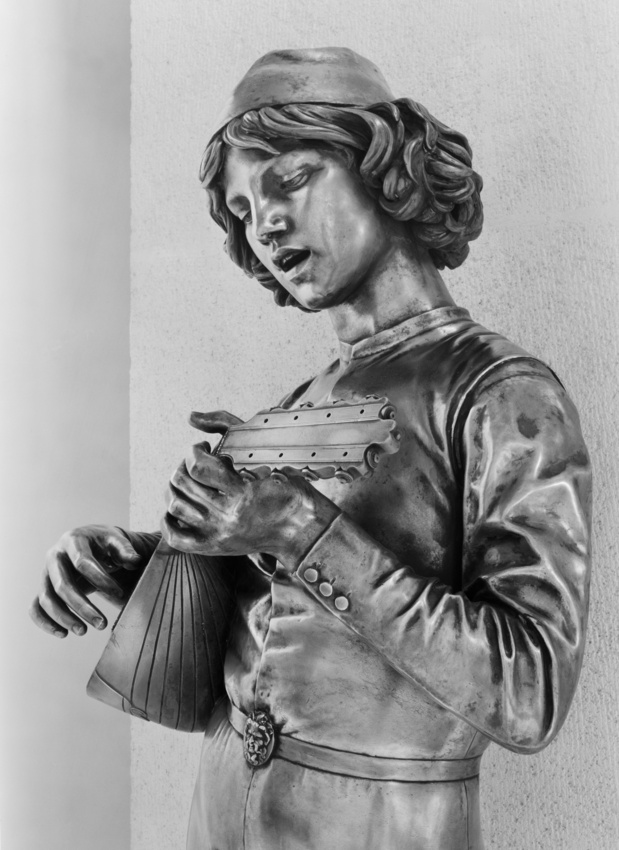
Un giovane musicista del Quattrocento, un abito elegante ricostruito fin nei minimi particolari e una superficie argentata che cattura la luce come un prezioso oggetto di oreficeria. È il Cantore fiorentino del Quattrocento, una delle opere più celebri dello scultore francese Paul Dubois, realizzata nel 1865.
Questa raffinata scultura in bronzo argentato racconta la sensibilità artistica dell’Ottocento e il fascino esercitato dal Rinascimento italiano sugli artisti europei.
Paul Dubois e il fascino del Rinascimento italiano
Nato nel 1829, Paul Dubois fu uno scultore francese profondamente influenzato dall’arte italiana. Il suo soggiorno in Italia rappresentò un momento importante nella formazione del suo linguaggio artistico, portandolo a guardare con particolare interesse alla scultura rinascimentale, alla sua eleganza formale e all‘attenzione riservata ai dettagli.
Al suo ritorno, Dubois sviluppò uno stile raffinato, nel quale la sensibilità ottocentesca si intrecciava con il recupero dei modelli quattrocenteschi.
È proprio in questo contesto che nacque il Cantore fiorentino del Quattrocento, opera presentata al Salon del 1865, dove ottenne la medaglia d’onore. Il successo fu immediato e particolarmente significativo: la scultura divenne una delle creazioni più apprezzate dell’epoca.
Il primo esemplare venne acquistato dalla principessa Matilde Bonaparte, figura di spicco della vita culturale del Secondo Impero francese, che animava uno dei più importanti salotti artistici e letterari di Parigi.
Un giovane musicista tra eleganza e precisione dei dettagli
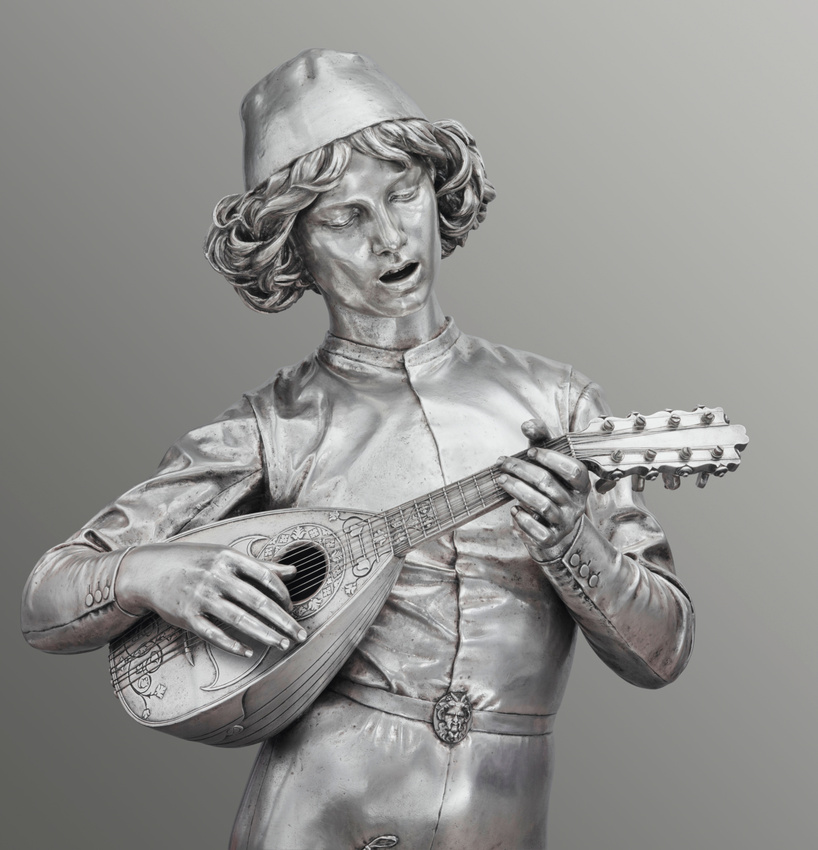
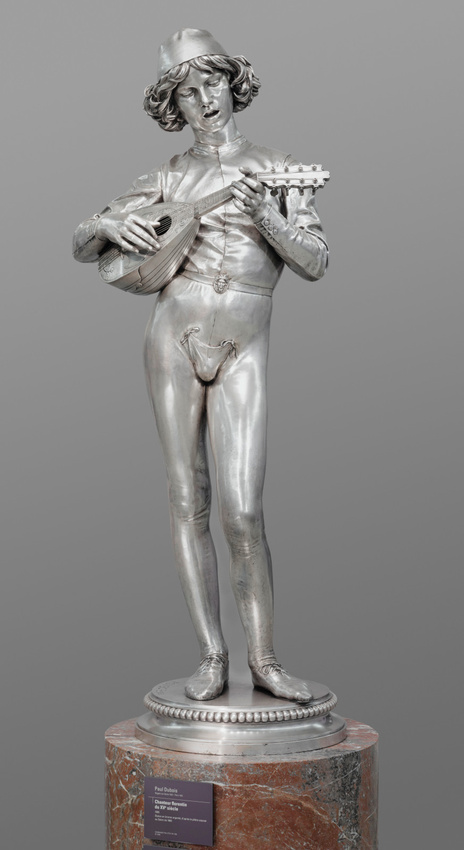
Il protagonista della scultura è un giovane cantore dall’aspetto gracile e aggraziato. La sua figura è slanciata, le gambe hanno forme morbide e levigate e l’intera composizione trasmette una sensazione di equilibrio e naturalezza.
A colpire, però, è soprattutto la straordinaria accuratezza con cui Paul Dubois ha restituito l’abbigliamento e gli accessori del personaggio.
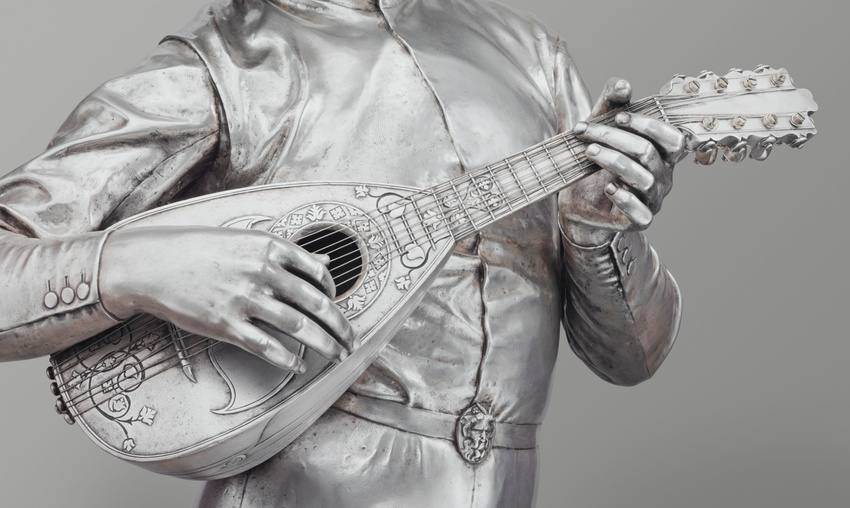
Lo sguardo si sofferma sui lacci delle calzature, sulle pieghe dei calzoni raccolti all’altezza delle ginocchia, sui piccoli bottoni delle maniche e sui particolari dello strumento musicale che il giovane porta con sé. Le corde e le chiavi sono modellate con una precisione sorprendente, così come la capigliatura, lavorata con una cesellatura minuziosa.
Ogni particolare contribuisce a restituire l’immagine di un musicista appartenente a un’altra epoca, evocando l’atmosfera delle corti e delle città italiane del Quattrocento.
Il bronzo argentato: quando la scultura incontra l’oreficeria
Dubois scelse di realizzare l’opera in bronzo argentato, una soluzione che conferisce alla superficie un aspetto prezioso e luminoso. La luce scivola sulle parti levigate, sottolinea i dettagli dell’abbigliamento e mette in risalto la lavorazione accurata degli accessori.
L’effetto è quello di un’opera a metà strada fra la scultura e l’oreficeria. Il metallo non viene utilizzato soltanto per dare forma al personaggio, ma diventa parte integrante della sua eleganza.
Una scultura che conquistò il pubblico per quasi un secolo
Il successo ottenuto al Salon del 1865 non rimase confinato agli ambienti artistici parigini. Il Cantore fiorentino ebbe una fortuna straordinaria anche presso il pubblico, tanto da essere riprodotto per quasi un secolo in diverse dimensioni dal celebre editore e fonditore Ferdinand Barbedienne.
La diffusione delle repliche contribuì a rendere l’opera una delle immagini più riconoscibili della scultura francese ispirata al Rinascimento italiano.
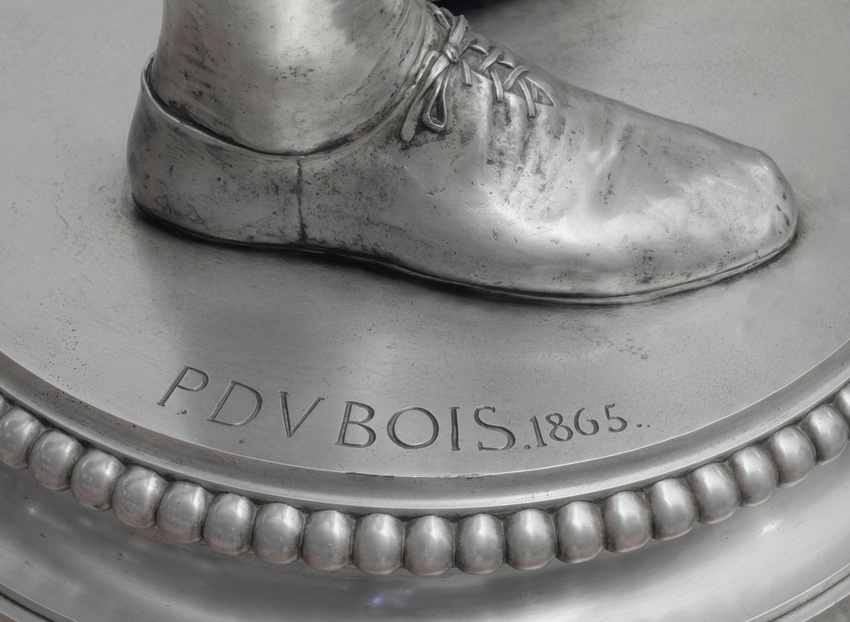
Quasi dimenticavo di dirvi che questo capolavoro appartiene al Musee d’Orsay di Parigi.
Per il momento il sempre vostro Michelangelo Buonarroti vi saluta dandovi appuntamento ai prossimi post e sui social.
Paul Dubois and the Florentine Singer: The 1865 Silvered Bronze Sculpture That Captivated the Public
A young musician from the fifteenth century, an elegant costume reconstructed down to the finest detail, and a silvered surface that catches the light like a precious piece of goldsmith’s work—this is the Florentine Singer (Cantore fiorentino), one of the most celebrated works by the French sculptor Paul Dubois, created in 1865.
This refined silvered bronze sculpture speaks to the artistic sensibilities of the nineteenth century and the enduring fascination that the Italian Renaissance held for European artists.
Paul Dubois and the Allure of the Italian Renaissance
Born in 1829, Paul Dubois was a French sculptor deeply influenced by Italian art. His time spent in Italy was a pivotal phase in the development of his artistic language, leading him to take a keen interest in Renaissance sculpture—specifically its formal elegance and meticulous attention to detail.
Upon his return, Dubois cultivated a sophisticated style in which nineteenth-century sensibilities were interwoven with a revival of fifteenth-century models.
It was against this backdrop that the Florentine Singer was conceived. The piece was presented at the 1865 Salon, where it was awarded the Medal of Honor. Its success was both immediate and significant, establishing the sculpture as one of the most highly regarded creations of the era.
The first cast was acquired by Princess Mathilde Bonaparte—a prominent figure in the cultural life of the French Second Empire, who hosted one of the most important artistic and literary salons in Paris.
A Young Musician: Elegance and Precision in Every Detail
The subject of the sculpture is a young singer, possessing a slender and graceful appearance. The figure is slender, with softly rounded, smooth limbs; the entire composition conveys a sense of balance and naturalness.
What is most striking, however, is the extraordinary precision with which Paul Dubois has rendered the character’s clothing and accessories.
The eye is drawn to the laces of his footwear, the folds of his breeches gathered at the knees, the small buttons on his sleeves, and the details of the musical instrument he carries. The strings and tuning pegs are modeled with astonishing accuracy, as is the hair, which is rendered with meticulous chasing.
Every detail helps to evoke a musician from another era, conjuring the atmosphere of the courts and cities of fifteenth-century Italy.
Silvered bronze: where sculpture meets the goldsmith’s art
Dubois chose to create the work in silvered bronze—a choice that lends the surface a precious, luminous quality. Light glides across the smooth areas, accentuating the details of the attire and highlighting the fine craftsmanship of the accessories.
The result is a work that sits somewhere between sculpture and the goldsmith’s art; the metal is not merely a means to give form to the figure, but an integral part of its elegance.
A sculpture that captivated the public for nearly a century
The success achieved at the 1865 Salon was not confined to Parisian artistic circles. The Florentine Singer (Le Chanteur florentin) enjoyed such extraordinary popularity with the general public that it was reproduced in various sizes for nearly a century by the renowned publisher and founder Ferdinand Barbedienne.
The widespread circulation of these replicas helped make the piece one of the most recognizable images in French sculpture inspired by the Italian Renaissance. I almost forgot to mention that this masterpiece belongs to the Musée d’Orsay in Paris.
For now, yours truly, Michelangelo Buonarroti, bids you farewell—see you in future posts and on social media.

Sostienici – Support Us
Se questo blog ti piace e ti appassiona, puoi aiutarci a farlo crescere sempre più sostenendoci in modo concreto condividendo i post, seguendo le pagine social e con un contributo che ci aiuta ad andare avanti con il nostro lavoro di divulgazione. . ENGLISH: If you like and are passionate about this blog, you can help us make it grow more and more by supporting us in a concrete way by sharing posts, following social pages and with a contribution that helps us to move forward with our dissemination work.
10,00 €

Condividi:


Questo sono io




sostienici

Sostienici - Support Us
Se questo blog ti piace e ti appassiona, puoi aiutarci a farlo crescere sempre più sostenendoci in modo concreto condividendo i post, seguendo le pagine social e con un contributo che ci aiuta ad andare avanti con il nostro lavoro di divulgazione. . ENGLISH: If you like and are passionate about this blog, you can help us make it grow more and more by supporting us in a concrete way by sharing posts, following social pages and with a contribution that helps us to move forward with our dissemination work.
€10,00


