
Cappella Sistina, il restauro cancellò parti della mia opera? Ecco quello che ho da dirvi
Puntuale come un orologio svizzero, torna in auge anche quest’anno una poco nuova e poco sensata polemica, per non dire anacronistica, sui miei affreschi che realizzai nella Cappella Sistina.
Ma dico io, del restauro degli affreschi quattrocenteschi non si interessa mai nessuno? Perché sempre quelli miei?
In fondo della Sistina fu restaurato anche il secondo registro ma a quanto pare, visto che i riquadri purtroppo sono meno noti al grande pubblico anche se realizzati da giganti della storia dell’arte, fa più clamore ogni volta tirare in ballo il restauro che interessò per 14 anni i miei lavori sistini.
Prima di puntare il dito sul capo restauratore Colalucci con il suo team e sugli esperti che realizzarono le indagini diagnostiche, bisognerebbe conoscere a menadito il lavoro e tutti i passaggi eseguiti in fase di restauro, senza guardare solamente incisioni o guardare foto del prima e del dopo.
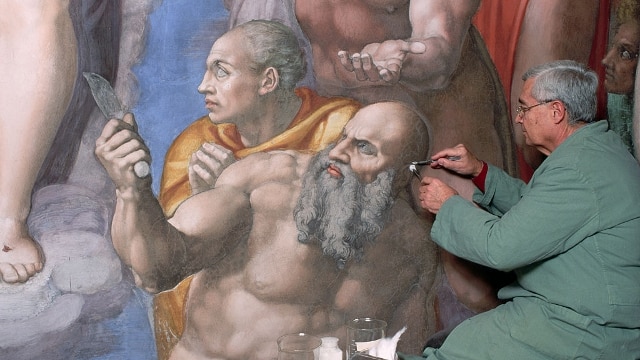
Facile vedere una foto di un mio brano pittorico adesso, metterla a confronto con un’immagine di prima della pulitura e dire che appaiono diverse senza tenere conto dei ritocchi eseguiti in epoche successive, dei restauri precedenti eseguiti per ovvie ragioni senza che fossero messi in campo i moderni criteri e di tutti i depositi che nel corso dei secoli si sono sedimentati sulla pellicola pittorica.
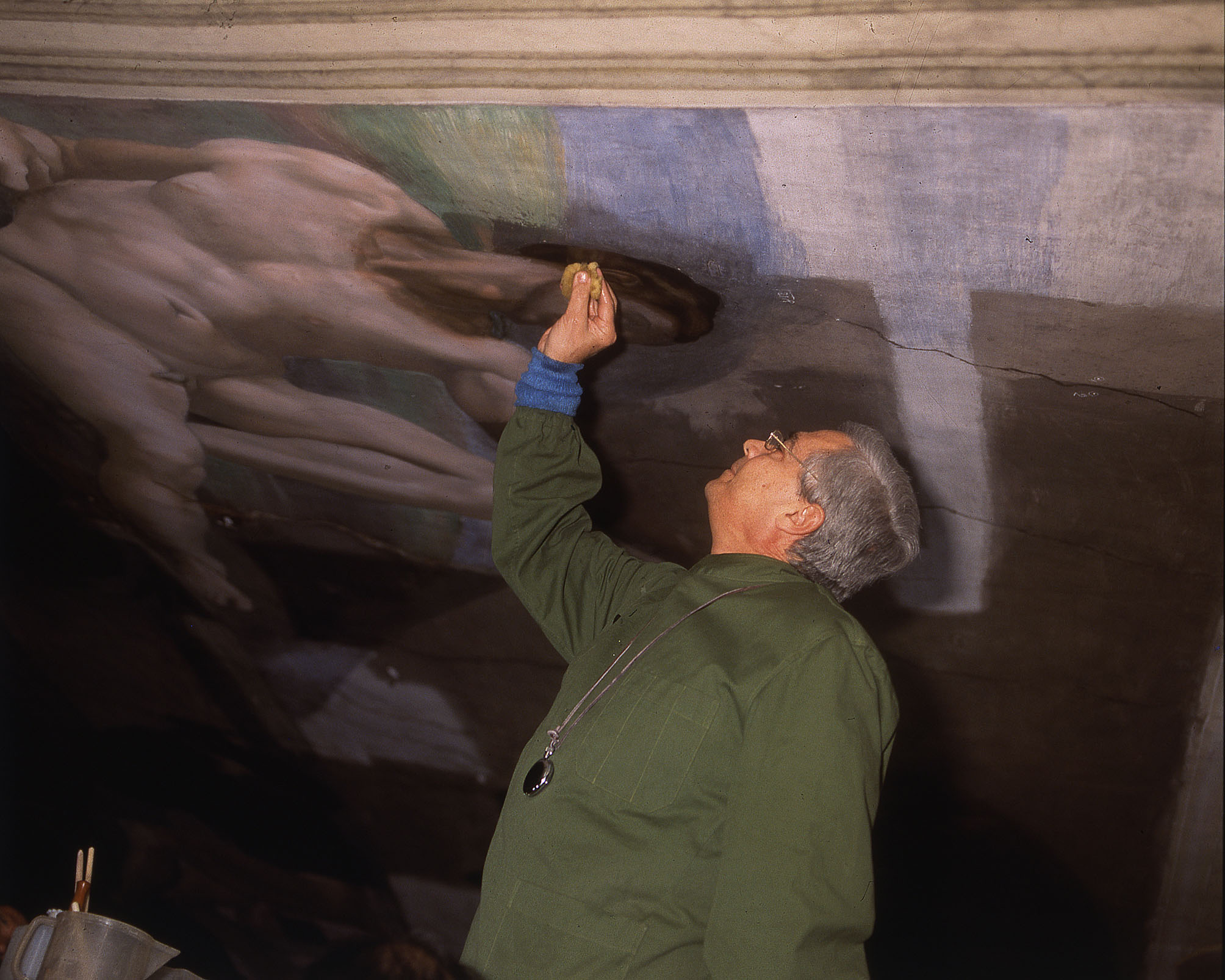
Il restauro realizzato tra il 1980 e il 1994 ha fatto scuola e, pur che ne dicano i detrattori, ha riportato alla luce i colori offuscati dai depositi, dalle colle animali alterati ed è stato fondamentale per consolidare la pellicola pittorica laddove presentava dei distacchi, controllare lo stato delle grappe e la salute degli affreschi.
Durante i restauri non ero fisicamente sui ponteggi per supportare quei grandi professionisti. Non potevo indicare con il dito una pennellata e dire: “Questa l’ho fatta io e questa è frutto di un ritocco successivo”. Non potevo spiegare se una certa ombra fosse uscita dal mio pennello, se una piega fosse stata aggiunta successivamente, se una velatura fosse mia oppure appartenesse a un restauratore venuto dopo di me.
Colalucci e tutto il suo team non avevano davanti ai loro occhi l’opera mia e basta ma un’opera realizzata cinque secoli prima, con tutti quei lustri di storia. Ecco perché, prima di intervenire, le indagini diagnostiche sono state lunghe e dettagliate, un po’ come avviene oggi su tutti i restauri.
Il restauro della Sistina non fu una semplice ‘pulitura’
Chi oggi guarda una fotografia degli affreschi prima e dopo il restauro potrebbe essere tentato di pensare che si sia trattato semplicemente di togliere lo sporco. Ecco, non fu così.
Il grande intervento diretto dal capo restauratore Gianluigi Colalucci fu un’impresa lunga e complessa, condotta dal personale interno dei Musei Vaticani e accompagnata da studi, verifiche, test e indagini scientifiche. Il restauro della volta e quello del Giudizio Universale si svilupparono nell’arco di quattordici anni.
Mi sorprende che ancora oggi, a distanza di decenni, si possa parlare di quelle operazioni come se i restauratori avessero preso pennelli e solventi e si fossero messi semplicemente a ‘ripulire Michelangelo’.
No.
Prima di toccare la mia pittura, quei restauratori dovettero capire che cosa avevano davanti.
Furono eseguiti test preliminari, furono studiate le condizioni delle superfici e furono utilizzati strumenti e competenze scientifiche che quand’ero ancora in vita naturalmente non esistevano. La diagnostica diventò parte integrante della conoscenza dell’opera e della scelta delle modalità d’intervento per tutti i restauri che seguirono nel resto del mondo.
Ciò che è stato non si cancella come se niente fosse con le supposizioni. Ci sono i fatti e poi ci sono fiumi di parole che lasciano il tempo che trovano.

Colalucci non lavorò contro di me: lavorò contro ciò che si era depositato sopra i miei affreschi
Per secoli sulla superficie degli affreschi si erano accumulati polvere, fumo, grassi, cere e materiali provenienti da precedenti interventi di manutenzione e restauro come le colle animali, oramai deteriorate.
Il risultato era una Cappella Sistina profondamente alterata nella percezione dei colori.
Il lavoro di Colalucci e di tutto il team permise di riportare alla luce una tavolozza molto più brillante di quella che il pubblico era abituato a vedere. Le indagini e la pulitura mostrarono, fra l’altro, quanto la superficie fosse stata modificata dai depositi e dai materiali applicati nel corso del tempo.
Finalmente i colori erano tornati a respirare. Il colore non è un ornamento secondario della mia pittura ma ne è parte fondamentale.
“Avete cancellato Michelangelo”: è davvero così semplice?
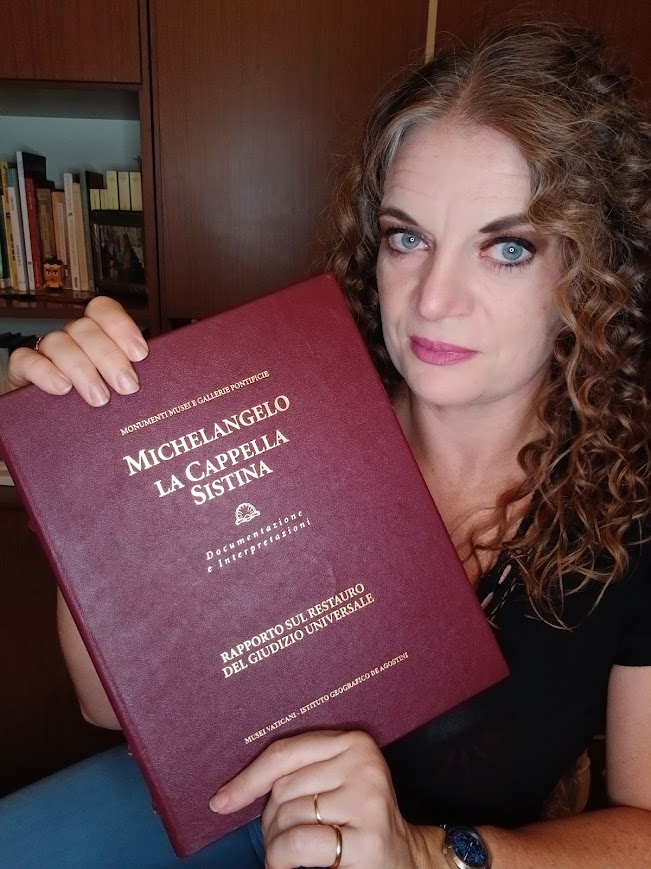
Una recente rilettura critica effettuata da tal Jessica Consalvi , riprendendo anche posizioni formulate in passato, sostiene che durante la pulitura possano essere state eliminate alcune parti eseguite da me a secco, cioè sull’intonaco asciutto, perché interpretate come ridipinture successive.
Fra gli esempi citati vengono ricordati alcuni dettagli dei panneggi del Profeta Zaccaria e differenze riscontrabili, secondo questa interpretazione, anche nella Sibilla Libica, nella Sibilla Eritrea e nel Profeta Daniele.
C’è una domanda preliminare alla quale bisogna rispondere: quelle parti che oggi non vediamo erano davvero mie?
Una fotografia antica può documentare che un particolare esisteva prima del restauro. Un’incisione può mostrare che un dettaglio era stato visto da un artista o da un incisore secoli prima. Ma nessuno di questi elementi, da solo, dimostra necessariamente che quel dettaglio fosse stato stato realizzato da me.
Esistenza antica non significa automaticamente autografia michelangiolesca. E questo dovrebbe essere il primo principio da ricordare quando si affronta una questione che non si può fermare al titolone gridato.
A detta di Consalvi, il restauro eseguito sotto la direzione dello storico dell’arte Fabrizio Mancinelli e del capo restauratore Gianluigi Colalucci, ha cancellato per sempre parti originali dipinte da me ovvero i dettagli dipinti a secco una volta asciugato l’intonaco dell’affresco.
Una bestemmia per chi conosce gli studi effettuati prima di eseguire il restauro sulla volta e sul Giudizio. Come vi ho accennato prima, perché si dibatte sempre delle presunte cancellazioni sui miei affreschi durante il restauro e mai si prendono in considerazione i cicli quattrocenteschi della Sistina?
Beh, il mio nome collegato soprattutto il Giudizio fanno più presa sull’opinione pubblica rispetto a un riquadro dipinto dal Signorelli, pur sublime che sia come quello del Testamento e morte di Mosè, realizzato dall’artista coadiuvato da Bartolomeo della Gatta, altro eccellente pittore.
Per distinguere ciò che appartiene alla fase originale da ciò che fu aggiunto successivamente è indispensabile avere una conoscenza approfondita dei materiali, della tecnica e della storia conservativa della superficie. I restauratori che misero mano agli affreschi della Sistina non ebbero la presunzione di sapere già la risposta prima ancora di cercarla attraverso gli strumenti disponibili.
Il lavoro di Colalucci e del suo staff fu accompagnato da una consistente attività scientifica e tecnica, e la letteratura sul restauro documenta un approccio nel quale analisi, prove preliminari e conoscenza dei materiali erano parte integrante del processo.
Io mi fiderei di chi ha studiato la mia pittura prima di toccarla
Nessuno di coloro che hanno messo mano ai miei affreschi della Cappella Sistina è arrivato lì casualmente. Tanto meno lo fu Colalucci, restauratore formatosi nella tradizione dell’Istituto Centrale del Restauro e allievo di Cesare Brandi, uno dei padri della moderna teoria del restauro.
E il risultato del suo lavoro fu talmente importante da modificare profondamente la percezione pubblica della pittura della Sistina.
Colalucci alle accuse non può più rispondere ma a parlare per lui continua il suo straordinario lavoro. Preziosa è la sua testimonianza diretta di quegli anni, raccolta nel libro Io e Michelangelo, nel quale raccontò il lungo cantiere della Sistina e le scoperte fatte durante il restauro.
Oggi, prima di formulare accuse definitive nei confronti di quel gruppo di restauratori, sarebbe necessario tornare proprio alle loro documentazioni, ai rapporti tecnici, alle analisi e alle pubblicazioni scientifiche. Non basta confrontare una fotografia del 1950 con una fotografia del 1995. Bisogna capire che cosa c’era fra quelle due fotografie.

Decenni di storia conservativa, restauri precedenti, materiali depositati, ridipinture, alterazioni, ci sono fenomeni chimici e fisici.
La diagnostica non è un semplice supporto tecnico. La scienza è un’importante strumento e no può non essere adoperato in questo settore.
Le analisi sui pigmenti, lo studio stratigrafico, la conoscenza dei materiali e delle tecniche esecutive possono contribuire a ricostruire la storia di una superficie pittorica e a distinguere, per quanto possibile, ciò che appartiene alla fase originaria da ciò che è stato aggiunto nel tempo.
Non venitemi a dire, senza prove definitive e soprattutto scientifiche, che chi ha lavorato per quattordici anni sulla mia pittura lo abbia fatto con superficialità.
So quanto sia stato affrescare nella Cappella Sistina e so quanto sia stato complesso restaurare quelle pitture.
Per questo, prima di puntare il dito su un lavoro del genere, è sempre meglio conoscere a menadito le indagini scientifiche che sono state condotte.
Mettere in discussione una scelta di restauro è legittimo; trasformare quella discussione nell’accusa di aver cancellato Michelangelo è un’altra cosa.
Impossibile dibattere con chi afferma “Il capo restauratore era molto confuso. Gli ho dovuto spiegare cosa avessero cancellato, che pena”. Non vi pare?
Per il momento il sempre vostro Michelangelo Buonarroti vi saluta dandovi appuntamento ai prossimi post e sui social.
Sistine Chapel: did the restoration erase parts of my work? Here is what I have to say.
With Swiss-watch precision, a new—and rather senseless, if not downright anachronistic—controversy has resurfaced this year regarding the frescoes I painted in the Sistine Chapel.
I ask you: does no one ever care about the restoration of the 15th-century frescoes? Why is it always mine that draw attention? After all, the second register of the Sistine Chapel was restored too; yet, it seems that—because those panels are unfortunately less known to the general public, despite being created by giants of art history—it causes a greater stir to bring up the restoration of my Sistine works, which lasted fourteen years.
Before pointing fingers at chief restorer Colalucci and his team, or at the experts who conducted the diagnostic analyses, one ought to know the work—and every step taken during the restoration—inside out, rather than simply looking at engravings or “before-and-after” photographs.
It is easy to look at a photo of a section of my painting today, compare it to an image from before the cleaning, and say they look different—without taking into account the retouching done in later eras, the earlier restorations (carried out, for obvious reasons, without regard for modern criteria), and all the deposits that accumulated on the paint surface over the centuries.
The restoration carried out between 1980 and 1994 set a benchmark. Whatever detractors may say, it brought back colors that had been obscured by deposits and altered animal glues; it was also crucial for consolidating the paint layer where it was detaching, and for checking the condition of the metal anchors and the overall health of the frescoes.
I was not physically present on the scaffolding during the restoration to support those great professionals. I couldn’t point a finger at a brushstroke and say, “I painted this one, while that one is the result of a later touch-up.” I couldn’t explain whether a particular shadow had come from my brush, if a fold had been added later, or if a glaze was mine or belonged to a restorer who came after me.
Colalucci and his entire team weren’t just looking at my work; they were looking at a masterpiece created five centuries earlier, bearing all those long years of history. That is why, before any work began, the diagnostic investigations were extensive and detailed—much like the proper restoration procedures followed today.
The restoration of the Sistine Chapel was not merely a ‘cleaning
Anyone looking at photographs of the frescoes from before and after the restoration might be tempted to think it was simply a matter of removing dirt. Well, that wasn’t the case.
The major project led by chief restorer Gianluigi Colalucci was a long and complex undertaking, carried out by the Vatican Museums’ own staff and accompanied by studies, verifications, tests, and scientific analyses. The restoration of the vault and The Last Judgment spanned fourteen years. It surprises me that, even decades later, people still speak of those operations as if the restorers had simply grabbed brushes and solvents and set about ‘cleaning up Michelangelo.’
No.
Before touching my paintings, those restorers had to understand exactly what lay before them.
Preliminary tests were conducted, surface conditions were studied, and scientific tools and expertise were employed—things that, naturally, did not exist while I was alive. Diagnostic analysis became an integral part of understanding the artwork and determining the restoration methods used for projects all over the world thereafter.
What actually happened cannot simply be erased by mere speculation. There are facts, and then there are rivers of words carried away by the wind. Colalucci did not work against me; he worked against what had settled upon my frescoes.
For centuries, dust, soot, grease, waxes, and materials from previous maintenance and restoration work—such as animal glues that had since deteriorated—had accumulated on the surface of the frescoes.
The result was a Sistine Chapel in which the perception of the colors was profoundly altered.
The work of Colalucci and the entire team made it possible to reveal a palette far more brilliant than the one the public was accustomed to seeing. Investigations and cleaning revealed, among other things, the extent to which the surface had been altered by deposits and materials applied over time.
At last, the colors could breathe again. Color is not a secondary ornament of my painting; it is a fundamental part of it.
“You have erased Michelangelo”—is it really that simple?
A recent critical re-examination by a certain Jessica Consalvi—echoing positions formulated in the past—argues that during the cleaning process, certain parts executed by me may have been removed that is, on the dry plaster—because they were interpreted as later overpaintings.
Among the examples cited are certain details of the drapery on the Prophet Zechariah, as well as differences observable—according to this interpretation—in the Libyan Sibyl, the Erythraean Sibyl, and the Prophet Daniel.
There is a preliminary question that must be answered: were those parts we do not see today truly mine?
An old photograph can document that a particular feature existed prior to the restoration. An engraving can show that a detail was observed by an artist or printmaker centuries earlier. Yet none of these elements, on its own, necessarily proves that the detail in question was painted by me.
The fact that something existed long ago does not automatically mean it is an autograph work by Michelangelo. This should be the first principle to bear in mind when addressing an issue that cannot simply be reduced to a sensational headline.
According to Consalvi, the restoration carried out under the direction of art historian Fabrizio Mancinelli and chief restorer Gianluigi Colalucci erased original parts painted by me—specifically, details executed a secco (on dry plaster) after the fresco’s plaster base had dried.
This is an outrage to anyone familiar with the studies conducted prior to the restoration of the Vault and the Last Judgment. As I mentioned earlier: why is there constant debate regarding alleged erasures on my frescoes during the restoration, yet the Sistine Chapel’s Quattrocento cycles are never taken into consideration?
Well, my name—and above all, the Last Judgment—captures the public imagination far more than a panel painted by Signorelli, however sublime it may be—such as the Testament and Death of Moses, created by that artist with the assistance of Bartolomeo della Gatta, another excellent painter.
It comes down to detail. That is why distinguishing between what belongs to the original phase and what was added later requires a profound understanding of the materials, the technique, and the conservation history of the surface. The restorers who worked on the Sistine Chapel frescoes did not presume to know the answer before even seeking it through the available tools.
The work of Colalucci and his team was accompanied by extensive scientific and technical activity; the literature on the restoration documents an approach in which analysis, preliminary testing, and knowledge of materials were integral parts of the process.
I would trust someone who studied my painting before touching it
None of those who worked on my Sistine frescoes arrived there by chance. This was certainly true of Colalucci, a restorer trained in the tradition of the Central Institute for Restoration and a student of Cesare Brandi—one of the fathers of modern restoration theory.
The result of his work was so significant that it profoundly altered public perception of the Sistine Chapel paintings.
Colalucci can no longer respond to accusations, but his extraordinary work continues to speak for him. His firsthand account of those years—captured in the book Io e Michelangelo (Me and Michelangelo), where he recounted the long restoration project and the discoveries made along the way—is invaluable.
Today, before leveling definitive accusations against that group of restorers, it is essential to revisit their documentation: technical reports, analyses, and scientific publications. Simply comparing a 1950 photograph with one from 1995 is not enough; one must understand what lies between those two images.
There are decades of conservation history, previous restorations, accumulated deposits, overpainting, alterations, and various chemical and physical phenomena.
Diagnostics are not merely a form of technical support. Science is a vital tool that simply cannot be ignored in this field.
Pigment analysis, stratigraphic studies, and knowledge of materials and execution techniques can help reconstruct the history of a painted surface and distinguish—as far as possible—between the original work and additions made over time. Do not try to tell me—without definitive, and above all scientific, proof—that those who spent fourteen years working on my paintings did so carelessly.
I know what it took to paint the frescoes in the Sistine Chapel, and I know how complex it was to restore those works.
That is why, before pointing fingers at a project of this nature, it is always best to be thoroughly familiar with the scientific investigations that were conducted.
Questioning a restoration decision is legitimate; turning that discussion into an accusation that Michelangelo was “erased” is quite another matter.
For now, yours truly, Michelangelo Buonarroti, bids you farewell and looks forward to seeing you in future posts and on social media.

Sostienici – Support Us
Se questo blog ti piace e ti appassiona, puoi aiutarci a farlo crescere sempre più sostenendoci in modo concreto condividendo i post, seguendo le pagine social e con un contributo che ci aiuta ad andare avanti con il nostro lavoro di divulgazione. . ENGLISH: If you like and are passionate about this blog, you can help us make it grow more and more by supporting us in a concrete way by sharing posts, following social pages and with a contribution that helps us to move forward with our dissemination work.
10,00 €
-
La donna morsa dal serpente nella Cappella Sistina
🇮🇹Quattro segni sul braccio. Nella volta della Cappella Sistina ho dipinto serpenti velenosi, corpi contorti e volti deformati dal terrore. Ma c’è un particolare che potrebbe sfuggirvi… 🇬🇧Four marks on the arm. On the ceiling of the Sistine Chapel, I painted venomous snakes, contorted bodies, and faces twisted by terror. But there is a detail…
-
Gian Lorenzo Bernini: l’uomo che fece muovere il marmo
🇮🇹Davanti a una scultura di Gian Lorenzo Bernini, capita di avvicinarsi per osservare un dettaglio e ritrovarsi a seguire con lo sguardo l’intera scena. Una mano stringe una coscia, un volto si volta per sfuggire a uno sguardo, le dita si trasformano in foglie… 🇬🇧When standing before a sculpture by Gian Lorenzo Bernini, you might…
-
L’Allegoria della Geometria di Prospero Fontana: il dipinto attribuito per errore a Jacopo Coppi
🇮🇹L’Allegoria della Geometria, attribuita un tempo a Jacopo Coppi, è stata restituita a Prospero Fontana: storia, significato e segreti del dipinto… 🇬🇧The Allegory of Geometry, once attributed to Jacopo Coppi, has been reattributed to Prospero Fontana: the history, meaning, and secrets of the painting…
Condividi:


Questo sono io




sostienici

Sostienici – Support Us
Se questo blog ti piace e ti appassiona, puoi aiutarci a farlo crescere sempre più sostenendoci in modo concreto condividendo i post, seguendo le pagine social e con un contributo che ci aiuta ad andare avanti con il nostro lavoro di divulgazione. . ENGLISH: If you like and are passionate about this blog, you can help us make it grow more and more by supporting us in a concrete way by sharing posts, following social pages and with a contribution that helps us to move forward with our dissemination work.
€10,00


Interessante, non sapevo di questi restauri 👌👌👍👍👏👏👏👏👏👏👏👏
"Mi piace"Piace a 1 persona