
18 luglio 1610, muore Caravaggio: gli ultimi giorni del genio che cambiò per sempre la storia dell’arte
Il 18 luglio 1610, in una piccola località della costa toscana affacciata sul Monte Argentario, si concluse una delle vite più straordinarie, tormentate e rivoluzionarie della storia dell’arte. Michelangelo Merisi, conosciuto universalmente come Caravaggio, morì a Porto Ercole a soli 39 anni, lontano dai fasti di Roma che lo avevano consacrato e dalle corti che avevano ammirato il suo genio.
La sua scomparsa passò quasi inosservata. Nessuna grande celebrazione, nessun corteo funebre degno dell’artista che oggi milioni di persone considerano uno dei più grandi pittori mai esistiti. Soltanto il silenzio di un uomo esausto, consumato dalle fughe, dalla malattia e da un destino che sembrava inseguirlo ovunque.

Eppure, quattro secoli dopo, Caravaggio continua a essere uno degli artisti più amati, studiati e ammirati al mondo. Le sue opere attirano ogni anno milioni di visitatori nei musei internazionali, mentre studiosi e storici dell’arte continuano a interrogarsi sulla sua vita, sulle sue inquietudini e soprattutto sugli ultimi giorni trascorsi prima della morte.
La parabola di Michelangelo Merisi appare ancora oggi incredibile. Riuscì a ribaltare completamente il modo di rappresentare la realtà, introducendo una pittura fatta di uomini veri, volti segnati dalla fatica, mani sporche, rughe profonde e una luce teatrale che trasformava ogni scena in un dramma umano.
Il suo nome è diventato sinonimo di rivoluzione. Nessun artista prima di lui aveva avuto il coraggio di eliminare ogni artificio idealizzato per mostrare la realtà nella sua forma più autentica. I santi avevano i piedi sporchi, gli apostoli sembravano popolani incontrati in una taverna romana e la Vergine poteva assumere le sembianze di una donna del popolo.
Fu proprio questa scelta radicale a renderlo immortale.

Milano, il luogo dove iniziò la storia di Caravaggio
Per molto tempo si credette che Michelangelo Merisi fosse nato nella cittadina di Caravaggio, in provincia di Bergamo, tanto da attribuirgli il soprannome con cui è entrato nella storia. Soltanto nel Novecento il ritrovamento dell’atto di battesimo chiarì definitivamente le sue origini.
Caravaggio nacque infatti a Milano il 29 settembre 1571, giorno dedicato a san Michele Arcangelo, da cui probabilmente prese il nome Michelangelo. La famiglia apparteneva a una condizione sociale tutt’altro che misera. Il padre Fermo Merisi lavorava come maestro muratore e amministratore per il marchese di Caravaggio Francesco Sforza Colonna, mentre la madre Lucia Aratori proveniva da una famiglia ben inserita nella società lombarda.
Il destino del piccolo Michelangelo cambiò radicalmente quando la peste colpì Milano nel 1576. Come molte famiglie dell’epoca, anche i Merisi lasciarono la città cercando rifugio proprio nel borgo di Caravaggio. La speranza era sfuggire al contagio, ma il morbo si rivelò implacabile.
Nel giro di pochi anni morirono il padre, il nonno e diversi parenti stretti. Michelangelo crebbe così in un clima segnato dalla perdita e dalla precarietà, esperienze che molti studiosi ritengono abbiano inciso profondamente sulla sua sensibilità artistica.
La morte, il dolore e la fragilità dell’esistenza diventeranno infatti temi costanti nella sua produzione pittorica.
L’apprendistato che formò un genio
A tredici anni Michelangelo entrò nella bottega del pittore Simone Peterzano, artista veneziano che si vantava di essere stato allievo di Tiziano.
Fu un apprendistato fondamentale. Peterzano insegnò al giovane Merisi le basi del disegno, della preparazione delle tele, dell’uso dei pigmenti e delle tecniche pittoriche allora più avanzate.
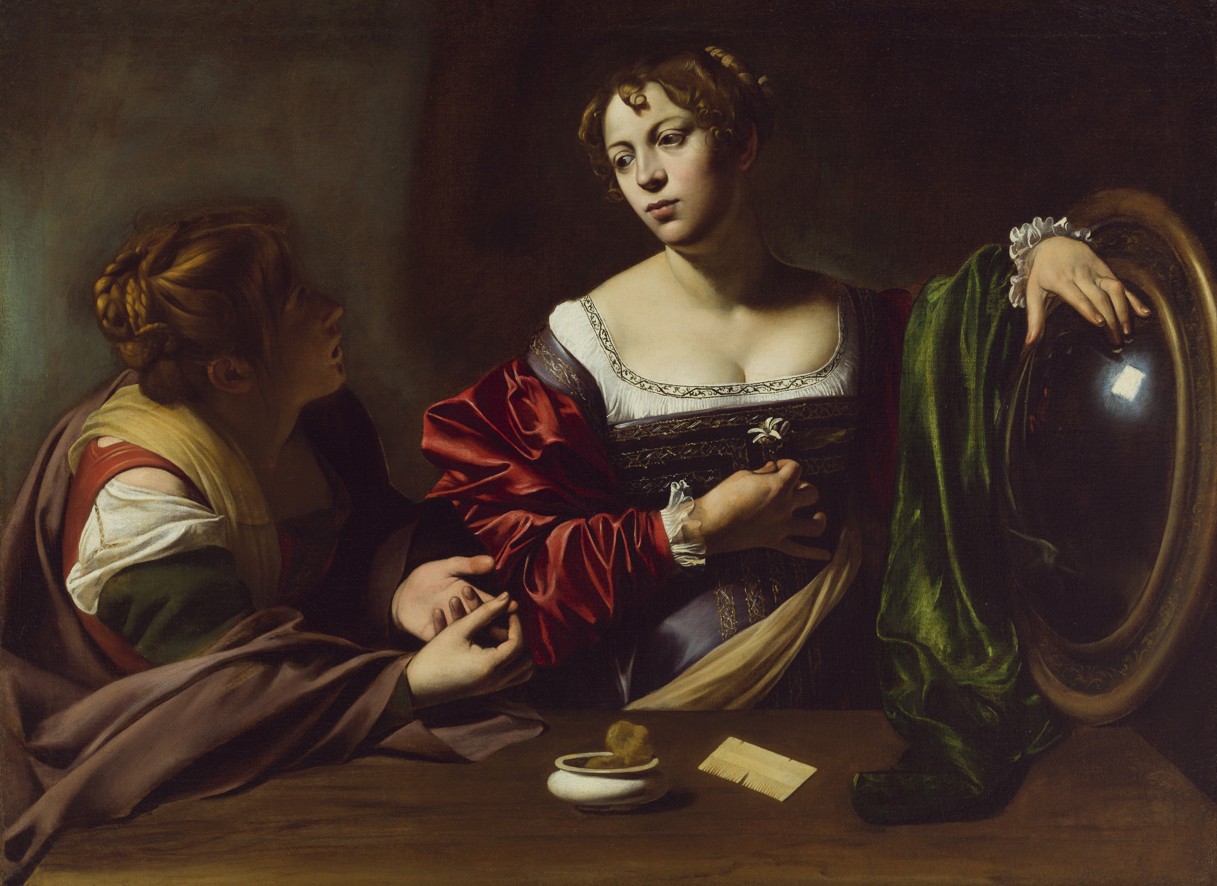
Ma Caravaggio mostrò fin da subito un carattere indipendente. Più che copiare gli schemi tradizionali, osservava con attenzione il mondo reale. Le persone comuni lo affascinavano molto più delle figure idealizzate.
I mercanti, gli artigiani, i contadini, i mendicanti e i ragazzi incontrati nelle strade sarebbero diventati negli anni successivi i protagonisti assoluti delle sue tele.
Anche la Lombardia contribuì enormemente alla sua formazione. La pittura lombarda del secondo Cinquecento era infatti caratterizzata da un forte naturalismo, da una ricerca della realtà quotidiana che avrebbe trovato in Caravaggio il suo interprete più rivoluzionario.
Roma, la città che cambiò il destino di Michelangelo Merisi
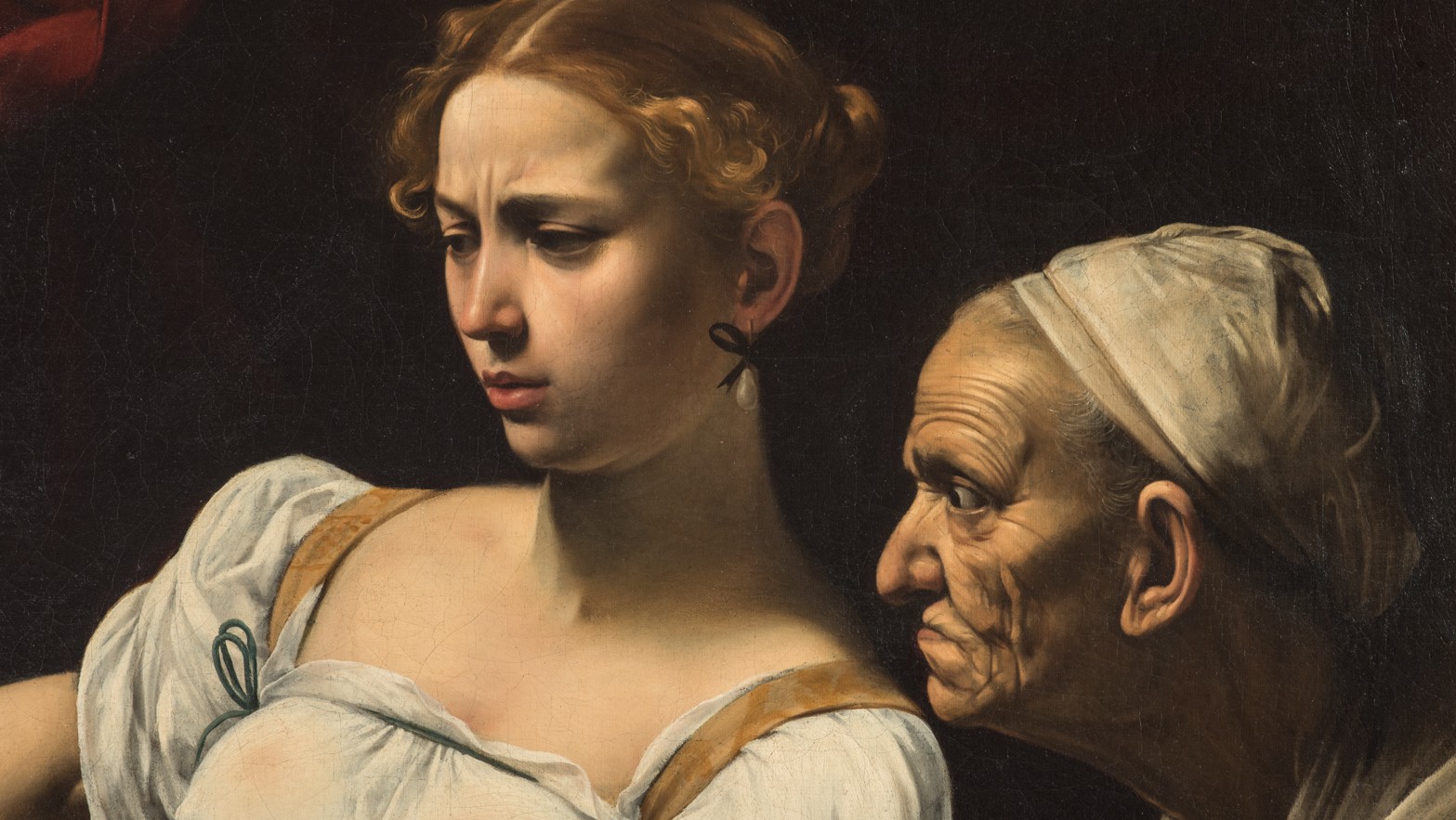
Intorno al 1592 il giovane pittore decise di lasciare definitivamente la Lombardia per raggiungere Roma.
La capitale dello Stato Pontificio era il centro artistico più importante d’Europa. Qui lavoravano i migliori architetti, gli scultori più celebri e i pittori destinati a decorare chiese, palazzi cardinalizi e residenze nobiliari.
Ma per Caravaggio l’arrivo nella Città Eterna fu tutt’altro che semplice. Privo di denaro e senza protezioni importanti, visse mesi difficilissimi.
Dormiva dove poteva, cambiava continuamente alloggio e cercava piccoli lavori presso botteghe già avviate. Le fonti raccontano di un giovane spesso affamato, costretto a dipingere rapidamente quadri destinati al mercato privato.
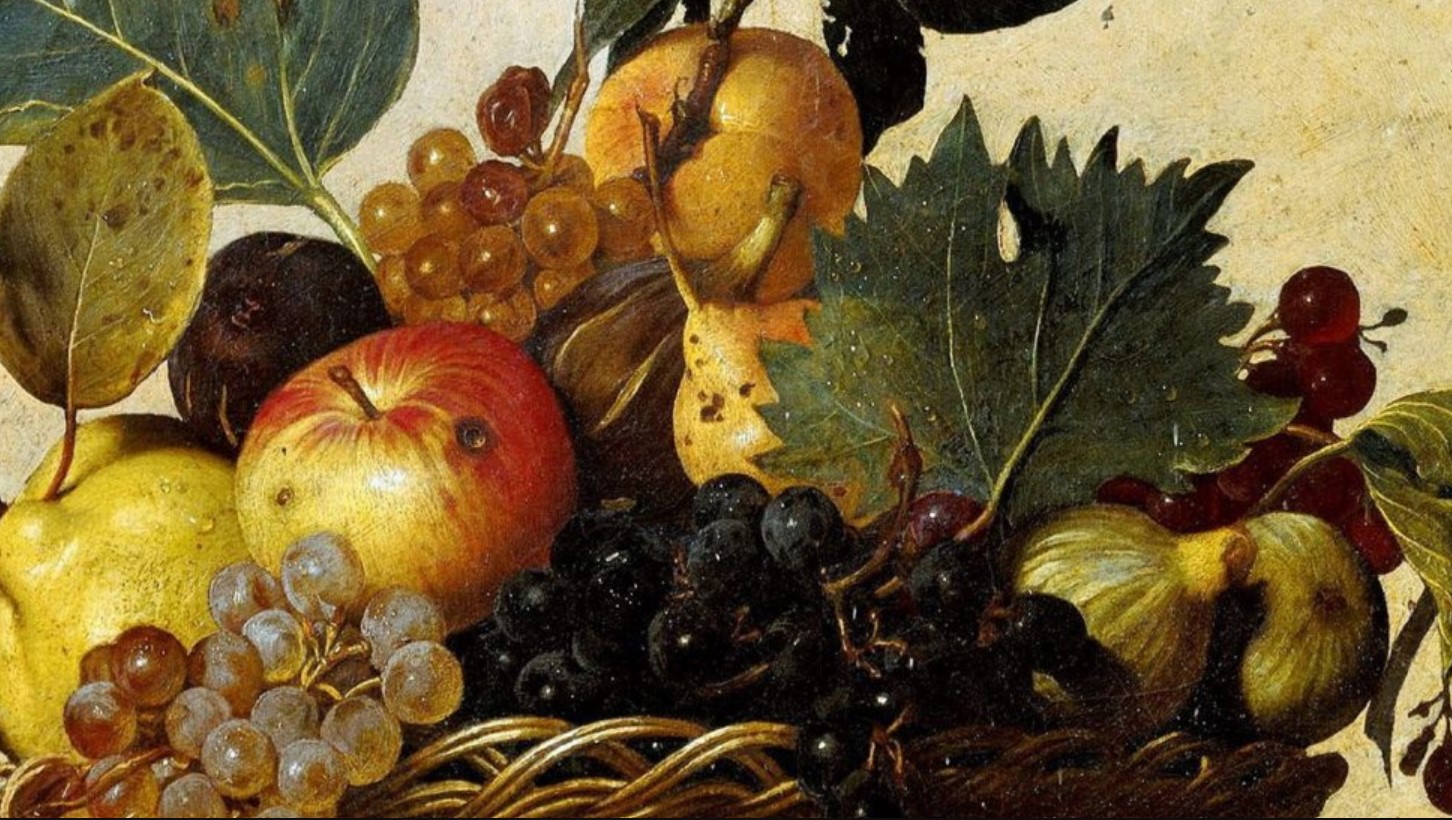
Realizzava soprattutto nature morte, fiori e mezze figure di ragazzi musicisti o venditori ambulanti. Nonostante le difficoltà economiche, quelle opere dimostravano già un talento fuori dal comune.

Il Bacchino malato: il primo capolavoro che racconta il dolore
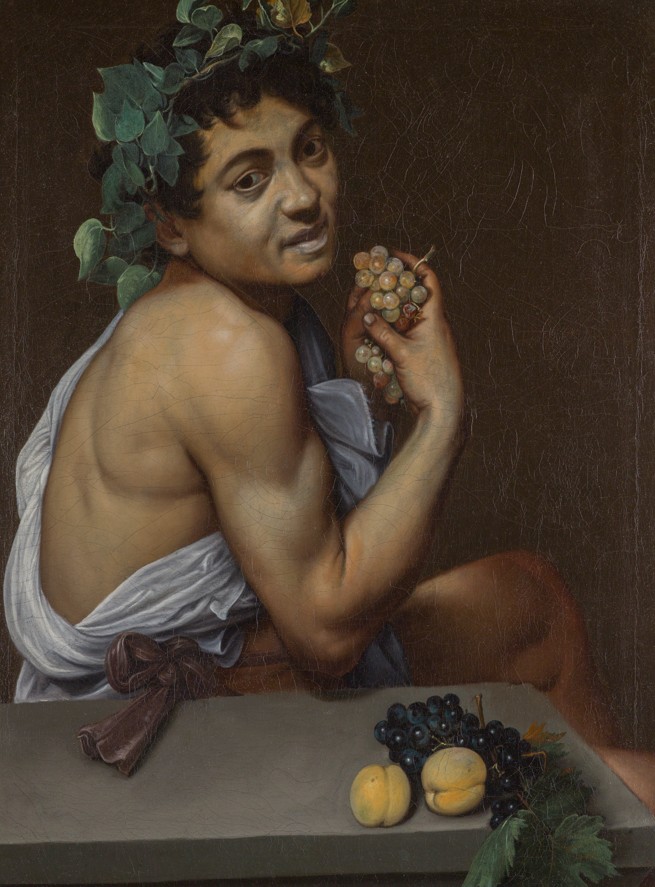
Tra le opere più celebri di questo primo periodo romano spicca il Bacchino malato, oggi custodito alla Galleria Borghese di Roma.
Il dipinto rappresenta un giovane Bacco dal volto pallido, con labbra livide e uno sguardo stanco che sembra tradire una profonda sofferenza fisica.
Molti storici dell’arte ritengono che si tratti di un autoritratto realizzato mentre Caravaggio era ricoverato all’Ospedale della Consolazione, probabilmente dopo aver contratto la malaria o in seguito a un grave incidente causato dal calcio di un cavallo. Qualunque sia stata la causa, quell’immagine racconta qualcosa di completamente nuovo.
Non esiste alcuna idealizzazione della figura mitologica. Bacco appare fragile, malato. La pelle non è perfetta, le mani mostrano tensione, il volto rivela stanchezza.
Caravaggio sembra voler affermare che perfino gli dèi possono conoscere la sofferenza. È una dichiarazione poetica destinata a cambiare per sempre la pittura occidentale.
Una rivoluzione che nasce dall’osservazione della realtà
Mentre molti artisti continuavano a ispirarsi ai modelli classici, Caravaggio sceglieva la strada opposta.
Non amava disegnare preparatori. Preferiva mettere il modello davanti alla tela, osservare attentamente la luce che cadeva sul volto e iniziare direttamente a dipingere.
Questa tecnica conferiva alle sue figure una presenza straordinariamente reale. Ogni ruga, ogni vena della mano, ogni piega dell’abito sembrava appartenere a persone vive.
Era una rivoluzione assoluta. Non interessava rappresentare un’idea astratta di bellezza. L’obiettivo era raccontare l’essere umano con tutte le sue imperfezioni.
Le strade di Roma diventano il suo atelier
La vera fonte d’ispirazione di Caravaggio non erano le corti aristocratiche ma le strade della città. Passeggiava nei quartieri popolari, frequentava le taverne, osservava mendicanti, soldati, musicisti e prostitute.
Erano loro i protagonisti delle sue tele e molti contemporanei rimasero scandalizzati.
Come poteva un santo avere il volto di un popolano? Come poteva la Madonna assomigliare a una donna incontrata lungo il Tevere? Per Caravaggio non esisteva alcuna contraddizione. Anzi, proprio quella scelta rendeva il messaggio religioso ancora più potente.
La santità non apparteneva a esseri irraggiungibili, ma agli uomini e alle donne comuni. Era una visione profondamente innovativa che anticipava una sensibilità moderna.

Il talento che iniziava a farsi notare
Ben presto alcuni collezionisti romani iniziarono ad accorgersi del giovane lombardo. Tra questi vi fu il mercante d’arte Costantino Spata, seguito da personaggi sempre più influenti che rimasero colpiti dalla forza narrativa delle sue opere.
La fama cresceva lentamente, ma era evidente che quel pittore possedeva qualcosa di diverso. La luce sembrava provenire da un teatro invisibile. Le emozioni erano autentiche.
I personaggi sembravano uscire dalla tela.
Ogni quadro raccontava una storia che lo spettatore poteva quasi toccare. Nessuno immaginava che di lì a poco un incontro avrebbe cambiato completamente il destino del giovane Michelangelo Merisi.
Sarebbe bastato un dipinto, realizzato intorno al 1595, per spalancargli le porte delle più importanti committenze romane. Quel dipinto si intitolava I Bari e avrebbe segnato l’inizio della leggenda di Caravaggio.

L’incontro con il cardinale Del Monte, il successo delle grandi commissioni e la rivoluzione del chiaroscuro
Se i primi anni romani furono segnati dalla povertà e dall’incertezza, la seconda metà degli anni Novanta del Cinquecento rappresentò per Michelangelo Merisi una svolta destinata a cambiare il corso della sua esistenza e, insieme, quello della storia della pittura. Bastò un’opera, apparentemente semplice nella composizione ma straordinaria nella sua capacità narrativa, per attirare l’attenzione di uno degli uomini più influenti della Roma pontificia.
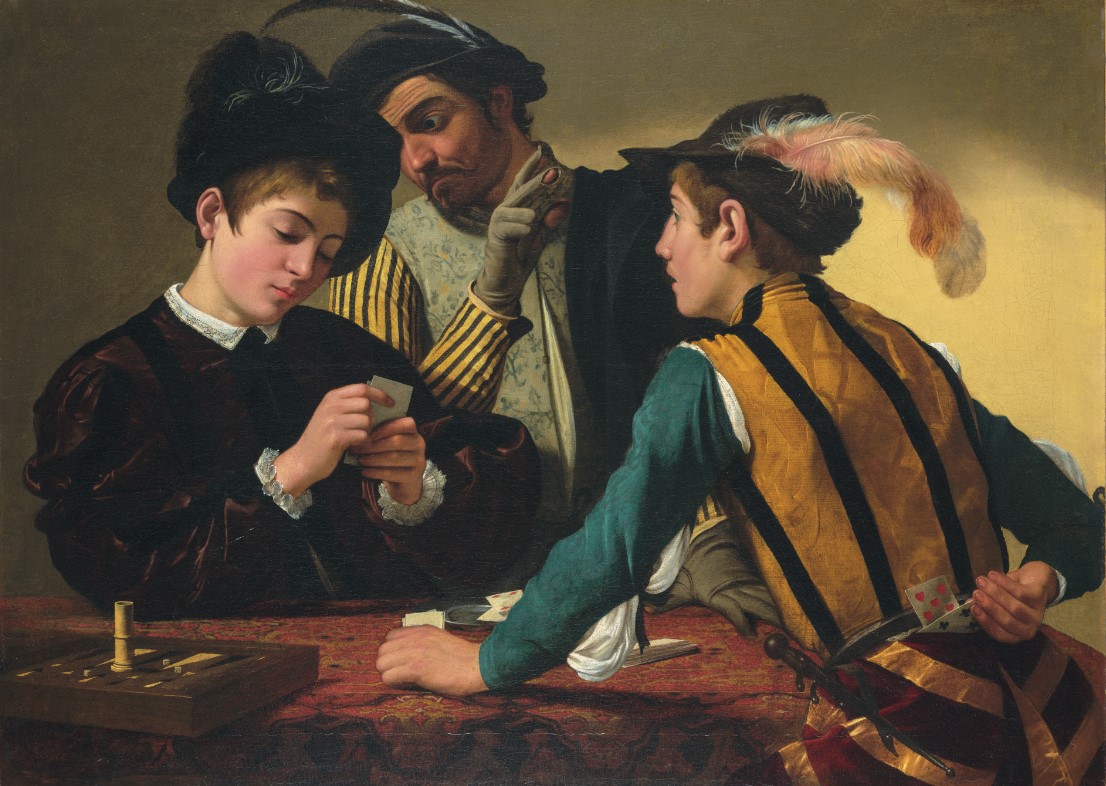
Quel dipinto era I Bari, realizzato intorno al 1595. Ancora oggi è considerato uno dei manifesti della pittura caravaggesca perché racchiude già tutti gli elementi che renderanno celebre il maestro lombardo: il naturalismo, la tensione psicologica, la luce drammatica e la capacità di trasformare una scena quotidiana in un racconto universale.
“I Bari”: il dipinto che aprì a Caravaggio le porte della grande pittura
A prima vista la scena sembra rappresentare un semplice gioco di carte. Due giovani siedono uno di fronte all’altro mentre un terzo personaggio, leggermente più anziano, osserva la partita alle spalle del ragazzo ingenuo.
Lo spettatore comprende immediatamente ciò che sta accadendo.
Il giovane elegante che guarda le proprie carte è la vittima inconsapevole di una truffa. L’altro giocatore riceve infatti l’aiuto del complice, che estrae furtivamente alcune carte nascoste dietro la schiena.
È un momento sospeso, quasi cinematografico.
La tensione cresce proprio perché chi osserva conosce la verità mentre il protagonista della scena continua a giocare ignaro del raggiro. Con questo dipinto Caravaggio dimostrò qualcosa di completamente nuovo: non era interessato soltanto alla bellezza della composizione, ma voleva coinvolgere emotivamente chi guardava il quadro.
Ogni dettaglio contribuisce alla narrazione. Le espressioni dei volti, i gesti delle mani, gli sguardi complici, il raffinato abbigliamento dei giovani e perfino il modo in cui la luce illumina le figure trasformano una semplice scena di genere in un racconto di straordinaria intensità.
La luce entra lateralmente, provenendo da sinistra, e scolpisce i corpi come farebbe un riflettore teatrale. Non esistono elementi superflui e ogni particolare è funzionale alla storia.
Proprio con I Bari che nasce una nuova concezione della pittura europea.
Kimbell Art Museum, Fort Worth, Texas
L’incontro decisivo con il cardinale Francesco Maria Del Monte
Il successo del dipinto attirò l’attenzione del cardinale Francesco Maria Del Monte, raffinato collezionista, diplomatico e grande appassionato d’arte. Fu un incontro destinato a cambiare radicalmente la vita dell’artista.
Del Monte comprese immediatamente di trovarsi davanti a un talento eccezionale e decise di offrirgli protezione, ospitalità e soprattutto la possibilità di lavorare senza l’assillo della miseria.
Caravaggio si trasferì nel prestigioso Palazzo Madama, allora residenza del cardinale. Per il pittore significò entrare in un ambiente culturalmente vivacissimo, frequentato da musicisti, filosofi, letterati, scienziati e importanti esponenti della Curia romana.
Per la prima volta nella sua vita non doveva preoccuparsi esclusivamente di sopravvivere: poteva dedicarsi completamente alla pittura.
Fu proprio in questi anni che il suo stile raggiunse una maturità sorprendente.
Il naturalismo diventa una rivoluzione artistica
Nella Roma della Controriforma la pittura religiosa seguiva regole molto precise. I santi erano rappresentati come figure idealizzate, eleganti e quasi irraggiungibili. Caravaggio ruppe completamente questo schema.
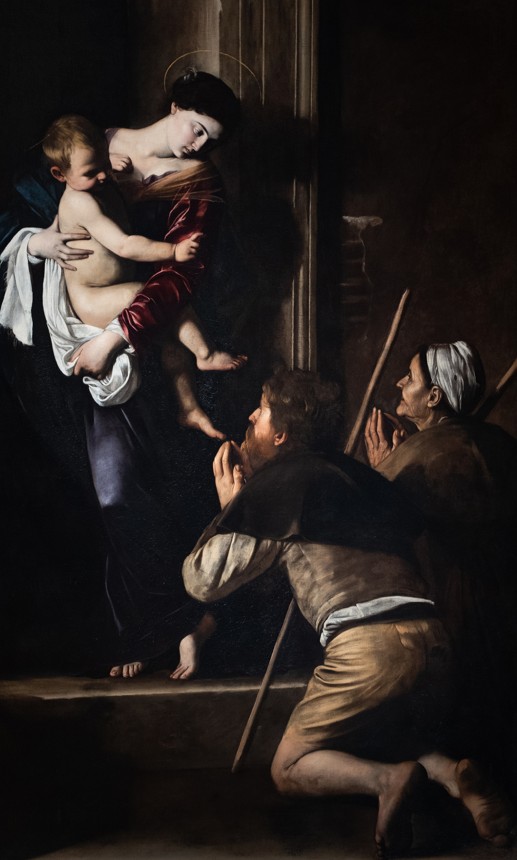
Le sue Madonne avevano il volto delle donne del popolo. Gli apostoli mostravano mani rovinate dal lavoro. I pellegrini arrivavano davanti alla Vergine con i piedi sporchi di polvere.
Cristo stesso appariva come un uomo vero. Per molti ecclesiastici era uno scandalo: per altri rappresentava il modo più efficace per trasmettere il messaggio evangelico.
Il fedele non osservava più personaggi lontani e perfetti, ma uomini e donne simili a lui.
Era impossibile restare indifferenti davanti ai suoi dipinti e lo è ancora oggi.

La luce che cambiò la storia della pittura
Il tratto più riconoscibile dell’arte di Caravaggio è senza dubbio il suo straordinario uso della luce. La luce diventava il linguaggio stesso della narrazione.
Entrava improvvisamente nello spazio della tela, emergeva dal buio più profondo e colpiva i protagonisti come una manifestazione divina. Le ombre non servivano soltanto a creare volume.
Diventavano parte integrante del racconto.
Il contrasto fra luce e oscurità rendeva ogni scena più intensa, più drammatica e profondamente umana.
Quella tecnica, oggi conosciuta come tenebrismo, avrebbe influenzato intere generazioni di artisti in tutta Europa. Da Rubens a Rembrandt, da Georges de La Tour a Velázquez, quasi tutti i grandi maestri del Seicento guardarono con ammirazione alle invenzioni luministiche di Caravaggio.
La Cappella Contarelli e il capolavoro che cambiò tutto
Il vero salto di qualità arrivò nel 1599. Grazie all’appoggio del cardinale Del Monte, Caravaggio ricevette una delle commissioni più importanti della sua carriera: decorare la Cappella Contarelli nella chiesa di San Luigi dei Francesi a Roma.
Era la sua prima grande impresa pubblica. Fino a quel momento era conosciuto soprattutto negli ambienti collezionistici. Da quel momento sarebbe diventato il pittore di cui tutta Roma parlava.
Per la cappella realizzò tre capolavori assoluti dedicati alla vita di San Matteo. La Vocazione di San Matteo, il Martirio di San Matteo e successivamente il San Matteo e l’angelo.
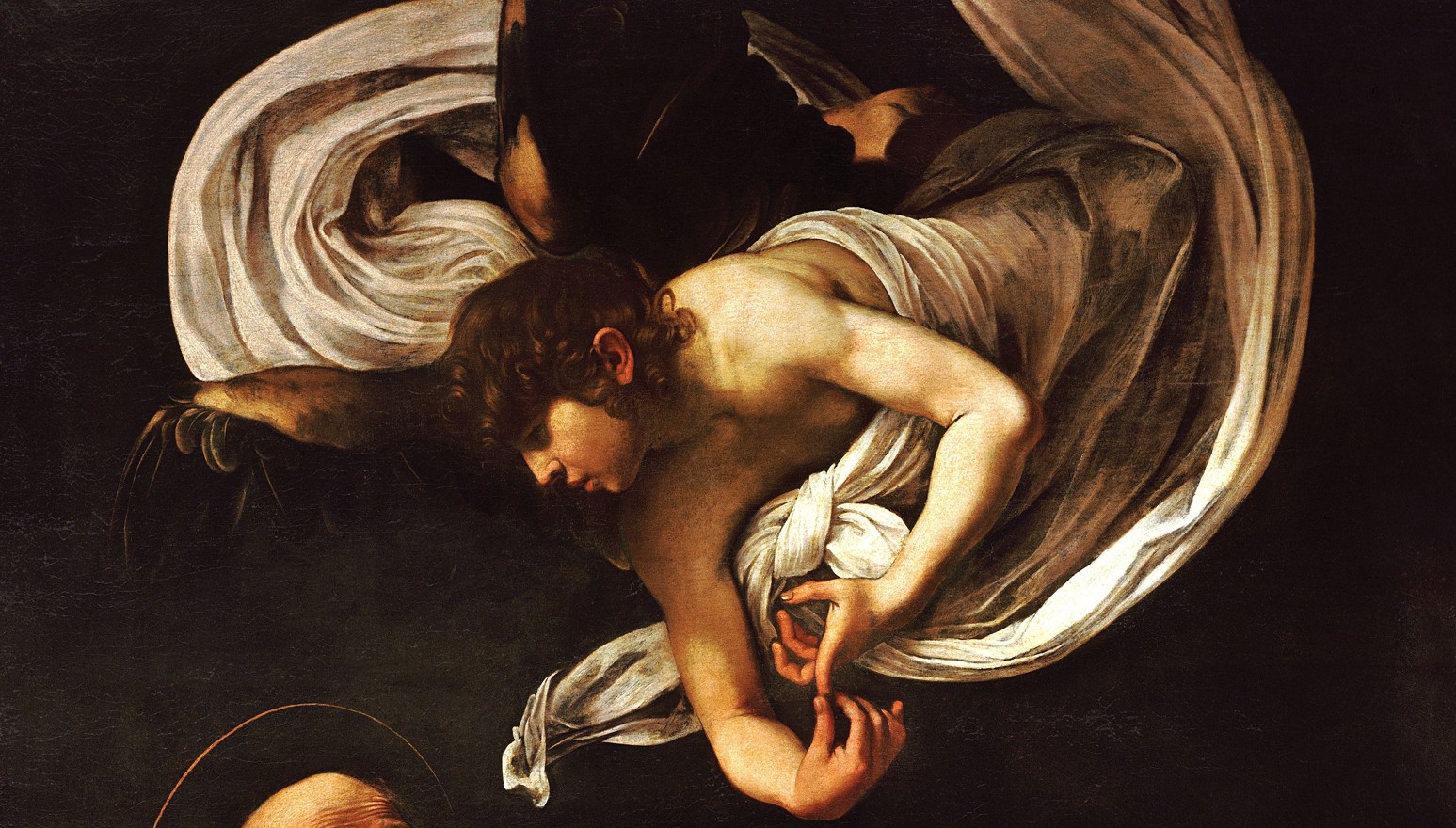
La prima versione di quest’ultima opera venne rifiutata perché giudicata troppo realistica. L’evangelista appariva infatti come un uomo semplice, quasi analfabeta, guidato fisicamente dall’angelo nella scrittura del Vangelo.
La Chiesa ritenne quella rappresentazione poco rispettosa. Caravaggio fu costretto a realizzarne una seconda versione, oggi conservata nella stessa cappella.
La Vocazione di San Matteo: un capolavoro senza tempo
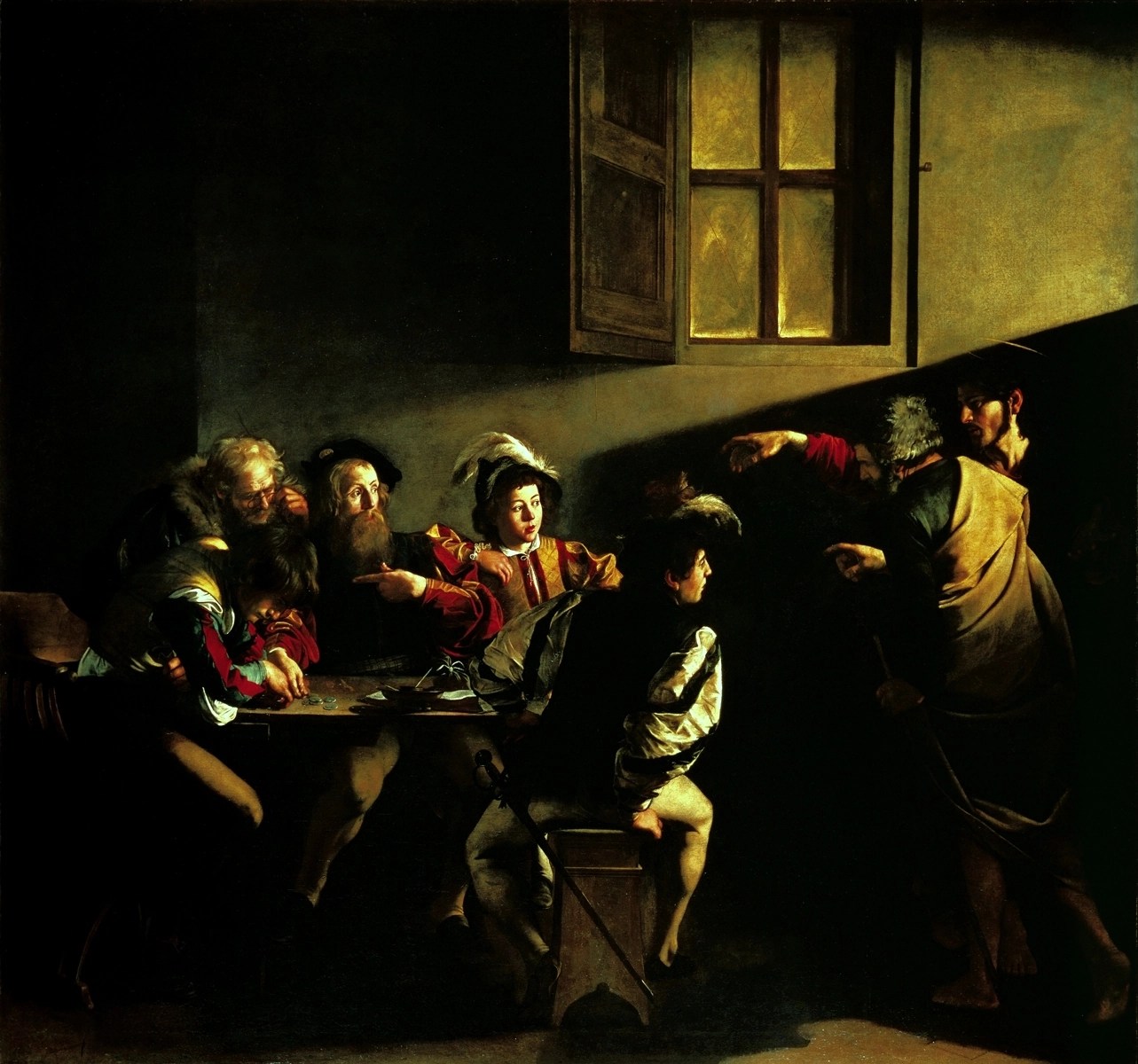
Tra tutte le opere della Cappella Contarelli, la Vocazione di San Matteo rappresenta uno dei momenti più alti della storia dell’arte. La scena è ambientata non in un luogo sacro ma in una stanza che ricorda una taverna romana.
Cinque uomini siedono attorno a un tavolo intenti a contare il denaro. All’improvviso, da destra, entrano Cristo e San Pietro. Gesù tende semplicemente una mano.
Nessun gesto teatrale.
Nessun miracolo spettacolare.
Solo una mano illuminata dalla luce.
San Matteo sembra chiedere stupito: “State chiamando me?”
In quell’istante la sua vita cambia per sempre.
È una scena di straordinaria modernità. La conversione diventa un fatto umano prima ancora che religioso. L’uomo viene sorpreso nella quotidianità. La grazia arriva senza preavviso.
La luce attraversa diagonalmente il dipinto e diventa il vero simbolo della chiamata divina. È difficile trovare nella storia della pittura un’immagine altrettanto potente.
I modelli arrivavano dalle strade di Roma
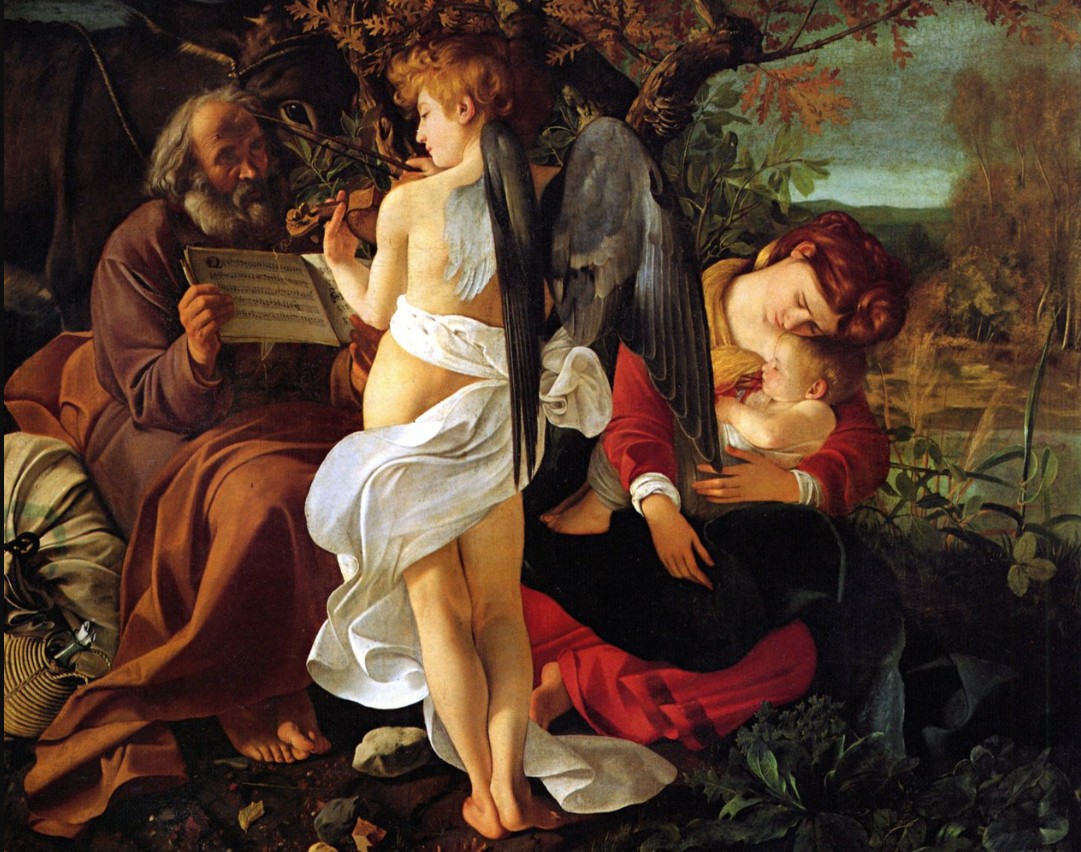
Uno degli aspetti che più scandalizzavano i contemporanei era la scelta dei modelli. Caravaggio non cercava nobili o giovani aristocratici, preferiva frequentare i quartieri popolari.
Passeggiava fra Campo Marzio, Piazza Navona, Trastevere e le taverne vicine al Tevere. Lì incontrava i volti che poi sarebbero entrati nella storia dell’arte: garzoni, facchini, giocatori d’azzardo, venditori ambulanti, musicisti, prostitute e persino mendicanti.
Quelle persone diventavano apostoli, santi, angeli e Madonne. Per Caravaggio la santità non aveva bisogno della perfezione estetica: aveva bisogno della verità.
Le polemiche che accompagnarono tutta la sua carriera
Ogni nuova opera provocava discussioni. Molti accusavano Caravaggio di essere incapace di rappresentare la bellezza ideale e secondo alcuni dipingeva soltanto la realtà più volgare. altri sostenevano addirittura che offendesse la religione.
In realtà il suo obiettivo era completamente diverso: voleva rendere il messaggio cristiano comprensibile anche agli ultimi.
Non dipingeva santi irraggiungibili ma dipingeva uomini capaci di sbagliare, soffrire e redimersi.
L’Incredulità di San Tommaso: la fede diventa esperienza
Tra il 1600 e il 1601 Caravaggio realizzò uno dei dipinti più celebri della sua produzione, L’Incredulità di San Tommaso, destinata al banchiere Vincenzo Giustiniani, uno dei più importanti collezionisti del suo tempo.
Il dipinto rappresenta il momento in cui Cristo invita Tommaso a verificare personalmente la ferita del costato. La scena è costruita con una forza narrativa impressionante. Tommaso affonda letteralmente il dito nella ferita mentre Cristo accompagna il suo gesto.
Gli altri due apostoli osservano con incredulità. I volti sono concentrati. Le rughe delle fronti raccontano lo stupore. Le mani sembrano vive. La luce illumina soltanto ciò che è essenziale.
Ancora una volta Caravaggio elimina qualsiasi elemento decorativo; resta solo l’essere umano davanti al mistero della fede.

Il successo non riuscì a domare il suo carattere
Mentre il suo nome diventava sempre più celebre, la vita privata di Caravaggio continuava a essere segnata da continui eccessi. Frequentava taverne, partecipava a risse, litigava facilmente e portava spesso la spada al fianco, come molti uomini dell’epoca.
Le cronache romane iniziarono a registrare numerosi episodi che lo vedevano protagonista: aggressioni, denunce, insulti arresti e scontri con la giustizia.
Era un uomo impulsivo, incapace di controllare il proprio temperamento. Il contrasto tra il genio dell’artista e la fragilità dell’uomo diventava ogni anno più evidente.
Nessuno poteva immaginare che proprio quel carattere irrequieto avrebbe presto cambiato definitivamente il corso della sua vita.
Nel 1606, una violenta lite degenerò in un duello destinato a entrare nella storia. Da quel momento Michelangelo Merisi non sarebbe stato più soltanto il pittore più innovativo del suo tempo, ma anche un uomo in fuga, condannato a vivere lontano dalla città che lo aveva reso celebre.
L’apice della carriera di Caravaggio coincise con l’inizio della sua rovina personale. Mentre Roma celebrava il suo talento e le chiese più importanti si contendevano le sue opere, il carattere impulsivo dell’artista continuava a trascinarlo in una spirale di violenza, denunce e scontri che sembravano ormai far parte della sua quotidianità.
Il duello che cambiò per sempre la vita di Caravaggio
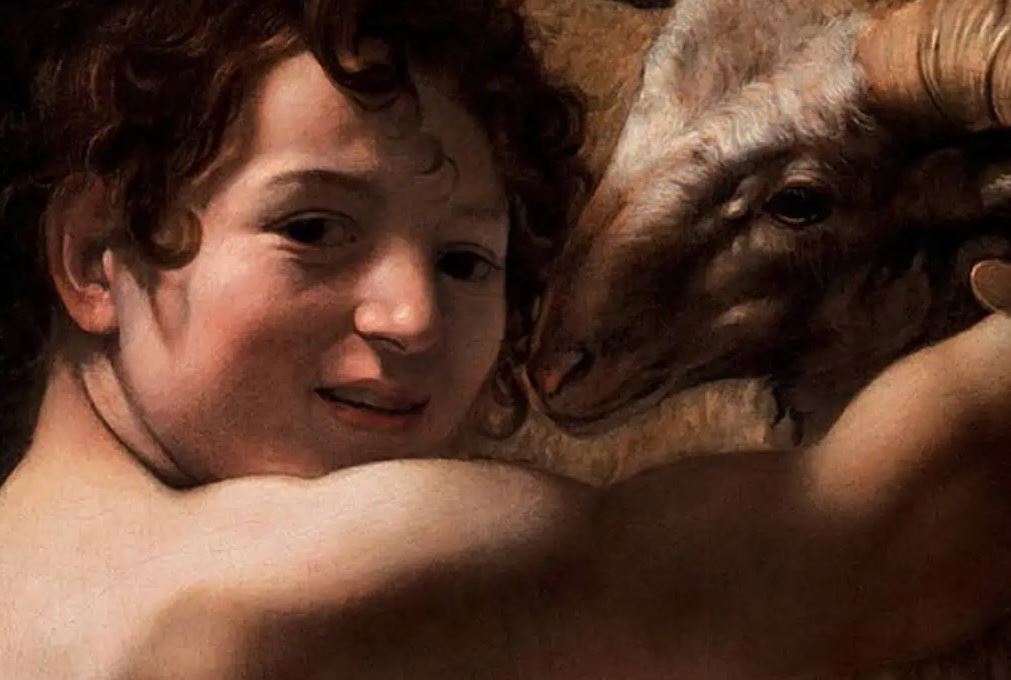
In un terreno vicino a Campo Marzio, a Roma, scoppiò una violenta lite tra Michelangelo Merisi e Ranuccio Tomassoni, appartenente a una famiglia influente. Ancora oggi gli storici discutono sulle vere cause dello scontro.
Secondo alcune testimonianze si trattò di una disputa nata durante una partita di pallacorda, uno sport molto praticato nel Seicento e considerato l’antenato del tennis moderno. Altre fonti parlano invece di questioni economiche, di debiti mai saldati o addirittura di una rivalità legata a una donna.
Qualunque fosse il motivo, la lite degenerò rapidamente. I due uomini estrassero le spade. Durante il combattimento Tomassoni rimase gravemente ferito e morì poco dopo.
Per Caravaggio le conseguenze furono devastanti.
Le autorità pontificie emisero una condanna capitale. Se fosse stato catturato nello Stato della Chiesa avrebbe potuto essere giustiziato mediante decapitazione. Da quel momento il pittore più richiesto di Roma diventò un fuggitivo.
L’inizio di una lunga fuga
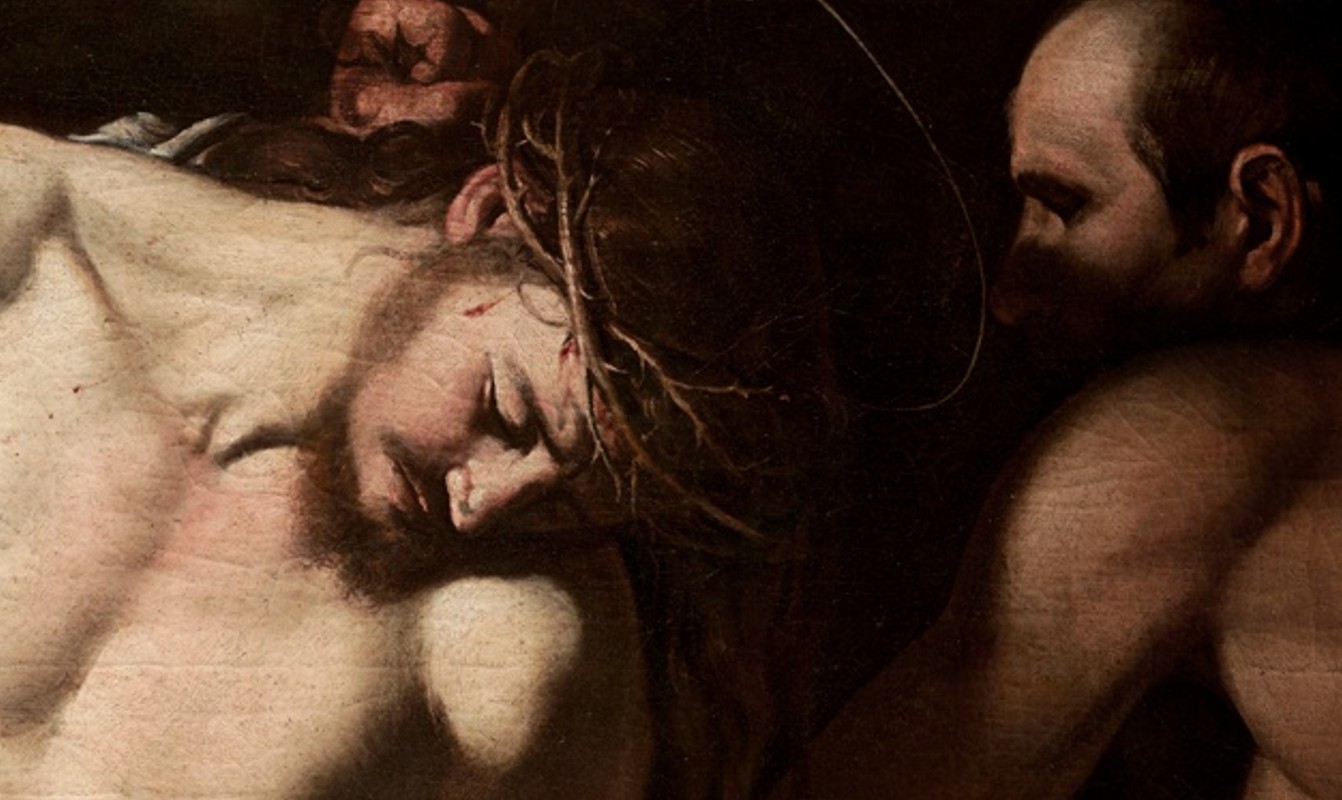
Lasciata Roma in tutta fretta, Caravaggio trovò inizialmente rifugio nei territori controllati dalla potente famiglia Colonna, che gli offrì protezione grazie ai rapporti costruiti dalla sua famiglia fin dall’infanzia.
La prima tappa fu Napoli. La città, allora sotto il dominio spagnolo, rappresentava uno dei centri artistici più importanti d’Europa. Qui Caravaggio ritrovò rapidamente il successo.
La sua fama aveva ormai superato i confini dello Stato Pontificio e i committenti napoletani fecero a gara per assicurarsi le sue opere. Paradossalmente, proprio durante gli anni della fuga la sua pittura raggiunse una profondità ancora maggiore: la luce si fece più intensa, le ombre divennero più profonde e i volti sembravano raccontare una sofferenza autentica, probabilmente specchio dello stato d’animo dello stesso artista.
Le Sette opere di Misericordia: il capolavoro napoletano
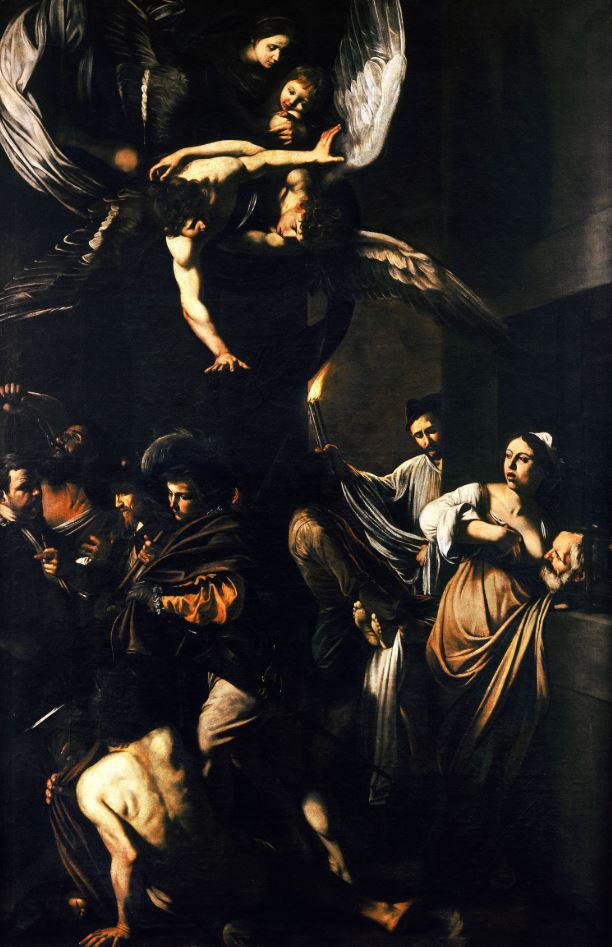
Tra i dipinti realizzati durante il soggiorno a Napoli spicca senza dubbio Le Sette opere di Misericordia, ancora oggi conservato nella chiesa del Pio Monte della Misericordia.
Si tratta di una composizione complessissima. Caravaggio riuscì a rappresentare in un’unica scena tutte le opere di misericordia corporale indicate dalla tradizione cristiana.
Dar da mangiare agli affamati. Dar da bere agli assetati. Vestire gli ignudi. Visitare gli infermi. Ospitare i pellegrini. Visitare i carcerati. Seppellire i morti.
Ciò che rende straordinario il dipinto è la naturalezza con cui ogni episodio si intreccia con gli altri. La luce attraversa la scena come una presenza divina, guidando lo sguardo dello spettatore senza interrompere il flusso narrativo.
È una delle prove più alte della maturità artistica di Caravaggio.
Il sogno di ottenere il perdono
Nonostante il successo, Michelangelo Merisi aveva un solo obiettivo: tornare a Roma. Per riuscirci aveva bisogno della grazia papale.
La strategia consisteva nell’acquisire nuovi protettori influenti. Per questo motivo decise di partire verso Malta, sede dei Cavalieri di San Giovanni. Entrare nell’Ordine avrebbe aumentato enormemente il suo prestigio e forse gli avrebbe aperto la strada verso il perdono.
Malta e il titolo di Cavaliere
Nel 1607 Caravaggio arrivò sull’isola di Malta. Qui trovò l’appoggio del Gran Maestro Alof de Wignacourt, che rimase profondamente colpito dal suo talento.
In breve tempo l’artista ricevette importanti commissioni e realizzò alcuni dei suoi ritratti più celebri. Il capolavoro assoluto del periodo maltese è la monumentale Decollazione di San Giovanni Battista, custodita ancora oggi nell’Oratorio della Concattedrale di San Giovanni alla Valletta. È l’unica opera firmata da Caravaggio.
La firma compare nel sangue che sgorga dal collo del santo. Un dettaglio impressionante, che molti storici interpretano come una sorta di confessione simbolica.
Proprio lui, condannato per omicidio, dipingeva la decapitazione di un santo. Sembrava quasi voler riflettere sulla propria colpa. Grazie ai suoi meriti artistici venne nominato Cavaliere dell’Ordine. Era il riconoscimento più prestigioso ottenuto nella sua vita.
Durò pochissimo.
Una nuova rissa e una nuova fuga
Anche a Malta il carattere di Caravaggio ebbe il sopravvento. Nel 1608 fu coinvolto in una violenta aggressione ai danni di un altro cavaliere.
Arrestato e rinchiuso nel Forte Sant’Angelo, riuscì incredibilmente a fuggire. Fu espulso dall’Ordine con la pesantissima accusa di essere un membro “putrido e fetido”. Una definizione che testimonia quanto fosse precipitata la sua situazione.
Ricominciò così un nuovo viaggio.
La Sicilia e gli ultimi capolavori
Siracusa, Messina e Palermo.
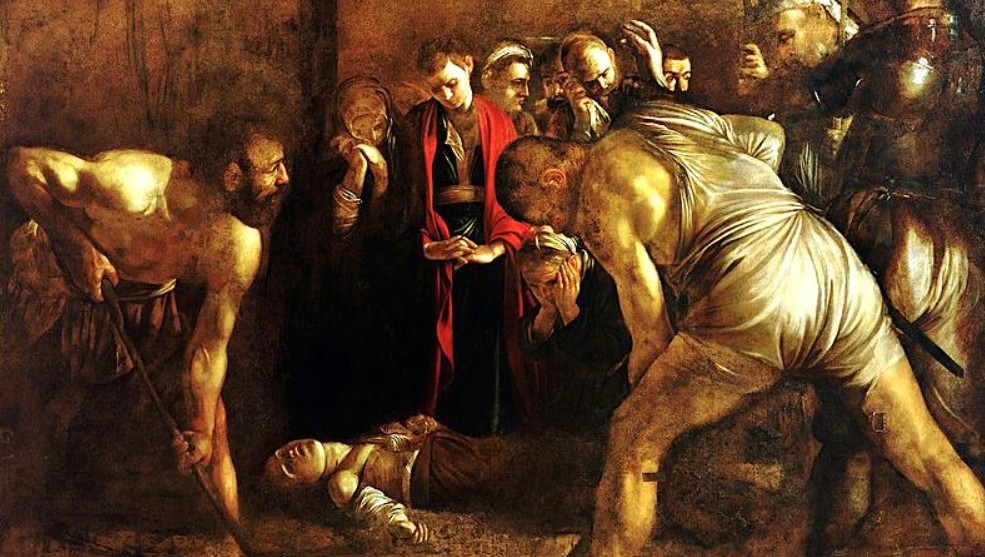
Negli ultimi due anni della sua vita Caravaggio attraversò tutta la Sicilia lasciando dietro di sé opere straordinarie. Realizzò il Seppellimento di Santa Lucia, la Resurrezione di Lazzaro, l’Adorazione dei Pastori e numerosi altri dipinti che mostrano una pittura ormai essenziale.
Le figure emergono dal buio con una forza quasi scultorea. Gli sfondi diventano sempre più spogli e la luce assume un significato spirituale.
È come se il pittore avesse eliminato tutto ciò che non era indispensabile: rimane soltanto l’uomo con il suo dolore, con la speranza e il suo destino.
L’ultimo viaggio verso Roma
Nel 1610 arrivò finalmente la notizia che Caravaggio attendeva da anni. Grazie all’intervento dei suoi protettori sembrava ormai vicina la concessione della grazia da parte di papa Paolo V.
Il pittore decise quindi di lasciare Napoli. Caricò alcune tele su una feluca e intraprese il viaggio lungo la costa tirrenica. Secondo la ricostruzione più accreditata, durante una sosta nei pressi di Palo Laziale fu arrestato per errore dalle autorità spagnole.
Quando venne rilasciato, la nave era già ripartita con tutti i suoi effetti personali e con i dipinti che sperava di offrire al pontefice. Disperato, cercò di inseguirla a piedi lungo il litorale, sotto il sole di luglio.
Fu una corsa estenuante e probabilmente inutile. Pochi giorni dopo arrivò a Porto Ercole ma era ormai allo stremo delle forze.
Il 18 luglio 1610 Caravaggio muore a Porto Ercole
Il 18 luglio 1610 Michelangelo Merisi morì nell’ospedale di Santa Maria Ausiliatrice di Porto Ercole: aveva soltanto trentanove anni.
La notizia raggiunse Roma diversi giorni dopo.
Nessuno immaginava che quell’uomo, morto quasi nell’anonimato, sarebbe diventato uno degli artisti più influenti della storia occidentale. Le cause della morte restano ancora oggi oggetto di studio.
Per secoli si parlò di malaria, contratta durante il viaggio. Altri ipotizzarono una violenta febbre provocata da un’infezione.
Negli ultimi decenni alcune ricerche hanno suggerito anche la possibilità di una setticemia dovuta alle numerose ferite riportate nelle risse oppure di un‘intossicazione cronica da piombo, sostanza presente nei pigmenti utilizzati dai pittori del Seicento.
Non manca nemmeno chi sostiene che sia stato assassinato per vendetta. La verità, probabilmente, non sarà mai conosciuta con assoluta certezza.
Il genio dimenticato che il tempo ha reso immortale
Nei decenni immediatamente successivi alla sua morte il nome di Caravaggio conobbe una fase di relativo declino.
Il gusto artistico cambiò rapidamente. Il classicismo promosso da Guido Reni e dai Carracci sembrò prevalere sul naturalismo esasperato del Merisi.
Solo nel Novecento gli studiosi riscoprirono pienamente la grandezza della sua opera. Roberto Longhi fu tra i principali protagonisti di questa rivalutazione, dimostrando come gran parte della pittura europea del Seicento fosse nata proprio dalla rivoluzione caravaggesca.
Da quel momento la fortuna critica di Caravaggio non si è più fermata. Oggi le sue opere sono custodite nei musei più prestigiosi del mondo: dalla Galleria Borghese ai Musei Vaticani, dal Louvre alla National Gallery, dal Metropolitan Museum di New York alla Gemäldegalerie di Berlino.

Ogni mostra dedicata al maestro registra numeri straordinari e milioni di persone continuano a emozionarsi davanti alle sue tele.
Il 18 luglio 1610 si concluse la vita di Michelangelo Merisi, ma non quella della sua rivoluzione artistica. Con il suo pennello dimostrò che la grande arte non nasce dall’idealizzazione, ma dalla capacità di osservare la realtà con occhi nuovi. Trasformò il chiaroscuro in uno strumento narrativo, rese protagonisti gli ultimi, diede dignità ai volti della gente comune e cambiò per sempre il modo di rappresentare il sacro.
Il più grande lascito di Caravaggio? Aver dimostrato che la pittura può raccontare la verità dell’uomo meglio di qualsiasi parola.
Per il momento il sempre vostro Michelangelo Buonarroti vi saluta dandovi appuntamento ai prossimi post e sui social.
July 18, 1610, Caravaggio dies: the final days of the genius who changed art history forever
On July 18, 1610, in a small town on the Tuscan coast overlooking Monte Argentario, one of the most extraordinary, tormented, and revolutionary lives in the history of art ended. Michelangelo Merisi, known universally as Caravaggio, died in Porto Ercole at just 39 years old, far from the pomp of Rome that had consecrated him and the courts that had admired his genius.
His passing went almost unnoticed. No great celebration, no funeral procession worthy of the artist whom millions today consider one of the greatest painters ever. Only the silence of an exhausted man, consumed by escapes, illness, and a destiny that seemed to pursue him everywhere.
And yet, four centuries later, Caravaggio continues to be one of the most beloved, studied, and admired artists in the world. His works attract millions of visitors to international museums every year, while scholars and art historians continue to ponder his life, his anxieties, and especially his final days before his death.
The story of Michelangelo Merisi remains incredible even today. He completely overturned the way reality was represented, introducing a painting style characterized by real people, faces marked by fatigue, dirty hands, deep wrinkles, and a theatrical light that transformed every scene into a human drama.
His name has become synonymous with revolution. No artist before him had had the courage to eliminate all idealized artifice to show reality in its most authentic form. The saints had dirty feet, the apostles resembled commoners encountered in a Roman tavern, and the Virgin could take the form of a common woman.
It was precisely this radical choice that made him immortal.
Milan, the place where Caravaggio’s story began
For a long time, it was believed that Michelangelo Merisi was born in the town of Caravaggio, in the province of Bergamo, so much so that he was given the nickname by which he entered history. Only in the twentieth century, the discovery of his baptismal certificate definitively clarified his origins.
Caravaggio was born in Milan on September 29, 1571, the day dedicated to Saint Michael the Archangel, from whom he likely took the name Michelangelo. His family was anything but humble. His father, Fermo Merisi, worked as a master bricklayer and administrator for the Marquis of Caravaggio, Francesco Sforza Colonna, while his mother, Lucia Aratori, came from a family well-connected to Lombard society.
The fate of young Michelangelo changed radically when the plague struck Milan in 1576. Like many families of the time, the Merisis left the city, seeking refuge in the village of Caravaggio. They hoped to escape the contagion, but the disease proved relentless.
Within a few years, his father, grandfather, and several close relatives died. Michelangelo thus grew up in an atmosphere marked by loss and uncertainty, experiences that many scholars believe profoundly influenced his artistic sensibility.
Death, pain, and the fragility of existence would become constant themes in his paintings.
The Apprenticeship That Shaped a Genius
At thirteen, Michelangelo entered the workshop of the painter Simone Peterzano, a Venetian artist who boasted of having been a student of Titian.
It was a crucial apprenticeship. Peterzano taught the young Merisi the basics of drawing, canvas preparation, the use of pigments, and the most advanced painting techniques of the time.
But Caravaggio immediately demonstrated an independent streak. Rather than copying traditional patterns, he carefully observed the real world. Ordinary people fascinated him far more than idealized figures.
The merchants, artisans, peasants, beggars, and children he encountered in the streets would become the undisputed protagonists of his canvases in later years.
Lombardy also contributed enormously to his development. Lombard painting in the second half of the 16th century was characterized by a strong naturalism, a search for everyday reality that would find its most revolutionary interpreter in Caravaggio.
Rome, the city that changed Michelangelo Merisi’s destiny
Around 1592, the young painter decided to leave Lombardy permanently for Rome.
The capital of the Papal States was the most important artistic center in Europe. The best architects, the most celebrated sculptors, and the painters destined to decorate churches, cardinals’ palaces, and noble residences worked here.
But for Caravaggio, arriving in the Eternal City was anything but easy. Without money and without significant protection, he endured extremely difficult months.
He slept wherever he could, constantly changed lodgings, and sought small jobs in established workshops. Sources describe him as a young man who was often hungry, forced to quickly paint pictures destined for the private market.
He mainly painted still lifes, flowers, and half-length figures of young musicians or street vendors. Despite his financial difficulties, these works already demonstrated an extraordinary talent.
The Sick Bacchus: The First Masterpiece to Relate Pain
Among the most famous works from this early Roman period is the Sick Bacchus, now housed in the Galleria Borghese in Rome.
The painting depicts a young Bacchus with a pale face, bruised lips, and a tired look that seems to betray profound physical suffering.
Many art historians believe it is a self-portrait painted while Caravaggio was hospitalized at the Ospedale della Consolazione, likely after contracting malaria or following a serious accident caused by a horse’s kick. Whatever the cause, this image conveys something entirely new.
There is no idealization of the mythological figure. Bacchus appears frail and ill. His skin is imperfect, his hands show tension, his face reveals tiredness.
Caravaggio seems to be affirming that even the gods can experience suffering. It is a poetic statement destined to change Western painting forever.
A revolution born from the observation of reality
While many artists continued to draw inspiration from classical models, Caravaggio chose the opposite path.
He disliked preparatory drawings. He preferred to place the model in front of the canvas, carefully observe the light falling on the face, and begin painting directly.
This technique gave his figures an extraordinarily real presence. Every wrinkle, every vein in the hand, every fold of the dress seemed to belong to living people.
It was an absolute revolution. He wasn’t interested in representing an abstract idea of beauty. The goal was to portray the human being with all their imperfections.
The streets of Rome became his atelier
Caravaggio’s true source of inspiration was not the aristocratic courts but the city streets. He strolled through the working-class neighborhoods, frequented the taverns, observed beggars, soldiers, musicians, and prostitutes.
They were the protagonists of his paintings, and many contemporaries were scandalized.
How could a saint have the face of a commoner? How could the Madonna resemble a woman he met along the Tiber? For Caravaggio, there was no contradiction. Indeed, that very choice made the religious message even more powerful.
Holiness did not belong to unattainable beings, but to ordinary men and women. It was a profoundly innovative vision that anticipated a modern sensibility.
The talent that was beginning to be noticed
Soon, some Roman collectors began to take notice of the young Lombard. Among them was the art dealer Costantino Spata, followed by increasingly influential figures who were struck by the narrative power of his works.
His fame grew slowly, but it was clear that this painter possessed something different. The light seemed to come from an invisible theater. The emotions were authentic.
The figures seemed to emerge from the canvas.
Each painting told a story that the viewer could almost touch. No one imagined that soon after, an encounter would completely change the destiny of the young Michelangelo Merisi.
A single painting, created around 1595, would have been enough to open the doors to the most important Roman commissions for him. That painting was entitled The Cardsharps and would mark the beginning of Caravaggio’s legend.
The Meeting with Cardinal Del Monte, the Success of Major Commissions, and the Chiaroscuro Revolution
If Michelangelo Merisi’s early years in Rome were marked by poverty and uncertainty, the second half of the 1590s represented a turning point for him, destined to change the course of his life and, along with it, the history of painting. A single work, seemingly simple in composition but extraordinary in its narrative power, was enough to attract the attention of one of the most influential men in papal Rome.
That painting was The Cardsharps, created around 1595. Even today, it is considered one of the manifestos of Caravaggio’s painting because it already embodies all the elements that would make the Lombard master famous: naturalism, psychological tension, dramatic lighting, and the ability to transform an everyday scene into a universal tale.
“The Cardsharps”: the painting that opened the doors to great painting for Caravaggio
At first glance, the scene appears to depict a simple card game. Two young men sit opposite each other while a third, slightly older figure observes the game from behind the naive boy.
The viewer immediately understands what is happening.
The elegant young man looking at his cards is the unwitting victim of a scam.
The other player receives the help of his accomplice, who furtively pulls out some cards hidden behind his back.
It is a suspended, almost cinematic moment.
The tension builds precisely because the viewer knows the truth while the protagonist of the scene continues to play, unaware of the deception. With this painting, Caravaggio demonstrated something completely new: he was not only interested in the beauty of the composition, but also in emotionally engaging the viewer.
Every detail contributes to the narrative. The facial expressions, the hand gestures, the knowing glances, the refined clothing of the young people, and even the way the light illuminates the figures transform a simple genre scene into a tale of extraordinary intensity.
The light enters laterally, coming from the left, and sculpts the bodies like a theatrical spotlight. There are no superfluous elements, and every detail serves the story.
It was with Cardsharps that a new conception of European painting was born.
The decisive meeting with Cardinal Francesco Maria Del Monte
The painting’s success attracted the attention of Cardinal Francesco Maria Del Monte, a refined collector, diplomat, and avid art enthusiast. It was a meeting that would radically change the artist’s life.
Del Monte immediately recognized the exceptional talent he had before him and decided to offer him protection, hospitality, and above all, the opportunity to work without the worry of poverty.
Caravaggio moved into the prestigious Palazzo Madama, then the cardinal’s residence. For the painter, it meant entering a vibrant cultural environment, frequented by musicians, philosophers, writers, scientists, and important members of the Roman Curia.
For the first time in his life, he no longer had to worry solely about surviving: he could devote himself entirely to painting.
It was precisely during these years that his style reached a surprising maturity.
Naturalism Becomes an Artistic Revolution
In Counter-Reformation Rome, religious painting followed very precise rules. Saints were depicted as idealized, elegant, and almost unattainable figures. Caravaggio completely broke this mold.
His Madonnas had the faces of common women. The apostles displayed hands ruined by work. Pilgrims arrived before the Virgin with dusty feet.
Christ himself appeared as a real man. For many clergymen, this was a scandal; for others, it represented the most effective way to convey the Gospel message.
The faithful no longer observed distant, perfect figures, but men and women similar to themselves.
It was impossible to remain indifferent to his paintings, and it remains so today.
The light that changed the history of painting
The most recognizable feature of Caravaggio’s art is undoubtedly his extraordinary use of light. Light became the very language of narration.
He suddenly entered the canvas, emerging from the deepest darkness and striking the protagonists like a divine manifestation. Shadows didn’t just serve to create volume.
They became an integral part of the story.
The contrast between light and darkness made each scene more intense, more dramatic, and profoundly human.
That technique, now known as tenebrism, would influence entire generations of artists throughout Europe. From Rubens to Rembrandt, from Georges de La Tour to Velázquez, almost all the great masters of the 17th century looked with admiration at Caravaggio’s inventions in light.
The Contarelli Chapel and the masterpiece that changed everything
The real breakthrough came in 1599. Thanks to the support of Cardinal Del Monte, Caravaggio received one of the most important commissions of his career: decorating the Contarelli Chapel in the church of San Luigi dei Francesi in Rome.
It was his first major public undertaking. Until then, he had been known primarily among collectors. From that moment on, he would become the painter all Rome was talking about.
For the chapel, he created three absolute masterpieces dedicated to the life of Saint Matthew: The Calling of Saint Matthew, The Martyrdom of Saint Matthew, and later Saint Matthew and the Angel.
The first version of the latter work was rejected because it was deemed too realistic. The evangelist appeared as a simple, almost illiterate man, physically guided by the angel in writing the Gospel.
The Church deemed this representation disrespectful. Caravaggio was forced to create a second version, now preserved in the same chapel.
The Calling of Saint Matthew: a timeless masterpiece
Of all the works in the Contarelli Chapel, The Calling of Saint Matthew represents one of the high points in the history of art. The scene is set not in a sacred place but in a room reminiscent of a Roman tavern.
Five men sit around a table, intent on counting money. Suddenly, Christ and Saint Peter enter from the right. Jesus simply holds out his hand.
No theatrical gestures.
No spectacular miracles.
Just a hand illuminated by light.
Saint Matthew seems to ask in astonishment: “Are you calling me?”
In that moment, his life changes forever.
It is a scene of extraordinary modernity. Conversion becomes a human event even before it is a religious one. Man is surprised in his everyday life. Grace arrives without warning.
The light crosses the painting diagonally and becomes the true symbol of the divine call. It is difficult to find a more powerful image in the history of painting.
The models came from the streets of Rome.
One of the aspects that most scandalized his contemporaries was his choice of models. Caravaggio didn’t seek out nobles or young aristocrats; he preferred to frequent the working-class neighborhoods.
He strolled through Campo Marzio, Piazza Navona, Trastevere, and the taverns near the Tiber. There, he encountered faces that would later become part of art history: porters, gamblers, street vendors, musicians, prostitutes, and even beggars.
These people became apostles, saints, angels, and Madonnas. For Caravaggio, sanctity didn’t require aesthetic perfection: it required truth.
The controversies that accompanied his entire career
Each new work sparked discussion. Many accused Caravaggio of being incapable of representing ideal beauty, and some claimed he only painted the most vulgar reality. Others even claimed he offended religion.
In reality, his goal was completely different: he wanted to make the Christian message understandable even to the most vulnerable.
He didn’t paint unattainable saints, but rather men capable of making mistakes, suffering, and redeeming themselves.
The Incredulity of Saint Thomas: Faith Becomes Experience
Between 1600 and 1601, Caravaggio created one of his most famous paintings, The Incredulity of Saint Thomas, intended for the banker Vincenzo Giustiniani, one of the most important collectors of his time.
The painting depicts the moment when Christ invites Thomas to personally examine the wound in his side. The scene is constructed with impressive narrative force. Thomas literally plunges his finger into the wound while Christ accompanies his gesture.
The other two apostles observe in disbelief. Their faces are focused. The wrinkles on their foreheads express amazement. The hands seem alive. The light illuminates only what is essential.
Once again, Caravaggio eliminates all decorative elements; Only the human being remains before the mystery of faith.
Success failed to tame his temper
While his name grew increasingly famous, Caravaggio’s private life continued to be marked by constant excess. He frequented taverns, got into brawls, quarreled easily, and often carried a sword at his side, like many men of the time.
The Roman chronicles began to record numerous incidents involving him: assaults, denunciations, insults, arrests, and run-ins with the law.
He was an impulsive man, unable to control his temper. The contrast between the genius of the artist and the fragility of the man became more evident with each passing year.
No one could have imagined that precisely this restless nature would soon definitively change the course of his life.
In 1606, a violent argument escalated into a duel destined to go down in history. From that moment on, Michelangelo Merisi would no longer be just the most innovative painter of his time, but also a man on the run, condemned to live far from the city that had made him famous.
The pinnacle of Caravaggio’s career coincided with the beginning of his personal downfall. While Rome celebrated his talent and the most important churches competed for his works, the artist’s impulsive nature continued to drag him into a spiral of violence, denunciations, and clashes that seemed to have become part of his daily routine.
The Duel That Changed Caravaggio’s Life Forever
On a plot of land near Campo Marzio in Rome, a violent argument broke out between Michelangelo Merisi and Ranuccio Tomassoni, a member of an influential family. Historians still debate the true causes of the clash.
According to some accounts, it was a dispute that arose during a game of tennis, a popular sport in the 17th century and considered the ancestor of modern tennis. Other sources speak of financial issues, unpaid debts, or even a rivalry over a woman.
Whatever the reason, the argument quickly escalated. The two men drew their swords. During the fight, Tomassoni was seriously injured and died shortly thereafter.
The consequences for Caravaggio were devastating.
The papal authorities issued a death sentence. Had he been captured in the Papal States, he could have been executed by beheading. From that moment, Rome’s most sought-after painter became a fugitive.
The Beginning of a Long Escape
Hastily leaving Rome, Caravaggio initially found refuge in the territories controlled by the powerful Colonna family, who offered him protection thanks to the relationships his family had built since childhood.
His first stop was Naples. The city, then under Spanish rule, was one of Europe’s most important artistic centers. Here, Caravaggio quickly regained success.
His fame had now spread beyond the borders of the Papal States, and Neapolitan patrons vied to secure his works. Paradoxically, it was during his years of escape that his painting achieved even greater depth: the light became more intense, the shadows deeper, and the faces seemed to convey a sense of genuine suffering, likely reflecting the artist’s own state of mind.
The Seven Works of Mercy: The Neapolitan Masterpiece
Among the paintings created during his stay in Naples, The Seven Works of Mercy undoubtedly stands out, still preserved in the church of Pio Monte della Misericordia.
It is a highly complex composition. Caravaggio succeeded in representing all the corporal works of mercy indicated by Christian tradition in a single scene.
Feeding the hungry. Giving drink to the thirsty. Clothing the naked. Visiting the sick. Hosting pilgrims. Visiting the imprisoned. Burying the dead.
What makes this painting extraordinary is the natural way each episode intertwines with the others. Light flows through the scene like a divine presence, guiding the viewer’s gaze without interrupting the narrative flow.
It is one of the finest examples of Caravaggio’s artistic maturity.
The dream of obtaining forgiveness
Despite his success, Michelangelo Merisi had only one goal: to return to Rome. To achieve this, he needed papal pardon.
The strategy consisted of acquiring new, influential patrons. For this reason, he decided to leave for Malta, home of the Knights of St. John. Joining the Order would greatly increase his prestige and perhaps open the way to pardon.
Malta and the Title of Knight
In 1607, Caravaggio arrived on the island of Malta. There he found the support of Grand Master Alof de Wignacourt, who was deeply impressed by his talent.
The artist quickly received important commissions and created some of his most famous portraits. The absolute masterpiece of his Maltese period is the monumental Beheading of St. John the Baptist, still preserved today in the Oratory of St. John’s Co-Cathedral in Valletta. It is the only work signed by Caravaggio.
The signature appears in the blood flowing from the saint’s neck. A striking detail, which many historians interpret as a sort of symbolic confession.
He, convicted of murder, painted the beheading of a saint. He almost seemed to be reflecting on his own guilt. Thanks to his artistic merits, he was named a Knight of the Order. It was the most prestigious recognition he had ever received.
It lasted a very short time.
A new brawl and another escape
Caravaggio’s temper also prevailed in Malta. In 1608, he was involved in a violent attack on another knight.
Arrested and locked up in Fort St. Angelo, he incredibly managed to escape. He was expelled from the Order on the very serious charge of being a “putrid and fetid” member. A description that testifies to the depths of his situation.
Thus, a new journey began.
The Seven Works of Mercy: The Neapolitan Masterpiece
Among the paintings created during his stay in Naples, The Seven Works of Mercy undoubtedly stands out, still preserved in the church of Pio Monte della Misericordia.
It is a highly complex composition. Caravaggio succeeded in representing all the corporal works of mercy indicated by Christian tradition in a single scene.
Feeding the hungry. Giving drink to the thirsty. Clothing the naked. Visiting the sick. Hosting pilgrims. Visiting the imprisoned. Burying the dead.
What makes this painting extraordinary is the natural way each episode intertwines with the others. Light flows through the scene like a divine presence, guiding the viewer’s gaze without interrupting the narrative flow.
It is one of the finest examples of Caravaggio’s artistic maturity.
The dream of obtaining forgiveness
Despite his success, Michelangelo Merisi had only one goal: to return to Rome. To achieve this, he needed papal pardon.
The strategy consisted of acquiring new, influential patrons. For this reason, he decided to leave for Malta, home of the Knights of St. John. Joining the Order would greatly increase its prestige and perhaps open the way to pardon.
Malta and the Title of Knight
In 1607, Caravaggio arrived on the island of Malta. There he found the support of Grand Master Alof de Wignacourt, who was deeply impressed by his talent.
The artist quickly received important commissions and created some of his most famous portraits. The absolute masterpiece of his Maltese period is the monumental Beheading of St. John the Baptist, still preserved today in the Oratory of St. John’s Co-Cathedral in Valletta. It is the only work signed by Caravaggio.
The signature appears in the blood flowing from the saint’s neck. A striking detail, which historian many interpret as a sort of symbolic confession.
He, convicted of murder, painted the beheading of a saint. He almost seemed to be reflecting on his own guilt. Thanks to his artistic merits, he was named a Knight of the Order. It was the most prestigious recognition he had ever received.
It lasted a very short time.
A new brawl and another escape
Caravaggio’s temper also prevailed in Malta. In 1608, he was involved in a violent attack on another knight.
Arrested and locked up in Fort St. Angelo, he incredibly managed to escape. He was expelled from the Order on the very serious charge of being a “putrid and fetid” member. A description that tests to the depths of his situation.
Thus, a new journey began.
The forgotten genius immortalized by time
In the decades immediately following his death, Caravaggio’s reputation underwent a period of relative decline.
Artistic tastes changed rapidly. The classicism promoted by Guido Reni and the Carraccis seemed to prevail over the exaggerated naturalism of Caravaggio.
Only in the twentieth century did scholars fully rediscover the grandeur of his work. Roberto Longhi was among the leading figures in this reappraisal, demonstrating how much of seventeenth-century European painting was born precisely from the Caravaggesque revolution.
From that moment on, Caravaggio’s critical acclaim has never wavered. Today, his works are held in the world’s most prestigious museums: from the Galleria Borghese to the Vatican Museums, from the Louvre to the National Gallery, from the Metropolitan Museum in New York to the Gemäldegalerie in Berlin.
Every exhibition dedicated to the master draws extraordinary numbers, and millions of people continue to be moved by his paintings.
July 18, 1610, marked the end of Michelangelo Merisi’s life, but not that of his artistic revolution. With his brush, he demonstrated that great art is not born from idealization, but from the ability to observe reality with new eyes. He transformed chiaroscuro into a narrative tool, made the most vulnerable protagonists, gave dignity to the faces of ordinary people, and forever changed the way the sacred is represented.
Caravaggio’s greatest legacy? Having demonstrated that painting can tell the truth about humanity better than any word.
For now, yours truly, Michelangelo Buonarroti bids you farewell and invites you to join him in future posts and on social media.

Sostienici – Support Us
Se questo blog ti piace e ti appassiona, puoi aiutarci a farlo crescere sempre più sostenendoci in modo concreto condividendo i post, seguendo le pagine social e con un contributo che ci aiuta ad andare avanti con il nostro lavoro di divulgazione. . ENGLISH: If you like and are passionate about this blog, you can help us make it grow more and more by supporting us in a concrete way by sharing posts, following social pages and with a contribution that helps us to move forward with our dissemination work.
10,00 €
Articoli
Condividi:


Questo sono io




sostienici

Sostienici – Support Us
Se questo blog ti piace e ti appassiona, puoi aiutarci a farlo crescere sempre più sostenendoci in modo concreto condividendo i post, seguendo le pagine social e con un contributo che ci aiuta ad andare avanti con il nostro lavoro di divulgazione. . ENGLISH: If you like and are passionate about this blog, you can help us make it grow more and more by supporting us in a concrete way by sharing posts, following social pages and with a contribution that helps us to move forward with our dissemination work.
€10,00


gran testa calda ma un grande maestro della luce, quanti scelsero poi la sua tecnica espressiva
"Mi piace"Piace a 1 persona
straordinario e illuminato artista
"Mi piace""Mi piace"