

“Il David dovrà cadere in rovina”: il drammatico rapporto del 1867
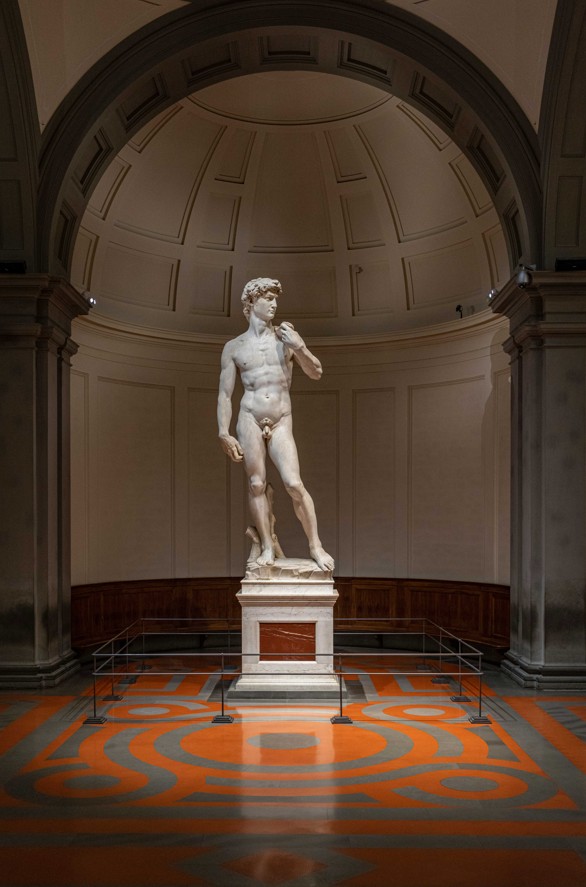
Chi non conosce il David e la sua invincibilità? Coloro che hanno avuto modo di vederlo in foto o dal vero, nella tribuna realizzata per lui da Emilio de Fabris nella Galleria dell’Accademia, hanno percepito a pelle una sensazione di potenza, fierezza e di eternità.
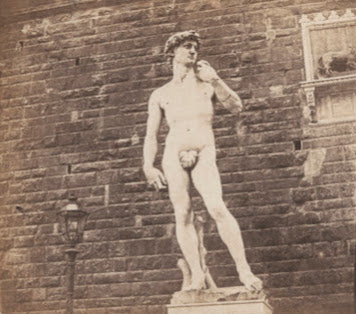
Per secoli la scultura rimasta esposta alle intemperie, sull’arengario di Palazzo Vecchio. Il tempo iniziò a gravargli sulle spalle e pareva quasi che potesse cedere sotto il peso della vecchiezza.
Lo scrissero gli uomini più illustri dell’Italia appena unita in una relazione ufficiale inviata al Ministero della Pubblica Istruzione il 25 gennaio 1867, un documento che a leggerlo adesso mette i brividi ma permette di comprendere quanto il David fosse stato allora vicino alla rovina.
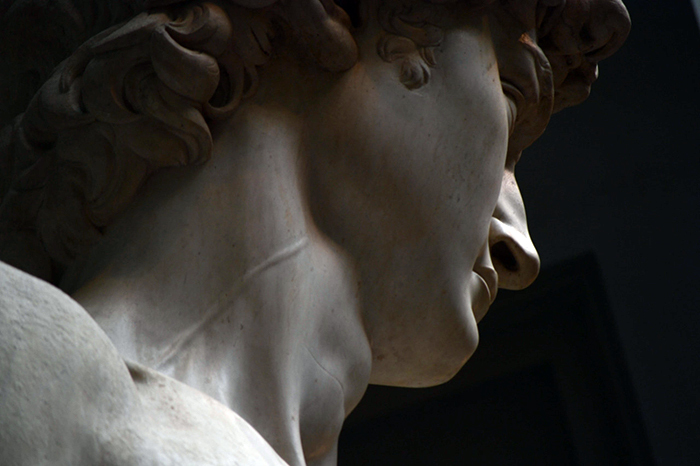
Il David era già gravemente malato
Nel 1866 lo scultore Emilio Santarelli, profondo conoscitore delle opere d’arte, osservava da anni con crescente preoccupazione le condizioni del David. Fu lui a chiedere che il Governo intervenisse.
Venne così nominata una commissione composta da scienziati, ingegneri, geologi, matematici e artisti di assoluto prestigio, tra cui Giovanni Dupré, Quintino Sella, Luigi Menabrea, Giuseppe Poggi, Igino Cocchi ed Enrico Betti.
Il loro compito era semplice ma gravoso: verificare se il David stesse davvero andando incontro alla distruzione. La risposta fu sconvolgente.
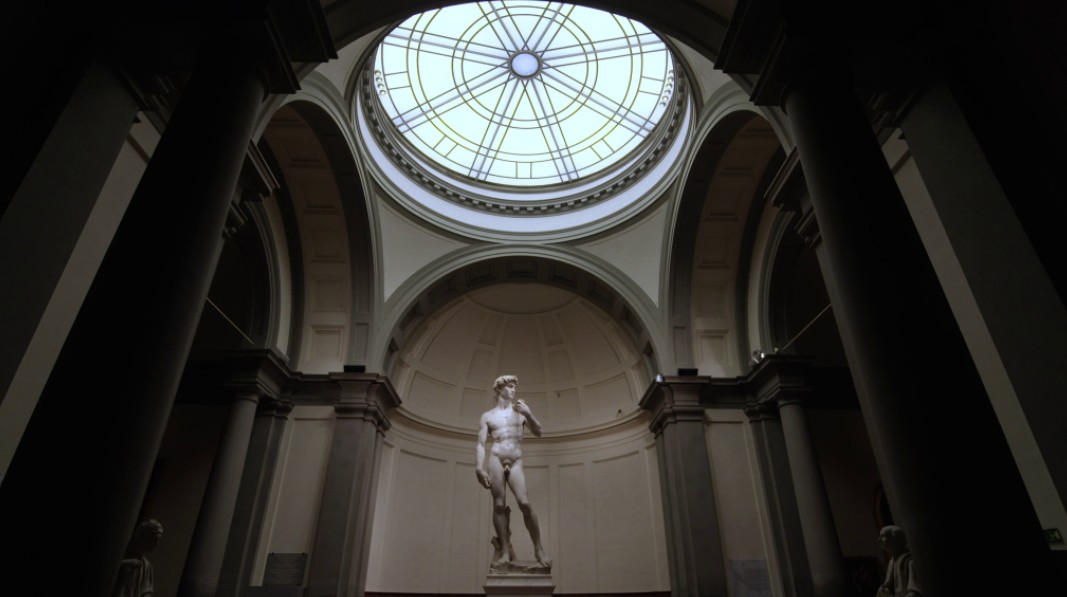
“La statua dovrà di necessità cadere in rovina”
Dopo mesi di sopralluoghi, rilievi e confronti con una precedente ispezione effettuata nel 1852, la Commissione non lasciò spazio ai dubbi.
Scrisse infatti:
«La statua del David di Michelangiolo, lasciata nel sito e nelle condizioni in cui oggi si trova, in un lasso di tempo, che essa non saprebbe precisare, ma che ritiene non poter esser troppo lungo, dovrà di necessità cadere in rovina.»
È una delle frasi più drammatiche mai scritte su una mia opera. Fermatevi un attimo a pensare: non si parlava di danni meramente estetici ma della possibilità di un collasso su sé stessa.
Le crepe stavano aumentando anno dopo anno
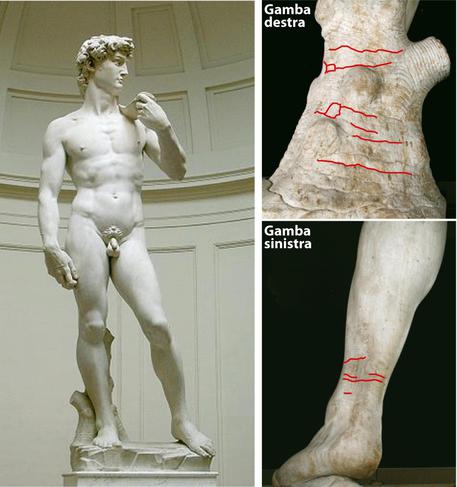
Gli esperti notarono che i cretti, ovvero le fenditure presenti nelle gambe e nel tronco, erano aumentate sensibilmente rispetto all’ispezione precedente.
Scrissero:
«I guasti riconosciuti nell’esame fatto nel 1866 sono sensibilmente maggiori di quelli riscontrati nel 1852.»
Le fratture seguivano tutte una stessa direzione. Il peso della scultura gravava infatti sulle gambe in modo estremamente delicato anche perché con il trascorrere dei secoli il basamento stava cedendo verso il basso sprofondando e il baricentro originale dell’opera, di conseguenza, s’era spostato.
La Commissione spiegava:
«Il complesso dei peli, dei cretti e delle fenditure osservate… accenna troppo chiaramente ad un medesimo sistema di frattura.»
Anche il marmo stava lentamente scomparendo
Il problema non erano soltanto i cretti. Il marmo con il passare dei secoli veniva lentamente eroso dalla pioggia, dall’umidità e dagli sbalzi climatici.
La relazione affermava:
«Il marmo… non è della migliore qualità; esso non è omogeneo e troppo tenero… sotto l’azione continua degli agenti atmosferici diventa, a lungo andare, friabile e si disgrega.»
Gli studiosi scoprirono che in alcune parti erano già andati perduti oltre due millimetri di marmo. Può sembrare poco ma è un’enormità.
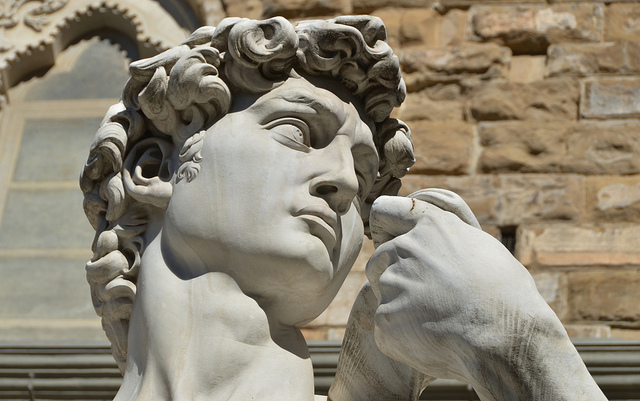
Due millimetri possono cancellare la tensione di un muscolo, la morbidezza di una palpebra, la precisione di una vena.

“La presente generazione si farebbe colpevole verso le future”
La Commissione scrive:
«Se pertanto non si provveda opportunamente a mettere la statua completamente al riparo dell’azione degli agenti atmosferici… la presente generazione si farebbe colpevole verso le future, defraudandole di così preziosa eredità.»
Era il richiamo alla responsabilità che ogni epoca ha nei confronti del patrimonio artistico. Lezione da tener ben presente e valida ancora oggi.
Trasportarlo oppure costruire un edificio attorno al David?
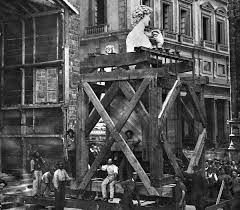
Gli studiosi individuarono soltanto due possibili soluzioni. La prima era costruire una grande struttura di ferro e vetro direttamente davanti a Palazzo Vecchio. La seconda era trasferire la statua al chiuso.
Nella relazione si legge:
«O coprirlo e rinchiuderlo in un apposito edifizio… ovvero trasportarlo.»
La Commissione escluse la prima ipotesi perché avrebbe deturpato la facciata di Palazzo Vecchio. Restò dunque come unica soluzione il trasferimento.
Una copia al posto dell’originale
Gli esperti conclusero la relazione inviata al Ministero con un desiderio preciso. Se il David fosse stato trasferito, davanti a Palazzo Vecchio avrebbe dovuto trovare posto una replica in marmo.
Scrissero:
«Ivi debba essere sostituito da una copia in marmo… onde sia sempre mantenuta al cospetto del pubblico l’immagine di quel miracolo d’arte che è il David.»
È esattamente ciò che sarebbe accaduto negli anni successivi. L’originale trovò finalmente protezione all’interno della Galleria dell’Accademia, mentre una copia continuò a vegliare sulla piazza che per secoli era stata la sua casa.
La salvezza
Così arrivò il momento in cui il David, il giovane pastorello armato della sola fede in Dio, ebbe bisogno dell’aiuto degli uomini e del loro coraggio per salvarsi.
Quella dettagliata relazione del 1867 salvò il David per le future generazioni.
E ogni volta che oggi entrate nella Galleria dell’Accademia e alzate gli occhi verso il David, ricordate che quel capolavoro è arrivato fino a voi anche grazie a quegli studiosi che ebbero il coraggio di scrivere, senza timore:
«A studiare il modo di tramandare la statua, così come ora si trova, alla posterità la più tarda.»
L’arte non appartiene mai soltanto a chi la crea ma anche a chi sa custodirla.
Per il momento il sempre vostro Michelangelo Buonarroti vi saluta dandovi appuntamento ai prossimi post e sui social.
“The David Will Fall into Ruin”: The Dramatic Report of 1867
Who doesn’t know the David and his pride and invincibility? Those who have seen him in photographs or in person, in the tribune created for him by Emilio de Fabris in the Galleria dell’Accademia, have instinctively sensed a sense of power, pride, and eternity.
For centuries, the sculpture remained exposed to the elements on the Arengario of Palazzo Vecchio. Time began to weigh on its shoulders, and it almost seemed as if it might collapse under the weight of old age.
The most illustrious men of newly united Italy wrote this in an official report sent to the Ministry of Education on January 25, 1867, a document that sends shivers down the spine when read now, but allows us to understand how close the David had come to ruin.
The David was already seriously ill
In 1866, the sculptor Emilio Santarelli, a profound connoisseur of works of art, had been observing the David’s condition with growing concern for years. He was the one who asked the government to intervene.
A commission was thus appointed, composed of scientists, engineers, geologists, mathematicians, and artists of the highest caliber, including Giovanni Dupré, Quintino Sella, Luigi Menabrea, Giuseppe Poggi, Igino Cocchi, and Enrico Betti.
Their task was simple but onerous: to verify whether the David was truly on the verge of destruction. The response was shocking.
“The statue must necessarily fall into ruin.”
After months of inspections, surveys, and comparisons with a previous inspection conducted in 1852, the Commission left no room for doubt.
In fact, she wrote:
“Michelangelo’s statue of David, left on the site and in the condition it is in today, will inevitably fall into ruin within a period of time she cannot specify, but which she believes cannot be too long.”
It’s one of the most dramatic sentences ever written about one of my works. Stop and think for a moment: they weren’t talking about merely aesthetic damage, but about the possibility of collapse.
The cracks were increasing year after year
The experts noted that the cretti, or fissures in the legs and trunk, had increased significantly since the previous inspection.
They wrote:
“The damage recognized in the examination conducted in 1866 is noticeably greater than that found in 1852.”
The fractures all followed the same direction. The weight of the sculpture rested extremely delicately on the legs, partly because over the centuries the base was sagging and sinking, and the work’s original center of gravity had consequently shifted.
The Commission explained:
“The complex of hairs, cracks, and fissures observed… suggests too clearly a single fracture system.”
The marble was also slowly disappearing
The problem wasn’t just the cracks. Over the centuries, the marble was slowly eroded by rain, humidity, and climatic changes.
The report stated:
“The marble… is not of the best quality; it is not homogeneous and too soft… under the continuous action of atmospheric agents, it becomes, over time, brittle and disintegrates.”
The scholars discovered that in some areas, more than two millimeters of marble had already been lost. This may not seem like much, but it is a huge amount.
Two millimeters can erase the tension of a muscle, the softness of an eyelid, the precision of a vein.
“The present generation would be guilty of harming future generations.”
The Commission wrote:
“Therefore, if appropriate measures are not taken to completely protect the statue from the elements… the present generation would be guilty of harming future generations, defrauding them of such a precious legacy.”
It was a reminder of the responsibility each age has towards its artistic heritage. A lesson that must be kept in mind and is still valid today.
Transport it or build a building around the David?
The scholars identified only two possible solutions. The first was to build a large iron and glass structure directly in front of Palazzo Vecchio. The second was to move the statue indoors.
The report states:
“Either cover it and enclose it in a special building… or transport it.”
The Commission ruled out the first option because it would have damaged the façade of Palazzo Vecchio. Thus, the only solution was to move it.
A copy in place of the original
The experts concluded their report to the Ministry with a specific wish. If the David were moved, a marble replica would have to stand in front of the Palazzo Vecchio.
They wrote:
“It should be replaced there by a marble copy… so that the image of that miracle of art that is the David is always maintained before the public.”
This is exactly what would happen in the years that followed. The original finally found protection within the Galleria dell’Accademia, while a copy continued to watch over the square that had been its home for centuries.
Salvation
Thus came the moment when David, the young shepherd armed only with faith in God, needed the help of men and their courage to save himself.
That detailed report of 1867 saved the David for future generations.
And every time you enter the Accademia Gallery today and raise your eyes to the David, remember that this masterpiece has come down to you thanks to those scholars who had the courage to fearlessly write:
“To study how to pass on the statue, as it now stands, to the later posterity.”
Art never belongs only to those who create it, but also to those who know how to preserve it.
For now, yours truly, Michelangelo Buonarroti bids you farewell, and invites you to join him in future posts and on social media.

Sostienici – Support Us
Se questo blog ti piace e ti appassiona, puoi aiutarci a farlo crescere sempre più sostenendoci in modo concreto condividendo i post, seguendo le pagine social e con un contributo che ci aiuta ad andare avanti con il nostro lavoro di divulgazione. . ENGLISH: If you like and are passionate about this blog, you can help us make it grow more and more by supporting us in a concrete way by sharing posts, following social pages and with a contribution that helps us to move forward with our dissemination work.
10,00 €
-
Freyja piange oro: la triste storia della dea nordica dipinta da Anne-Marie Zilberman

🇮🇹Le lacrime di Freyja di Anne-Marie Zilberman racconta la dea nordica attraverso il mito, il dolore e l’amore. Scopri la storia delle sue leggendarie lacrime d’oro… 🇬🇧Anne-Marie Zilberman’s *Freyja’s Tears* portrays the Norse goddess through myth, sorrow, and love. Discover the story of her legendary golden tears…
-
I giganti del Barocco: i grandi scultori del Seicento
🇮🇹Nel Seicento la scultura cambia per sempre. A Roma, Bernini, Algardi, Mochi e Maderno trasformano le sculture in scene capaci di coinvolgere lo sguardo e lasciare senza fiato… 🇬🇧In the seventeenth century, sculpture changed forever. In Rome, Bernini, Algardi, Mochi, and Maderno transformed sculptures into scenes capable of captivating the eye and leaving the viewer…
-
Matisse, il mondo intero dentro una stanza: al MUDEC la mostra che racconta la sua arte
🇮🇹’Matisse. Il mondo in una stanza’ al MUDEC di Milano racconta come Africa, Islam, Russia, Cina e Tahiti cambiarono l’arte di Henri Matisse… 🇬🇧’Matisse: The World in a Room’ at MUDEC in Milan tells the story of how Africa, Islam, Russia, China, and Tahiti transformed the art of Henri Matisse…
Condividi:


Questo sono io




sostienici

Sostienici – Support Us
Se questo blog ti piace e ti appassiona, puoi aiutarci a farlo crescere sempre più sostenendoci in modo concreto condividendo i post, seguendo le pagine social e con un contributo che ci aiuta ad andare avanti con il nostro lavoro di divulgazione. . ENGLISH: If you like and are passionate about this blog, you can help us make it grow more and more by supporting us in a concrete way by sharing posts, following social pages and with a contribution that helps us to move forward with our dissemination work.
€10,00


E’ vero, saper conservare nei secoli un’opera simile non è mica cosa da poco. Poi mettici anche le piogge acide di oggi, ed ecco che la scelta del trasferimento appare la più saggia in assoluto 🤷♂️👏👏👏👏👌👌👌😊😊😉👍👍👍👍👍👍👍
"Mi piace"Piace a 1 persona
mai scelta fu appropriata ma il momento di decidere suscitò non pochi dibattiti
"Mi piace"Piace a 1 persona