

Rubata a Vienna la collana della regina Nazli: 673 diamanti e oltre 200 carati, caccia ai due ladri
Una rapina spettacolare nel cuore di Vienna. Due uomini sono entrati come normali visitatori nel Museo di Arti Applicate (MAK) e hanno infranto con un martello la teca che custodiva una straordinaria collana di diamanti appartenuta alla regina Nazli d’Egitto.
Il gioiello, firmato Van Cleef & Arpels, nel 2015 era stato venduto all’asta a New York per 4,3 milioni di dollari.
La polizia austriaca ha diffuso le immagini dei due sospetti, ripresi dalle telecamere di sorveglianza mentre agivano a volto scoperto, e ha avviato una vasta ricerca che si estende anche oltre i confini nazionali. Anche l’Interpol ha inserito il gioiello nella propria banca dati delle opere d’arte rubate.
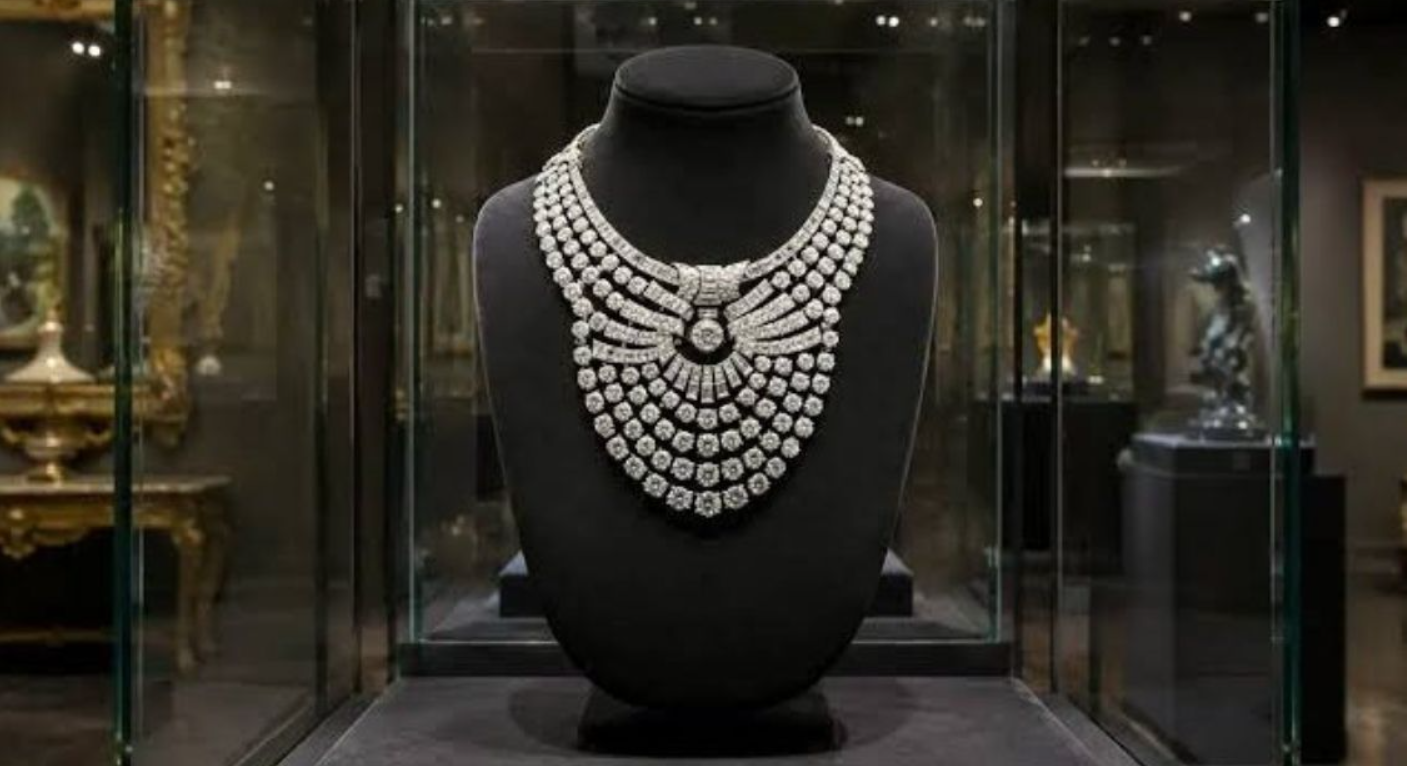
La rapina al museo: entrano con il biglietto e poi distruggono la teca
Il furto è avvenuto nel pomeriggio di giovedì 27 agosto 2026, durante l’orario di apertura del museo.
Secondo la ricostruzione della polizia, i due uomini avrebbero acquistato regolarmente il biglietto e sarebbero entrati nel MAK comportandosi inizialmente come normali visitatori. Dopo aver visitato alcune sale, si sarebbero diretti verso la vetrina che custodiva il prezioso collier.
A quel punto uno dei due avrebbe utilizzato un martello per infrangere il vetro della teca. I ladri hanno afferrato la collana e sono fuggiti a piedi, riuscendo a dileguarsi. L’azione si è consumata davanti ad altri visitatori, ma senza provocare feriti.
Le telecamere hanno però immortalato i sospetti, un elemento che potrebbe rivelarsi decisivo per gli investigatori.
Due uomini ricercati in Austria e all’estero
La polizia viennese ha diffuso le fotografie dei due uomini e ha descritto i sospetti come persone di corporatura esile, alte circa 170-175 centimetri, con capelli e barba scuri. Al momento della rapina indossavano abiti scuri e scarpe da ginnastica.
Le autorità hanno avviato una vasta operazione di ricerca e l’indagine è affidata all’Ufficio criminale regionale di Vienna. È stato inoltre utilizzato un cane specializzato nelle ricerche.
La vicenda ha assunto rapidamente una dimensione internazionale. Il gioiello è stato infatti segnalato nella banca dati dell’Interpol dedicata alle opere d’arte rubate, rendendo più difficile per i responsabili tentare di trasferirlo o rivenderlo attraverso i normali canali del mercato internazionale.
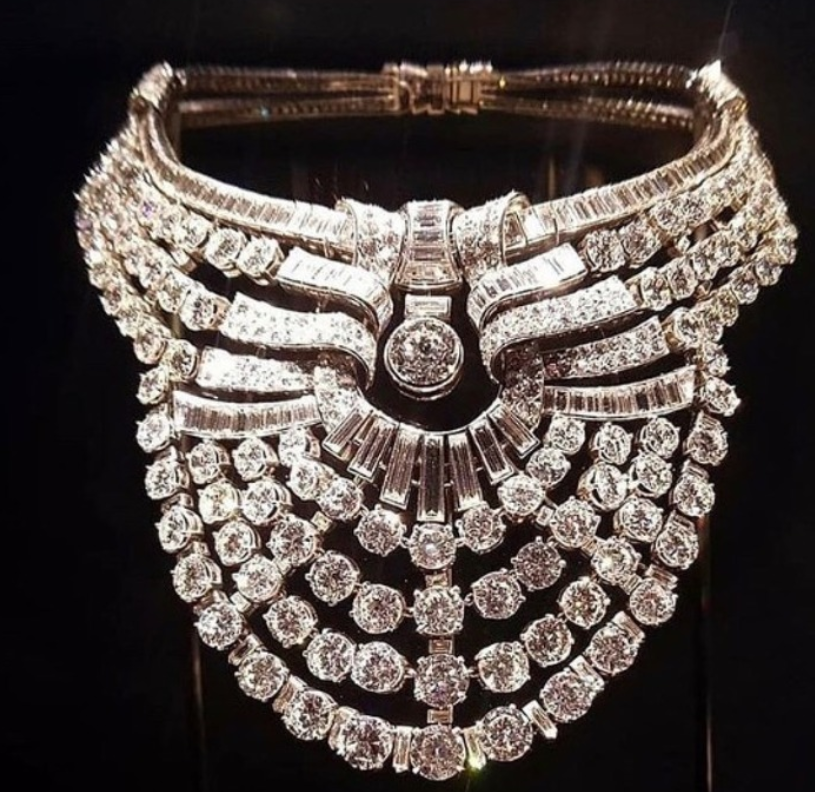
La collana con 673 diamanti: un capolavoro Art déco
Non si tratta soltanto di un gioiello di enorme valore economico. La collana possiede una storia legata alla famiglia reale egiziana e alla grande gioielleria internazionale.
Realizzata nel 1939 da Van Cleef & Arpels, è in platino e presenta 673 diamanti, per un peso complessivo di oltre 200 carati. Le pietre, tra diamanti rotondi e tagli baguette, sono disposte secondo una composizione a raggiera, caratteristica dell’estetica Art déco.
La collana era stata commissionata dalla regina Nazli d’Egitto insieme a una tiara coordinata in occasione di un matrimonio destinato a entrare nella storia delle monarchie del Novecento.
La regina Nazli e il matrimonio della principessa Fawzia
Nazli Sabri, regina consorte d’Egitto e seconda moglie di re Fuad I, fece realizzare il prezioso insieme per le nozze della figlia Fawzia con il principe ereditario iraniano Mohammad Reza Pahlavi, futuro scià di Persia.
Il matrimonio fu celebrato nel 1939 al Cairo e rappresentò uno degli eventi mondani più importanti dell’epoca. La collana rubata a Vienna era dunque parte di un gioiello di corte strettamente legato alla storia delle monarchie egiziana e iraniana.
Nel 2015 fu venduta per 4,3 milioni di dollari
Il collier era già comparso sul mercato internazionale dell’arte e dell’alta gioielleria.
Nel 2015 Sotheby’s lo mise all’asta a New York, dove venne venduto per 4,3 milioni di dollari, una cifra che corrispondeva a circa 3,7 milioni di euro secondo le ricostruzioni riportate dalla stampa e i dati della casa d’aste.
Proprio questa precedente vendita permette di comprendere la straordinaria importanza economica del gioiello, anche se la polizia viennese non ha diffuso una nuova stima ufficiale del suo valore.
Il gioiello era esposto nella mostra Van Cleef & Arpels
La collana era arrivata al MAK nell’ambito della mostra “Prime Pieces: Van Cleef & Arpels High Jewellery x Masterpieces from the MAK Collection”, dedicata alla maison francese e alle sue creazioni.
L’esposizione avrebbe dovuto rimanere aperta fino al 27 settembre 2026 e presentava centinaia di opere e gioielli della celebre maison. Dopo il furto, l’area interessata è stata naturalmente chiusa e il museo ha collaborato con gli investigatori.
Un altro clamoroso furto nei musei europei
Il colpo di Vienna si inserisce in una preoccupante serie di furti spettacolari che negli ultimi tempi hanno coinvolto musei europei e gioielli di enorme valore.
Il caso riporta alla memoria anche il furto della Saliera di Benvenuto Cellini dal Kunsthistorisches Museum di Vienna nel 2003. L’opera, valutata allora circa 50 milioni di euro, venne recuperata tre anni dopo.
La nuova rapina riaccende così il dibattito sulla sicurezza dei musei e sulla vulnerabilità delle esposizioni temporanee, soprattutto quando custodiscono oggetti facilmente trasportabili ma di valore eccezionale.
Questa volta, però, gli investigatori possono contare su un elemento importante: i due presunti ladri non indossavano maschere e sono stati ripresi dalle telecamere. La caccia alla collana della regina Nazli e ai suoi due rapinatori è quindi appena cominciata.
Insomma, quest’estate, oltre a essere caratterizzata da un’incredibile ondata di calore, è anche la stagione nera per il mondo dell’arte soprattutto per i furti che si sono verificati nel corso degli ultimi tre mesi.
Per il momento il sempre vostro Michelangelo Buonarroti vi saluta dandovi appuntamento ai prossimi post e sui social.
Queen Nazli’s necklace stolen in Vienna: 673 diamonds and over 200 carats, hunt for two thieves
A spectacular robbery in the heart of Vienna. Two men entered the Museum of Applied Arts (MAK) as ordinary visitors and smashed the display case containing an extraordinary diamond necklace that belonged to Queen Nazli of Egypt with a hammer. The jewel, designed by Van Cleef & Arpels, was sold at auction in New York in 2015 for $4.3 million.
The Austrian police have released surveillance footage of the two suspects, captured uncovered, and have launched a vast search that extends beyond the national borders. Interpol has also added the jewel to its database of stolen art.
Museum robbery: they enter with the ticket and then destroy the display case
The theft occurred on the afternoon of Thursday, August 27, 2026, during museum opening hours.
According to the police reconstruction, the two men purchased a valid ticket and entered the MAK, initially acting like ordinary visitors. After visiting several rooms, they headed toward the display case containing the precious necklace.
At that point, one of the men used a hammer to smash the glass case. The thieves grabbed the necklace and fled on foot, managing to escape. The attack occurred in front of other visitors, but without causing any injuries.
However, cameras captured the suspects, a finding that could prove decisive for investigators.
Two men wanted in Austria and abroad
Viennese police have released photographs of the two men and described the suspects as slim, approximately 170-175 centimeters tall, with dark hair and a beard. At the time of the robbery, they were wearing dark clothing and sneakers.
Authorities have launched a large-scale search operation, and the investigation is being handled by the Vienna Regional Criminal Office. A specialized search dog has also been deployed.
The story quickly gained international prominence. The jewel was reported to the Interpol database dedicated to stolen works of art, making it more difficult for those responsible to attempt to transfer or resell it through normal international market channels.
The 673-Diamond Necklace: An Art Deco Masterpiece
It’s not just a jewel of enormous economic value. The necklace has a history tied to the Egyptian royal family and to the great international jewelry industry.
Made in 1939 by Van Cleef & Arpels, it is made of platinum and features 673 diamonds, weighing over 200 carats. The stones, including round and baguette-cut diamonds, are arranged in a radial composition, characteristic of the Art Deco aesthetic.
The necklace was commissioned by Queen Nazli of Egypt, along with a matching tiara, for a wedding destined to go down in the history of twentieth-century monarchies.
Queen Nazli and the Wedding of Princess Fawzia
Nazli Sabri, Queen Consort of Egypt and second wife of King Fuad I, had the precious ensemble made for the wedding of her daughter Fawzia to Iranian Crown Prince Mohammad Reza Pahlavi, the future Shah of Persia.
The wedding took place in 1939 in Cairo and was one of the most important social events of the time. The necklace stolen in Vienna was therefore part of a court jewel closely linked to the history of the Egyptian and Iranian monarchies.
In 2015, it was sold for $4.3 million
The necklace had already appeared on the international art and fine jewelry markets.
In 2015, Sotheby’s auctioned it in New York, where it sold for $4.3 million, a figure equivalent to approximately €3.7 million according to press reports and auction house data.
This previous sale provides insight into the jewel’s extraordinary economic importance, even though the Viennese police have not released a new official estimate of its value.
The jewel was exhibited in the Van Cleef & Arpels exhibition
The necklace arrived at the MAK as part of the exhibition “Prime Pieces: Van Cleef & Arpels High Jewelry x Masterpieces from the MAK Collection,” dedicated to the French fashion house and its creations.
The exhibition was supposed to remain open until September 27, 2026, and featured hundreds of works and jewelry from the famous fashion house. Following the theft, the affected area was naturally closed, and the museum cooperated with investigators.
Another sensational theft from European museums
The Vienna theft is part of a worrying series of spectacular thefts involving European museums and jewels of enormous value in recent times.
The case also brings to mind the theft of Benvenuto Cellini’s Salt Cellar from the Kunsthistorisches Museum in Vienna in 2003. The work, then valued at around €50 million, was recovered three years later.
The new robbery thus reignites the debate on museum security and the vulnerability of temporary exhibitions, especially when they house easily transportable yet exceptionally valuable objects.
This time, however, investigators can count on an important piece of evidence: the two alleged thieves were not wearing masks and were caught on camera. The hunt for Queen Nazli’s necklace and its two robbers has therefore only just begun.
In short, this summer, in addition to being characterized by an incredible heat wave, is also a dark season for the art world, especially due to the thefts that have occurred over the last three months.
For now, yours truly, Michelangelo Buonarroti bids farewell and says he will see you in future posts and on social media.

Sostienici – Support Us
Se questo blog ti piace e ti appassiona, puoi aiutarci a farlo crescere sempre più sostenendoci in modo concreto condividendo i post, seguendo le pagine social e con un contributo che ci aiuta ad andare avanti con il nostro lavoro di divulgazione. . ENGLISH: If you like and are passionate about this blog, you can help us make it grow more and more by supporting us in a concrete way by sharing posts, following social pages and with a contribution that helps us to move forward with our dissemination work.
10,00 €
-
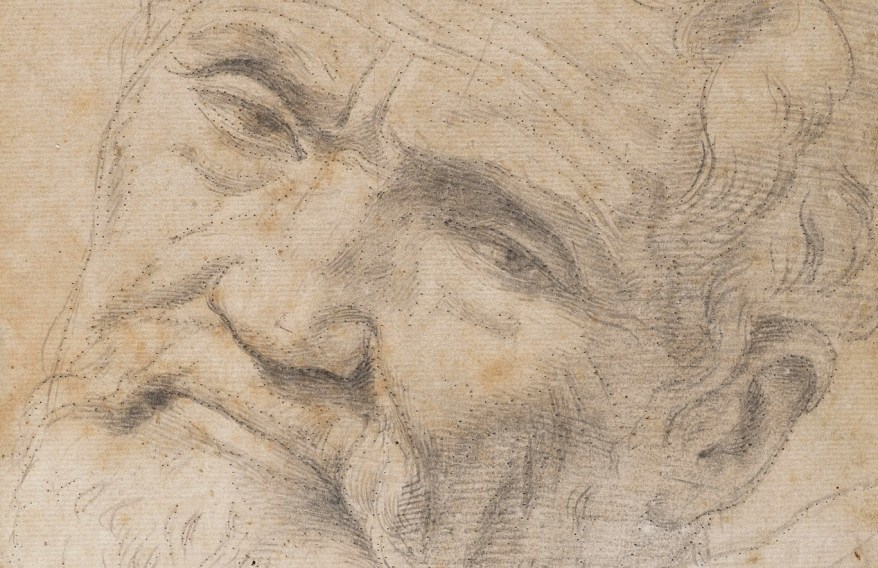
Facevo paura anche ai papi
🇮🇹Facevo paura persino ai papi. Non sono mai stato famoso per la diplomazia. Avevo un carattere difficile, poca pazienza e nessuna voglia di compiacere i potenti… 🇬🇧I struck fear even into popes. I was never known for diplomacy. I had a difficult temperament, little patience, and no desire to curry favor with the powerful…
-

Pontormo a Roma: apre oggi la grande mostra alle Scuderie del Quirinale
🇮🇹Apre oggi a Roma la mostra di Pontormo: oltre 130 opere, la celebre Visitazione, dipinti, disegni e prestiti internazionali alle Scuderie del Quirinale… 🇬🇧A Pontormo exhibition opens today in Rome at the Scuderie del Quirinale, featuring over 130 works—including the famous *Visitation*—as well as paintings, drawings, and international loans…
-
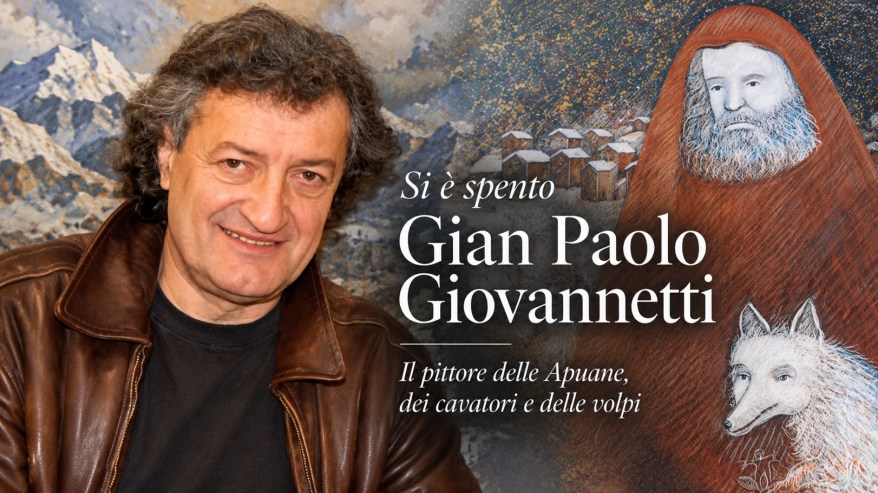
Si è spento Gian Paolo Giovannetti, il pittore delle Apuane, dei cavatori e delle volpi
🇮🇹È morto Gian Paolo Giovannetti, pittore e scultore di Giustagnana. Il ricordo di un artista che ha raccontato Apuane, cavatori, volpi e Alta Versilia… 🇬🇧Gian Paolo Giovannetti, a painter and sculptor from Giustagnana, has passed away. A tribute to an artist who chronicled the Apuan Alps, quarrymen, foxes, and Alta Versilia…
Condividi:


Questo sono io




sostienici

Sostienici – Support Us
Se questo blog ti piace e ti appassiona, puoi aiutarci a farlo crescere sempre più sostenendoci in modo concreto condividendo i post, seguendo le pagine social e con un contributo che ci aiuta ad andare avanti con il nostro lavoro di divulgazione. . ENGLISH: If you like and are passionate about this blog, you can help us make it grow more and more by supporting us in a concrete way by sharing posts, following social pages and with a contribution that helps us to move forward with our dissemination work.
€10,00


