25 novembre, Santa Caterina d’Alessandria nell’arte: la santa censurata nel mio Giudizio Universale
Il 25 novembre si celebra Santa Caterina d’Alessandria, giovane martire cristiana diventata nei secoli una delle figure più rappresentate nella storia dell’arte.
Da Raffaello a Caravaggio, fino al mio Giudizio Universale, ecco come gli artisti hanno raccontato la sua storia e il suo martirio.
Chi era Santa Caterina d’Alessandria? La storia della giovane martire
Di Caterina d’Alessandria non possediamo testimonianze storiche certe che consentano di ricostruirne con sicurezza la vita. La sua vicenda ci è stata tramandata soprattutto attraverso la Passio, un racconto agiografico formatosi tra il V e il VII secolo, che descrive il suo martirio e la sua straordinaria fermezza nella fede.
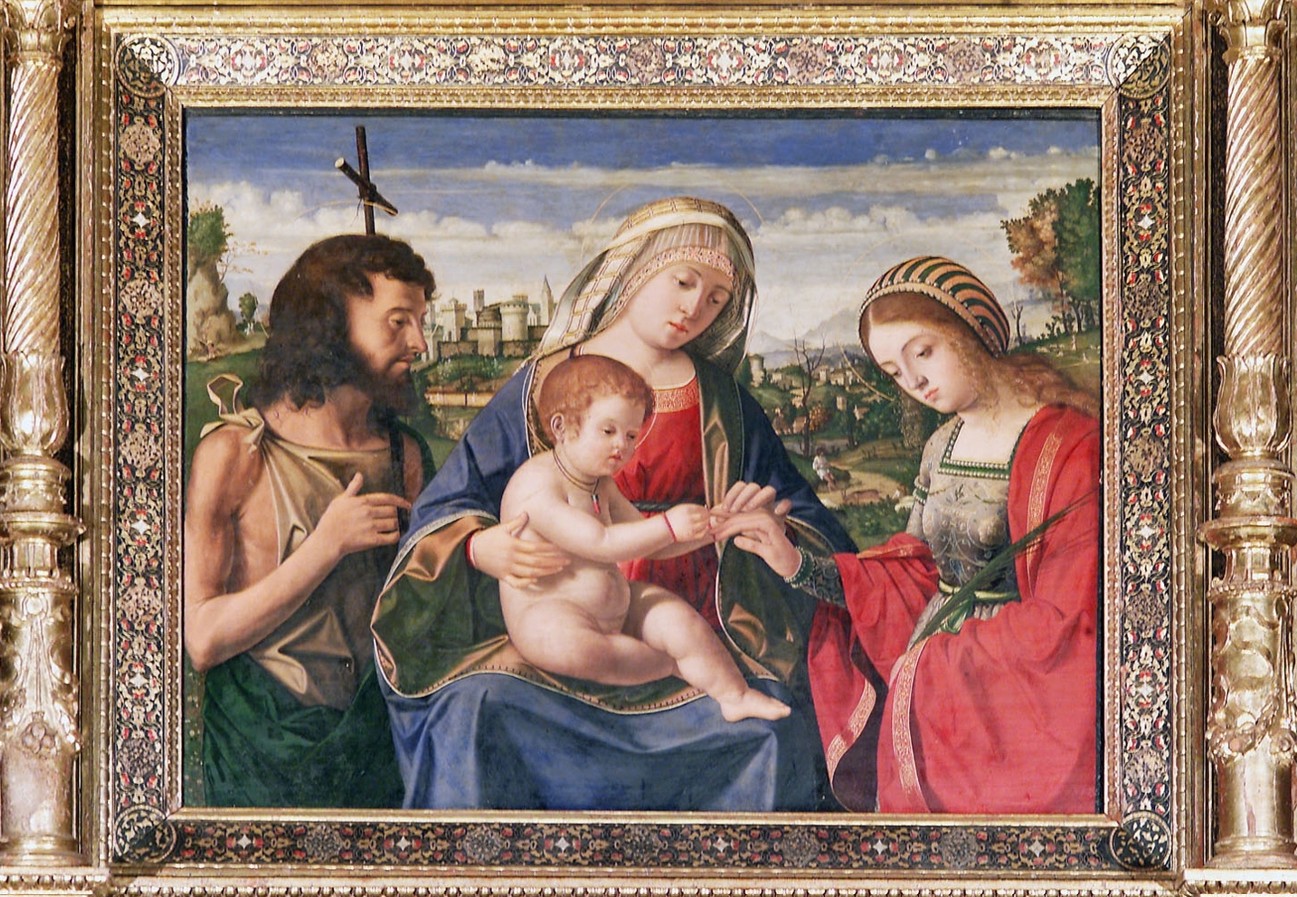

La tradizione colloca la sua esistenza agli inizi del IV secolo, durante le persecuzioni contro i cristiani, ad Alessandria d’Egitto. Caterina sarebbe stata una giovane di nobili origini, bellissima e dotata di una cultura e di una sapienza fuori dal comune.
Secondo il racconto della Passio, l’imperatore Massenzio, indicato in alcune versioni della leggenda anche con il nome di Massimino, giunse ad Alessandria e volle celebrare un grande sacrificio agli dèi pagani. Fece uccidere ben 130 tori e ordinò che la popolazione seguisse il suo esempio: i più ricchi avrebbero dovuto sacrificare un toro, mentre i poveri un uccello.
Fu allora che una giovane di appena diciotto anni si fece avanti. Era Caterina.
Senza lasciarsi intimidire dalla presenza dell’imperatore, gli rimproverò apertamente il culto degli dei pagani e lo invitò a riconoscere il vero Creatore del mondo e Gesù Cristo, attraverso il quale l’umanità era stata liberata dal peccato.
Le sue parole colpirono profondamente il sovrano, che la convocò a palazzo e decise di metterla alla prova.
La sapienza di Caterina e il confronto con i filosofi
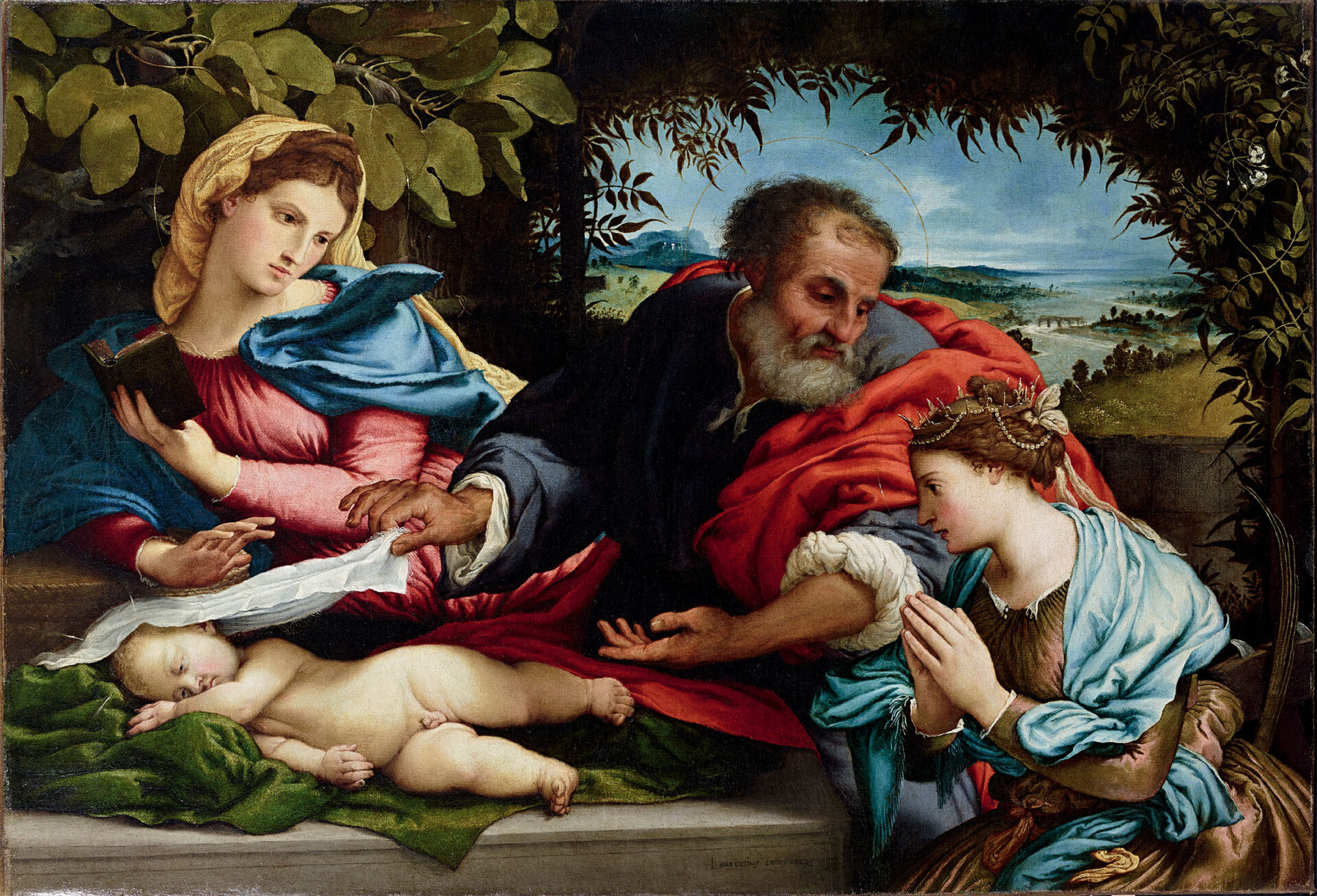
L’imperatore volle che Caterina si confrontasse con i più illustri filosofi e sapienti del suo tempo, convinto che sarebbero riusciti a confutare le sue argomentazioni. Accadde invece il contrario.
La giovane sostenne il confronto con tale abilità che, secondo la narrazione agiografica, i filosofi rimasero conquistati dalle sue parole e si convertirono al cristianesimo. Una decisione che fece infuriare l’imperatore, il quale ordinò che fossero messi a morte sul rogo.
Massenzio, che secondo la leggenda era già sposato, tentò allora di conquistare Caterina offrendole la corona e la possibilità di diventare sua moglie. La giovane rifiutò la proposta. Aveva già scelto il suo sposo, Cristo, e non intendeva rinunciare alla propria fede.

La reazione dell’imperatore fu spietata. Caterina venne imprigionata e condannata a morire di fame. Durante la prigionia, sempre secondo il racconto tradizionale, una colomba le avrebbe portato quotidianamente il nutrimento. Non riuscendo a piegarla, i suoi persecutori decisero di sottoporla a un supplizio ancora più crudele: una macchina munita di ruote e chiodi appuntiti avrebbe dovuto straziarle il corpo.
Ma anche questa volta si verificò un miracolo. Quando la giovane venne avvicinata allo strumento di tortura, le ruote si spezzarono e i chiodi si spuntarono. Il popolo, sconvolto dall’accaduto, avrebbe gridato che il Dio dei cristiani era il vero Dio.
La condanna a morte venne infine eseguita attraverso la decapitazione. La tradizione racconta che dal collo della martire non sgorgò sangue, ma latte, e che gli angeli trasportarono miracolosamente il suo corpo sul monte Sinai, dove ancora oggi è venerata presso il monastero a lei dedicato.
Gli attributi iconografici di Santa Caterina: come riconoscerla nei dipinti
Se vi capita di incontrare una figura femminile con una ruota dentata, una palma e una spada, è sicuramente Santa Caterina d’Alessandria. Gli artisti hanno utilizzato nel tempo alcuni attributi ricorrenti per renderla immediatamente riconoscibile.
La ruota dentata, spesso rappresentata spezzata, ricorda il supplizio dal quale sarebbe miracolosamente sopravvissuta. La spada richiama la decapitazione, mentre la palma è il simbolo tradizionale del martirio cristiano.
Non mancano la corona, riferimento alle sue leggendarie origini nobili, e talvolta un libro, che allude alla sua sapienza e alla sua cultura.
Santa Caterina nel manoscritto Vallicelliano: una miniatura del Quattrocento
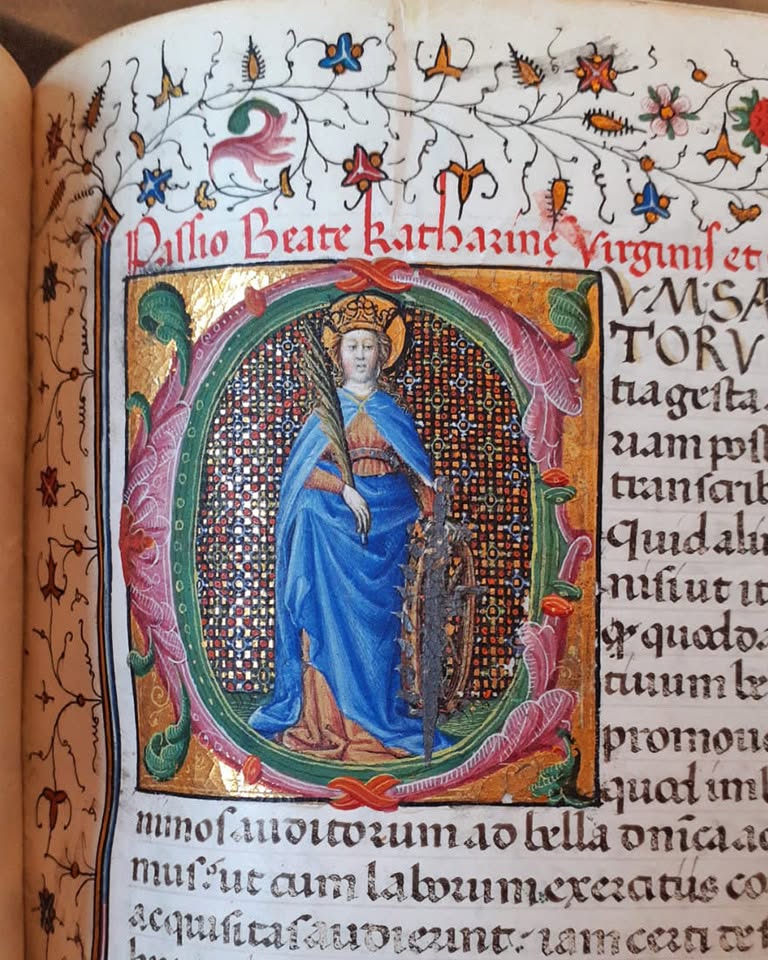
L’immagine di Santa Caterina non appartiene soltanto alle grandi pale d’altare e ai dipinti celebri. La troviamo anche nelle pagine miniate dei manoscritti medievali. Un esempio particolarmente interessante si trova nel manoscritto Vallicelliano F 49, dove è presente un’iniziale miniata raffigura Santa Caterina d’Alessandria con i suoi attributi tradizionali.
La giovane martire tiene con sé la ruota chiodata del supplizio, alla quale sarebbe miracolosamente sopravvissuta, e la spada utilizzata per la sua decapitazione. Completano la rappresentazione la palma del martirio e la corona.
Il manoscritto contiene la Passio beate Katharinae virginis et martiris ed è databile tra il 1441 e il 1460.
Santa Caterina d’Alessandria di Raffaello: la grazia del Rinascimento
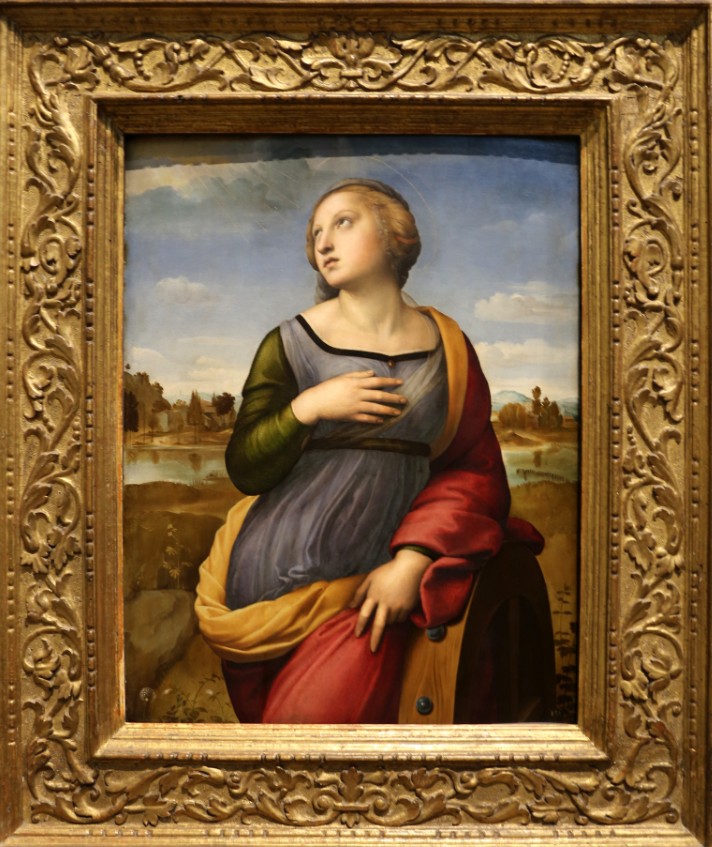
Raffaello dedicò alla giovane martire il dipinto oggi conservato alla National Gallery di Londra.
La santa è raffigurata appoggiata alla ruota dentata. Il corpo si sviluppa in una posa elegante, con il busto leggermente inclinato e il volto rivolto verso l’alto, in un movimento che sembra sospendere la figura tra la dimensione terrena e quella spirituale.
L’opera viene generalmente datata intorno al 1507-1508, quando Raffaello era ancora giovane ma aveva già raggiunto una notevole maturità artistica.
In quegli anni il pittore urbinate si stava affermando come uno dei protagonisti del Rinascimento italiano. In questa Santa Caterina si avverte anche una sensibilità per il modellato monumentale del corpo che guarda alla grande tradizione fiorentina. La posizione della santa e il gioco dei contrapposti richiamano quella ricerca plastica che aveva trovato espressione anche nelle mie opere.

La mia Santa Caterina d’Alessandria nel Giudizio Universale: una figura censurata
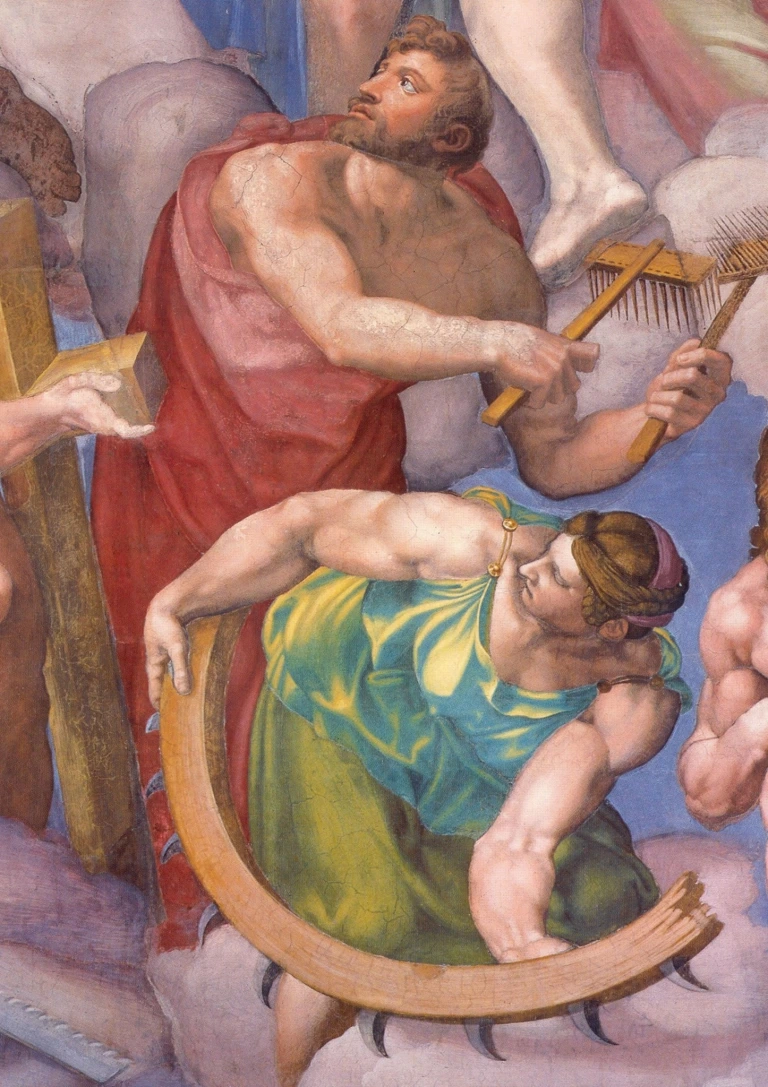
Anch’io volli riservare a Caterina un posto nel mio Giudizio Universale. La collocai accanto a San Biagio, riconoscibile dai pettini di ferro con i quali, secondo la tradizione, era stato torturato. La santa, invece, era identificabile attraverso la ruota dentata spezzata che teneva tra le mani.
L’affrescai senza vesti, come feci con molte altre figure del grande affresco. Non intendevo certo scandalizzare qualcuno: nel mio Giudizio i corpi sono corpi, manifestazioni della condizione umana davanti al destino ultimo. La nudità aveva un significato che andava ben oltre il semplice desiderio di mostrare l’anatomia.
Papa Paolo III Farnese non ebbe nulla da ridire su questa scelta. I benpensanti arrivati dopo, invece, ebbero molto da obiettare. Con il Concilio di Trento e la successiva applicazione delle disposizioni sulla moralità delle immagini sacre, il mio affresco finì sotto la lente di chi riteneva sconveniente quella libertà espressiva che avevo rivendicato.
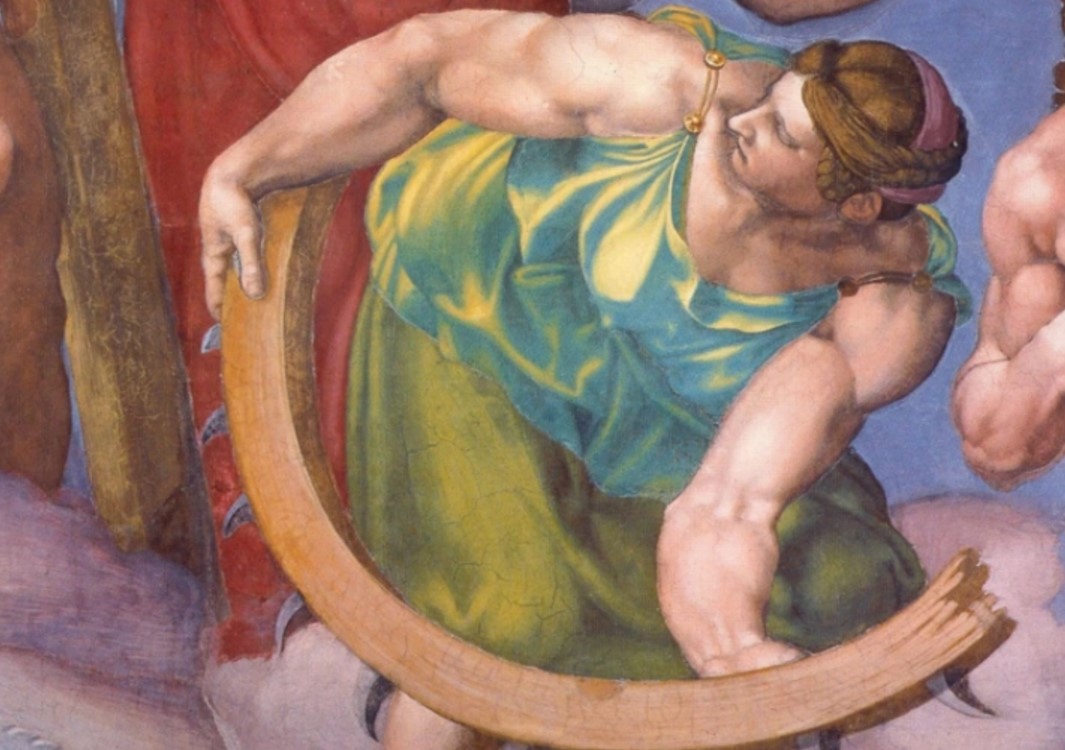
A Daniele da Volterra spettò il compito di coprire le nudità che io avevo lasciato volutamente visibili, aggiungendo panneggi e vestimenti. Per San Biagio e Santa Caterina la sorte fu però peggiore.
I malpensanti, perché spesso mal fanno, interpretarono la posizione delle due figure come qualcosa che potesse alludere a un rapporto sessuale. Una lettura che nulla aveva a che fare con le mie intenzioni.
Daniele dovette quindi intervenire in maniera drastica, scalpellando via le due figure e ridipingendole. Di quello che avevo realizzato rimase ben poco. La vicenda è documentata anche dalle polemiche che seguirono la realizzazione dell’affresco. Gilio, scrivendo a papa Carafa, contestò proprio la posizione del gruppo di San Biagio e Santa Caterina:
«Per meglio fare le persone ridere, l’ha fatta chinare dinanzi a San Biagio con atto poco onesto, il quale, standole sopra coi pettini, par che gli minacci che stia fissa, et ella si rivolta a lui in guisa che dice -che farai?- o simil cosa».
Per fortuna, possiamo farci un’idea abbastanza precisa di come apparisse originariamente questa parte dell’affresco grazie alla copia realizzata da Marcello Venusti, che conserva una testimonianza preziosa della composizione prima degli interventi di censura.
Santa Caterina d’Alessandria di Caravaggio: la martire dagli occhi inquieti
Tra il 1598 e il 1599 Caravaggio realizzò una straordinaria Santa Caterina d’Alessandria, oggi custodita al Museo Nacional Thyssen-Bornemisza di Madrid.
Il dipinto faceva parte della collezione del cardinale Francesco Maria Del Monte, grande mecenate e protettore del pittore, che ebbe un ruolo importante nella sua formazione e nella sua carriera.
La rappresentazione si allontana sensibilmente dalle immagini tradizionali della santa. Caterina é una giovane donna dalla presenza concreta, con uno sguardo intenso e quasi interrogativo. È seduta accanto alla ruota dentata, mentre tiene in mano la spada. Accanto a lei compare la palma, simbolo del martirio.

Caravaggio costruisce la composizione attraverso un chiaroscuro potente, facendo emergere il volto, le mani e i particolari della figura da uno sfondo scuro. La luce non si limita a illuminare la scena: modella il corpo, crea profondità e conferisce alla giovane una presenza quasi tangibile.
La modella sarebbe stata probabilmente Fillide Melandroni, una cortigiana romana che posò anche per altre opere del pittore.
Per il momento il sempre vostro Michelangelo Buonarroti vi saluta dandovi appuntamento ai prossimi post e sui social.
November 25th, Saint Catherine of Alexandria in Art: The Saint Censored in My Last Judgment
November 25th marks the feast day of Saint Catherine of Alexandria, a young Christian martyr who, over the centuries, has become one of the most frequently depicted figures in the history of art.
From Raphael to Caravaggio—and even within my own Last Judgment—let us explore how artists have portrayed her story and her martyrdom.
Who was Saint Catherine of Alexandria? The Story of the Young Martyr
There is no definitive historical evidence regarding Saint Catherine of Alexandria that allows us to reconstruct her life with certainty. Her story has come down to us primarily through the Passio—a hagiographical account that took shape between the 5th and 7th centuries—which describes her martyrdom and her extraordinary steadfastness in the faith.
Tradition places her life in the early 4th century, in Alexandria, Egypt, during the persecutions of Christians. Catherine was said to be a young woman of noble birth, possessing great beauty as well as exceptional learning and wisdom.
According to the Passio, the Emperor Maxentius (referred to as Maximinus in some versions of the legend) arrived in Alexandria and sought to hold a grand sacrifice to the pagan gods. He ordered the slaughter of 130 bulls and commanded the populace to follow suit: the wealthy were expected to sacrifice a bull, while the poor were to offer a bird.
It was then that a young woman, only eighteen years old, stepped forward. It was Catherine.
Unintimidated by the Emperor’s presence, she openly rebuked him for his worship of pagan gods and urged him to acknowledge the true Creator of the world and Jesus Christ, through whom humanity had been redeemed from sin. Her words struck the sovereign deeply; he summoned her to the palace and decided to put her to the test.
Catherine’s wisdom and her encounter with the philosophers
The emperor arranged for Catherine to engage in debate with the most illustrious philosophers and scholars of the time, convinced that they would easily refute her arguments. Instead, the opposite occurred.
The young woman held her own with such skill that, according to hagiographic accounts, the philosophers were won over by her words and converted to Christianity. This decision infuriated the emperor, who ordered that they be put to death at the stake.
Maxentius—who, according to legend, was already married—then attempted to win Catherine over by offering her a crown and the chance to become his wife. She rejected the proposal; she had already chosen her spouse—Christ—and had no intention of renouncing her faith.
The emperor’s reaction was ruthless. Catherine was imprisoned and condemned to starve to death. During her imprisonment, as the traditional account goes, a dove brought her nourishment every day. Unable to break her resolve, her persecutors decided to subject her to an even crueler torment: a device fitted with wheels and sharp spikes, intended to tear her body apart.
Yet, once again, a miracle occurred. As she was brought toward the instrument of torture, the wheels shattered and the spikes grew blunt. The crowd, stunned by what they had witnessed, reportedly cried out that the God of the Christians was the true God.
Ultimately, her death sentence was carried out by beheading. Tradition holds that, rather than blood, milk flowed from the martyr’s neck, and that angels miraculously transported her body to Mount Sinai, where she is still venerated today at the monastery dedicated to her.
The iconographic attributes of Saint Catherine: how to identify her in paintings
If you happen to come across a female figure accompanied by a toothed wheel, a palm branch, and a sword, it is almost certainly Saint Catherine of Alexandria. Over time, artists have employed specific, recurring attributes to make her instantly recognizable.
The toothed wheel—often depicted broken—recalls the torture from which she is said to have miraculously survived. The sword alludes to her beheading, while the palm branch serves as the traditional symbol of Christian martyrdom.
She is also frequently shown wearing a crown, a reference to her legendary noble origins, and sometimes holding a book, which signifies her wisdom and learning.
Saint Catherine in the Vallicelliana manuscript: a 15th-century illumination
The image of Saint Catherine is not limited to grand altarpieces or famous paintings; she also appears within the illuminated pages of medieval manuscripts. A particularly compelling example can be found in the Vallicelliana manuscript F 49, which features an illuminated initial depicting Saint Catherine of Alexandria with her traditional attributes.
The young martyr holds the spiked wheel of her torture—from which she supposedly survived by a miracle—along with the sword used for her beheading. The palm of martyrdom and a crown complete the depiction.
The manuscript contains the Passio beate Katharinae virginis et martiris, which can be dated to between 1441 and 1460.
Raphael’s Saint Catherine of Alexandria: The Grace of the Renaissance
Raphael dedicated a painting—now housed in the National Gallery in London—to the young martyr.
The saint is depicted leaning against a toothed wheel. Her body is arranged in an elegant pose, with her torso slightly inclined and her face turned upward—a movement that seems to suspend the figure between the earthly and spiritual realms.
The work is generally dated to around 1507–1508, a time when Raphael was still young but had already attained a remarkable artistic maturity.
During those years, the painter from Urbino was establishing himself as a leading figure of the Italian Renaissance. In this Saint Catherine, one can also sense a sensitivity toward the monumental modeling of the human form, drawing upon the great Florentine tradition. The saint’s posture and the interplay of contrapposto evoke the same exploration of sculptural form that also found expression in my own works.
My Saint Catherine of Alexandria in the Last Judgment: A Censored Figure
I, too, chose to include Catherine in my Last Judgment. I placed her beside Saint Blaise, who is recognizable by the iron combs with which, according to tradition, he was tortured. The saint, meanwhile, could be identified by the broken toothed wheel she held in her hands.
I painted her without clothing, just as I did with many other figures in that grand fresco. It was certainly not my intention to cause scandal; in my Last Judgment, bodies are simply bodies—manifestations of the human condition facing its ultimate destiny. Their nudity carried a meaning that went far beyond a mere desire to display anatomy. Pope Paul III Farnese had no objections to this choice. Those with more rigid moral sensibilities who came later, however, took great issue with it. With the Council of Trent and the subsequent enforcement of rules regarding the propriety of sacred imagery, my fresco came under the scrutiny of those who deemed the expressive freedom I had claimed to be inappropriate.
The task of covering the nudity I had intentionally left visible—by adding drapery and garments—fell to Daniele da Volterra. For Saint Blaise and Saint Catherine, however, the outcome was even worse.
Certain narrow-minded critics—who often harbor impure thoughts themselves—interpreted the positioning of these two figures as an allusion to a sexual act—an interpretation that had nothing to do with my original intentions.
Daniele was therefore forced to take drastic measures: he chiseled away the two figures and repainted them. Very little of my original work remained. This episode is well-documented in the controversies that followed the fresco’s completion. In a letter to Pope Carafa, Gilio specifically took issue with the positioning of the figures of Saint Blaise and Saint Catherine:
“To elicit laughter, he has depicted her bending over before Saint Blaise in a rather indecent manner; he stands over her, holding his combs, as if commanding her to remain still, while she turns toward him as if to ask, ‘What will you do?’—or something to that effect.”
Fortunately, we can form a fairly accurate idea of how this part of the fresco originally appeared, thanks to a copy by Marcello Venusti, which serves as a valuable record of the composition as it existed before the acts of censorship.
Caravaggio’s Saint Catherine of Alexandria: The Martyr with Restless Eyes
Between 1598 and 1599, Caravaggio created an extraordinary Saint Catherine of Alexandria, now housed at the Museo Nacional Thyssen-Bornemisza in Madrid.
The painting was once part of the collection of Cardinal Francesco Maria Del Monte—a great patron and protector of the artist—who played a significant role in his development and career.
This depiction departs notably from traditional representations of the saint. Catherine appears as a young woman with a tangible, physical presence, her gaze intense and almost questioning. She sits beside a spiked wheel, holding a sword in her hand; nearby, a palm frond—the symbol of martyrdom—is also visible.
Caravaggio constructs the composition through a powerful use of chiaroscuro, allowing the figure’s face, hands, and other details to emerge from a dark background. The light does more than simply illuminate the scene; it sculpts the body, creates depth, and lends the young woman an almost palpable presence.
The model is believed to have been Fillide Melandroni, a Roman courtesan who also posed for several of the artist’s other works.
For now, yours truly, Michelangelo Buonarroti, bids you farewell—until the next post, here or on social media.
Sostienici – Support Us
Se questo blog ti piace e ti appassiona, puoi aiutarci a farlo crescere sempre più sostenendoci in modo concreto condividendo i post, seguendo le pagine social e con un contributo che ci aiuta ad andare avanti con il nostro lavoro di divulgazione. . ENGLISH: If you like and are passionate about this blog, you can help us make it grow more and more by supporting us in a concrete way by sharing posts, following social pages and with a contribution that helps us to move forward with our dissemination work.
10,00 €
Condividi:


Questo sono io



sostienici

Sostienici - Support Us
Se questo blog ti piace e ti appassiona, puoi aiutarci a farlo crescere sempre più sostenendoci in modo concreto condividendo i post, seguendo le pagine social e con un contributo che ci aiuta ad andare avanti con il nostro lavoro di divulgazione. . ENGLISH: If you like and are passionate about this blog, you can help us make it grow more and more by supporting us in a concrete way by sharing posts, following social pages and with a contribution that helps us to move forward with our dissemination work.
€10,00