

Alba nel paese di Circe: il grande dipinto di Giulio Aristide Sartorio che porta il mito sulla spiaggia
C’è qualcosa di ipnotico nell’Alba nel paese di Circe di Giulio Aristide Sartorio. Non sono solo le dimensioni notevoli della tela a catturare lo sguardo e i pensieri ma è quella luce sospesa che pare voler cancellare il confine fra il paesaggio reale e il mondo antico, quasi mitologico.
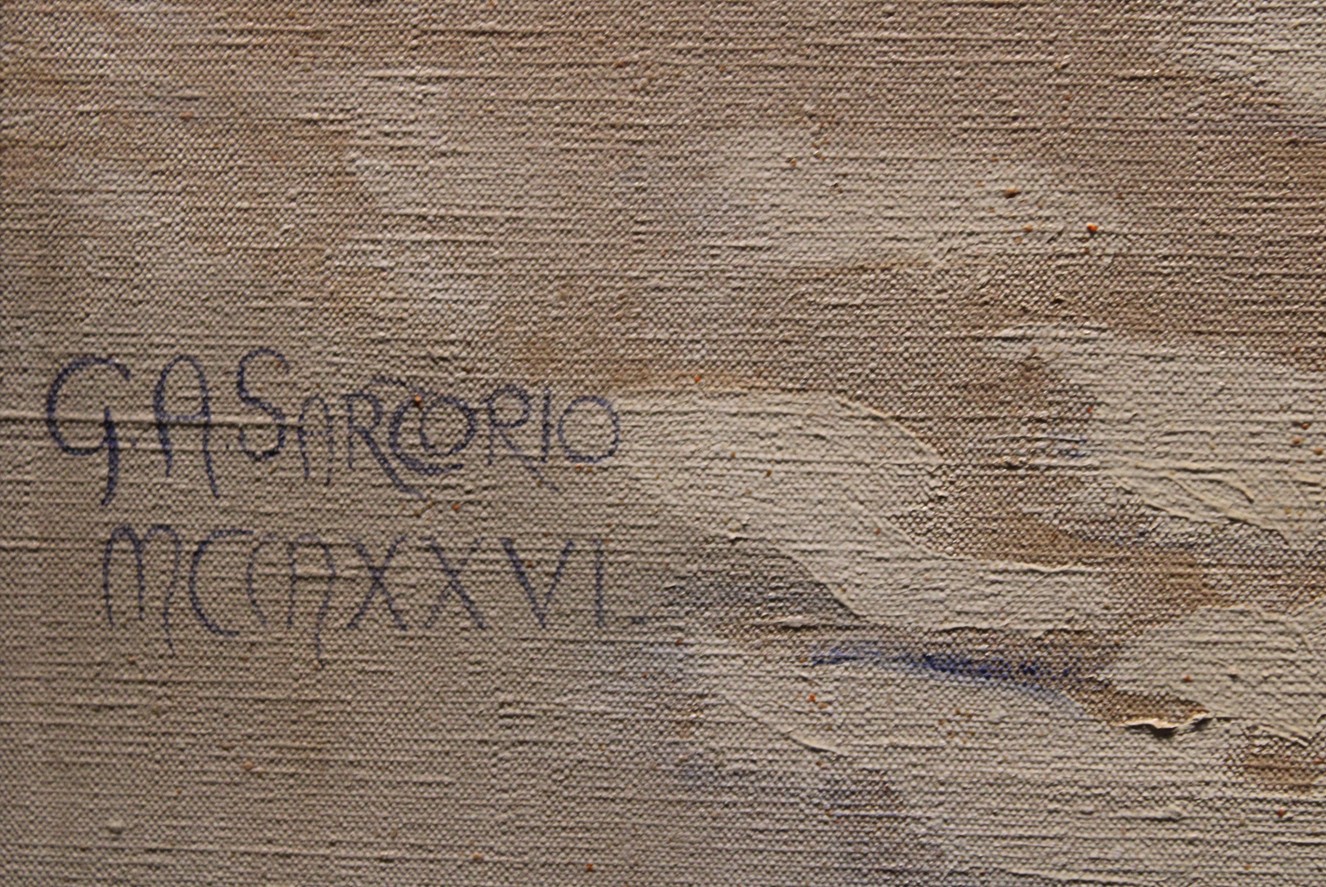
Dipinta nel 1926, l’opera misura 3 metri e 60 centimetri per 1 metro e 80 centimetri. Si tratta di un’olio su tela firmato e datato in basso a sinistra: ‘“‘G.A. Sartorio MCMXXVI‘.
L’opera è esposta al momento alla 34ª Biennale Internazionale dell’Antiquariato di Firenze, portato dalla Galleria Carlo Virgilio & C., e rappresenta una delle opere capaci di raccontare molto bene quella particolare ricerca di Sartorio sul paesaggio, sulla luce e sul rapporto fra natura e figura umana.
La luce dell’alba e il paese di Circe
Davanti alla grande tela il primo elemento che salta agli occhi è l’acqua.
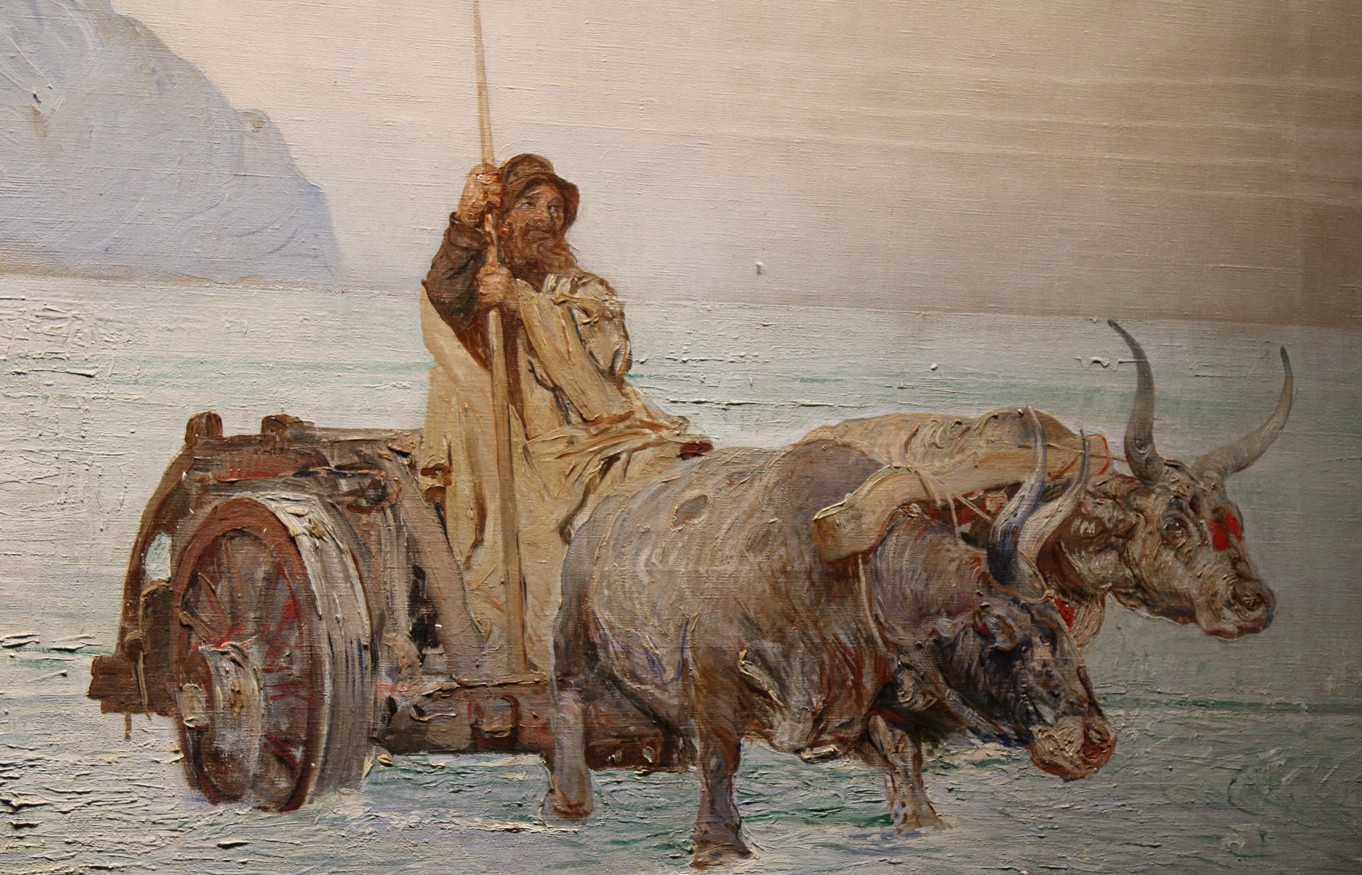
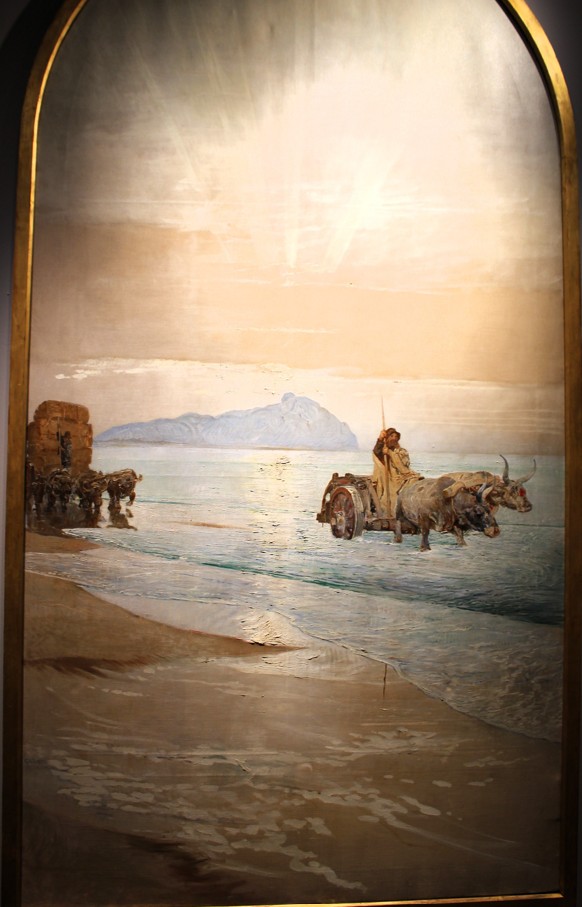
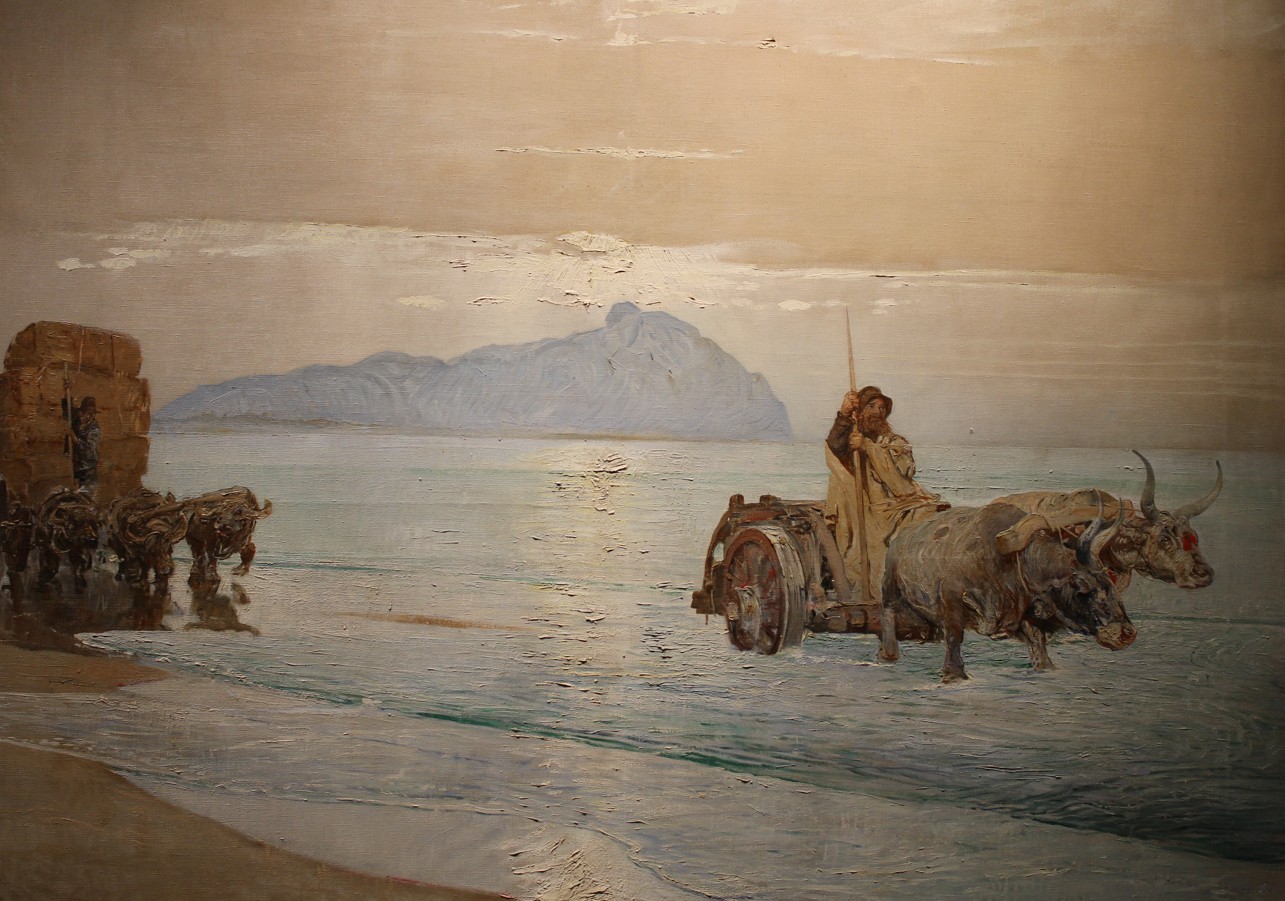
La spiaggia occupa la parte inferiore della composizione e conduce lentamente lo sguardo verso il mare, dove l’acqua riflette una luce chiarissima. Sullo sfondo appare il profilo del promontorio, mentre sulla destra avanzano lentamente due buoi che trascinano un carro attraverso le acque basse. È una scena quotidiana, quasi umile, ma Sartorio la trasforma in qualcosa di molto più grande.
L’uomo, gli animali, il carro e il mare sembrano appartenere a un tempo indefinito. Non siamo più semplicemente davanti alla rappresentazione di un paesaggio: siamo davanti a una visione del paesaggio, nella quale la realtà contemporanea sembra riemergere da un passato remoto.
Il titolo, Alba nel paese di Circe, introduce un’ulteriore dimensione.
Il riferimento è al territorio legato alla figura mitologica di Circe, la maga dell’Odissea, tradizionalmente associata al promontorio del Circeo. Il mito non viene rappresentato attraverso la figura della maga o episodi narrativi ben riconoscibili. Il pittore Sartorio lascia che sia il paesaggio stesso a evocare il mito.
E così il mare, la montagna lontana, la spiaggia e i buoi diventano gli elementi di una sorta di racconto silenzioso.
Un paesaggio monumentale
La scelta del formato verticale, con i suoi tre metri e sessanta di altezza, contribuisce a rendere ancora più particolare l’esperienza visiva.
La parte superiore della tela è quasi interamente occupata dal cielo. La luce dell’alba invade la superficie pittorica e crea una grande zona luminosa che sembra dissolversi gradualmente verso l’orizzonte.
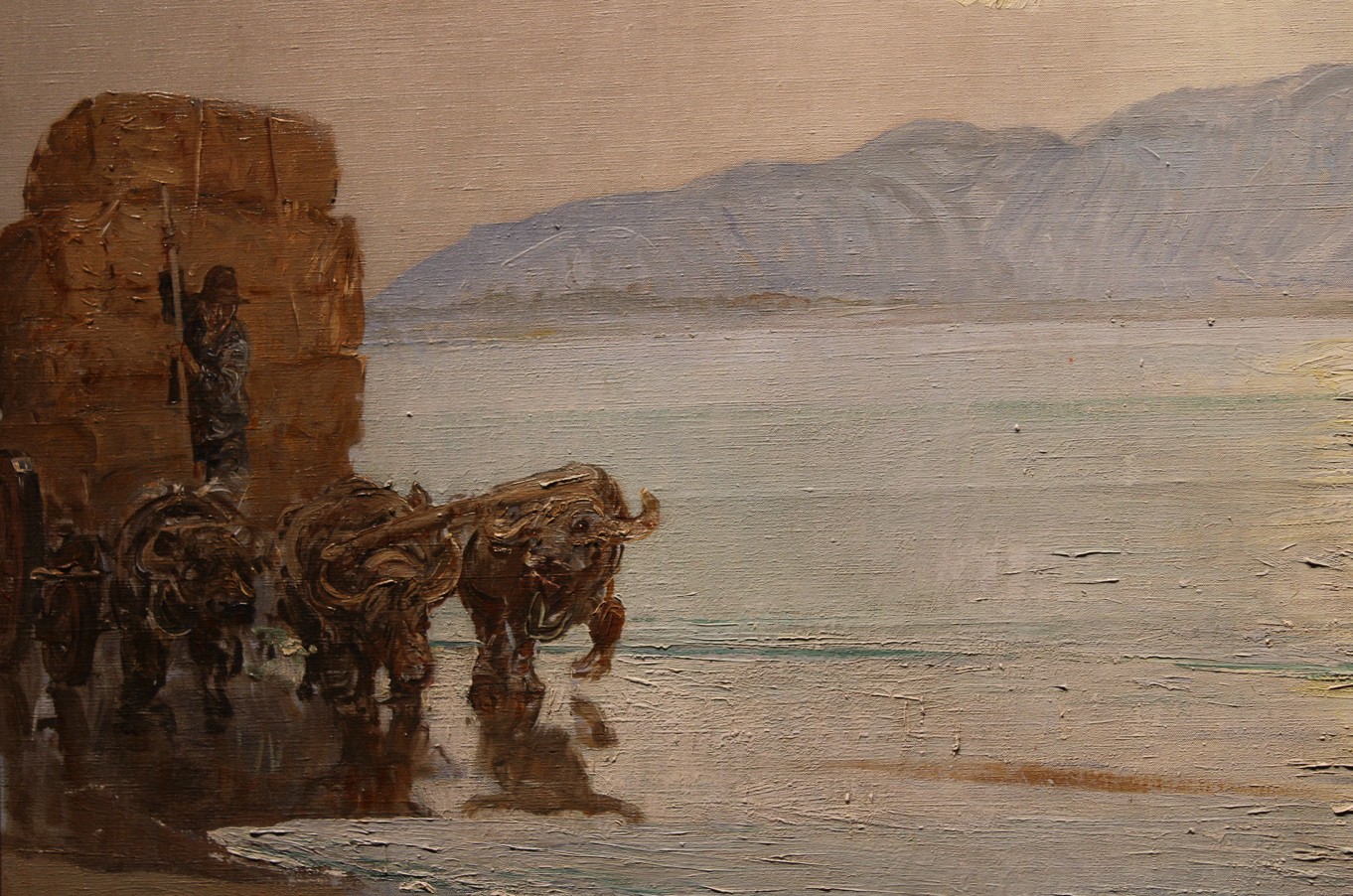
Sotto, invece, la scena diventa più concreta: la spiaggia, l’acqua, il carro, gli animali e le figure umane.
È come se Sartorio avesse costruito una sorta di teatro naturale, nel quale il paesaggio occupa quasi tutta la scena e l’uomo appare piccolo, inserito in una dimensione più grande di lui.
Giulio Aristide Sartorio, un artista difficile da racchiudere in una sola definizione
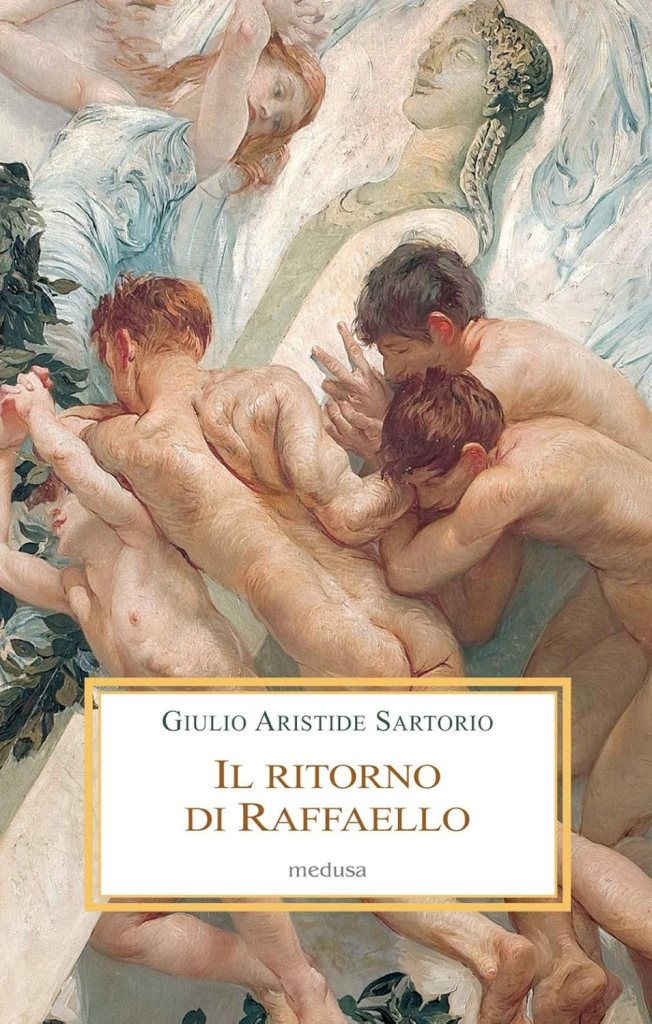
Nato a Roma l’11 febbraio 1860, Giulio Aristide Sartorio proveniva da una famiglia di artisti: il nonno Girolamo era scultore e il padre Raffaele era pittore e scultore. La sua formazione iniziò quindi nell’ambiente familiare, per poi svilupparsi attraverso lo studio della tradizione artistica romana.
Sartorio fu però un artista estremamente poliedrico. Fu pittore, scultore, disegnatore, illustratore e scrittore, e la sua ricerca attraversò esperienze molto diverse.
Nella prima fase della sua carriera si avvicinò al verismo, come dimostra Malaria, presentata all’Esposizione di Roma nel 1883. Parallelamente entrò in contatto con l’ambiente culturale romano e con figure come Gabriele d’Annunzio, con il quale ebbe un lungo rapporto di amicizia e collaborazione.
Il viaggio in Inghilterra del 1893 fu particolarmente importante. Sartorio entrò in contatto con la cultura preraffaellita e approfondì l’opera di artisti come Dante Gabriel Rossetti e Edward Burne-Jones. In seguito soggiornò anche in Germania, entrando in rapporto con gli ambienti simbolisti.
Queste esperienze contribuirono alla costruzione di un linguaggio personale nel quale natura, mito, simbolo e bellezza potevano convivere.
Dalla Campagna romana al grande fregio di Montecitorio
Il paesaggio fu una presenza costante nella sua attività.
Sartorio aderì al gruppo dei “Venticinque della Campagna Romana”, dedicandosi alla rappresentazione della campagna e dei suoi abitanti, ma il suo percorso artistico lo portò anche verso imprese decorative di dimensioni monumentali.
Tra queste spicca il grande fregio allegorico dell’aula di Montecitorio, realizzato tra il 1908 e il 1912, una delle sue imprese più importanti.
La sua attività non si limitò però alla pittura. Sartorio si interessò all’illustrazione, alla scrittura e persino al cinema, dirigendo negli anni Dieci e Venti alcuni film.
Il viaggio, la guerra e gli ultimi anni
Nel 1915 Sartorio partì volontario per la Prima guerra mondiale. Fu ferito e fatto prigioniero, trascorrendo un lungo periodo di prigionia a Mauthausen. Dopo la liberazione tornò al fronte come artista, documentando attraverso disegni e dipinti la vita dei soldati.
Negli anni successivi continuò a viaggiare. Visitò Egitto, Siria e Palestina, realizzando numerosi paesaggi, e proseguì la propria attività espositiva in Italia e all’estero. Partecipò alla Biennale di Venezia fino al 1930 e nel 1931 fu presente alla prima Quadriennale di Roma.
Morì a Roma il 3 ottobre 1932.
La storia di Alba nel paese di Circe
La tela del 1926 ha una provenienza particolarmente interessante. Era esposta a Roma, nella villa di Giulio e Maria Barluzzi, proprio nel 1926, per poi passare in una collezione privata romana.
Oggi, dopo essere stata conservata nella collezione privata, è arrivata a Firenze per la Biennale Internazionale dell’Antiquariato, dove viene proposta dalla Galleria Carlo Virgilio & C., galleria che documenta anche online la produzione di Sartorio.
Un’immagine monumentale e insieme silenziosa, nella quale il paese di Circe diventa più che un luogo: diventa una memoria del Mediterraneo, sospesa fra la storia e il mito.
Per il momento il sempre vostro Michelangelo Buonarroti vi saluta dandovi appuntamento ai prossimi post e sui social.
Dawn in the Land of Circe: Giulio Aristide Sartorio’s grand painting that brings myth to the seashore
There is something hypnotic about Giulio Aristide Sartorio’s Dawn in the Land of Circe. It is not merely the canvas’s impressive size that captures the eye and the imagination, but that suspended light which seems to blur the boundary between the real landscape and an ancient, almost mythological world.
Painted in 1926, the work measures 3.60 meters by 1.80 meters. This is an oil on canvas, signed and dated at the bottom left: ‘G.A. Sartorio MCMXXVI’.
The work is currently on display at the 34th International Antiques Biennale in Florence, presented by the Carlo Virgilio & C. Gallery; it is a piece that eloquently captures Sartorio’s distinctive exploration of landscape, light, and the relationship between nature and the human figure.
Dawn light and the land of Circe
Standing before the large canvas, the first element that catches the eye is the water.
The beach occupies the lower section of the composition, slowly drawing the gaze toward the sea, where the water reflects a brilliant, clear light. The profile of the promontory appears in the background, while on the right, two oxen slowly advance, pulling a cart through the shallow water. It is an everyday, almost humble scene, yet Sartorio transforms it into something far grander.
The man, the animals, the cart, and the sea seem to belong to a timeless realm. We are no longer merely looking at a depiction of a landscape; we are witnessing a vision of the landscape, in which contemporary reality seems to re-emerge from a distant past.
The title, Dawn in the Land of Circe, introduces yet another dimension.
It refers to the territory linked to the mythological figure of Circe—the sorceress from the Odyssey—traditionally associated with the Circeo promontory. The myth is not depicted through the figure of the sorceress or through readily recognizable narrative episodes; instead, Sartorio allows the landscape itself to evoke the myth.
Thus, the sea, the distant mountain, the beach, and the oxen become elements of a kind of silent story.
A monumental landscape
The choice of a vertical format—standing 3.60 meters tall—contributes to making the visual experience all the more distinctive.
The upper part of the The canvas is almost entirely filled by the sky. The light of dawn floods the painted surface, creating a vast, luminous area that seems to dissolve gradually toward the horizon.
Below, however, the scene becomes more tangible: the beach, the water, the cart, the animals, and the human figures.
It is as if Sartorio had constructed a kind of natural theater, where the landscape dominates the scene and man appears small, set within a dimension far greater than himself.
Giulio Aristide Sartorio: an artist who defies simple definition
Born in Rome on February 11, 1860, Giulio Aristide Sartorio came from a family of artists: his grandfather Girolamo was a sculptor, and his father Raffaele was both a painter and a sculptor. His training began within the family circle and subsequently evolved through the study of the Roman artistic tradition.
Sartorio was, however, an exceptionally multifaceted artist. He was a painter, sculptor, draftsman, illustrator, and writer, and his creative journey encompassed a wide range of experiences.
In the early phase of his career, he gravitated toward Verism—a style of realism—as evidenced by the work Malaria, exhibited in Rome in 1883. At the same time, he became involved in Rome’s cultural scene and connected with figures such as Gabriele d’Annunzio, with whom he maintained a long-standing friendship and professional collaboration.
A trip to England in 1893 proved particularly significant. Sartorio encountered Pre-Raphaelite culture and delved deeply into the work of artists like Dante Gabriel Rossetti and Edward Burne-Jones. Later, he also spent time in Germany, where he engaged with Symbolist circles.
These experiences helped shape a distinctive artistic language in which nature, myth, symbol, and beauty could coexist.
From the Roman countryside to the great frieze at Montecitorio
The landscape was a constant presence in his work.
Sartorio joined the “Venticinque della Campagna Romana” group, dedicating himself to depicting the Roman countryside and its inhabitants, though his artistic career also led him to undertake monumental decorative projects.
Notable among these is the large allegorical frieze in the Montecitorio chamber—created between 1908 and 1912—which stands as one of his most significant achievements.
However, his work was not limited to painting. Sartorio took an interest in illustration, writing, and even cinema, directing several films during the 1910s and 1920s.
Travel, War, and Final Years
In 1915, Sartorio volunteered for service in World War I. He was wounded and taken prisoner, enduring a long period of captivity at Mauthausen. After his liberation, he returned to the front as an artist, documenting the lives of soldiers through drawings and paintings.
In the years that followed, he continued to travel. He visited Egypt, Syria, and Palestine—creating numerous landscapes—and pursued his exhibition career both in Italy and abroad. He participated in the Venice Biennale until 1930 and took part in the first Rome Quadriennale in 1931.
He died in Rome on October 3, 1932.
The story of Dawn in Circe’s Town
This 1926 canvas has a particularly interesting provenance. It was displayed in Rome at the villa of Giulio and Maria Barluzzi in 1926, before passing into a private Roman collection.
Today, after having been held in that private collection, it has arrived in Florence for the International Antiques Biennale, where it is being presented by the Carlo Virgilio & C. gallery—a gallery that also documents Sartorio’s body of work online.
It is an image that is at once monumental and silent, in which Circe’s town becomes more than just a place: it becomes a memory of the Mediterranean, suspended between history and myth.
For now, your ever-faithful Michelangelo Buonarroti bids you farewell, looking forward to seeing you in future posts and on social media.

Sostienici – Support Us
Se questo blog ti piace e ti appassiona, puoi aiutarci a farlo crescere sempre più sostenendoci in modo concreto condividendo i post, seguendo le pagine social e con un contributo che ci aiuta ad andare avanti con il nostro lavoro di divulgazione. . ENGLISH: If you like and are passionate about this blog, you can help us make it grow more and more by supporting us in a concrete way by sharing posts, following social pages and with a contribution that helps us to move forward with our dissemination work.
10,00 €
Condividi:


Questo sono io




sostienici

Sostienici – Support Us
Se questo blog ti piace e ti appassiona, puoi aiutarci a farlo crescere sempre più sostenendoci in modo concreto condividendo i post, seguendo le pagine social e con un contributo che ci aiuta ad andare avanti con il nostro lavoro di divulgazione. . ENGLISH: If you like and are passionate about this blog, you can help us make it grow more and more by supporting us in a concrete way by sharing posts, following social pages and with a contribution that helps us to move forward with our dissemination work.
€10,00


1 commento »