
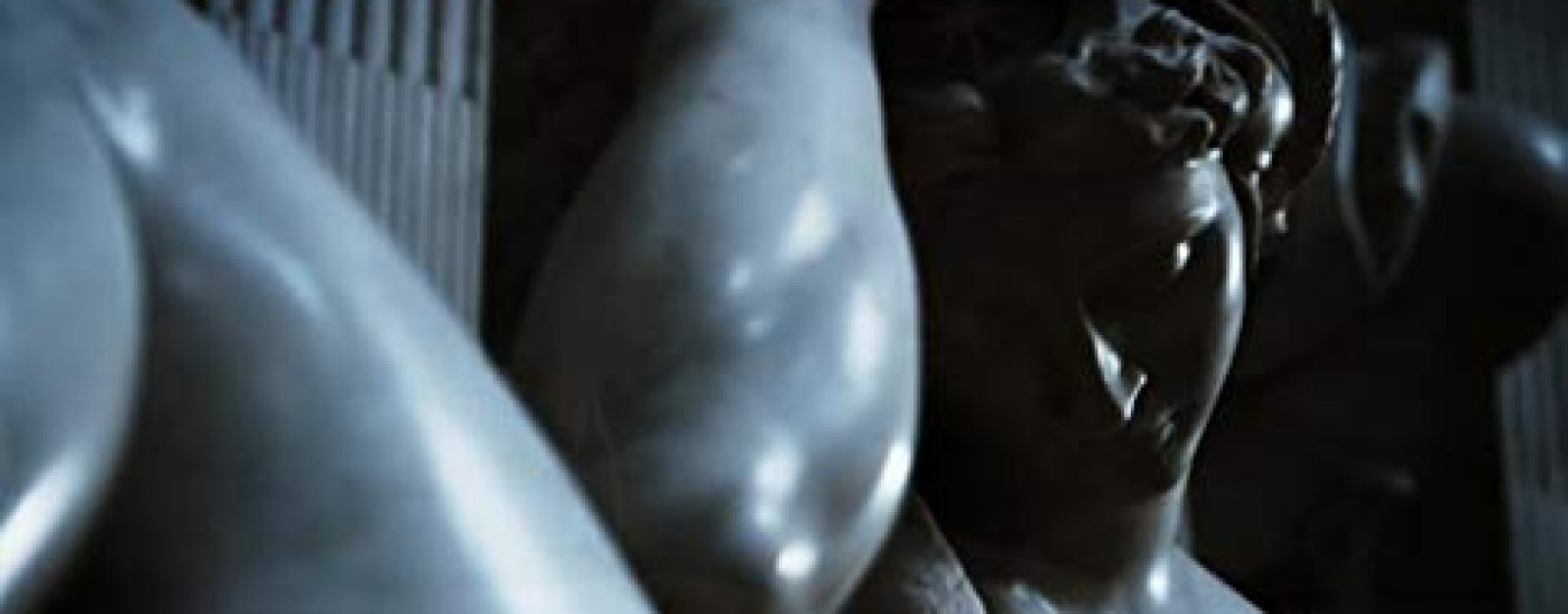
Prima del Giudizio Universale: errori, ripensamenti e colpi di genio
Quando mi venne affidato il compito di dipingere il Giudizio Universale, compresi nell’immediato che la vera sfida non sarebbe stata stendere il colore sull’intonaco fresco. Il lavoro più complesso iniziava molto prima: dovevo immaginarmi un universo intero, popolato da centinaia di corpi, anime, santi, angeli e dannati, tutti uniti in un’unica, immensa visione.
Non potevo volevo la tradizione: dovevo creare qualcosa che nessuno avesse mai visto.
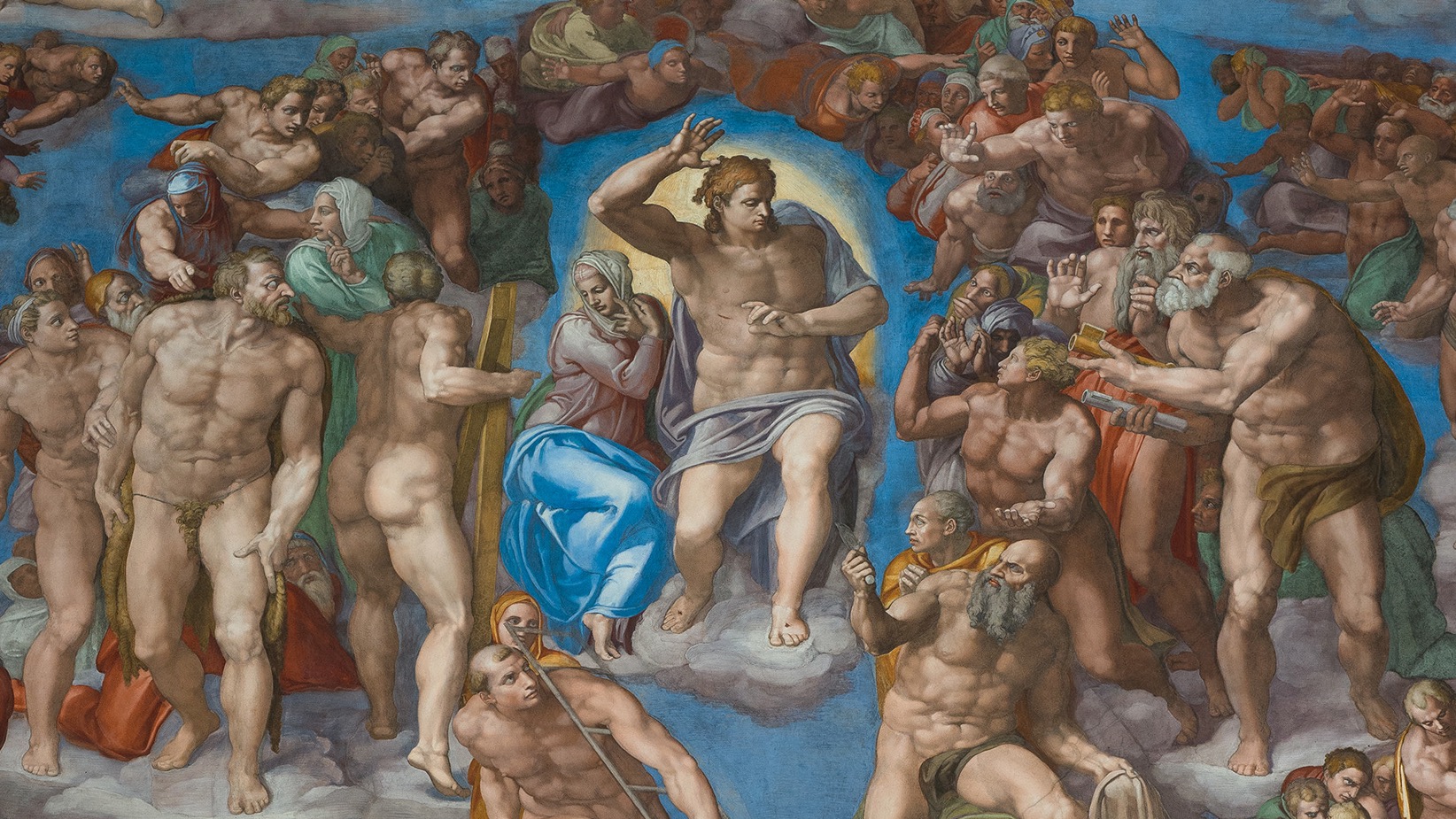
Ogni mia opera precedente mi preparava al Giudizio Universale
Il Giudizio Universale non nacque all’improvviso, in modo estemporaneo.
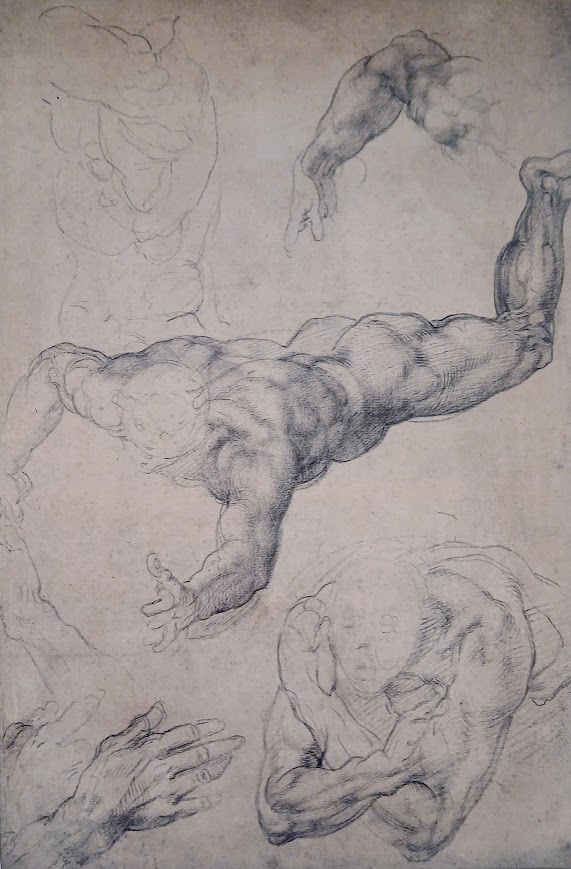
Da anni la mia mente, senza saperlo, lavorava a quell’opera, ai suoi corpi e a quegli atteggiamenti. I disegni dedicati al Fetonte, punito dalla folgore di Giove, mi avevano fatto capire come avrei dovuto raffigurare la forza divina capace di travolgere uomini e cielo nello stesso istante.
Persino il mito della Caduta dei Giganti aveva alimentato la mia immaginazione.
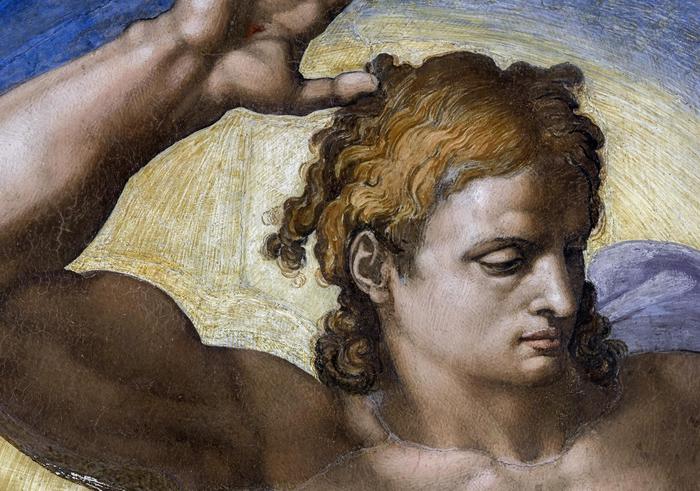
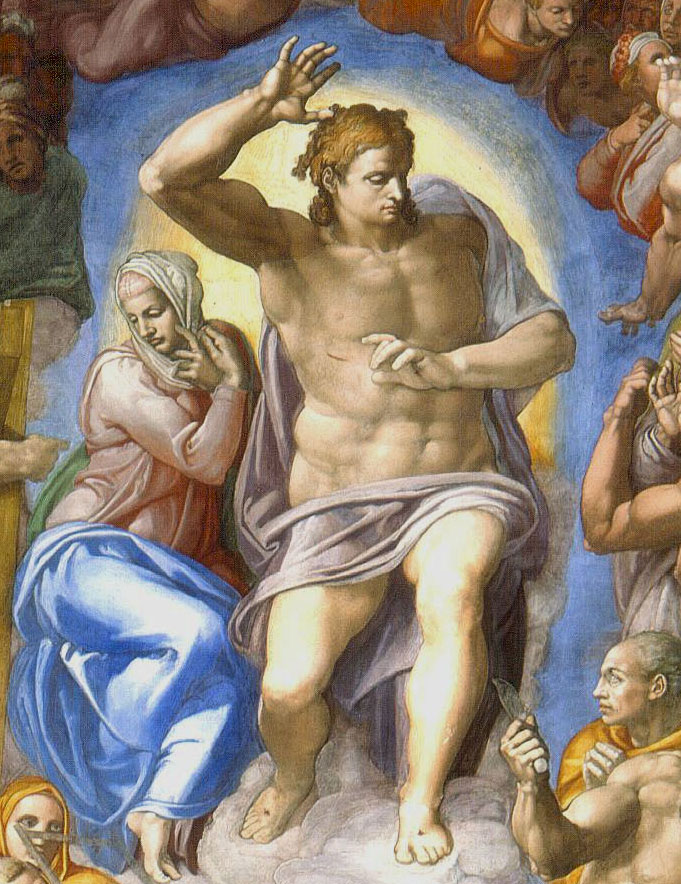
Ma soprattutto era il Cristo Risorto ad accompagnare continuamente i miei pensieri. Per lungo tempo studiai il corpo del Redentore non certo come un uomo sconfitto dalla croce, bensì come il vincitore della morte. Quelle ricerche finirono inevitabilmente dentro il Giudizio Universale.
Fu così che maturai una scelta destinata a suscitare scandalo: rappresentare un Cristo giovane senza barba, che mostrasse un corpo che parlasse della perfezione divina e della resurrezione, non della sofferenza.
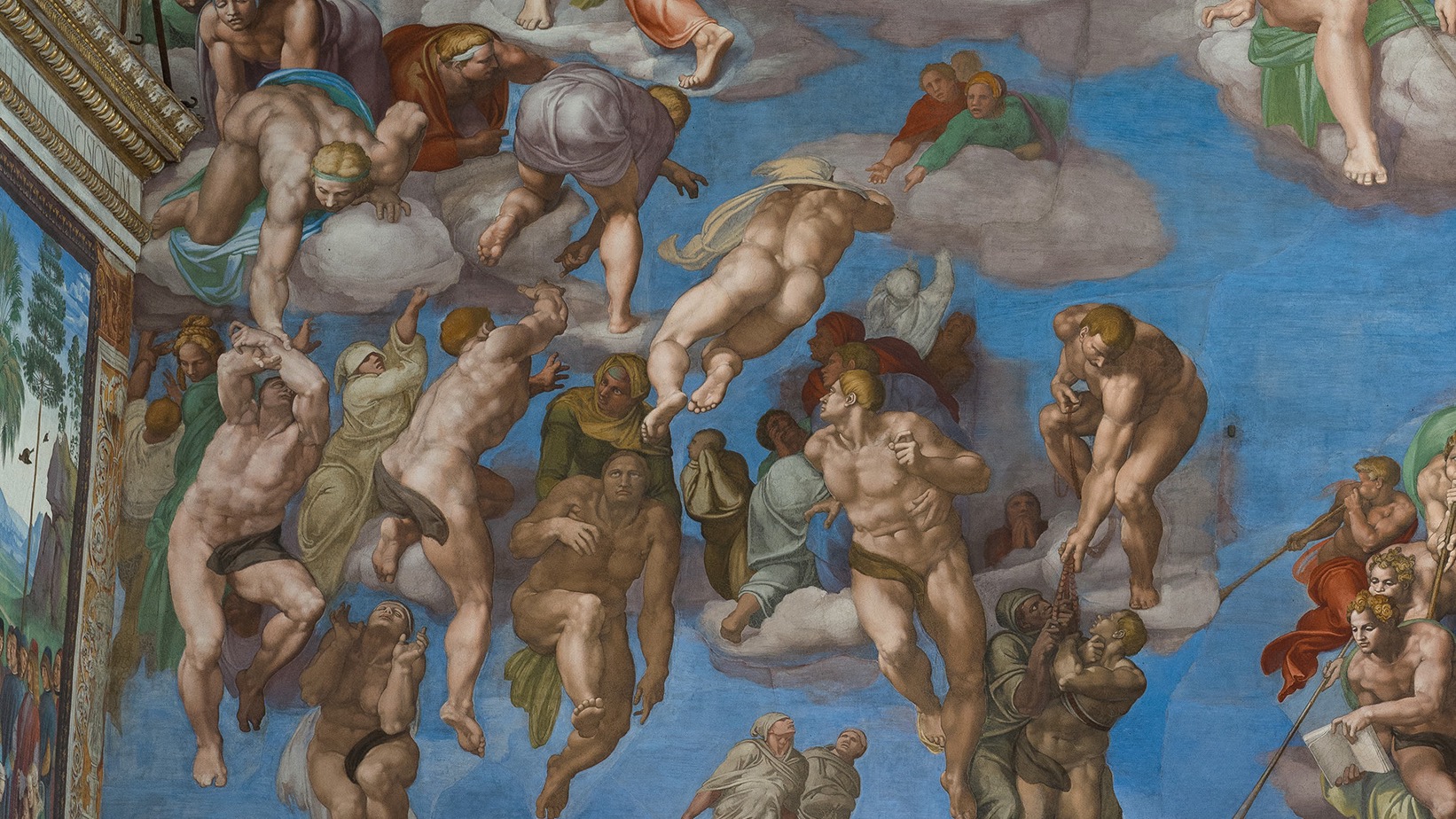
Il primo problema: come organizzare centinaia di figure
La composizione era tutto. Non bastava certo posizionare tutte le figure che vedevo nella mente sulla parete: dovevano vivere insieme, trascinate dalla stessa energia.
Nei primi studi eliminai subito una delle convenzioni più antiche dell’iconografia cristiana. Non volevo più file ordinate di santi seduti accanto a Cristo.
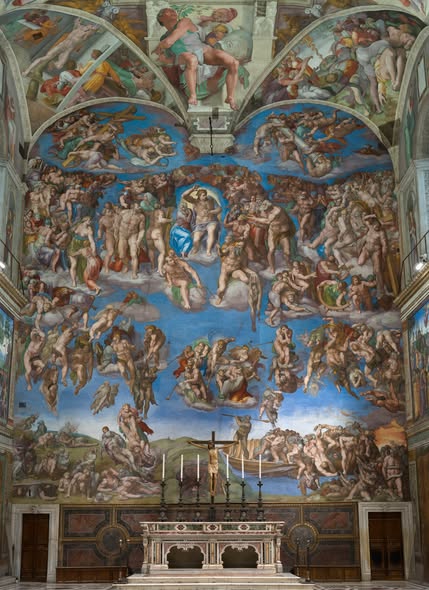
Li immaginai disposti in un grande cerchio, quasi risucchiati dalla Sua presenza. Tutto doveva ruotare attorno al Cristo Risorto, giudice supremo, il centro di tutto.
Anche i Santi sarebbero stati quasi tutti nudi. Decisione audace? Il corpo umano, nella sua perfezione, era il linguaggio con cui volevo raccontare la gloria e il destino dell’uomo. Non siamo forse stati fatti a immagine e somiglianza di Dio? Quindi perché il corpo nudo avrebbe dovuto destare scandalo se riflette la potenza e perfezione divina?
L’idea della composizione a forma di S che ruota
Continuando a studiare, cercai una soluzione ancora più dinamica. Pensai allora a una grande linea a forma di S, che attraversasse l’intero affresco.
Da una parte i beati salivano verso l’alto; dall’altra i dannati precipitavano nell’abisso.
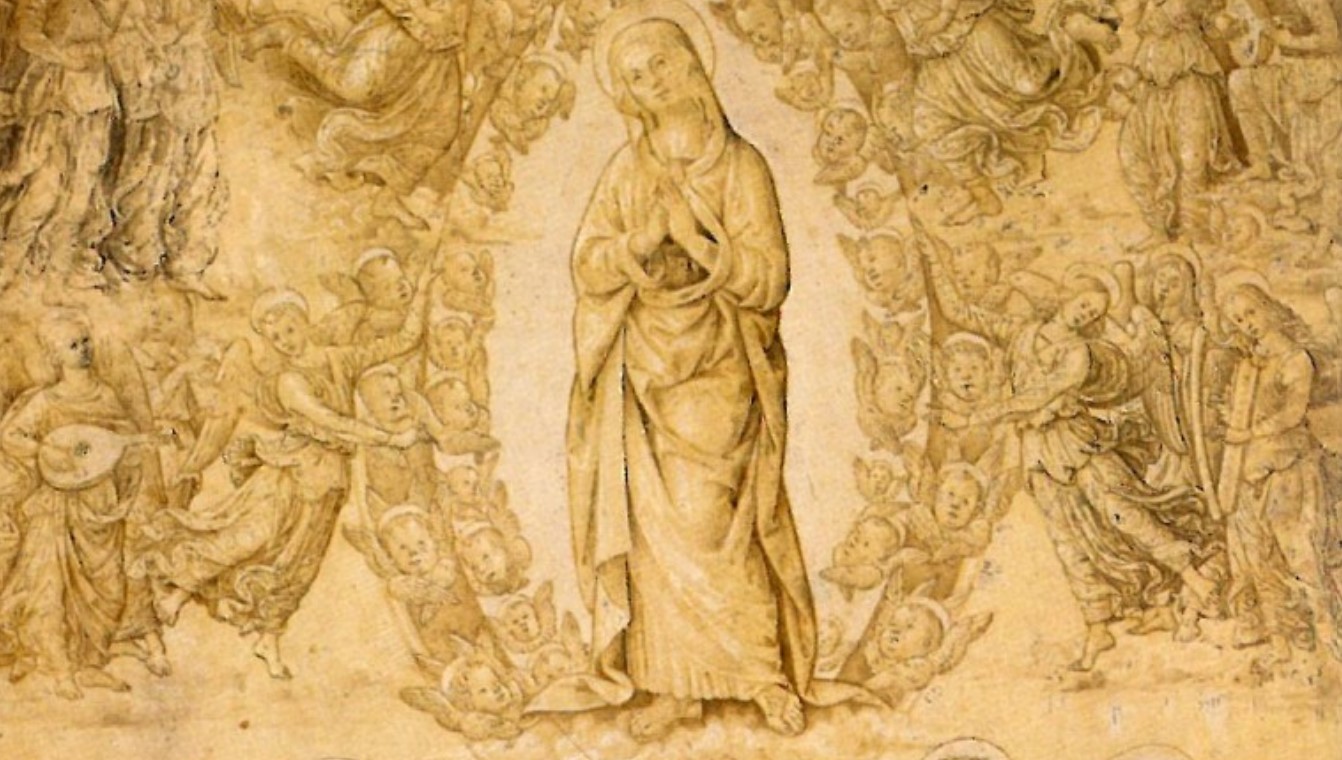
All’inizio perfino l’affresco dell’Assunzione della Vergine dipinto da Perugino diventava parte del mio progetto: immaginavo Maria collocata sopra la sua immagine, come naturale prosecuzione della sua ascesa al cielo.
Anche la cornice dell’altare si trasformava, nella mia mente, in una fortezza assediata dai dannati che tentavano disperatamente di conquistare il Paradiso. Era una soluzione che mi convinceva profondamente.
La demolizione dell’opera del Perugino cambiò ogni cosa
Quando si decise di eliminare il dipinto del Perugino, tutto il mio progetto dovette essere ripensato. Con quell’affresco se ne andarono anche la prima storia di Cristo e quella di Mosè, affrescate sempre dal Perugino e due mie lunette.
All’improvviso avevo a disposizione una superficie molto più ampia. Le vecchie relazioni tra le immagini non esistevano più e dovetti trovare nuovi punti d’equilibrio.
Scelsi allora di utilizzare le grandi cornici architettoniche della Cappella Sistina come struttura invisibile della composizione. Esse dividevano naturalmente la parete in più registri e mi spinsero ad abbandonare la spettacolare curva a “S” per una costruzione più ampia e monumentale.
Fu una scelta che rese l’affresco ancora più grandioso.
Dante entrò nel mio Giudizio Universale
Avevo bisogno di riempire il grande spazio lasciato libero nella parte inferiore della parete. Non cercai la soluzione nei trattati di teologia ma nella poesia.
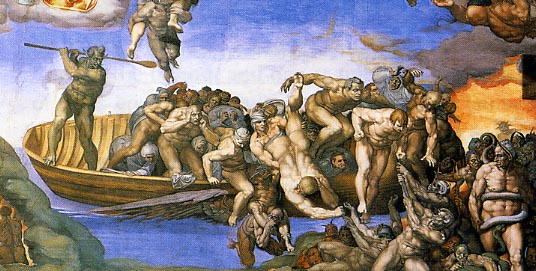
Conoscevo Dante e la Divina Commedia a menadito. Volli inserire diverse figure ispirate dal suo Inferno, compreso Caronte. il traghettatore dell’Acheronte, così come lo descrisse in versi il mio amato poeta,
Fu una scelta sorprendente: una figura della Divina Commedia entrava in uno dei più importanti affreschi della cristianità. Con lui il mondo dei dannati acquistava una forza narrativa che nessuna rappresentazione tradizionale possedeva.
Anche la Vergine cambiò volto
Nei primi progetti Maria era ancora l’interceditrice dell’umanità. La immaginavo con le braccia aperte mentre accoglieva i salvati. Poi qualcosa cambiò.
La raffigurai mentre si ritrae accanto a Cristo, con lo sguardo abbassato e quasi timorosa davanti alla potenza del Giudizio.
Fu una delle decisioni più rivoluzionarie dell’intera composizione. La misericordia lasciava spazio all’ultimo atto di giustizia divina.
Molti ne rimasero turbati, ma era l’unica immagine capace di esprimere il silenzio assoluto dell’ultimo giorno.
Nessun dettaglio era definitivo
Ogni disegno generava nuove domande. Spostavo continuamente santi, angeli e peccatori.
Cancellavo. Ridisegnavo. Provavo nuove combinazioni.
Alcune figure venivano trasferite da una parte all’altra dell’affresco. Altre sparivano completamente.
Perfino San Disma, il buon ladrone, cambiò posizione all’ultimo momento affinché la sua croce trovasse un appoggio perfetto sulla struttura architettonica della cappella. Ogni modifica obbligava a ripensare l’intero equilibrio della scena.
Disegnavo senza sosta prima di iniziare a dipingere
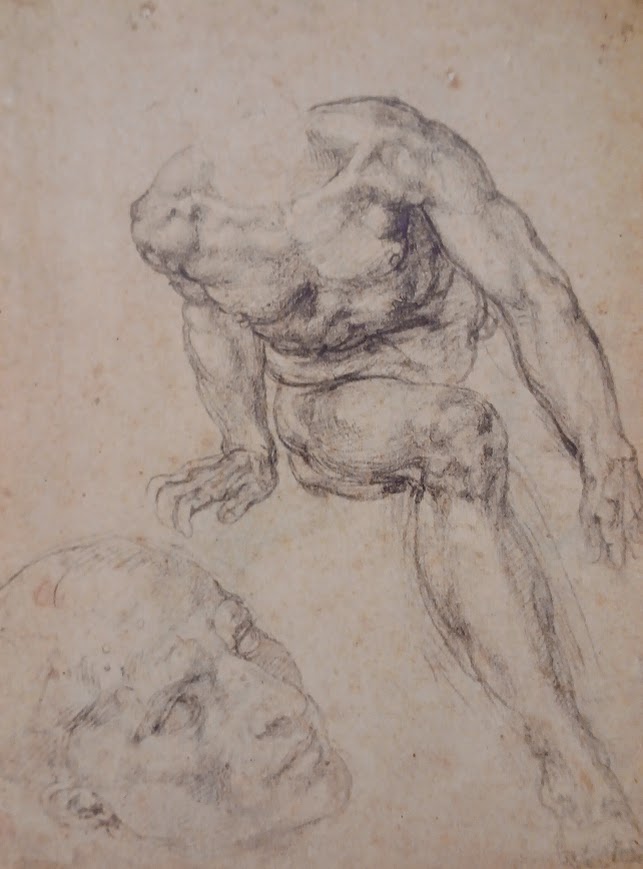
Realizzai una quantità enorme di studi preparatori. Analizzavo piccoli gruppi di figure. Provavo più volte lo stesso gesto.
In alcuni fogli un angelo e un demone combattono per la stessa anima in numerose varianti, fino a trovare il movimento esatto.
Altri studi erano dedicati ai corpi che risorgevano dalle tombe. Ogni muscolo, ogni torsione, ogni tensione della pelle: nulla era lasciato al caso.
I miei modelli vivevano già nell’affresco
Quando finalmente iniziai ad affrescare, conoscevo ogni figura come se l’avessi osservata per anni. Nei disegni studiavo la pressione del carboncino quasi come, più tardi, avrei steso il colore sull’intonaco.
Le anime poste più in basso ricevevano un trattamento ricco di dettagli, perché sarebbero state osservate da vicino. Quelle più in alto, invece, venivano costruite con segni più vigorosi e sintetici, capaci di mantenere forza anche viste da grande distanza.
Persino il modo di disegnare cambiava in funzione del punto della parete che ogni figura avrebbe occupato.

Le critiche non mancarono
Mentre lavoravo, molti vollero insegnarmi come avrebbe dovuto essere il Giudizio Universale. Tra loro vi erano cortigiani, ecclesiastici e uomini di lettere.
Il più insistente fu Pietro Aretino. Ascoltai i consigli o perlomeno diedi l’apparenza di farlo, poi seguii soltanto la mia visione.
Il Giudizio Universale fu il risultato di anni di riflessioni, di studi sul corpo umano, di dialoghi con Dante, con l’antichità classica e con la mia stessa idea di fede.
Per il momento il sempre vostro Michelangelo Buonarroti vi saluta dandovi appuntamento ai prossimi post e sui social.
Before the Last Judgment: Mistakes, Second Thoughts, and Strokes of Genius
When I was entrusted with painting the Last Judgment, I immediately understood that the real challenge wouldn’t be applying paint to wet plaster. The most complex work began much earlier: I had to imagine an entire universe, populated by hundreds of bodies, souls, saints, angels, and the damned, all united in a single, immense vision.
I couldn’t; I wanted tradition: I had to create something no one had ever seen.
Every previous work of mine prepared me for the Last Judgment
The Last Judgment didn’t come suddenly, extemporaneously.
For years, my mind, without knowing it, had been working on that work, on its bodies and those poses. The drawings dedicated to Phaeton, punished by Jupiter’s thunderbolt, had made me understand how I should depict the divine force capable of overwhelming man and heaven at the same time.
Even the myth of the Fall of the Giants had fueled my imagination.
But above all, it was the Risen Christ who constantly accompanied my thoughts. For a long time, I studied the body of the Redeemer not as a man defeated by the cross, but rather as the conqueror of death. Those investigations inevitably ended up in the Last Judgment.
Thus, I came to a decision destined to cause scandal: to depict a young, beardless Christ, revealing a body that spoke of divine perfection and resurrection, not of suffering.
The first problem: how to organize hundreds of figures
Composition was everything. It wasn’t enough to simply arrange all the figures I saw in my mind on the wall: they had to live together, drawn by the same energy.
In my first studies, I immediately eliminated one of the most ancient conventions of Christian iconography. I no longer wanted orderly rows of saints seated next to Christ.
I imagined them arranged in a large circle, almost sucked into His presence. Everything had to revolve around the Risen Christ, the supreme judge, the center of everything.
Even the saints would almost all be naked. A bold decision? The human body, in its perfection, was the language through which I wanted to express the glory and destiny of man. Were we not made in the image and likeness of God? So why should the naked body be scandalous if it reflects divine power and perfection?
The idea of the rotating S-shaped composition
As I continued to study, I searched for an even more dynamic solution. I then conceived of a large S-shaped line that would span the entire fresco.
On one side, the blessed ascended; on the other, the damned fell into the abyss.
At first, even Perugino’s fresco of the Assumption of the Virgin became part of my project: I imagined Mary placed above her image, a natural continuation of her ascension to heaven.
Even the altar frame transformed, in my mind, into a fortress besieged by the damned, desperately trying to conquer Paradise. It was a solution that deeply convinced me.
The demolition of Perugino’s work changed everything
When it was decided to eliminate Perugino’s painting, my entire project had to be rethought. With that fresco, the first story of Christ and that of Moses, also frescoed by Perugino, and two of my lunettes also disappeared.
Suddenly, I had a much larger surface at my disposal. The old relationships between the images no longer existed, and I had to find new points of balance.
I then chose to use the large architectural frames of the Sistine Chapel as the invisible structure of the composition. They naturally divided the wall into multiple registers and encouraged me to abandon the spectacular S-curve for a larger, more monumental construction.
It was a choice that made the fresco even more grandiose.
Dante Entered My Last Judgment
I needed to fill the large, empty space at the bottom of the wall. I didn’t look for the solution in theological treatises, but in poetry.
I knew Dante and the Divine Comedy by heart. I wanted to include several figures inspired by his Inferno, including Charon, the ferryman of the Acheron, as my beloved poet described him in verse.
It was a surprising choice: a figure from the Divine Comedy entered one of the most important frescoes in Christianity. With him, the world of the damned acquired a narrative force unmatched by any traditional representation.
Even the Virgin Mary Changed Her Face
In the early designs, Mary was still humanity’s intercessor. I imagined her with open arms welcoming the saved. Then something changed.
I depicted her portraying herself next to Christ, her gaze lowered and almost fearful before the power of Judgment.
It was one of the most revolutionary decisions of the entire composition. Mercy gave way to the final act of divine justice.
Many were troubled by it, but it was the only image capable of expressing the absolute silence of the last day.
No detail was definitive.
Each drawing raised new questions. I continually moved saints, angels, and sinners.
I erased. I redrew. I tried new combinations.
Some figures were moved from one part of the fresco to another. Others disappeared completely.
Even Saint Dismas, the good thief, changed position at the last moment so that his cross would find perfect support on the architectural structure of the chapel. Each change forced a rethinking of the entire balance of the scene.
I drew nonstop before starting to paint
I made an enormous number of preparatory studies. I analyzed small groups of figures. I tried the same gesture over and over.
In some drawings, an angel and a demon battle for the same soul in numerous variations, until they find the perfect movement.
Other studies were dedicated to bodies rising from the tombs. Every muscle, every twist, every tension of the skin: nothing was left to chance.
My models already lived in the fresco.
When I finally began to fresco, I knew every figure as if I had observed them for years. In the drawings, I studied the pressure of the charcoal almost as I would later apply paint to plaster.
The souls placed lower down received a richly detailed treatment, because they would be observed up close. Those higher up, however, were constructed with more vigorous and concise strokes, capable of maintaining strength even when seen from a great distance.
Even the drawing method changed depending on the spot on the wall each figure would occupy.
There was no shortage of criticism
While I was working, many wanted to teach me how the Last Judgment should look. Among them were courtiers, clergymen, and men of letters.
The most insistent was Pietro Aretino. I listened to their advice, or at least gave the appearance of doing so, then I simply followed my own vision.
The Last Judgment was the result of years of reflection, studies of the human body, dialogues with Dante, with classical antiquity, and with my own idea of faith.
For now, yours truly, Michelangelo Buonarroti bids you farewell, and looks forward to seeing you in future posts and on social media.

Sostienici – Support Us
Se questo blog ti piace e ti appassiona, puoi aiutarci a farlo crescere sempre più sostenendoci in modo concreto condividendo i post, seguendo le pagine social e con un contributo che ci aiuta ad andare avanti con il nostro lavoro di divulgazione. . ENGLISH: If you like and are passionate about this blog, you can help us make it grow more and more by supporting us in a concrete way by sharing posts, following social pages and with a contribution that helps us to move forward with our dissemination work.
10,00 €
Condividi:


Questo sono io




sostienici

Sostienici – Support Us
Se questo blog ti piace e ti appassiona, puoi aiutarci a farlo crescere sempre più sostenendoci in modo concreto condividendo i post, seguendo le pagine social e con un contributo che ci aiuta ad andare avanti con il nostro lavoro di divulgazione. . ENGLISH: If you like and are passionate about this blog, you can help us make it grow more and more by supporting us in a concrete way by sharing posts, following social pages and with a contribution that helps us to move forward with our dissemination work.
€10,00


Per tanti motivi emoziona più di altri capolavori, conoscendone le difficoltà tecniche oggettive, gli intoppi, le situazioni critiche, la postura difficile da mantenere durante l’esecuzione per un corpo non più giovanissimo. A maggior ragione la meraviglia è immensa e commovente
"Mi piace"Piace a 1 persona
Un’opera da divere, dalla prima all’ultima figura. Chi si trova davanti al Giudizio Universale per la prima volta, ricorderà quel momento per tutta la vita
"Mi piace"Piace a 1 persona
Vero, serena giornata!
"Mi piace"Piace a 1 persona
grazie, altrettanto
"Mi piace"Piace a 1 persona