
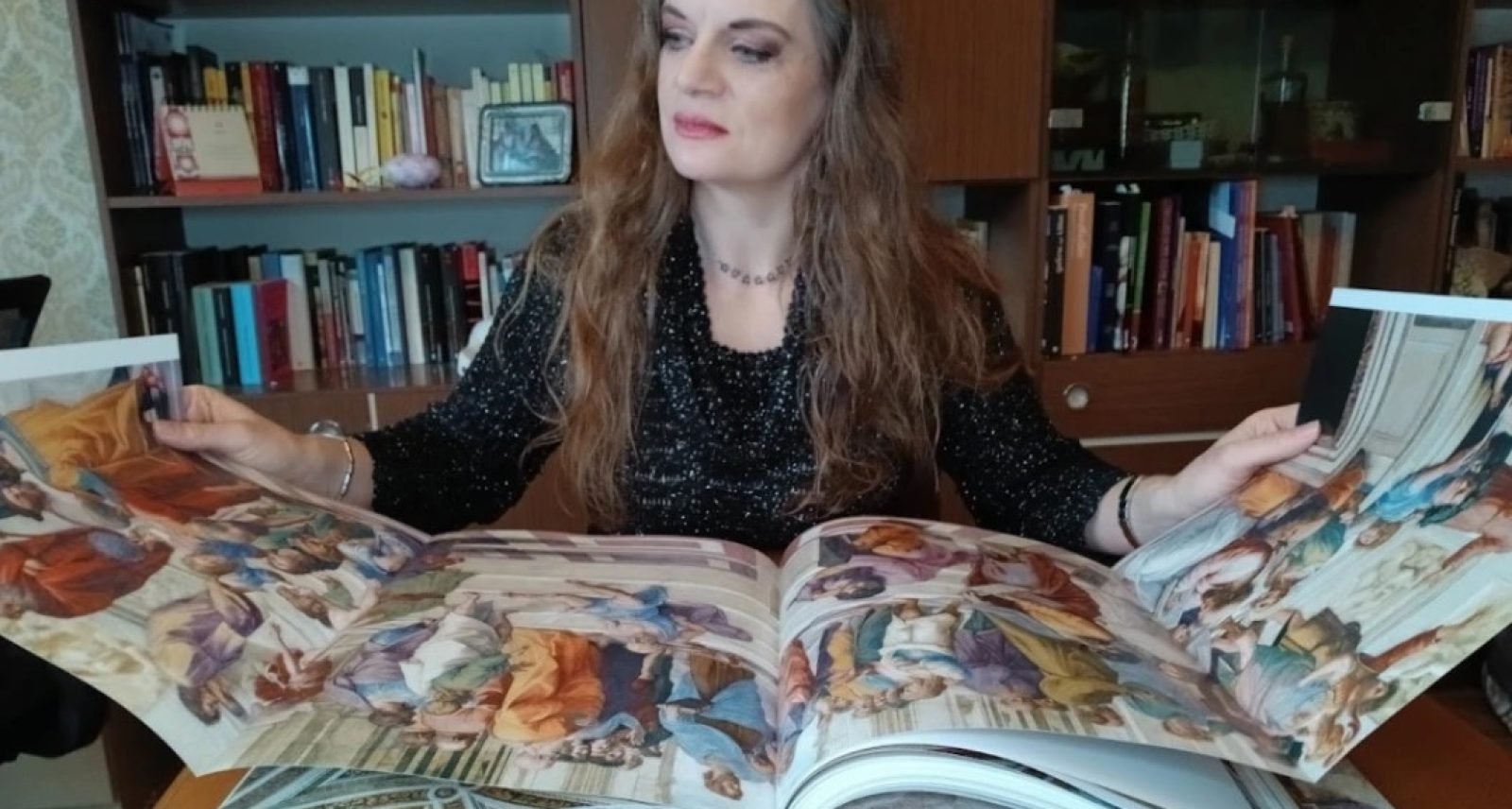
Stanza Segreta: il disegno del Cristo risorto
All’interno della Stanza Segreta, sulla parete sottile che separa quell’ambiente dal sottoscala, tracciai con i bastoncini di legno carbonizzati un grande Cristo risorto a grandezza maggiore del naturale.
Sembra un primo studio della posizione e della muscolatura del torso, spalle e gambe che ha molte affinità con i disegni successivi molto più dettagliati che ripropongono il medesimo soggetto, custoditi al Louvre e alla Royal Library del Castello di Windsor.
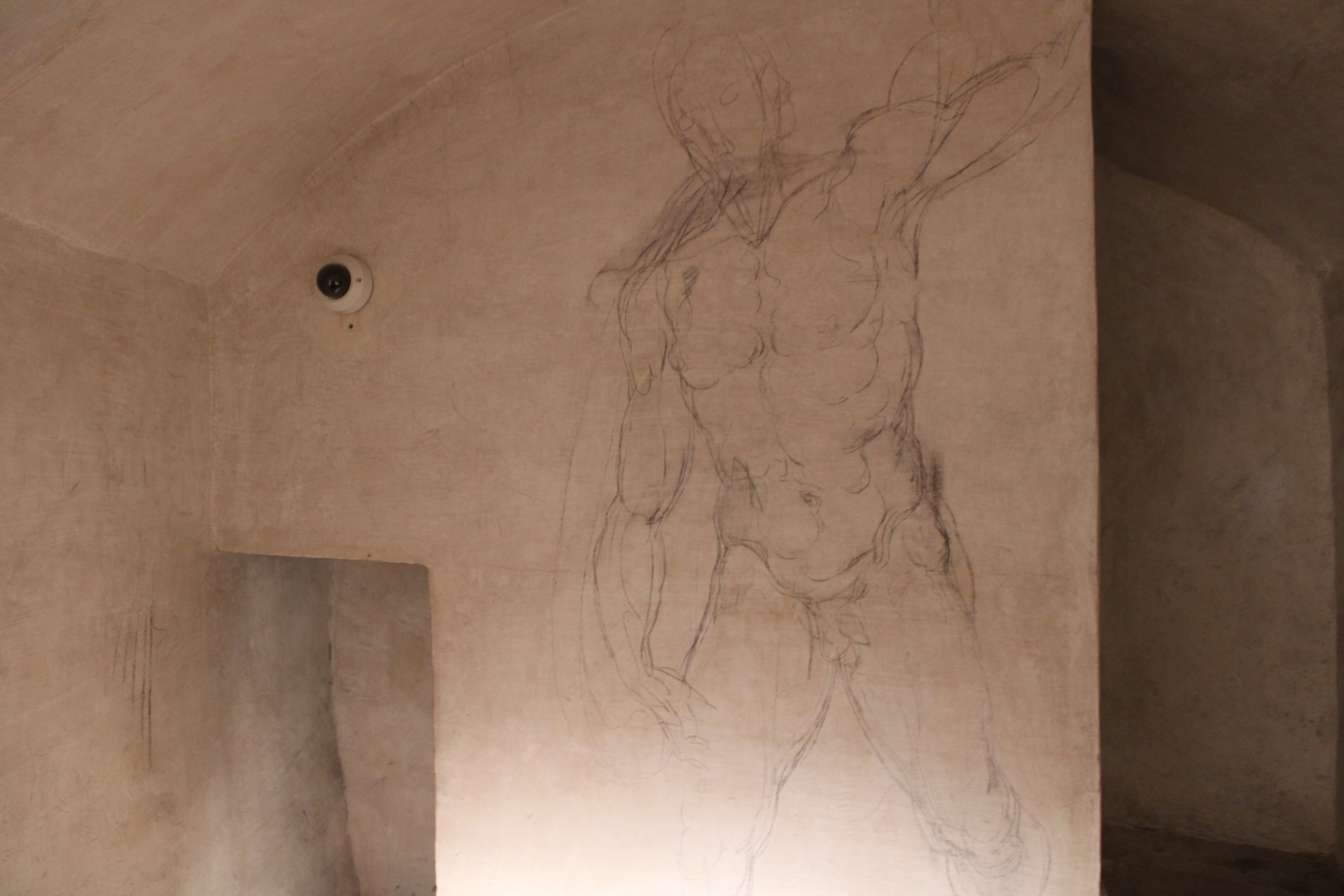
Il Cristo pare emerga dal sepolcro in quel preciso istante, emergendo dai due gradini reali che si trovano al di sotto di lui.
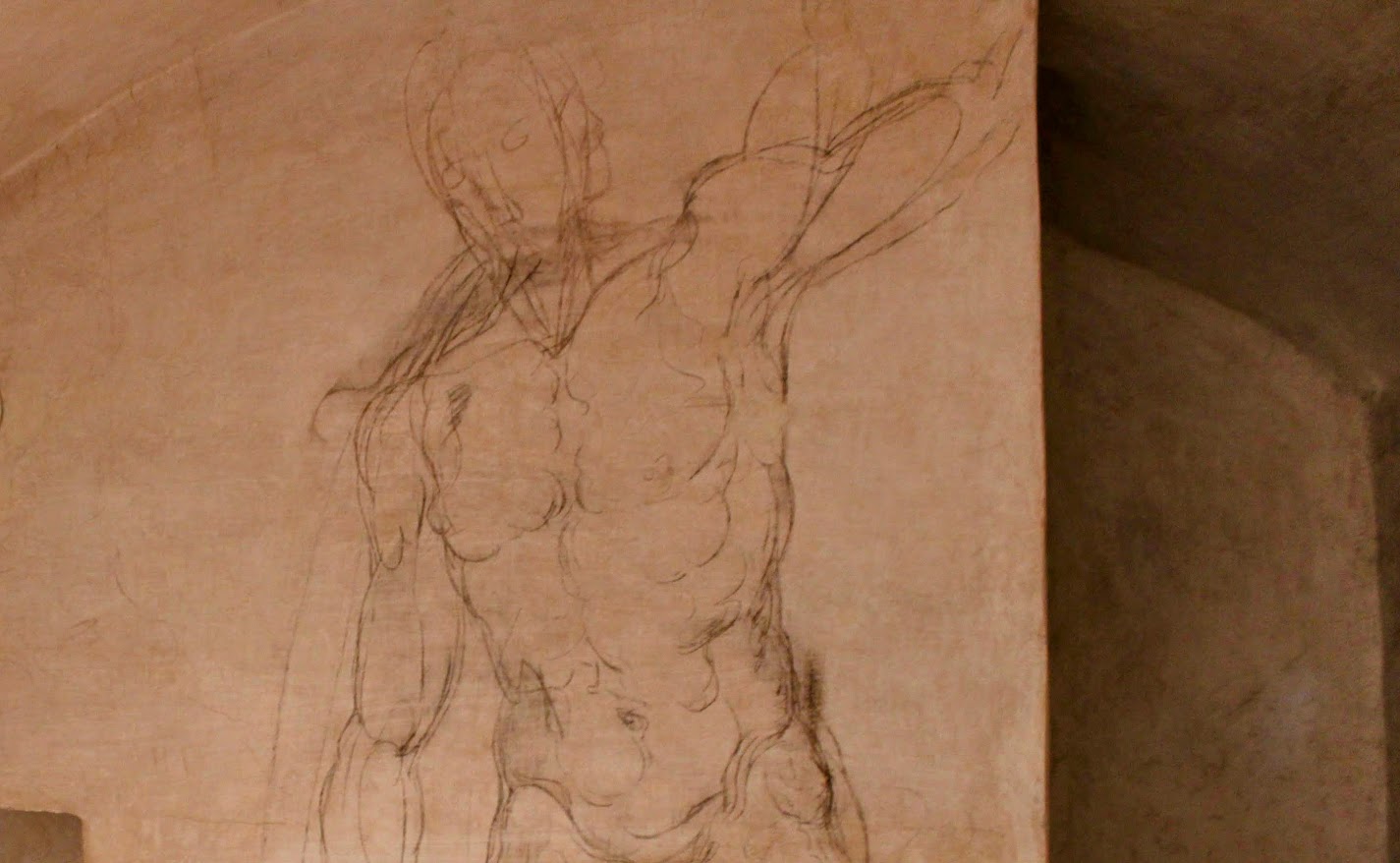
Modulai le forme del corpo con segni rapidi facendo assumere al capo e alle braccia pose differenti. Guardate infatti con attenzione la testa del Cristo che appare disegnata sia nella versione frontale che in quella girata di profilo.
Per quale affresco o dipinto poi non realizzato pensai questo Cristo risorto?
Sebbene non ci sia la certezza un indizio assai lampante lo fornì Paolo dal Poggetto, direttore delle Cappelle Medicee al momento del ritrovamento dei disegni murali al di sotto degli intonaci.
E’ noto che all’interno della Sagrestia Nuova avrei dovuto affrescare, secondo il progetto originale, le lunette. Quella al di sopra delle tombe dei Magnifici avrebbe dovuto avere come soggetto una Resurrezione e le altre due, sopra le tombe dei capitani, probabilmente con due storie tratte dal Serpente di bronzo.
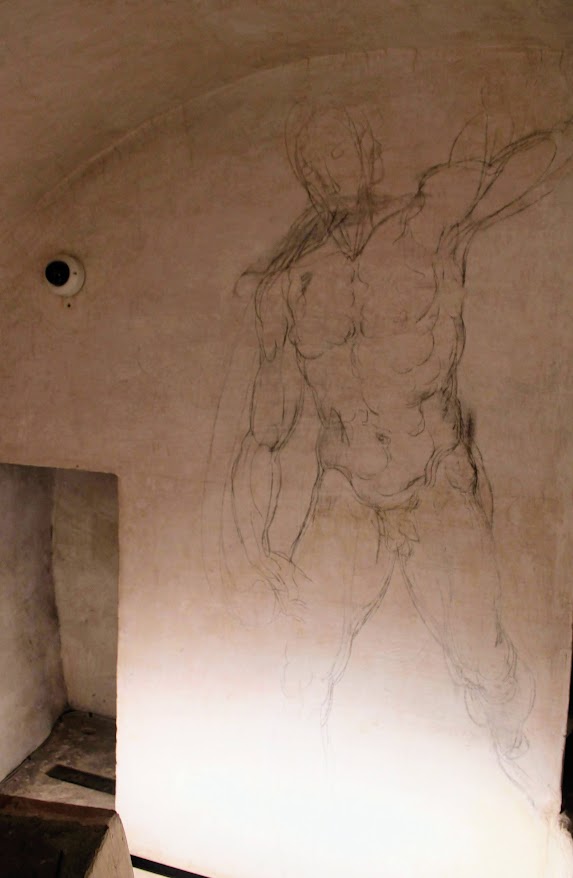
Come si interrogò al tempo dal Poggetto: “Sarà forse un caso che la lunetta nella Cappella Medicea, per cui era previsto l’affresco, misura due metri e 49 centimetri mentre l’altezza della paretina dello scantinato sottostante, su cui è disegnato questo Cristo Risorto, è di 2 metri e 50 centimetri?”
Per il momento il vostro Michelangelo Buonarroti vi saluta dandovi appuntamento ai prossimi post e sui social.
Secret Room: the drawing of the risen Christ
Inside the Secret Room, on the thin wall that separates that room from the basement, I traced a larger-than-life-size large resurrected Christ with charred wooden sticks.
It appears to be a first study of the position and musculature of the torso, shoulders and legs which has many affinities with the much more detailed subsequent drawings featuring the same subject, kept in the Louvre and the Royal Library of Windsor Castle.
Christ appears to emerge from the tomb at that precise moment, emerging from the two royal steps located below him.
I modulated the shapes of the body with rapid signs, making the head and arms assume different poses. In fact, look carefully at the head of Christ which appears drawn both in the frontal version and in the one turned in profile.
For which fresco or painting that was not later realized did I think of this risen Christ? Although there is no certainty, a very clear clue was provided by Paolo dal Poggetto, director of the Medici Chapels at the time of the discovery of the wall drawings beneath the plaster.
It is known that inside the New Sacristy I should have frescoed the lunettes according to the original project. The one above the tombs of the Magnificents should have had a Resurrection as its subject and the other two, above the tombs of the captains, probably with two stories taken from the Bronze Serpent.
As Poggetto asked himself at the time: “It may perhaps be a coincidence that the lunette in the Medici Chapel, for which the fresco was planned, measures two meters and 49 centimeters while the height of the small wall in the basement below, on which this Christ is drawn Risen, is he 2 meters and 50 centimeters?”
For the moment, your Michelangelo Buonarroti greets you and will meet you in future posts and on social media.

Sostienici – Support Us
Se questo blog ti piace e ti appassiona, puoi aiutarci a farlo crescere sempre più sostenendoci in modo concreto condividendo i post, seguendo le pagine social e con un contributo che ci aiuta ad andare avanti con il nostro lavoro di divulgazione. . ENGLISH: If you like and are passionate about this blog, you can help us make it grow more and more by supporting us in a concrete way by sharing posts, following social pages and with a contribution that helps us to move forward with our dissemination work.
8,00 €
-
Le 10 città d’arte europee più belle da visitare a Natale: musei e luoghi da non perdere
🇮🇹Quali città d’arte europee visitare a Natale? Da Vienna a Parigi, da Praga a Bruges, 10 mete tra mercatini, musei, capolavori e atmosfere da fiaba… 🇬🇧Which European cities of art should you visit at Christmas? From Vienna to Paris, from Prague to Bruges—10 destinations featuring Christmas markets, museums, masterpieces, and a fairytale atmosphere…
-
Artemisia Gentileschi a Firenze: la storia, le opere e la mostra agli Innocenti fino al 2027
🇮🇹Artemisia Gentileschi a Firenze: dalle commissioni dei Medici all’Allegoria dell’Inclinazione di Casa Buonarroti. La storia e la mostra agli Innocenti… 🇬🇧Artemisia Gentileschi in Florence: from commissions by the Medici to the *Allegory of Inclination* at Casa Buonarroti. The story and the exhibition at the Ospedale degli Innocenti…
-
26 ottobre 1890: muore Carlo Collodi, lo scrittore toscano che inventò Pinocchio
Il 26 ottobre 1890 moriva a Firenze Carlo Collodi, autore di Pinocchio. Dalla prima pubblicazione nel 1881 al successo mondiale del burattino…
Condividi:


Questo sono io




sostienici

Sostienici – Support Us
Se questo blog ti piace e ti appassiona, puoi aiutarci a farlo crescere sempre più sostenendoci in modo concreto condividendo i post, seguendo le pagine social e con un contributo che ci aiuta ad andare avanti con il nostro lavoro di divulgazione. . ENGLISH: If you like and are passionate about this blog, you can help us make it grow more and more by supporting us in a concrete way by sharing posts, following social pages and with a contribution that helps us to move forward with our dissemination work.
€10,00


1 commento »