
La cornice del Tondo Doni: i misteri, i simboli e le cinque teste scolpite
Se quando guardate il Tondo Doni i vostri occhi corrono subito alla Sacra Famiglia, non ve ne faccio una colpa. È lì che voglio portarvi con la mente e con il cuore.
Oggi però vi voglio far guardare con più attenzione la cornice. Non è una decorazione a sé stante ma serve a comprendere meglio l’opera e ne racconta parte della storia.
L’ho disegnata per farla dialogare direttamente con la Sacra Famiglia celebrando Agnolo Doni e Maddalena Strozzi.
La cornice del Tondo Doni non è puramente decorativa
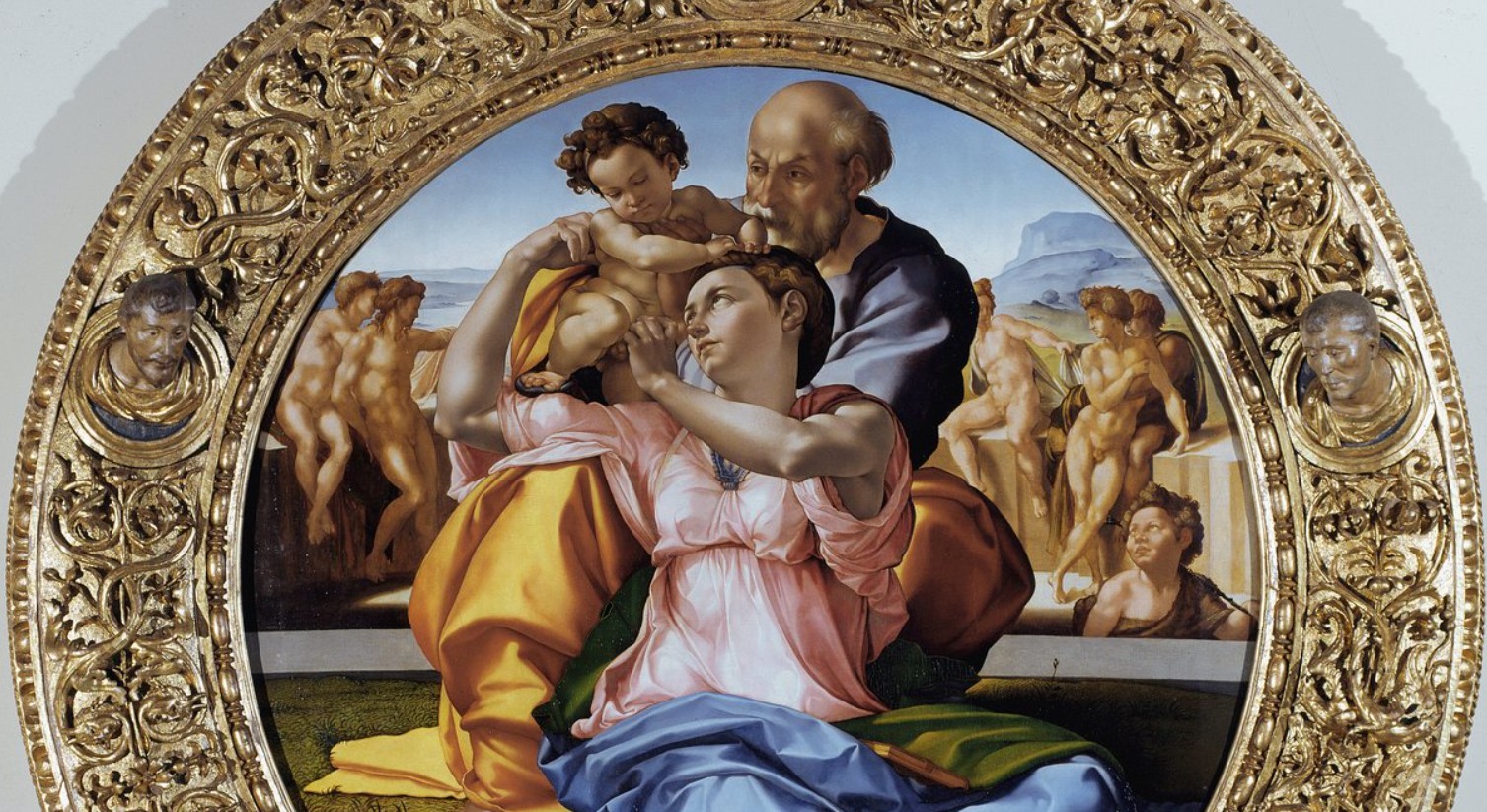
Quando realizzai il Tondo Doni, intorno al 1506-1507, non pensai soltanto al dipinto e alla tavola che l’avrebbe accolta. La cornice doveva essere all’altezza del dipinto.
È una struttura complessa, ricchissima di particolari: palmette, cordoni, ovoli, perle, fusaruole, virgulti d’ulivo, elementi vegetali e motivi ornamentali che sembrano rincorrersi lungo il legno.
Osservate tutte quelle decorazioni coperte con foglia d’oro zecchino: fogliame, volti mostruosi e motivi che ricordano le grottesche trasformano la cornice in una racconto parallelo. Se saprete osservarla con attenzione, scoprirete che quasi nulla è stato lasciato al caso.

Cinque teste sporgono dalla cornice: ma chi rappresentano?
Cinque teste sporgono dalla cornice del Tondo Doni. Cinque volti, cinque espressioni differenti, cinque presenze che sembrano affacciarsi sul dipinto.
Quella collocata proprio sopra la tavola è Cristo. Per le altre quattro, invece, la faccenda della loro identificazione diventa più complessa.
Le due teste nella parte superiore vengono tradizionalmente interpretate come profeti, mentre le due inferiori sono spesso identificate come sibille.
Non sono però tutti d’accordo. Alcuni studiosi hanno infatti proposto di riconoscere nelle figure più femminili due angeli.
Insomma, anche dopo cinque secoli, quelle teste continuano a far discutere.
In fondo un’opera può essere davanti ai vostri occhi da secoli e riuscire ancora a farvi porre delle domande.

Fui io a disegnare la cornice
La cornice la disegnai io. La sua realizzazione materiale scolpita nel legno è da attribuire alla bottega dei Tasso, gli stessi artigiani che lavorarono agli arredi della camera dei Doni.
Non pensate dunque che io abbia dipinto una tavola e poi qualcun altro abbia deciso di metterle intorno una bella cornice. Eh no.
La cornice nacque in relazione al dipinto.
Le tre lune degli Strozzi: il dettaglio che racconta la famiglia
Tra i motivi ornamentali della cornice compaiono più volte tre lune crescenti.
Sono il riferimento araldico alla famiglia Strozzi, alla quale apparteneva Maddalena, moglie di Agnolo Doni.
Il Tondo Doni racconta così anche una famiglia, un matrimonio e una discendenza desiderata.

I virgulti d’ulivo e il desiderio di una figlia
Accanto alle lune compaiono virgulti d’ulivo. Per comprendere il possibile significato di questo motivo bisogna guardare alla Bibbia e, in particolare, al Salmo 128:
“La tua sposa come vite feconda nell’intimità della tua casa; i tuoi figli come virgulti d’ulivo intorno alla tua mensa.”
Capite adesso perché questi piccoli rami possono assumere un significato tutt’altro che ornamentale? Il tema della fecondità, della famiglia e dei figli sembra adattarsi perfettamente alla storia dei Doni.
Agnolo Doni e Maddalena Strozzi ebbero una figlia, Maria, attesa a lungo dalla coppia. Ecco che quei piccoli virgulti d’ulivo potrebbero assumere un significato particolarmente suggestivo: la promessa della discendenza, la famiglia che cresce, la vita che continua.
La cornice racconta così quello che il dipinto stesso non narra apertamente.
La prossima volta che vedrete il Tondo Doni, osservate anche cornice
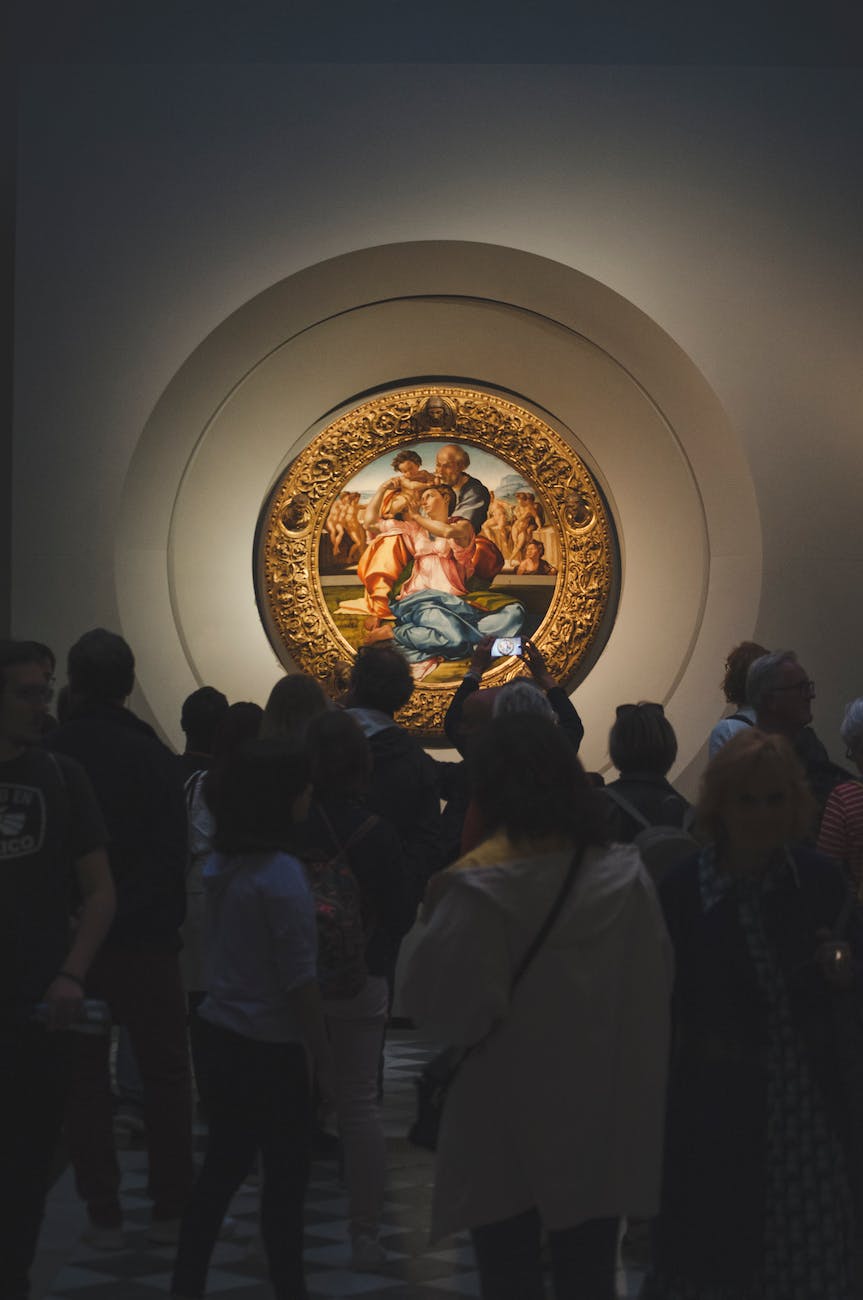
La prossima volta che sarete davanti al Tondo Doni agli Uffizi, provate a non fermarvi alla pittura.
Alzate lo sguardo. Guardate il legno scolpito, le decorazioni dorate, le lune, i virgulti d’ulivo e quelle cinque teste che sporgono verso di voi.
La cornice del Tondo Doni è parte integrante dell’opera.
Per il momento il sempre vostro Michelangelo Buonarroti vi saluta dandovi appuntamento ai prossimi post e si social.



The Frame of the Tondo Doni: Mysteries, Symbols, and Five Sculpted Heads
If your eyes are immediately drawn to the Holy Family when you look at the Tondo Doni, I certainly don’t blame you. That is precisely where I want to lead your mind and heart.
Today, however, I would like you to take a closer look at the frame. It is not merely a standalone decoration; rather, it helps us better understand the artwork and tells part of its story.
I designed it to engage in a direct dialogue with the Holy Family, while also celebrating Agnolo Doni and Maddalena Strozzi.
The Tondo Doni frame is not purely decorative
When I created the Tondo Doni around 1506–1507, I did not think only of the painting and the panel that would hold it. The frame had to be worthy of the painting itself.
It is a complex structure, rich in detail: palmettes, twisted cords, egg-and-dart moldings, pearls, spindle-like motifs, olive sprigs, botanical elements, and ornamental patterns that seem to chase one another across the wood.
Observe the decorations covered in pure gold leaf: foliage, monstrous faces, and motifs reminiscent of grottesche transform the frame into a parallel narrative. If you look closely, you will discover that almost nothing was left to chance.
Five heads protrude from the frame—but who do they represent?
Five heads project from the frame of the Tondo Doni. Five faces, five distinct expressions, five presences that seem to be gazing out at the painting.
The head positioned directly above the panel represents Christ. Identifying the other four, however, is a more complex matter. The two heads at the top are traditionally interpreted as prophets, while the two at the bottom are often identified as sibyls.
However, not everyone agrees. Some scholars have suggested that the more feminine-looking figures are actually angels.
In short, even after five centuries, those heads continue to spark debate.
After all, a work of art can sit before your eyes for centuries and still prompt you to ask questions.
I designed the frame myself
I designed the frame. Its actual carving in wood is attributed to the Tasso workshop—the same craftsmen who worked on the furnishings for the Doni couple’s bedchamber.
So, do not think that I painted a panel and then someone else decided to put a nice frame around it. Oh no.
The frame was created in conjunction with the painting.
The three Strozzi moons: a detail that tells the family’s story
Three crescent moons appear repeatedly among the frame’s ornamental motifs.
They are a heraldic reference to the Strozzi family, to which Maddalena—Agnolo Doni’s wife—belonged.
Thus, the Doni Tondo also tells the story of a family, a marriage, and a longed-for lineage.
Olive shoots and the desire for a daughter
Olive shoots appear alongside the moons. To understand the possible meaning of this motif, one must look to the Bible—specifically, Psalm 128:
“Your wife shall be like a fruitful vine within your home; your children like olive shoots around your table.”
Do you see now why these small branches might hold a significance that goes far beyond mere decoration? The themes of fertility, family, and children seem to fit the story of the Doni family perfectly. Agnolo Doni and Maddalena Strozzi had a daughter, Maria—a child the couple had long awaited. Those small olive shoots might thus take on a particularly evocative meaning: the promise of progeny, a growing family, and the continuation of life.
In this way, the frame tells a story that the painting itself does not explicitly narrate.
The next time you see the Tondo Doni, take a look at the frame as well.
The next time you stand before the Tondo Doni at the Uffizi, try not to stop at the painting itself.
Look up. Observe the carved wood, the gilded decorations, the moons, the olive shoots, and those five heads projecting toward you.
The frame of the Tondo Doni is an integral part of the artwork.
For now, your ever-faithful Michelangelo Buonarroti bids you farewell and looks forward to seeing you in future posts and on social media.

Sostienici – Support Us
Se questo blog ti piace e ti appassiona, puoi aiutarci a farlo crescere sempre più sostenendoci in modo concreto condividendo i post, seguendo le pagine social e con un contributo che ci aiuta ad andare avanti con il nostro lavoro di divulgazione. . ENGLISH: If you like and are passionate about this blog, you can help us make it grow more and more by supporting us in a concrete way by sharing posts, following social pages and with a contribution that helps us to move forward with our dissemination work.
10,00 €
Condividi:


Questo sono io




sostienici

Sostienici - Support Us
Se questo blog ti piace e ti appassiona, puoi aiutarci a farlo crescere sempre più sostenendoci in modo concreto condividendo i post, seguendo le pagine social e con un contributo che ci aiuta ad andare avanti con il nostro lavoro di divulgazione. . ENGLISH: If you like and are passionate about this blog, you can help us make it grow more and more by supporting us in a concrete way by sharing posts, following social pages and with a contribution that helps us to move forward with our dissemination work.
€10,00


