
Giuditta I, la donna fatale di Klimt
Una donna bellissima, uno sguardo enigmatico e una testa mozzata quasi nascosta nell’angolo della tela.
Nel 1901 Gustav Klimt dipinse una Giuditta completamente diversa da quella che la tradizione aveva raccontato per secoli, trasformando l’eroina biblica in una delle più seducenti e inquietanti femme fatale dell’arte europea.
Quando Giuditta I venne esposta per la prima volta nel 1901 alla X mostra della Secessione viennese, il pubblico si trovò davanti a un’immagine molto lontana da quella che la tradizione aveva costruito intorno alla protagonista dell’Antico Testamento. Gustav Klimt aveva preso una storia antica, conosciuta da secoli, e l’aveva completamente trasformata attraverso una pittura nella quale sensualità, decorazione, erotismo e riferimenti all’arte del passato si fondevano con l’immagine di una donna che sembrava appartenere non tanto al mondo biblico quanto alla sofisticata Vienna dell’inizio del Novecento.
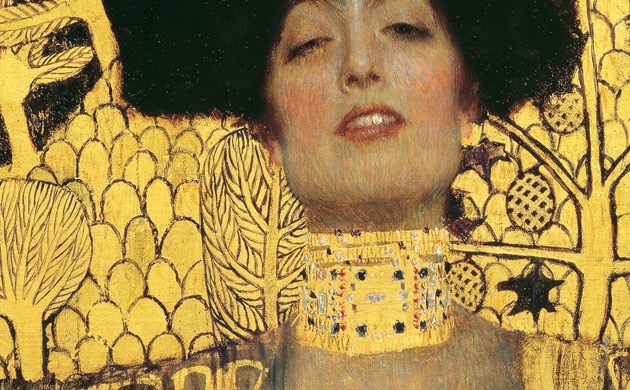
La Giuditta di Klimt non appare come una donna fragile che, attraverso l’aiuto divino, riesce a sconfiggere il nemico del proprio popolo, ma come una figura femminile consapevole del proprio fascino e del potere che esercita attraverso lo sguardo, la postura e la sensualità del corpo.
È una donna che non sembra avere paura di ciò che ha appena compiuto e che, proprio grazie alla sua ambiguità, riesce ancora oggi a mettere lo spettatore davanti a una domanda difficile: chi è veramente questa Giuditta?
Giuditta I, il capolavoro del 1901
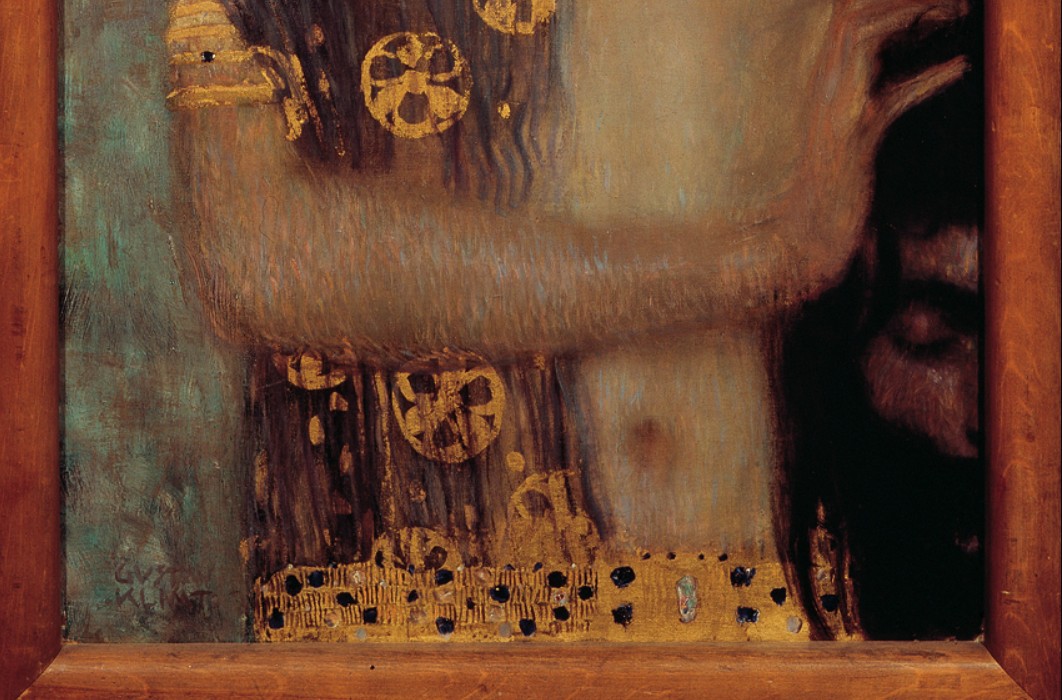
Realizzato nel 1901, il dipinto è un olio su tela di 84 × 42 centimetri, firmato in basso a sinistra con la dicitura “GUSTAV -/ KLIMT”, mentre sulla parte superiore della cornice compare il titolo “JUDITH UND -/ HOLOFERNES”, cioè “Giuditta e Oloferne”.
Oggi l’opera è conservata a Vienna, nelle collezioni del Belvedere, con numero di inventario 4737, ed è considerata una delle immagini più rappresentative della stagione secessionista di Klimt, proprio perché racchiude in una superficie relativamente piccola alcuni degli elementi destinati a diventare caratteristici della sua pittura: la figura femminile dominante, l’erotismo sottile, la preziosità degli ornamenti, il gusto per la bidimensionalità e il dialogo continuo fra arte antica e modernità.
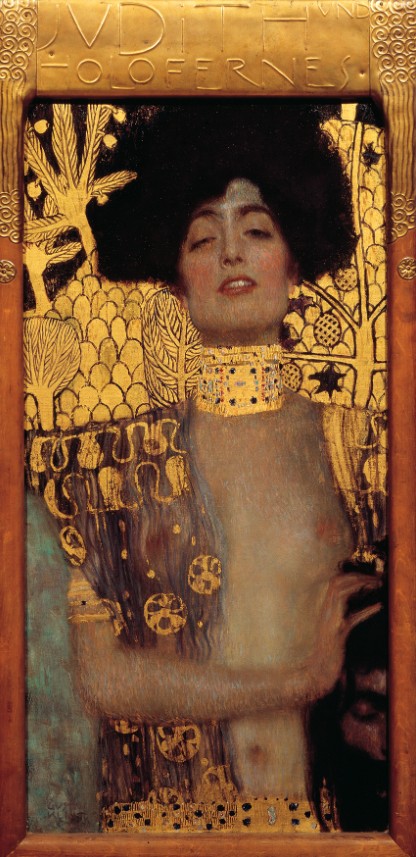
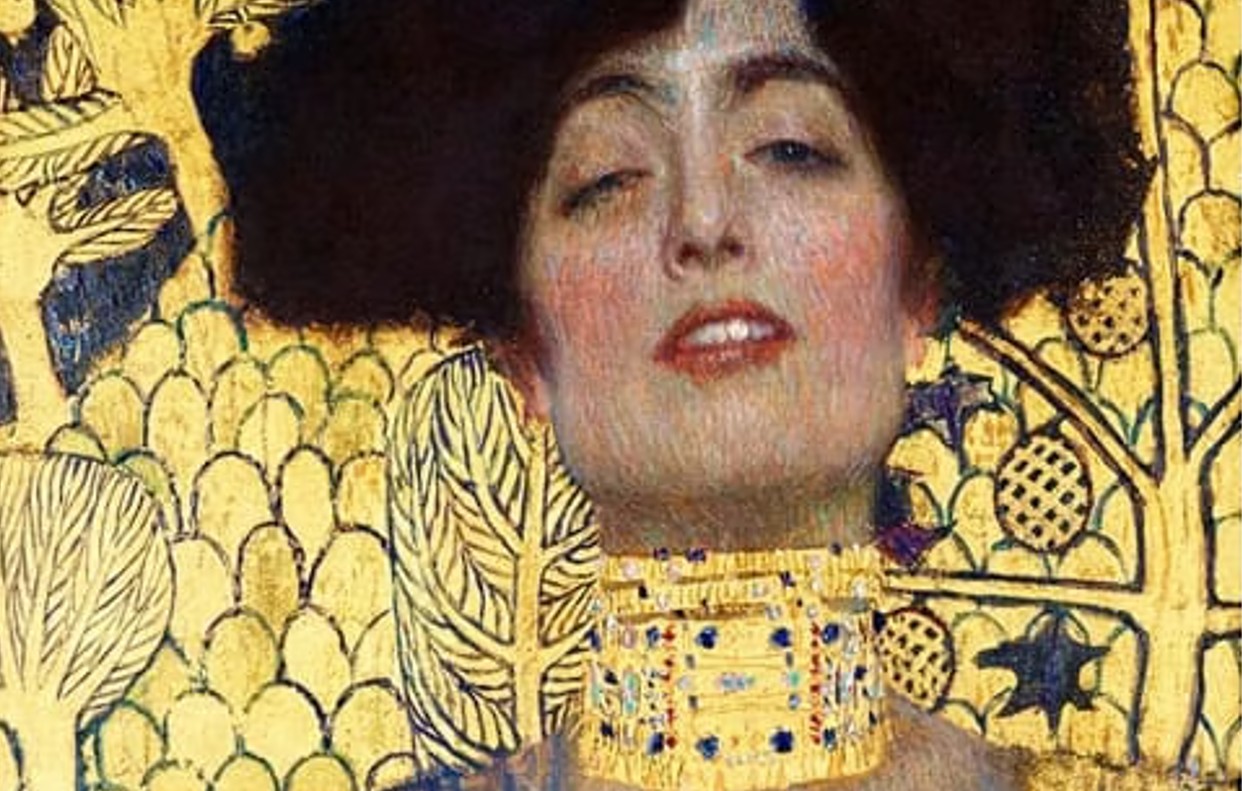
Giuditta è rappresentata a mezzo busto e occupa quasi interamente lo spazio verticale della tela, mentre il suo volto chiarissimo, incorniciato dai capelli neri, emerge con una forza particolare dal complesso sistema decorativo che la circonda.
Klimt non le attribuisce un’emozione immediatamente riconoscibile: non c’è paura, non c’è dolore, non c’è il trionfo esplicito dell’eroina che ha appena sconfitto il proprio nemico, ma una sensualità sospesa e ambigua che rende impossibile stabilire con certezza ciò che Giuditta stia pensando.
Klimt inventa una nuova donna
Nel 1901 il critico Ludwig Hevesi comprese immediatamente la portata innovativa della tela e definì questa nuova Giuditta una figura pericolosa e seducente, mettendola inoltre in relazione con la Pallade Atena che Klimt aveva dipinto tre anni prima.
Il confronto è particolarmente significativo perché, nonostante Giuditta e Atena provengano da tradizioni completamente differenti, nella lettura di Hevesi entrambe appartengono a una stessa idea di femminilità, arcaica e allo stesso tempo modernissima, nella quale la donna non è più rappresentata semplicemente come oggetto di protezione o come figura idealizzata, ma come una presenza capace di esercitare una forza autonoma e quasi inquietante.
Klimt stava dunque costruendo un nuovo tipo di donna, una figura femminile che avrebbe avuto un ruolo centrale nella sua arte e che avrebbe trovato nella femme fatale una delle sue espressioni più celebri.
La sua Giuditta è infatti snella, quasi efebica, lontanissima dalle forme opulente che spesso avevano caratterizzato la rappresentazione idealizzata del corpo femminile, e possiede un volto dai tratti sottili e spigolosi che contribuisce a darle quell’aspetto contemporaneo che tanto colpì i critici dell’epoca.
La testa di Oloferne? Bisogna cercarla
C’è poi un particolare che cambia completamente il modo di osservare il dipinto e che spesso sfugge a un primo sguardo: la testa di Oloferne si trova nell’angolo inferiore destro della composizione, ma è quasi nascosta.
Klimt non mostra con brutalità il momento della decapitazione e non costruisce la scena attorno alla violenza dell’episodio biblico, preferendo concentrare tutta l’attenzione sulla protagonista e lasciando che la presenza della vittima venga scoperta soltanto in un secondo momento.
È una scelta estremamente raffinata perché modifica il rapporto fra Giuditta e Oloferne: l’uomo che nella storia biblica rappresenta il potente nemico di Israele diventa quasi un elemento marginale, mentre la donna che lo ha sconfitto domina completamente la composizione.
Oloferne è relegato nell’angolo; Giuditta occupa il centro della scena.
Il corpo, la trasparenza e i gioielli
La sensualità della protagonista nasce anche dal modo in cui Klimt tratta il corpo, che appare sottile e delicato, con una pelle chiarissima che sembra quasi illuminata dall’interno e un piccolo seno appena accennato che emerge dalla veste trasparente.
Sulle spalle ricade un tessuto leggerissimo, attraversato da pennellate bluastre e traslucide, mentre intorno al collo e al corpo si sviluppano preziosi ornamenti di ispirazione asiatica che sembrano fondersi con la carne invece di limitarsi a decorarla.
È proprio questo rapporto fra corpo e ornamento a rendere la Giuditta di Klimt così particolare, perché la preziosità dei gioielli non appare come qualcosa di esterno alla figura, ma come una sorta di prolungamento naturale della sua pelle, creando una superficie nella quale carne, tessuto, pietre e decorazione sembrano appartenere alla stessa materia.
Klimt sta già costruendo quel linguaggio prezioso e ornamentale che negli anni successivi raggiungerà uno dei suoi vertici durante la cosiddetta fase aurea.
Lo sfondo viene dall’arte assira
Anche il paesaggio che compare alle spalle di Giuditta nasconde una curiosità particolarmente interessante, perché non nasce da una semplice invenzione decorativa dell’artista, ma deriva da un riferimento preciso all’arte del Vicino Oriente antico.
Lo sfondo, fortemente stilizzato, presenta un paesaggio collinare con alberi di fico e viti che Klimt riprende da un bassorilievo del Palazzo di Sennacherib, contribuendo così a costruire quell’atmosfera arcaica e orientale che tanto affascinava la cultura europea di fine Ottocento e inizio Novecento.
La cosa sorprendente è che questi elementi antichi vengono inseriti accanto alla figura di una donna che i contemporanei percepivano come assolutamente moderna, creando così una sorta di cortocircuito visivo nel quale il passato e il presente convivono sulla stessa superficie.
Perché Giuditta venne confusa con Salomè?
La sensualità della protagonista fu talmente forte da generare anche un equivoco iconografico destinato a diventare parte della storia dell’opera. Giuditta venne confusa con Salomè.
Le due figure appartengono a racconti differenti, ma entrambe sono legate a una testa mozzata: Giuditta a quella del generale assiro Oloferne, Salomè a quella di Giovanni Battista.
La presenza della testa maschile e soprattutto l’atteggiamento sensuale della protagonista fecero sì che alcuni osservatori leggessero l’immagine secondo l’iconografia di Salomè, tanto che nel 1905, quando il dipinto fu esposto a Berlino, venne presentato con il titolo alternativo di “Salomè”.
La cornice è parte dell’opera
Un’altra curiosità fondamentale riguarda la cornice, che nel caso di Giuditta I non può essere considerata un semplice elemento destinato a proteggere la tela.
La cornice fu realizzata dal fratello di Gustav Klimt, Georg Klimt, che era orafo, sulla base di un disegno dello stesso Gustav, il quale intervenne personalmente anche nella progettazione degli elementi decorativi e dell’iscrizione.
Questa attenzione rivela quanto fosse importante per Klimt l’idea dell’opera d’arte totale, nella quale pittura, decorazione, artigianato, cornice e testo non fossero elementi separati, ma parti di un unico progetto estetico.
È una concezione perfettamente coerente con lo spirito della Secessione viennese e con il celebre motto secessionista: “Al tempo la sua arte, all’arte la sua libertà.”
Dal possibile scandalo al successo
Quando Giuditta venne presentata nel 1901, Klimt si trovava ancora al centro di numerose polemiche, soprattutto dopo le reazioni provocate dalle sue opere precedenti.
Hevesi raccontò con ironia come gli stessi spettatori che pochi anni prima avevano reagito con indignazione davanti alla Pallade Atena sembrassero ora approvare con entusiasmo la nuova opera, arrivando a esclamare che quella Giuditta era finalmente qualcosa che piaceva.
Il paradosso è evidente: Klimt aveva continuato a essere provocatorio, ma aveva trovato un modo ancora più sofisticato di esserlo, utilizzando la sensualità, l’oro, la decorazione e la bellezza femminile per trasformare una storia antica in un’immagine perfettamente aderente alla sensibilità della Vienna moderna.
La storia dell’opera
La provenienza di Giuditta I comprende il collezionista viennese Anton Loew, quindi Ferdinand Hodler a Ginevra e il successivo lascito dello stesso Hodler, fino all’ingresso nelle collezioni della Österreichische Galerie Belvedere di Vienna, che acquisì l’opera nel 1954.
Prima del 1918 il dipinto fu inoltre presentato in diverse esposizioni, tra cui quella di Monaco del 1901, mentre la sua presenza nelle collezioni del Belvedere ne ha consolidato nel tempo il ruolo di una delle opere più rappresentative di Gustav Klimt.
Con Giuditta Klimt dipinse la nascita di una nuova immagine femminile, seducente, libera, ambigua e capace di esercitare un potere che non ha più bisogno di essere spiegato.
Per il momento il sempre vostro Michelangelo Buonarroti vi saluta dandovi appuntamento ai prossimi post e sui social.
Judith I, Klimt’s Femme Fatale
A stunning woman, an enigmatic gaze, and a severed head almost hidden in the corner of the canvas.
In 1901, Gustav Klimt painted a Judith entirely different from the one depicted by tradition for centuries, transforming the biblical heroine into one of European art’s most seductive and unsettling femmes fatales.
When Judith I was first exhibited in 1901 at the 10th Vienna Secession exhibition, the public encountered an image far removed from the traditional portrayal of this Old Testament figure. Gustav Klimt had taken an ancient, long-known story and completely transformed it through a style in which sensuality, ornamentation, eroticism, and references to art history merged with the image of a woman who seemed to belong not to the biblical world, but to the sophisticated Vienna of the early twentieth century.
Klimt’s Judith does not appear as a frail woman who, with divine aid, defeats her people’s enemy; instead, she is a female figure fully aware of her allure and the power she wields through her gaze, her posture, and her sensual physicality.
She is a woman who seems unafraid of her recent deed and who, precisely because of her ambiguity, continues to confront the viewer with a difficult question: who is this Judith, really?
Judith I: The 1901 Masterpiece
Created in 1901, the painting is an oil on canvas measuring 84 × 42 centimeters. It is signed in the bottom left corner with the inscription “GUSTAV -/ KLIMT,” while the title “JUDITH UND -/ HOLOFERNES”—meaning “Judith and Holofernes”—appears on the upper part of the frame. Today, the work is housed in Vienna within the Belvedere collections (inventory number 4737) and is considered one of the most representative images of Klimt’s Secessionist period. This is precisely because, within a relatively small surface area, it encapsulates elements destined to become hallmarks of his painting style: the dominant female figure, subtle eroticism, exquisite ornamentation, a predilection for two-dimensionality, and an ongoing dialogue between ancient art and modernity.
Judith is depicted in a half-length portrait that almost entirely fills the vertical space of the canvas; her strikingly pale face, framed by dark hair, emerges with remarkable intensity from the intricate decorative patterns surrounding her.
Klimt does not endow her with any immediately recognizable emotion: there is no fear, no grief, and no explicit triumph of a heroine who has just vanquished her enemy. Instead, there is a suspended, ambiguous sensuality that makes it impossible to determine with certainty what Judith is thinking.
Klimt invents a new kind of woman
In 1901, the critic Ludwig Hevesi immediately grasped the innovative significance of the canvas. He described this new Judith as a dangerous and seductive figure, drawing a parallel between her and the Pallas Athena that Klimt had painted three years earlier.
This comparison is particularly significant because, although Judith and Athena stem from vastly different traditions, Hevesi saw them as sharing the same concept of femininity—one that was simultaneously archaic and ultra-modern. In this vision, the woman is no longer portrayed merely as an object to be protected or an idealized figure, but as a presence capable of exerting an autonomous and almost unsettling power.
Klimt was thus forging a new type of woman—a female figure destined to play a central role in his art and to find one of its most famous expressions in the femme fatale. Her Judith is slender—almost ephebic—and far removed from the voluptuous forms that often characterized idealized depictions of the female body; she possesses a face with delicate, angular features that lend her the contemporary look that so struck critics of the time.
Holofernes’s head? You have to look for it
There is a detail that completely changes how one views the painting—one that often escapes the initial glance: Holofernes’s head is located in the bottom-right corner of the composition, yet it is almost hidden.
Klimt does not brutally depict the moment of beheading, nor does he build the scene around the violence of the biblical episode; instead, he focuses all attention on the protagonist, allowing the victim’s presence to be discovered only upon closer inspection.
This is a highly sophisticated choice, as it alters the relationship between Judith and Holofernes: the man who, in the biblical story, represents Israel’s powerful enemy becomes almost a marginal element, while the woman who defeated him completely dominates the composition.
Holofernes is relegated to the corner; Judith occupies center stage.
The body, transparency, and jewelry
The protagonist’s sensuality stems in part from the way Klimt renders the body: slender and delicate, with fair skin that seems almost illuminated from within, and small, subtly suggested breasts emerging from a sheer garment.
A gossamer-light fabric drapes over her shoulders, streaked with translucent blue brushstrokes, while exquisite, Asian-inspired ornaments wrap around her neck and body, appearing to merge with her flesh rather than merely adorning it.
It is precisely this relationship between body and ornament that makes Klimt’s Judith so distinctive; the precious jewelry does not appear as something external to the figure but rather as a natural extension of her skin, creating a surface where flesh, fabric, stones, and decoration seem to be made of the same substance.
Klimt is already developing the rich, ornamental visual language that would later reach its pinnacle during his so-called “Golden Phase.”
The background draws from Assyrian art
The landscape appearing behind Judith also holds a particularly interesting detail: it is not merely a decorative invention by the artist but derives from a specific reference to the art of the ancient Near East.
The highly stylized background depicts a hilly landscape with fig trees and grapevines—elements Klimt adapted from a bas-relief in the Palace of Sennacherib. This helps evoke the archaic, Oriental atmosphere that so captivated European culture in the late 19th and early 20th centuries.
Remarkably, these ancient elements are juxtaposed with a female figure whom contemporaries perceived as thoroughly modern, creating a kind of visual “short circuit” where past and present coexist on the same surface.
Why was Judith mistaken for Salome?
The protagonist’s sensuality was so potent that it sparked an iconographic misunderstanding that became part of the work’s history: Judith was mistaken for Salome. The two figures belong to different stories, yet both are linked to a severed head: Judith to that of the Assyrian general Holofernes, and Salome to that of John the Baptist.
The presence of the male head—and, above all, the protagonist’s sensual demeanor—led some observers to interpret the image through the lens of Salome’s iconography; indeed, when the painting was exhibited in Berlin in 1905, it was presented under the alternative title Salome.
The frame is part of the artwork
Another key detail concerns the frame; in the case of Judith I, it cannot be viewed merely as a protective element for the canvas.
The frame was crafted by Gustav Klimt’s brother, Georg Klimt—a goldsmith—based on a design by Gustav himself, who also personally oversaw the planning of the decorative elements and the inscription.
This level of attention reveals the importance Klimt placed on the concept of the Gesamtkunstwerk (total work of art), in which painting, decoration, craftsmanship, framing, and text were not separate elements but parts of a unified aesthetic vision.
This approach is perfectly in tune with the spirit of the Vienna Secession and its famous motto: “To every age its art, to art its freedom.”
From potential scandal to success
When Judith was unveiled in 1901, Klimt was still at the center of considerable controversy, particularly following the reactions provoked by his earlier works.
Hevesi wryly noted how the very same viewers who, just a few years prior, had reacted with indignation to Pallas Athena now seemed to enthusiastically approve of the new work, going so far as to exclaim that this Judith was, at last, something they liked. The paradox is evident: Klimt remained provocative, yet he had found an even more sophisticated way to be so, employing sensuality, gold, ornamentation, and female beauty to transform an ancient tale into an image that resonated perfectly with the sensibilities of modern Vienna.
The history of the work
The provenance of Judith I includes the Viennese collector Anton Loew, followed by Ferdinand Hodler in Geneva and Hodler’s subsequent bequest, leading to its inclusion in the collections of the Österreichische Galerie Belvedere in Vienna, which acquired the work in 1954.
Prior to 1918, the painting was also featured in various exhibitions—including one in Munich in 1901—while its presence in the Belvedere collections has, over time, cemented its status as one of Gustav Klimt’s most iconic works.
With Judith, Klimt depicted the birth of a new female image: seductive, liberated, and ambiguous, capable of wielding a power that no longer requires explanation.
For now, yours truly, Michelangelo Buonarroti, bids you farewell and looks forward to seeing you in future posts and on social media.

Sostienici – Support Us
Se questo blog ti piace e ti appassiona, puoi aiutarci a farlo crescere sempre più sostenendoci in modo concreto condividendo i post, seguendo le pagine social e con un contributo che ci aiuta ad andare avanti con il nostro lavoro di divulgazione. . ENGLISH: If you like and are passionate about this blog, you can help us make it grow more and more by supporting us in a concrete way by sharing posts, following social pages and with a contribution that helps us to move forward with our dissemination work.
10,00 €
-
Dopo un secolo lontano dal pubblico, il Banchetto di Psiche torna a vivere: al via il restauro
🇮🇹Al via a Firenze il restauro del Banchetto di Psiche, l’arazzo seicentesco del Bargello rimasto nei depositi per un secolo. L’intervento durerà 30 mesi… 🇬🇧Restoration work has begun in Florence on *The Banquet of Psyche*, a 17th-century tapestry from the Bargello that had remained in storage for a century. The project will last 30 months…
-
Artemisia Gentileschi, Giuditta e l’ancella con la testa di Oloferne: il dramma biblico
🇮🇹Giuditta e l’ancella con la testa di Oloferne di Artemisia Gentileschi è in mostra al Museo degli Innocenti di Firenze: storia, dettagli e confronti con Orazio Gentileschi… 🇬🇧Judith and Her Maidservant with the Head of Holofernes* by Artemisia Gentileschi is on display at the Museo degli Innocenti in Florence: history, details, and comparisons with Orazio…
-

Il Cavallo colossale di Canova torna a casa in 10 casse: ecco quando si potrà ammirare
🇮🇹Il Cavallo colossale di Antonio Canova torna a Bassano il 27 ottobre 2026. Dopo il restauro, sarà visibile al Museo Civico dal 12 dicembre… 🇬🇧Antonio Canova’s colossal horse returns to Bassano on October 27, 2026. Following its restoration, it will be on display at the Civic Museum starting December 12…
Condividi:


Questo sono io




sostienici

Sostienici – Support Us
Se questo blog ti piace e ti appassiona, puoi aiutarci a farlo crescere sempre più sostenendoci in modo concreto condividendo i post, seguendo le pagine social e con un contributo che ci aiuta ad andare avanti con il nostro lavoro di divulgazione. . ENGLISH: If you like and are passionate about this blog, you can help us make it grow more and more by supporting us in a concrete way by sharing posts, following social pages and with a contribution that helps us to move forward with our dissemination work.
€10,00


