
La Sibilla Libica: quando il corpo diventa profezia
Ho sempre cercato nelle mie figure l’anima, la tensione vitale che trascendesse l’esteriorità per raccontare un’idea, un destino, una storia.
Tra tutte le figure monumentali che ho realizzato per gli affreschi della volta della Cappella Sistina, oggi vi voglio raccontare della Sibilla Libica e dell’incontro tra profezia, forza fisica e destino salvifico.

Chi era la Sibilla Libica?
Nel mondo antico, le sibille erano le donne consacrate alle divinità, dotate del dono della profezia. Non sacerdotesse comuni, ma figure che vivevano tra i mondi, recuperando visioni che trascendevano i confini del tempo e dello spazio.
La Sibilla Libica, secondo la tradizione classica, era la profetessa dell’Africa settentrionale. A differenza delle altre sibille greche e italiche, era associata a terre remote e misteriose, dove i confini tra il reale e il sovrannaturale si sfumavano. I Romani la consideravano portatrice di antiche rivelazioni, testimoni di una sapienza che preannunciava grandi eventi futuri, tra cui la venuta di un Salvatore.

Una posa audace per una voce profetica
Quando dipinsi la Sibilla Libica nel settore nord-est della volta, desideravo qualcosa pensai a una figura potente, in equilibrio tra azione e contemplazione.
La sua posa in contrapposto non è solo un escamotage estetico ma mette al centro di un pensiero attivo la Sibilla, sospesa tra passato e futuro.
In lei si coglie un gesto appena iniziato: sembra stia per chiudere o riporre il libro delle profezie. Non è un gesto conclusivo, ma un istante sospeso, un momento in cui la conoscenza si fa presenza corporea. Quel libro che custodisce rivelazioni divine è il fulcro della scena: il centro intorno a cui ruota la sua concentrazione e la sua forza.
L’abito, il corpo, la forza
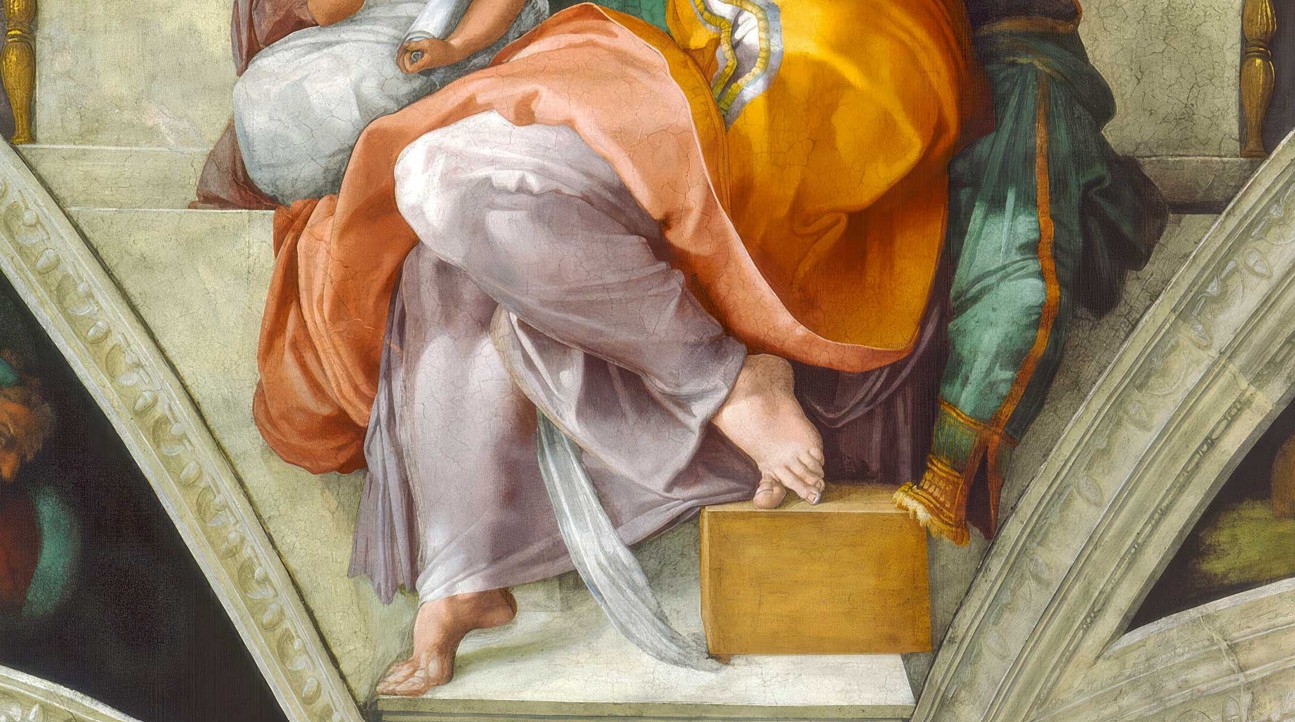
Ho voluto rappresentare una Sibilla Libica concerta e reale. L’abito che indossa giallo cangiante che si apre sulle gambe e sulla sottoveste bianca rivela la struttura fisica robusta e le spalle possenti che danno un senso di disciplina e tensione spirituale. La stoffa segue il corpo, come una presenza che non lo nasconde, ma lo definisce.
Dietro di lei i due genietti discutono animatamente in netto contrasto con la concentrazione che sembra mostrare la SIbilla.
Dal disegno all’affresco: lo studio dal vero
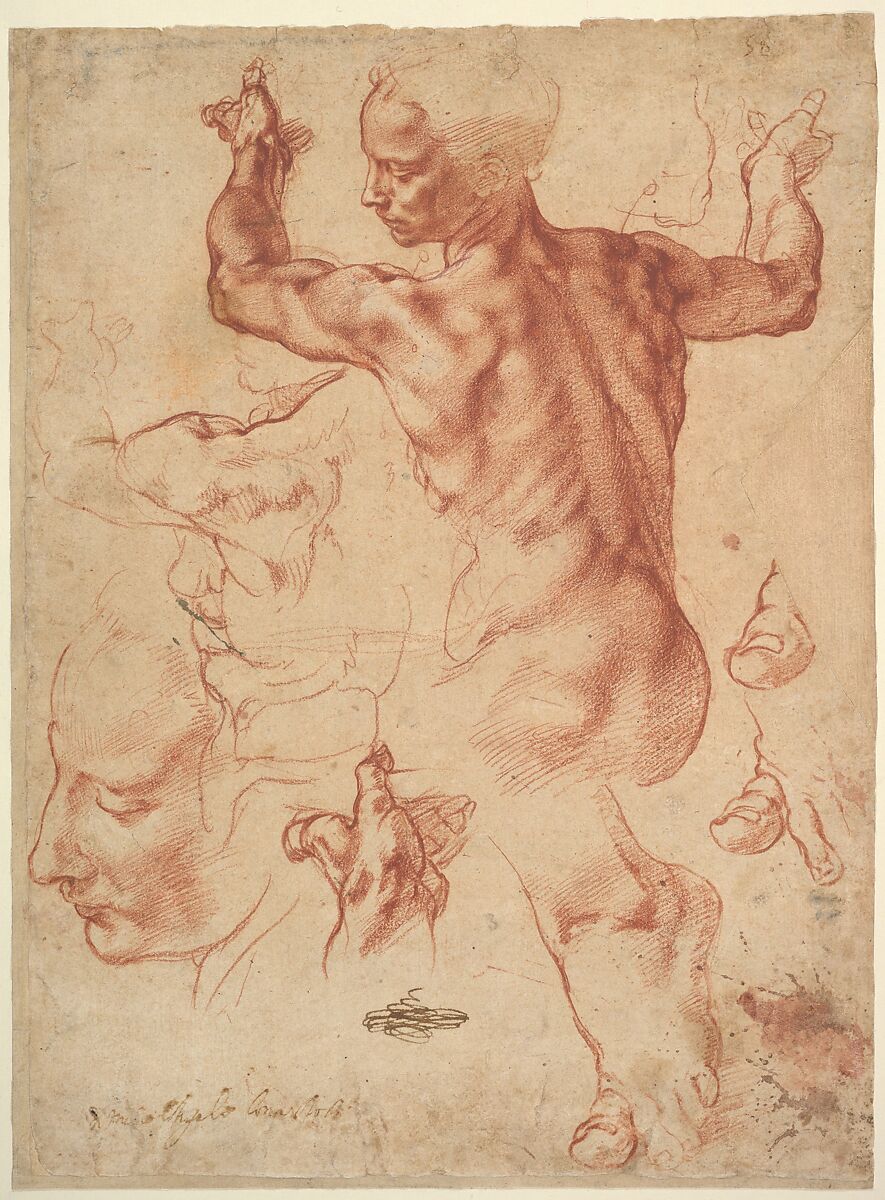
Prima di affrescare la volta, ho passato ore e giorni a studiare questa figura dal vero scegliendo un modello dal vero per riprodurre un corpo reale con muscoli, nervi e un ritmo interno palpabile.
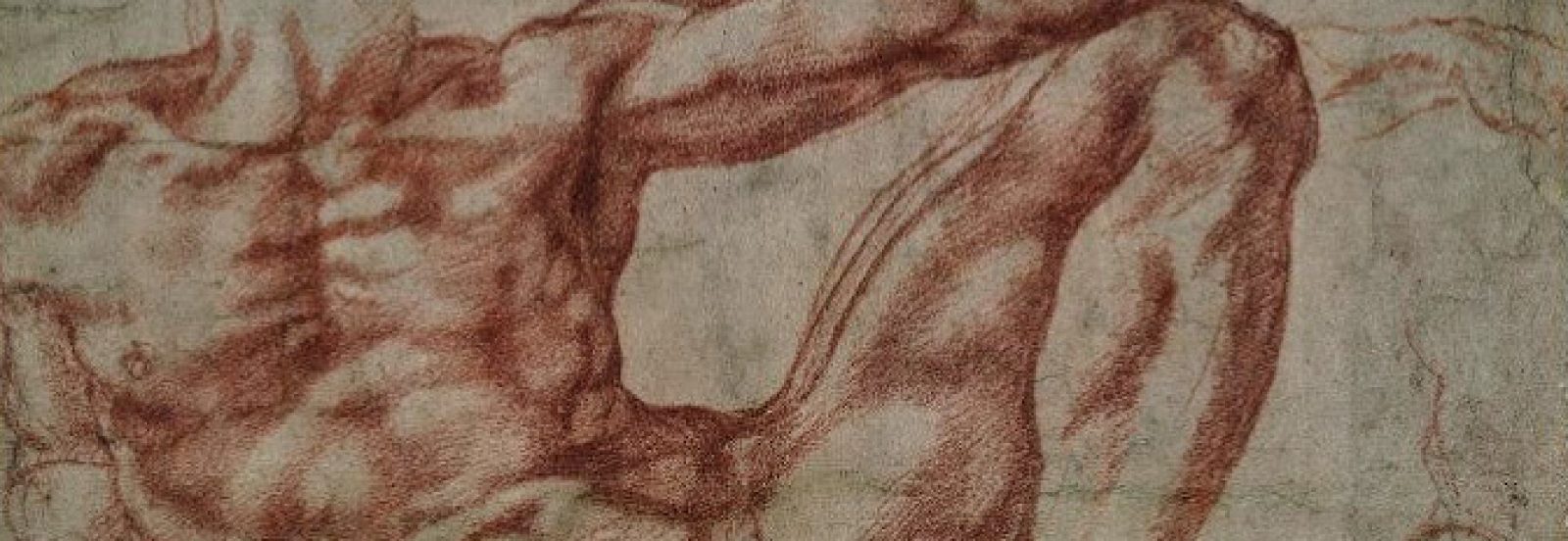
Il disegno preparatorio più significativo arrivato fino ai vostri giorni della Sibilla Libica lo realizzai con la sanguigna, un medium che mi consentiva di ottenere una resa anatomica che nessun altro mi dava.
Potevo infatti articolare ogni muscolo, ogni curva, ogni tensione.
Quel foglio, datato attorno al 1510, è oggi custodito con cura al Metropolitan Museum of Art di New York, acquistato l’8 agosto 1924 grazie alle trattative di John Singer Sargent con la vedova di Aureliano de Beruete.
Particolarità della Sibilla Libica
La Sibilla Libica è l’ultima tra le veggenti a cui lavorai nella volta. La dinamica del suo corpo parla di movimento interno. Non è infatti statica, ma è concentrata nel pensiero e nell’azione.
La sua presenza è una perfetta sintesi della profezia antica e dell’anticipazione cristiana.
Quando avrete occasione di entrare nella Cappella Sistina, soffermatevi a osservare la Sibilla Libica cercandone la tensione, i gesti e la profondità dello sguardo che sembra riflettere il peso della conoscenza.
Per il momento il sempre vostro Michelangelo Buonarroti vi saluta dandovi appuntamento ai prossimi post e sui social.
The Libyan Sibyl: When the Body Becomes Prophecy
I have always sought the soul in my figures, that vital tension that transcends the exterior to convey an idea, a destiny, a story.
Among all the monumental figures I created for the frescoes of the Sistine Chapel ceiling, today I want to tell you about the Libyan Sibyl and the intersection of prophecy, physical strength, and salvific destiny.
Who was the Libyan Sibyl?
In the ancient world, sibyls were women consecrated to the deities, endowed with the gift of prophecy. Not ordinary priestesses, but figures who lived between worlds, recovering visions that transcended the boundaries of time and space.
The Libyan Sibyl, according to classical tradition, was the prophetess of North Africa. Unlike other Greek and Italian sibyls, she was associated with remote and mysterious lands, where the boundaries between the real and the supernatural were blurred. The Romans considered her a bearer of ancient revelations, witnesses to a wisdom that foretold great future events, including the coming of a Savior.
A bold pose for a prophetic voice
When I painted the Libyan Sibyl in the northeast section of the vault, I wanted something—a powerful figure, poised between action and contemplation.
Her contrapposto pose is not merely an aesthetic device but places the Sibyl at the center of an active thought, suspended between past and future.
She appears to be in the act of closing or putting away the book of prophecies. It is not a conclusive gesture, but a suspended instant, a moment in which knowledge becomes corporeal presence. That book, which holds divine revelations, is the fulcrum of the scene: the center around which her concentration and strength revolve.
The dress, the body, the strength
I wanted to represent a Libyan Sibyl who is composed and real. The iridescent yellow dress she wears, which opens to reveal her legs and white slip, reveals her robust physique and powerful shoulders, conveying a sense of discipline and spiritual tension. The fabric follows the body, like a presence that doesn’t hide it, but defines it.
Behind her, the two geniuses argue animatedly, in stark contrast to the Sibyl’s apparent concentration.
From drawing to fresco: life study
Before frescoing the vault, I spent hours and days studying this figure from life, choosing a life model to reproduce a real body with muscles, nerves, and a palpable internal rhythm.
The most significant preparatory drawing of the Libyan Sibyl that has survived to this day was made in sanguine, a medium that allowed me to achieve an anatomical rendering that no other could.
I could, in fact, articulate every muscle, every curve, every tension.
That sheet, dated around 1510, is now carefully preserved at the Metropolitan Museum of Art in New York, having been acquired on August 8, 1924, thanks to negotiations between John Singer Sargent and the widow of Aureliano de Beruete.
Special Features of the Libyan Sibyl
The Libyan Sibyl is the last of the seers I worked on in the vault. The dynamics of her body speak of internal movement. She is not static, but rather focused on thought and action.
Her presence is a perfect synthesis of ancient prophecy and Christian anticipation.
When you have the opportunity to enter the Sistine Chapel, pause to observe the Libyan Sibyl, seeking her tension, her gestures, and the depth of her gaze, which seems to reflect the weight of knowledge.
For now, yours truly, Michelangelo Buonarroti bids you farewell and invites you to join him in future posts and on social media.

Sostienici – Support Us
Se questo blog ti piace e ti appassiona, puoi aiutarci a farlo crescere sempre più sostenendoci in modo concreto condividendo i post, seguendo le pagine social e con un contributo che ci aiuta ad andare avanti con il nostro lavoro di divulgazione. . ENGLISH: If you like and are passionate about this blog, you can help us make it grow more and more by supporting us in a concrete way by sharing posts, following social pages and with a contribution that helps us to move forward with our dissemination work.
10,00 €
Articoli
Condividi:


Questo sono io





sostienici

Sostienici – Support Us
Se questo blog ti piace e ti appassiona, puoi aiutarci a farlo crescere sempre più sostenendoci in modo concreto condividendo i post, seguendo le pagine social e con un contributo che ci aiuta ad andare avanti con il nostro lavoro di divulgazione. . ENGLISH: If you like and are passionate about this blog, you can help us make it grow more and more by supporting us in a concrete way by sharing posts, following social pages and with a contribution that helps us to move forward with our dissemination work.
€10,00


1 commento »