

La Scultura del giorno: Orfeo che incanta gli animali del Francavilla
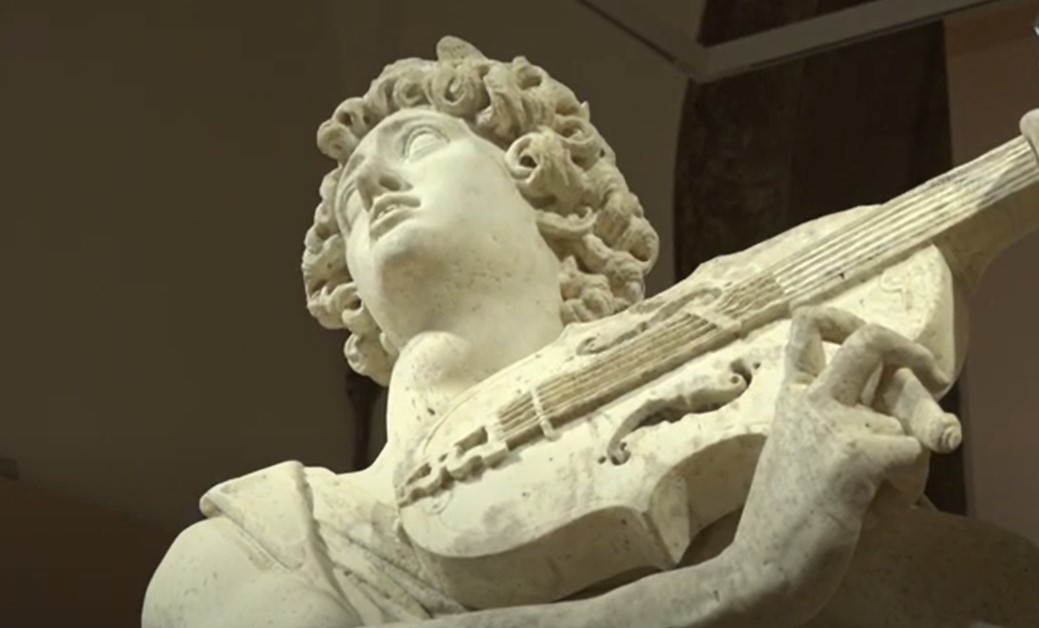
La scultura del giorno che vi propongo oggi è Orfeo che incanta gli animali, scolpito dal Francavilla nel 1598.
L’opera in marmo fu commissionata nello stesso anno allo scultore Pietro Francavilla dal banchiere Girolamo de’ Gondi per essere collocata al centro della fontana ubicata nel giardino dell’Hotel Gondi che poi prenderà il nome di Hotel de Condé.
Dal 1692 appare inventariato nel perimetro della mezzaluna di Apollo nel parco della Reggia di Versailles e su richiesta di Léon de Laborde, entrò a far parte delle collezioni del Louvre nel marzo 1851.
Francavilla scolpì Orfeo mentre in preda alla disperazione suona incessantemente la sua lira per stordire Cerbero ai suoi piedi e finalmente riuscire a raggiungere gli inferi per liberare la sua amata morta poco prima: Euridice.

La storia mitologica di Orfeo e Euridice è uno dei brani più celebri di tutta la mitologia. Orfeo, abile musicista, si innamorò perdutamente della bellissima ninfa Euridice che però, a causa del morso di un serpente, morì prematuramente.
Orfeo, figlio del dio Apollo, si invaghì della dea la quale però era spaventata da quel sentimento così potente. Nel tentativo di fuggire da Aristeo, la ninfa calpestò un serpente velenoso che la uccise. Orfeo disperato volle scendere negli inferi per ritrovarla.
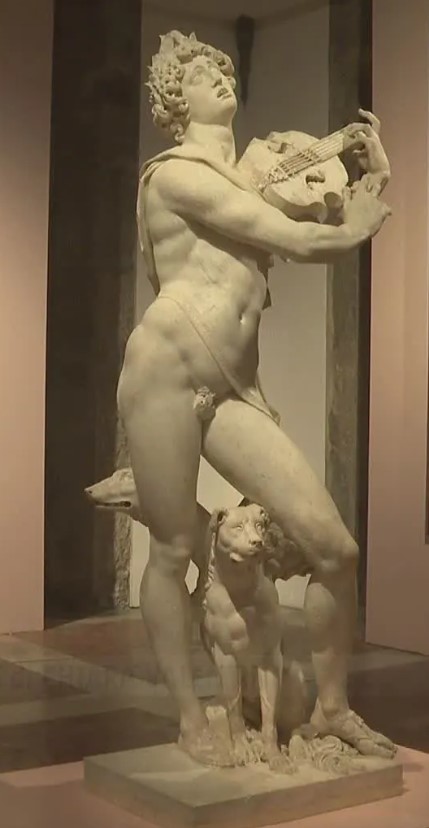
Suonando la sua lira riuscì a incantare prima Caronte e poi Cerbero, il cane a tre teste guardiano degli inferi. Dopo aver affrontato numerosi ostacoli, si ritrovò dinanzi ai padroni di quel luogo: Ade e Persefone.
Fu proprio Persefone che commossa dal grande amore di Orfeo, gli concesse di riavere Euridice con lui a patto che durante il percorso che li avrebbe portati fuori dall’Inferno, non si fosse mai voltato per guardarla.
Orfeo, oramai convinto di essere fuori dall’ade dopo un lungo cammino, si voltò ma Euridice scomparve per sempre.
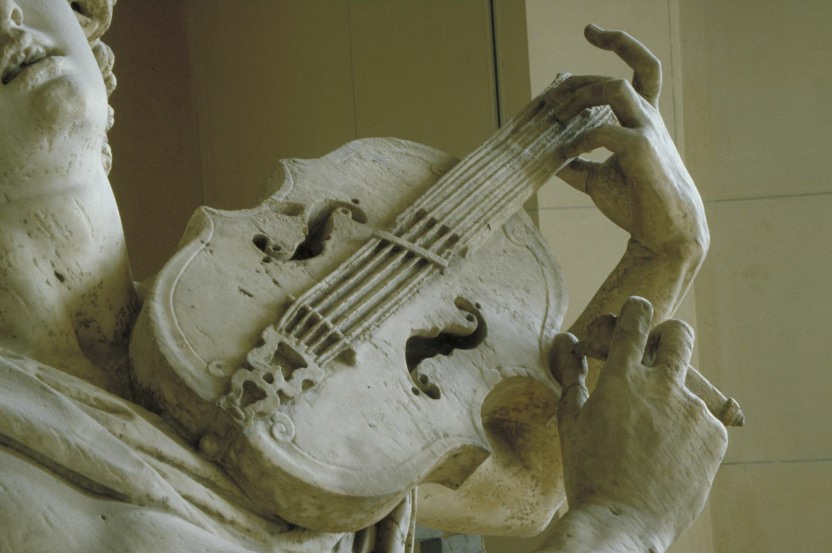
La scultura di Francavilla reca scolpita sulla stola che gli attraversa i fianchi la scritta OPVS PETRI FRANCAVILLAE BELGICI CAMARCENSI FLORENTINI ACADEMICI PISANI Q CIVIS. A. D. M. MDXCVIII, cioé “Opera di Pierre Franqueville, belga di Cambrai, dell’Accademia di Firenze (1586) e cittadino di Pisa, anno del signore 1598”.
Orfeo del Francavilla appartiene alle collezioni del Louvre ma al momento è esposto a Firenze nella mostra a Palazzo Medici Riccardi “L’incanto di Orfeo”: Ve ne ho parlato QUA.
Per il momento il sempre vostro Michelangelo Buonarroti vi saluta dandovi appuntamento ai prossimi post e sui social.
Sculpture of the day: Orpheus enchanting the animals of Francavilla
The sculpture of the day that I propose to you today is Orpheus enchanting the animals, sculpted by Francavilla in 1598.
The marble work was commissioned at the same time to the sculptor Pietro Francavilla by the banker Girolamo de’ Gondi to be placed in the center of the fountain located in the garden of the Hotel Gondi which would later take the name of Hotel de Condé.
Since 1692 it appears inventoried in the perimeter of the crescent of Apollo in the park of the Palace of Versailles and at the request of Léon de Laborde, it became part of the Louvre collections in March 1851.
Francavilla sculpted Orpheus while in desperation he incessantly plays the lyre to stun Cerberus at his feet and finally manage to reach the underworld to free his beloved who died shortly before him: Eurydice.
The mythological story of Orpheus and Eurydice is one of the most famous pieces in all of mythology. Orpheus, a skilled musician, fell madly in love with the beautiful nymph Eurydice who, however, died prematurely due to a snake bite.
Orpheus, son of the god Apollo, fell in love with her, but she was frightened by that powerful feeling. In an attempt to escape from Aristaeus, the nymph stepped on a poisonous snake which killed her. Desperate Orpheus wanted to go down to the underworld to find her.
By playing his lyre he managed to enchant first Charon and then Cerberus, the three-headed dog guardian of the underworld. After facing numerous obstacles, he found himself before the masters of that place: Hades and Persephone. It was Persephone who, moved by Orpheus’ great love, allowed him to have Eurydice back with him on the condition that during the journey that would take them out of Hell, he never turned to look at her.
Orpheus, now convinced that he was out of Hades after a long journey, turned around but Eurydice disappeared forever.
Francavilla’s sculpture has the writing OPVS PETRI FRANCAVILLAE BELGICI CAMARCENSI FLORENTINI ACADEMICI PISANI Q CIVIS carved on the stole that crosses his hips. A. D. M. MDXCVIII, i.e. “Work by Pierre Franqueville, Belgian from Cambrai, of the Academy of Florence (1586) and citizen of Pisa, year of the Lord 1598”.
Orpheus by Francavilla belongs to the Louvre collections but is currently on display in Florence in the exhibition “The Enchantment of Orpheus” at Palazzo Medici Riccardi: I told you about it HERE.
For the moment, your always Michelangelo Buonarroti greets you and will meet you in the next posts and on social media.

Sostienici – Support Us
Se questo blog ti piace e ti appassiona, puoi aiutarci a farlo crescere sempre più sostenendoci in modo concreto condividendo i post, seguendo le pagine social e con un contributo che ci aiuta ad andare avanti con il nostro lavoro di divulgazione. . ENGLISH: If you like and are passionate about this blog, you can help us make it grow more and more by supporting us in a concrete way by sharing posts, following social pages and with a contribution that helps us to move forward with our dissemination work.
8,00 €
-
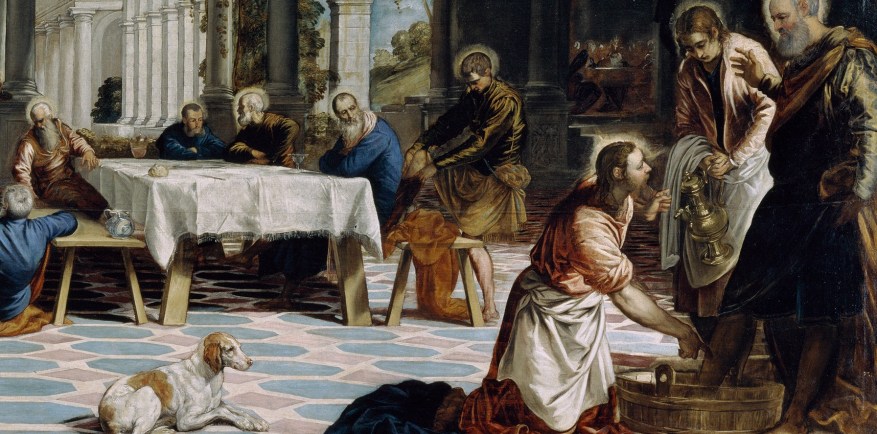
La Lavanda dei Piedi di Tintoretto: Il Capolavoro Veneziano al Prado
🇮🇹Tra i capolavori più affascinanti del Rinascimento veneziano, “La Lavanda dei Piedi” di Jacopo Tintoretto rappresenta un perfetto equilibrio tra spiritualità, innovazione compositiva e straordinaria forza narrativa… 🇬🇧Among the most fascinating masterpieces of the Venetian Renaissance, Jacopo Tintoretto’s “The Washing of the Feet” represents a perfect balance between spirituality, compositional innovation, and extraordinary narrative force…
-
Il Sacrificio di Isacco e quel momento tra la vita e la morte
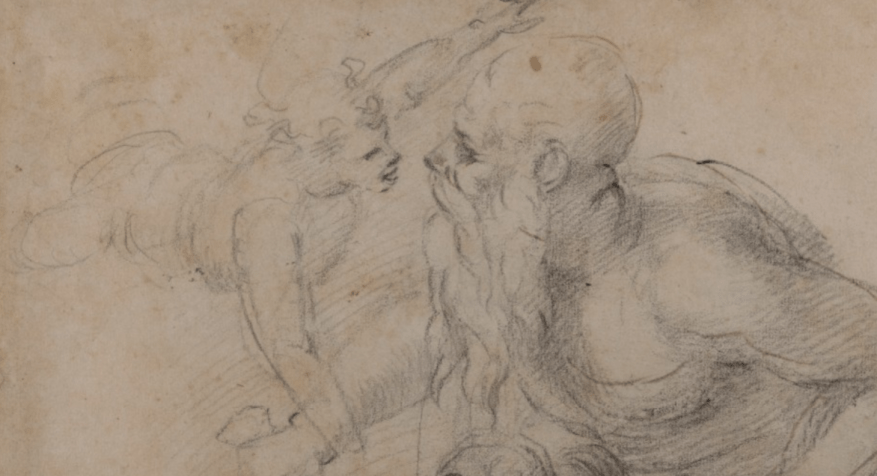
🇮🇹Oggi voglio raccontarvi alcuni dettagli sul mio disegno del Sacrificio di Isacco, conservato oggi a Casa Buonarroti. Su quel foglio volli tracciare il momento preciso in cui la paura fa spazio al miracolo… 🇬🇧Today I want to tell you some details about my drawing of the Sacrifice of Isaac, now preserved at Casa Buonarroti. On…
-
Mercoledì Santo: il giorno del tradimento di Giuda affrescato da Giotto
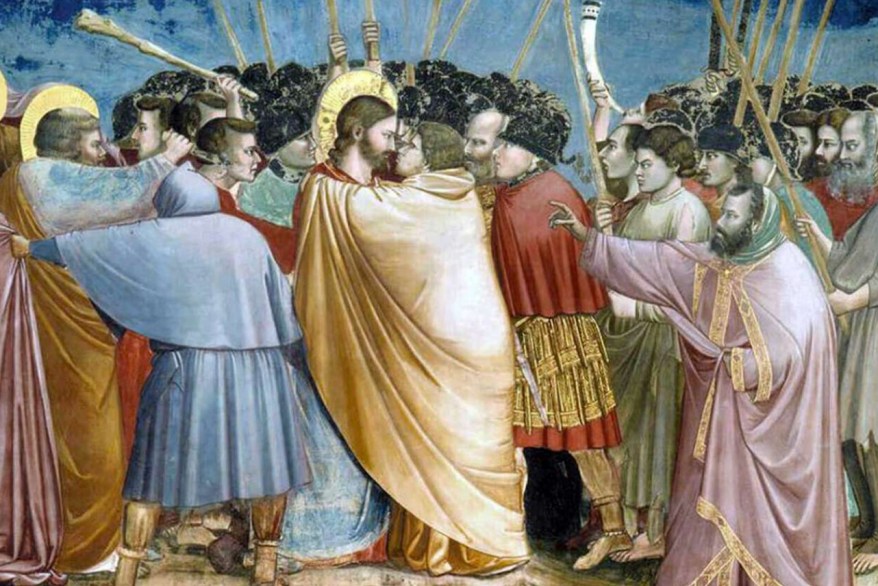
🇮🇹Il Mercoledì Santo è il giorno del silenzio, della riflessione e del tradimento. È il momento in cui Giuda sceglie di vendere Gesù per trenta denari, segnando uno dei passaggi più dolorosi della Settimana Santa…. 🇬🇧Holy Wednesday is a day of silence, reflection, and betrayal. ✝It is the moment when Judas chooses to sell Jesus…
Condividi:


Questo sono io





sostienici

Sostienici - Support Us
Se questo blog ti piace e ti appassiona, puoi aiutarci a farlo crescere sempre più sostenendoci in modo concreto condividendo i post, seguendo le pagine social e con un contributo che ci aiuta ad andare avanti con il nostro lavoro di divulgazione. . ENGLISH: If you like and are passionate about this blog, you can help us make it grow more and more by supporting us in a concrete way by sharing posts, following social pages and with a contribution that helps us to move forward with our dissemination work.
€10,00


