
Il Guercino rubato nella notte: la Madonna scomparve da Modena e ricomparve devastata in Marocco
Una notte d’agosto del 2014 una pala d’altare monumentale scomparve dalla chiesa di San Vincenzo a Modena.
Era la “Madonna col Bambino e i santi Giovanni Evangelista e Gregorio Taumaturgo” del Guercino. Tre anni dopo sarebbe stata ritrovata a Casablanca, gravemente danneggiata. Questa è la storia di uno dei più clamorosi furti d’arte degli ultimi decenni.
Era l’agosto del 2014 quando una delle opere più importanti conservate a Modena venne portata via nel cuore della notte. Non un piccolo dipinto facilmente trasportabile, ma una gigantesca pala d’altare di circa 293 × 184,5 centimetri, collocata nella chiesa di San Vincenzo, in corso Canalgrande, a pochissima distanza dal Tribunale e dalla Procura.
Il Guercino sparisce dalla chiesa di San Vincenzo
La mattina del 13 agosto 2014 il parroco si accorse che qualcosa non andava. La pala era sparita.
Il dipinto era stato sottratto dalla sua collocazione nella chiesa e portato all’esterno. Le prime ricostruzioni degli investigatori ipotizzarono che i ladri potessero essersi nascosti all’interno dell’edificio prima della chiusura, per poi agire quando la chiesa era ormai deserta.
La tela era stata portata via insieme al telaio, senza essere arrotolata sul posto.
Per gli investigatori non sembrava dunque un furto fatto da improvvisati ladri di chiese. Le modalità del furto, le dimensioni della tela e la notorietà del dipinto alimentarono immediatamente l’ipotesi di un’operazione organizzata.
La notizia fece rapidamente il giro d’Italia.
Quanto valeva quell’opera del Guercino?
Nel 2014 Vittorio Sgarbi parlò di una cifra compresa fra 5 e 6 milioni di euro, definendo la pala un’opera monumentale della maturità dell’artista.
Un’opera così celebre, di quelle dimensioni e con una provenienza tanto riconoscibile non poteva essere facilmente immessa sul mercato legale. Era troppo nota per poter essere semplicemente venduta a un museo o a un collezionista senza destare sospetti.
Anche gli investigatori sottolinearono come la fama e il valore del dipinto lo rendessero, di fatto, praticamente non commerciabile ma c’è chi avrebbe fatto carte false per possedere quel capolavoro, custodito lontano da sguardi indiscreti.
La polemica sull’allarme
Il furto fece esplodere anche una seconda questione: quella della sicurezza del patrimonio artistico custodito nelle chiese.
Inizialmente si parlò dell’assenza di un sistema d’allarme.
La Soprintendenza precisò però che la pala si trovava in una parrocchia ed era quindi nella disponibilità della Curia. La questione della sicurezza delle numerosissime opere presenti nelle chiese del territorio diventò immediatamente centrale nel dibattito.
Di fatto un impianto d’allarme nella parrocchia esisteva. Era stato realizzato grazie a un finanziamento della Fondazione Cassa di Risparmio di Modena, ma successivamente era stato disattivato a causa degli elevati costi di gestione, come spiegò allora il vicario generale dell’Arcidiocesi di Modena e Nonantola.
Il caso del Guercino mostrava così un problema molto più grande: come proteggere un patrimonio immenso, disseminato nelle chiese italiane, quando le risorse economiche per garantire sistemi di sicurezza adeguati non sono sufficienti?
Ma chi aveva commissionato quell’opera?
Per comprendere davvero l’importanza della tela bisogna tornare molto più indietro, al Seicento. La pala venne realizzata dal Guercino per gli Estensi e destinata alla chiesa dei Teatini di San Vincenzo a Modena.
Le fonti istituzionali la datano al 1629-1630 e non al 1639, data invece riportata in diverse cronache giornalistiche del 2014. La documentazione relativa all’opera e il successivo intervento di restauro confermano la datazione seicentesca attorno al 1629-1630.
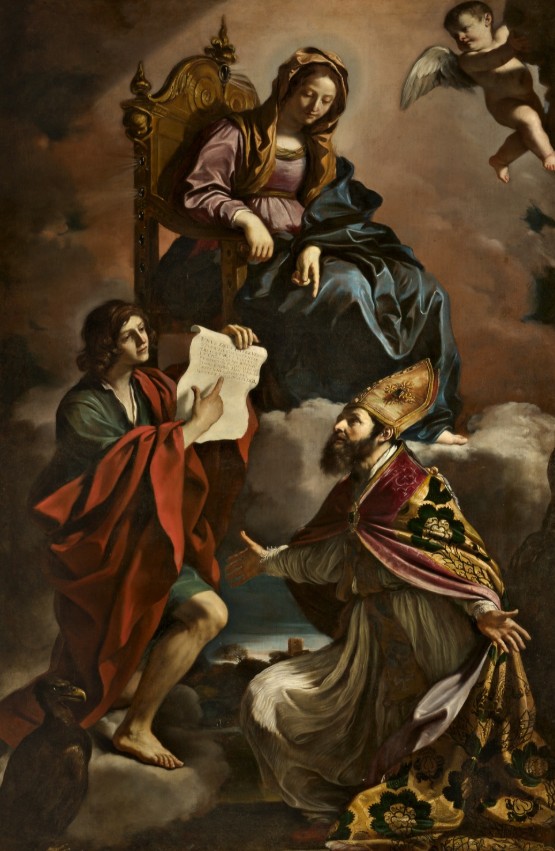
La composizione presenta la Madonna col Bambino accompagnata da san Giovanni Evangelista e san Gregorio Taumaturgo. È una pala monumentale nella quale il Guercino costruisce la scena attraverso la presenza imponente delle figure, la luce e la gestualità dei santi.
Tre anni di mistero
Dopo il furto iniziarono le indagini. Vennero esaminate le immagini delle telecamere presenti nella zona e i tabulati telefonici relativi all’area della chiesa. Gli investigatori cercarono di ricostruire il percorso seguito dai ladri e soprattutto di capire come fosse stato possibile trasportare una tela di quelle dimensioni fuori dal centro di Modena.
Per quasi tre anni, però, il Guercino rimase lontano da Modena.
Il Guercino ritrovato a Casablanca
Nel 2017, a quasi tre anni dal furto, il dipinto venne ritrovato a Casablanca, in Marocco, grazie alle attività del Comando Carabinieri per la Tutela del Patrimonio Culturale.
La tela era stata individuata dopo essere entrata nei circuiti dei falsi mercanti d’arte e grazie anche alla segnalazione di un collezionista.
La gioia per il ritrovamento fu però immediatamente accompagnata dalla preoccupazione: l’opera era stata gravemente danneggiata.
La tela era stata tagliata e arrotolata
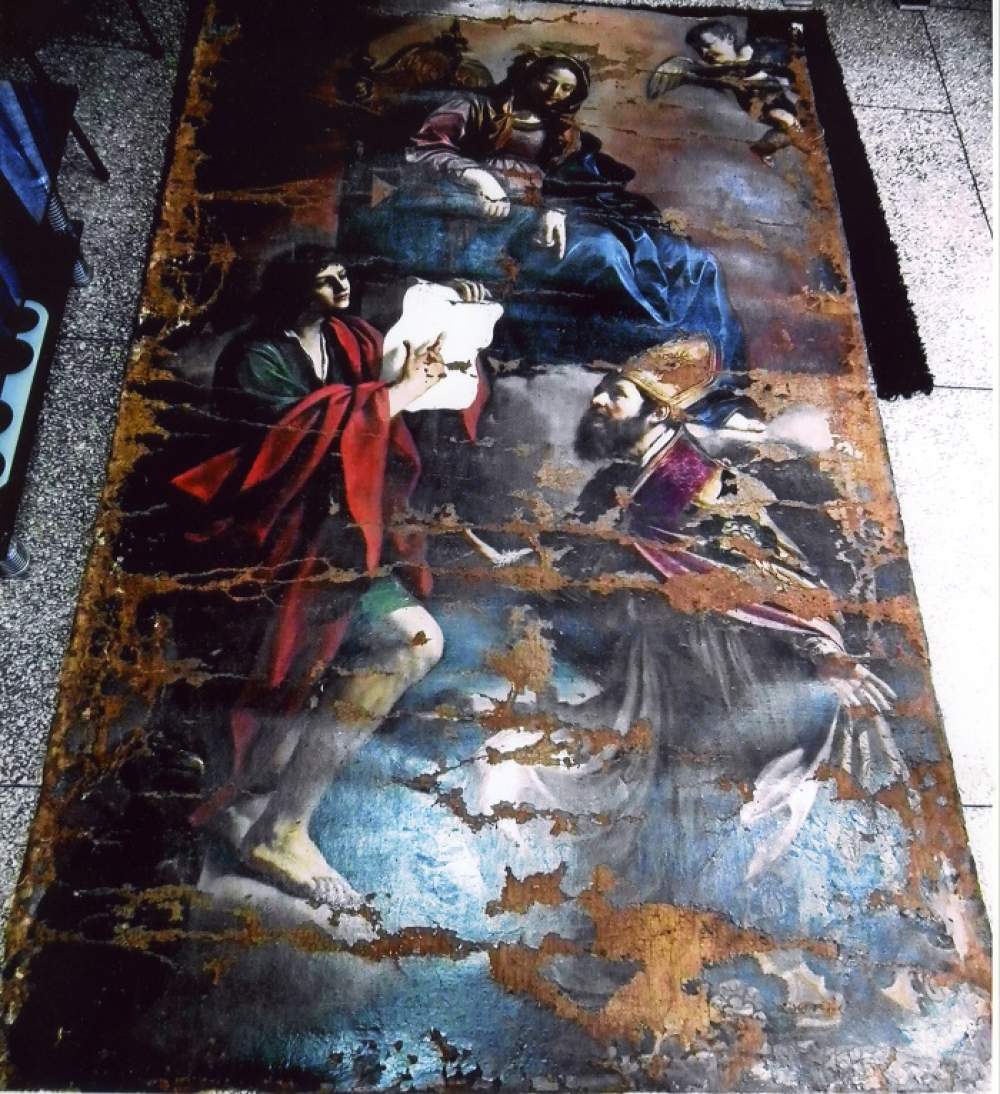
Quando l’opera tornò sotto la tutela delle autorità italiane, emerse la parte più drammatica della vicenda. Per trasportarla, i malviventi avevano tagliato la tela lungo tutto il perimetro del telaio.
Successivamente l’avevano arrotolata, con la superficie pittorica rivolta verso l’interno: una procedura devastante per un dipinto antico.
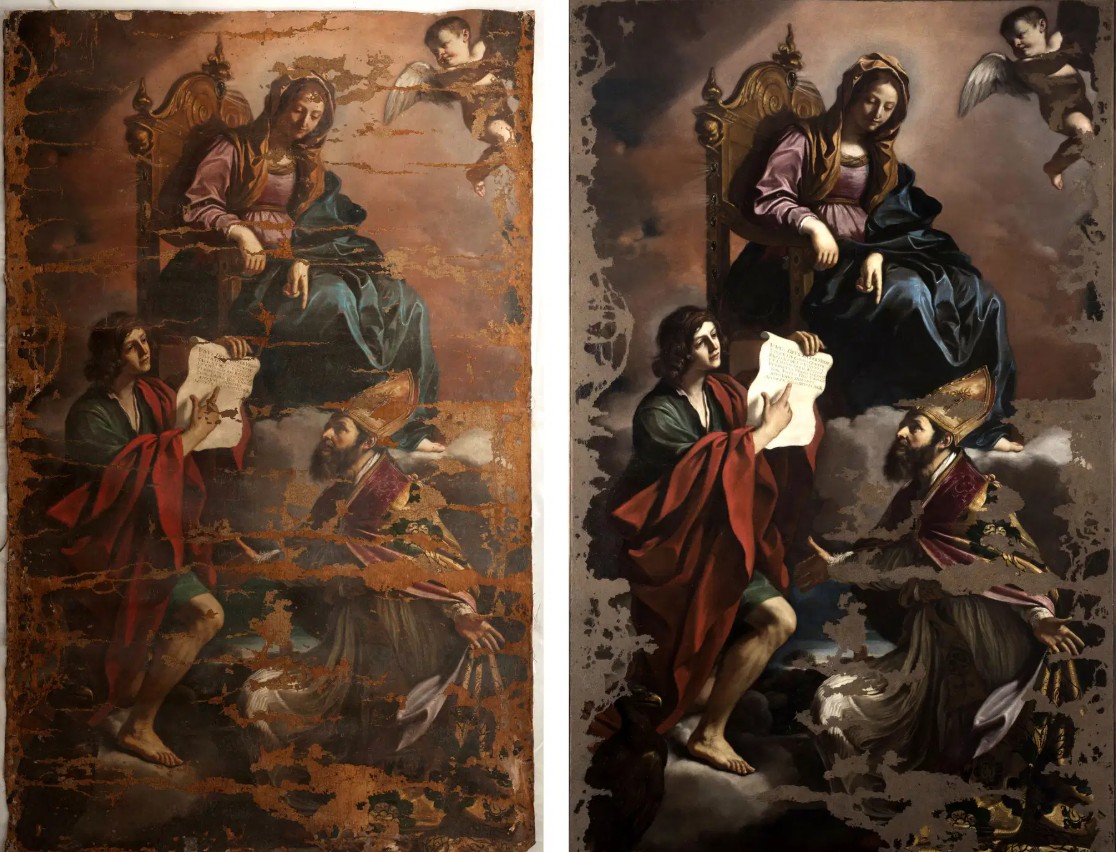
Secondo la documentazione della Soprintendenza, questa operazione aveva provocato la perdita di circa il 30% della policromia originale e dei precedenti ritocchi pittorici. Il Guercino che era tornato in Italia non era dunque più quello che era stato rubato ma era un’opera ferita.
Il difficile restauro
La tela venne affidata all’Istituto Superiore per la Conservazione e il Restauro di Roma, che dovette affrontare un intervento estremamente complesso.
Bisognava recuperare un dipinto che aveva subito tagli, deformazioni, cadute di colore e gravi perdite della materia pittorica. Il restauro consentì di risarcire le lacune laddove esistevano elementi sufficientemente sicuri per ricostruire la figurazione, recuperando anche parti originali che erano rimaste nascoste.
Era una seconda vita per il Guercino.
Nel 2019 il ritorno a Modena
Nel settembre del 2019 la tela restaurata venne finalmente presentata al pubblico alle Gallerie Estensi di Modena.
Per qualche tempo fu esposta nella Sala del Bernini, prima del previsto ritorno nella chiesa di San Vincenzo. Dopo cinque anni, dunque, la Madonna tornava a casa.
Quel furto aveva dimostrato quanto possa essere fragile il patrimonio artistico custodito nei luoghi sacri.
Un furto che ha cambiato per sempre la storia del dipinto
Oggi, quando si guarda la Madonna col Bambino e i santi Giovanni Evangelista e Gregorio Taumaturgo, è impossibile non pensare anche alla sua incredibile vicenda contemporanea.
Il Guercino era nato nel Seicento, aveva attraversato i secoli nella chiesa di San Vincenzo, era stato ammirato da generazioni di fedeli e visitatori.
Poi, in una notte d’agosto del 2014, scomparve. Aveva attraversato clandestinamente il Mediterraneo, era arrivato in Marocco, era stato ritrovato a Casablanca e infine era tornato in Italia.
Ma il prezzo di quella fuga era stato altissimo.
Un capolavoro può essere rubato in una notte. Per salvarlo, invece, possono servire anni di indagini, competenze, restauri e lavoro paziente.
Però da quel furto, a quanto pare, poco abbiamo imparato se troppo spesso nel nostro Paese continuano a sparire capolavori.
Per il momento il sempre vostro Michelangelo Buonarroti vi saluta dandovi appuntamento ai prossimi post e sui social.
The Guercino Stolen Overnight: The Madonna Vanished from Modena and Reappeared Devastated in Morocco
One night in August 2014, a monumental altarpiece vanished from the Church of San Vincenzo in Modena.
It was Guercino’s Madonna and Child with Saints John the Evangelist and Gregory Thaumaturgus. Three years later, it would be found in Casablanca, severely damaged. This is the story of one of the most sensational art thefts of recent decades.
It was August 2014 when one of the most important artworks housed in Modena was taken away in the dead of night. It was not a small, easily transportable painting, but a massive altarpiece measuring approximately 293 by 184.5 centimeters, located in the Church of San Vincenzo on Corso Canalgrande—just a stone’s throw from the courthouse and the public prosecutor’s office.
Guercino Vanishes from the Church of San Vincenzo
On the morning of August 13, 2014, the parish priest realized something was wrong. The altarpiece was gone.
The painting had been removed from its place in the church and taken outside. Initial reconstructions by investigators hypothesized that the thieves might have hidden inside the building before closing time, acting only once the church was deserted.
The canvas had been taken away along with its stretcher frame, without being rolled up on-site.
To investigators, it did not appear to be the work of amateur church thieves. The method of the theft, the size of the canvas, and the painting’s renown immediately fueled the theory that this was an organized operation.
News of the theft quickly spread across Italy.
How much was that Guercino work worth?
In 2014, Vittorio Sgarbi cited a figure between 5 and 6 million euros, describing the altarpiece as a monumental work from the artist’s mature period. A work of such renown, scale, and recognizable provenance could not easily be introduced into the legal market. It was too well-known to be simply sold to a museum or collector without arousing suspicion.
Investigators also noted that the painting’s fame and value made it, effectively, unsellable; yet, there were those who would have gone to great lengths to possess that masterpiece, keeping it hidden away from prying eyes.
The controversy over the alarm system
The theft also sparked a second issue: the security of the artistic heritage housed in churches.
Initially, there was talk of a lack of an alarm system.
However, the Superintendency clarified that the altarpiece was located in a parish church and was therefore under the jurisdiction of the Curia. The question of security for the vast number of artworks in local churches immediately became central to the debate.
In fact, an alarm system did exist at the parish. It had been installed thanks to funding from the Fondazione Cassa di Risparmio di Modena but was subsequently deactivated due to high operating costs, as explained at the time by the Vicar General of the Archdiocese of Modena and Nonantola.
The Guercino case thus highlighted a much larger problem: how can an immense heritage scattered across Italian churches be protected when financial resources are insufficient to ensure adequate security systems?
But who had commissioned the work?
To truly understand the importance of the canvas, one must look much further back, to the 17th century. The altarpiece was created by Guercino for the House of Este and intended for the Theatine church of San Vincenzo in Modena.
Official records date it to 1629–1630, rather than 1639—a date cited in various 2014 news reports. Documentation regarding the work and its subsequent restoration confirms the 17th-century dating of around 1629–1630. The composition depicts the Madonna and Child accompanied by Saint John the Evangelist and Saint Gregory Thaumaturgus. It is a monumental altarpiece in which Guercino constructs the scene through the imposing presence of the figures, the use of light, and the gestures of the saints.
Three years of mystery
Investigations began following the theft. Footage from local security cameras and telephone records from the area around the church were examined. Investigators attempted to reconstruct the route taken by the thieves and, above all, to understand how it had been possible to transport a canvas of that size out of the center of Modena.
For nearly three years, however, the Guercino painting remained far from Modena.
Guercino recovered in Casablanca
In 2017—almost three years after the theft—the painting was recovered in Casablanca, Morocco, thanks to the efforts of the Carabinieri Command for the Protection of Cultural Heritage.
The canvas was located after having entered the circles of illicit art dealers, and thanks also to a tip-off from a collector.
However, the joy of the recovery was immediately tempered by concern: the artwork had been severely damaged.
The canvas had been cut and rolled up
When the artwork returned to the custody of the Italian authorities, the most dramatic aspect of the affair came to light. To transport it, the thieves had cut the canvas all the way around the edge of the stretcher frame.
They had then rolled it up with the painted surface facing inward—a devastating procedure for an old painting.
According to the Superintendency’s records, this process caused the loss of approximately 30% of the original paintwork and earlier retouching. The Guercino that returned to Italy was, therefore, no longer the same painting that had been stolen; it was a wounded work of art.
The challenging restoration
The canvas was entrusted to the Higher Institute for Conservation and Restoration in Rome, which faced an extremely complex task.
They had to salvage a painting that had suffered cuts, warping, paint flaking, and severe loss of the paint layer itself. The restoration made it possible to fill in the gaps where there was sufficient evidence to reconstruct the imagery, while also recovering original sections that had remained hidden.
It was a second life for the Guercino.
Return to Modena in 2019
In September 2019, the restored canvas was finally unveiled to the public at the Gallerie Estensi in Modena.
For a time, it was displayed in the Bernini Hall before its scheduled return to the Church of San Vincenzo. After five years, the Madonna was finally coming home.
That theft demonstrated just how fragile the artistic heritage housed in sacred spaces can be.
A theft that changed the painting’s history forever
Today, when looking at the Madonna and Child with Saints John the Evangelist and Gregory Thaumaturgus, it is impossible not to think of its extraordinary modern-day saga.
The Guercino had been created in the 17th century, had endured through the centuries in the Church of San Vincenzo, and had been admired by generations of the faithful and visitors alike. Then, one night in August 2014, it vanished. It had been smuggled across the Mediterranean, reached Morocco, been found in Casablanca, and finally returned to Italy.
But the price of that escape had been incredibly high.
A masterpiece can be stolen in a single night. Saving it, however, may require years of investigation, expertise, restoration work, and patient effort.
Yet it seems we have learned little from that theft, given how often masterpieces continue to disappear in our country.
For now, yours truly—Michelangelo Buonarroti—bids you farewell and looks forward to seeing you in future posts and on social media.

Sostienici – Support Us
Se questo blog ti piace e ti appassiona, puoi aiutarci a farlo crescere sempre più sostenendoci in modo concreto condividendo i post, seguendo le pagine social e con un contributo che ci aiuta ad andare avanti con il nostro lavoro di divulgazione. . ENGLISH: If you like and are passionate about this blog, you can help us make it grow more and more by supporting us in a concrete way by sharing posts, following social pages and with a contribution that helps us to move forward with our dissemination work.
10,00 €
-
26 ottobre 1890: muore Carlo Collodi, lo scrittore toscano che inventò Pinocchio
Il 26 ottobre 1890 moriva a Firenze Carlo Collodi, autore di Pinocchio. Dalla prima pubblicazione nel 1881 al successo mondiale del burattino…
-
I musei meno conosciuti della Toscana che meritano una visita: 10 province, 10 luoghi da scoprire
🇮🇹Dalle statue stele della Lunigiana alle antiche botteghe artigiane, passando per case-museo, collezioni insolite e testimonianze della vita quotidiana: ecco dieci musei da visitare in Toscana, uno per ogni provincia, per scoprire un patrimonio artistico e culturale che va ben oltre le mete più famose… 🇬🇧From the stele statues of Lunigiana to ancient artisan workshops—not…
-
Perché il bue e l’asino sono accanto a Gesù Bambino? La storia dietro una tradizione secolare
🇮🇹Perché il bue e l’asinello sono accanto a Gesù Bambino nel presepe? Scopri le origini bibliche, il significato simbolico e la storia nell’arte… 🇬🇧Why are the ox and the donkey beside Baby Jesus in the nativity scene? Discover their biblical origins, symbolic meaning, and history in art…
Condividi:


Questo sono io




sostienici

Sostienici – Support Us
Se questo blog ti piace e ti appassiona, puoi aiutarci a farlo crescere sempre più sostenendoci in modo concreto condividendo i post, seguendo le pagine social e con un contributo che ci aiuta ad andare avanti con il nostro lavoro di divulgazione. . ENGLISH: If you like and are passionate about this blog, you can help us make it grow more and more by supporting us in a concrete way by sharing posts, following social pages and with a contribution that helps us to move forward with our dissemination work.
€10,00


