

Un disegno enigmatico: tre figure virili e un’intuizione
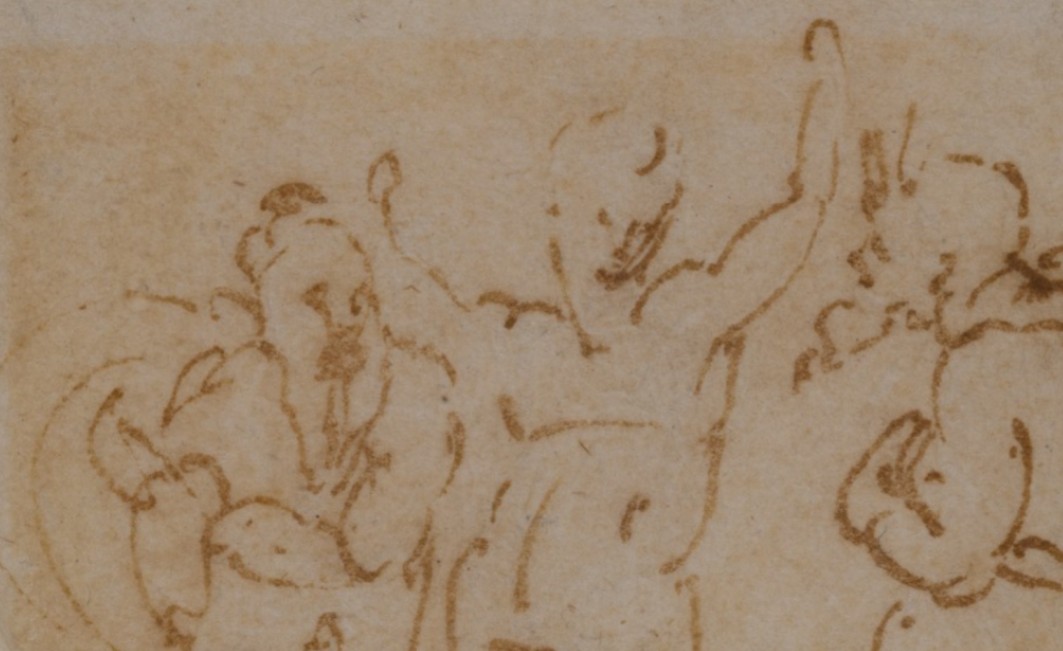
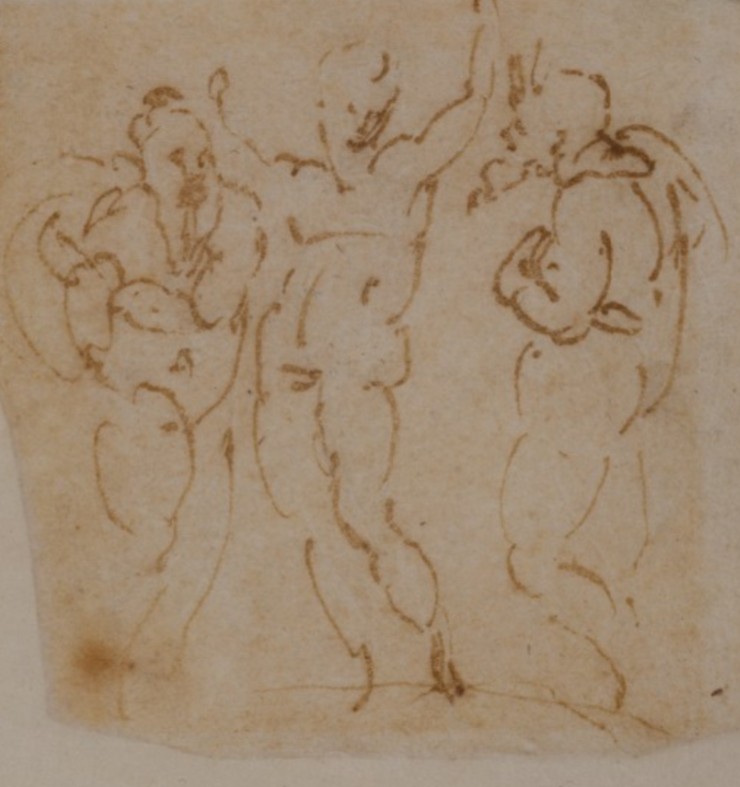
Questo piccolo foglio di Casa Buonarroti dai bordi irregolari che vi propongo custodisce una potente visione. Disegnai tre figure maschili che emergono con forza plastica e una spiccata tensione interiore.
Al centro, Cristo si erge dominante, con le braccia levate verso il cielo ma lo sguardo rivolto verso il basso, in un gesto che unisce ascesa e giudizio. Ai lati, Mosè ed Elia incarnano la legge e la profezia, colti in movimenti quasi estatici.
L’opera, identificata per la prima volta da Karl Frey agli inizi del Novecento, è stata letta come un mio studio per una scena di Trasfigurazione. Non certo un disegno compiuto ma un’idea dove il corpo umano diventa il vero linguaggio del divino.
Il segno rapido di un genio
Dal punto di vista tecnico, il foglio mostra l’utilizzo magistrale che sapevo fare della penna con inchiostro bruno. Il tratto è breve, sinuoso, interrotto nei punti chiave dell’anatomia, quasi a suggerire il movimento interno delle figure.
Prima della penna, si intravedono tracce di stilo e matita nera. Prima costruivo con cura la forma e poi la sottolineavo con segni essenziali. Le figure sono quasi nude, con minimi accenni agli abiti, perché ciò che conta è la struttura corporea, la tensione muscolare, la verità della carne.
Pensare attraverso il disegno era una mia abitudine.
Un frammento di un progetto più grande
Gli studi moderni hanno dimostrato che questo disegno non era isolato. Faceva infatti parte di un foglio più ampio, successivamente smembrato, insieme ad altri conservati oggi a Casa Buonarroti e all’Ashmolean Museum di Oxford.
La ricostruzione proposta da studiosi come Echinger-Maurach e Mussolin del 2019 ha permesso di identificare un intero nucleo di disegni dedicati alla Trasfigurazione, con varianti anche per il gruppo degli Apostoli ai piedi del monte Tabor.
A cosa serviva davvero questo studio? Il dibattito degli storici
Per lungo tempo, gli studiosi hanno discusso la funzione di questi disegni. Una delle ipotesi più diffuse, avanzata già da Henry Thode, li collega alla mia collaborazione con Sebastiano del Piombo.
Era il 1516 quando Sebastiano ricevette la commissione per decorare la Cappella Borgherini in San Pietro in Montorio a Roma. Le lettere dell’epoca testimoniano come fornissi idee e schizzi preparatori a quello che al tempo era ancora mio amico, intervenendo direttamente nella progettazione.
Secondo questa lettura, il foglio sarebbe una prima idea per la Trasfigurazione destinata alla cappella, poi però sviluppata in modo diverso da Sebastiano. Nel dipinto finale, Cristo appare più vigoroso e rivolto verso l’alto, mentre nel mio disegno ha una posa decisamente più eroica.
La datazione
Gli studi stilistici collocano il foglio intorno alla metà degli anni Dieci del Cinquecento, in una fase iniziale del progetto.
Per il momento il sempre vostro Michelangelo Buonarroti vi saluta dandovi appuntamento ai prossimi post e sui social.
An enigmatic drawing: three male figures and an intuition
This small, irregular-edged sheet from Casa Buonarroti that I present to you holds a powerful vision. I drew three male figures that emerge with plastic force and a marked inner tension.
In the center, Christ stands dominant, his arms raised toward the sky but his gaze cast downward, in a gesture that combines ascent and judgment. To the sides, Moses and Elijah embody the law and prophecy, captured in almost ecstatic movements.
The work, first identified by Karl Frey in the early twentieth century, has been interpreted as my study for a Transfiguration scene. Certainly not a finished drawing, but an idea where the human body becomes the true language of the divine.
The rapid stroke of a genius
From a technical standpoint, the sheet demonstrates my masterful use of pen and brown ink. The line is short, sinuous, interrupted at key points of the anatomy, almost suggesting the internal movement of the figures.
Before the pen, traces of stylus and black pencil can be seen. First, I carefully constructed the form and then emphasized it with essential strokes. The figures are almost nude, with minimal hints of clothing, because what matters is the body structure, the muscular tension, the truth of the flesh.
Thinking through drawing was a habit of mine.
A fragment of a larger project
Modern studies have shown that this drawing was not isolated. It was, in fact, part of a larger sheet, later dismembered, along with others now held at Casa Buonarroti and the Ashmolean Museum in Oxford.
The reconstruction proposed by scholars such as Echinger-Maurach and Mussolin in 2019 has allowed us to identify an entire group of drawings dedicated to the Transfiguration, with variations also for the group of the Apostles at the foot of Mount Tabor.
What was the real purpose of this study? The Historians’ Debate
Scholars have long debated the purpose of these drawings. One of the most popular hypotheses, advanced by Henry Thode, links them to my collaboration with Sebastiano del Piombo.
It was 1516 when Sebastiano received the commission to decorate the Borgherini Chapel in San Pietro in Montorio in Rome. Contemporary letters testify to how I provided ideas and preparatory sketches to the man who was still my friend at the time, directly intervening in the design.
According to this interpretation, the drawing was an initial idea for the Transfiguration intended for the chapel, but later developed differently by Sebastiano. In the final painting, Christ appears more vigorous and turned upward, while in my drawing he has a decidedly more heroic pose.
Dating
Stylist studies place the drawing around the mid-1510s, in an early phase of the project.
For now, yours truly, Michelangelo Buonarroti bids you farewell and invites you to join him in future posts and on social media.

Sostienici – Support Us
Se questo blog ti piace e ti appassiona, puoi aiutarci a farlo crescere sempre più sostenendoci in modo concreto condividendo i post, seguendo le pagine social e con un contributo che ci aiuta ad andare avanti con il nostro lavoro di divulgazione. . ENGLISH: If you like and are passionate about this blog, you can help us make it grow more and more by supporting us in a concrete way by sharing posts, following social pages and with a contribution that helps us to move forward with our dissemination work.
10,00 €
Articoli

Condividi:


Questo sono io




sostienici

Sostienici – Support Us
Se questo blog ti piace e ti appassiona, puoi aiutarci a farlo crescere sempre più sostenendoci in modo concreto condividendo i post, seguendo le pagine social e con un contributo che ci aiuta ad andare avanti con il nostro lavoro di divulgazione. . ENGLISH: If you like and are passionate about this blog, you can help us make it grow more and more by supporting us in a concrete way by sharing posts, following social pages and with a contribution that helps us to move forward with our dissemination work.
€10,00


