

Studio di testa Casa Buonarroti: Madonna del Tondo Doni o Giona?
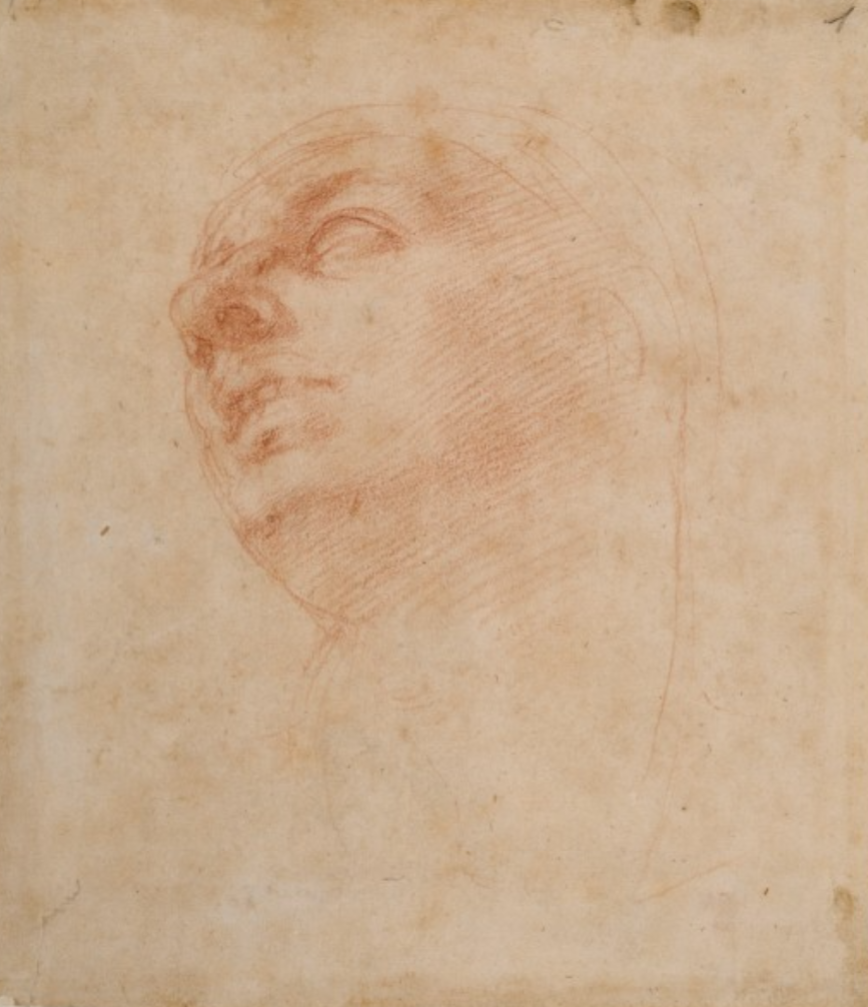
In questo studio di testa appartenente alle collezioni di Casa Buonarroti cercai qualcosa che andasse oltre il volto: volevo capire come la luce modellasse la carne e come dar forma a un’espressione, solo con una sanguigna in mano.
Il volto in scorcio
Tracciai questa testa nella seconda metà del primo decennio del Cinquecento. Non ha genere, perché non deve rappresentare qualcuno, ma un’idea. L’ho costruita in un poderoso scorcio prospettico: il capo si volge verso l’alto a sinistra, come attratto da qualcosa che non si vede.
In questo movimento c’è tensione, pathos, un sentimento quasi doloroso. Non cercavo infatti qui la bellezza ideale, ma un’espressività che parasse pure ai posteri, a chi sarebbe venuto dopo di me.
Come costruisco la luce con la matita rossa
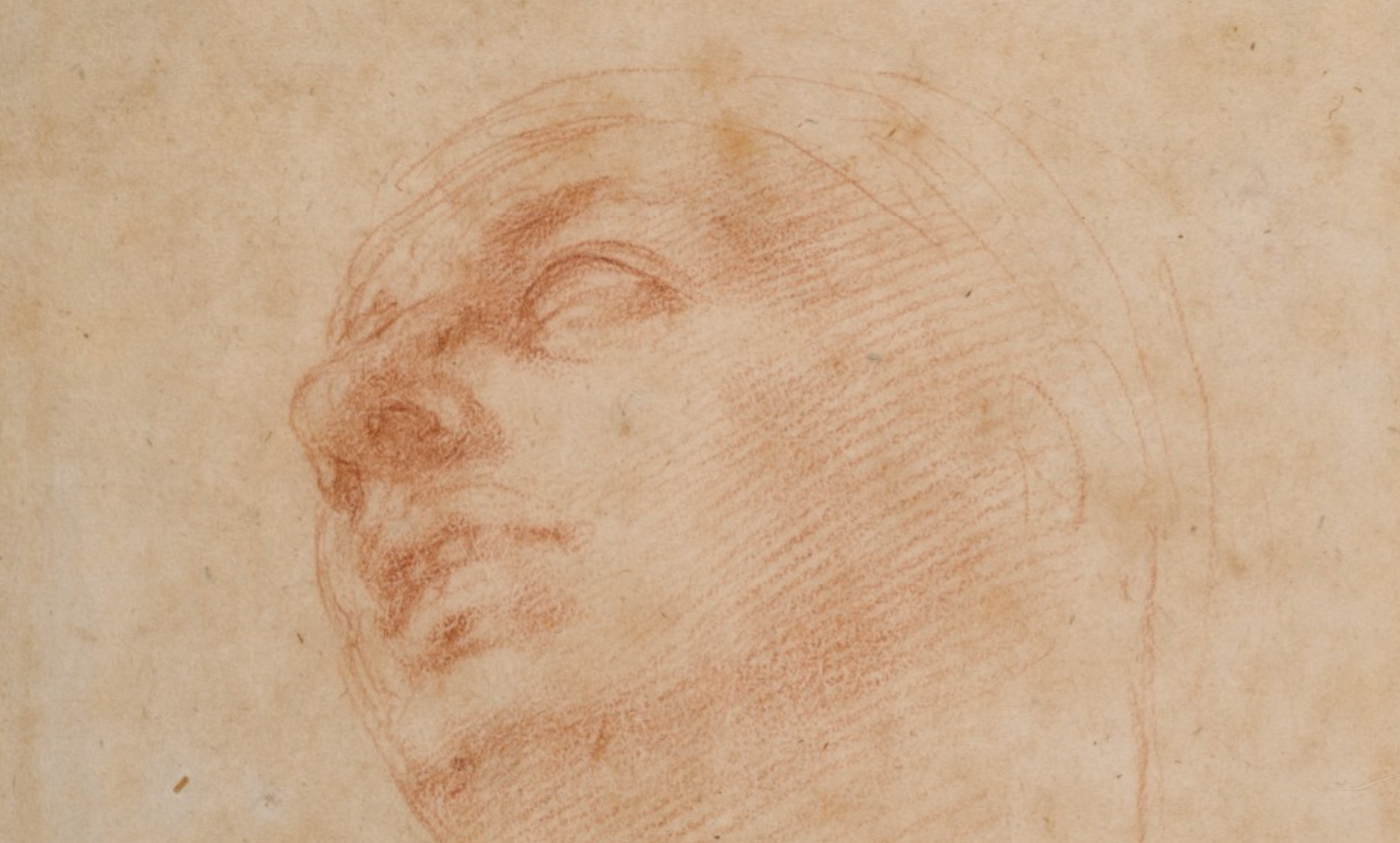
All’inizio sfioravo appena il foglio con la matita rossa, con un segno sottile e leggero. Poi in un secondo momento ho ripassato meglio il profilo sul lato sinistro. La luce decise il resto.
La parte destra del volto, immersa nell’ombra, la costruii con un tratteggio spaziato, fatto di linee parallele leggere. Nei punti più delicati, tra gola e mento, tra tempia e orbita, lasciai che il segno si dissolvesse in uno sfumato quasi impalpabile, variando pressione e inclinazione della mano.
A sinistra, invece, lavorai con maggiore intensità. Ombreggiai con cura l’arcata sopraccigliare, la palpebra inferiore, la canna nasale, le narici e la bocca socchiusa. La palpebra superiore e l’ombra sotto il labbro le segnai con più forza, quasi incidendo il foglio.
Come direbbe Michael Hirst, questo non è un volto da riconoscere. È un disegno di lavoro. Mi servì per studiare lo scorcio e capire come la luce cade sui punti principali del viso.
Non lo feci per essere finito.
Madonna o Giona? Il dubbio resta
Non è chiaro neppure a me dove questo studio troverà compimento. Mi sarebbe servito poi per la Vergine del Tondo Doni, per via dello scorcio così simile. Oppure potrebbe appartenere al Giona della Cappella Sistina, come alcuni hanno intuito.
Charles de Tolnay seppe vederci dentro la forza del profeta. Altri, come Bernard Berenson, pensarono invece alla Madonna. Forse entrambi hanno ragione: io stesso tornai sulle stesse idee, trasformandole e riadoperandole a distanza di tempo-
Le forme ellenistiche mi insegnano molto. Qualcuno noterà che questo volto ricorda una testa antica, come l’Alessandro morente conservato alle Gallerie degli Uffizi. È vero, ma io non copiavo: rendevo solo quelle forme più vive, più tormentate.
Per il momento il sempre vostro Michelangelo Buonarroti vi saluta dandovi appuntamento ai prossimi post e sui social.
Casa Buonarroti Head Study: Madonna of the Tondo Doni or Jonah?
In this head study from the Casa Buonarroti collections, I sought something beyond the face: I wanted to understand how light shapes flesh and how to give form to an expression, with only a sanguine pencil in my hand.
The Foreshortened Face
I sketched this head in the second half of the first decade of the 1500s. It has no gender, because it’s not meant to represent someone, but an idea. I constructed it in a powerful perspective foreshortening: the head turns upward to the left, as if drawn by something unseen.
In this movement, there’s tension, pathos, an almost painful feeling. I wasn’t seeking ideal beauty here, but an expressiveness that would also be a reminder for posterity, for those who would come after me.
How I Build Light with Red Pencil
At first, I barely touched the paper with the red pencil, with a thin, light stroke. Then, later, I retraced the profile on the left side more closely. The light determined the rest.
The right side of the face, immersed in shadow, I constructed with spaced hatching, made of light parallel lines. In the most delicate points, between the throat and chin, between the temple and the eye socket, I let the line dissolve into an almost impalpable sfumato, varying the pressure and inclination of my hand.
On the left side, however, I worked with greater intensity. I carefully shaded the brow ridge, the lower eyelid, the bridge of the nose, the nostrils, and the slightly open mouth. I marked the upper eyelid and the shadow under the lip more forcefully, almost carving into the paper.
As Michael Hirst would say, this is not a face to be recognized. It’s a working drawing. It helped me study the foreshortening and understand how the light falls on the main points of the face.
I didn’t do it to be finished.
Madonna or Jonah? The doubt remains
It’s not clear to me where this study will find its fulfillment. It would have been useful for the Virgin in the Doni Tondo, because of the similar foreshortening. Or it could belong to the Jonah in the Sistine Chapel, as some have guessed.
Charles de Tolnay saw the prophet’s strength in it. Others, like Bernard Berenson, instead thought of the Madonna. Perhaps both are right: I myself returned to the same ideas, transforming and reusing them over time.
Hellenistic forms teach me a lot. Some will notice that this face recalls an ancient head, like the Dying Alexander in the Uffizi Gallery. That’s true, but I wasn’t copying: I was simply making those forms more alive, more tormented.
For now, yours truly, Michelangelo Buonarroti bids you farewell and invites you to join me in future posts and on social media.

Sostienici – Support Us
Se questo blog ti piace e ti appassiona, puoi aiutarci a farlo crescere sempre più sostenendoci in modo concreto condividendo i post, seguendo le pagine social e con un contributo che ci aiuta ad andare avanti con il nostro lavoro di divulgazione. . ENGLISH: If you like and are passionate about this blog, you can help us make it grow more and more by supporting us in a concrete way by sharing posts, following social pages and with a contribution that helps us to move forward with our dissemination work.
10,00 €
Articoli
Condividi:


Questo sono io




sostienici

Sostienici – Support Us
Se questo blog ti piace e ti appassiona, puoi aiutarci a farlo crescere sempre più sostenendoci in modo concreto condividendo i post, seguendo le pagine social e con un contributo che ci aiuta ad andare avanti con il nostro lavoro di divulgazione. . ENGLISH: If you like and are passionate about this blog, you can help us make it grow more and more by supporting us in a concrete way by sharing posts, following social pages and with a contribution that helps us to move forward with our dissemination work.
€10,00


