

La firma nascosta nel Giudizio Universale: chi ha firmato sul remo di Caronte?
Sapete che nel Giudizio Universale c’è una firma non mia e che si trova proprio sul remo di Caronte?
È una piccola sigla, accompagnata da una data, che racconta una storia poco conosciuta e che permette di seguire le vicende della mia grande parete anche molti anni dopo che ebbi terminato di dipingerla.
Fermi tutti, non sto dicendo che il Giudizio Universale della Cappella Sistina non sia opera mia. Quello, naturalmente, è fuori discussione. Vi sto raccontando qualcosa di più curioso: dopo la mia morte, quando altri artisti furono chiamati a intervenire sulla parete per modificare, restaurare e completare alcune parti dell’affresco, uno di loro volle lasciare una traccia tangibile del proprio intervento proprio accanto a una delle figure più terribili che avevo dipinto, Caronte, il traghettatore delle anime dannate.
E quella piccola firma si trova sul suo remo.

Il mio Caronte nasce dalle parole di Dante
Quando dipinsi la parte inferiore destra del Giudizio Universale, avevo ben presente la straordinaria descrizione che Dante aveva fatto di Caronte nel terzo canto dell’Inferno. Non volevo rappresentare semplicemente un traghettatore infernale, ma dare forma a quel personaggio che il poeta aveva immaginato mentre raccoglie le anime destinate alla dannazione e le conduce oltre il confine che separa il mondo dei vivi da quello dei morti.
Dante scrive:
«Caron dimonio, con occhi di bragia
lor accennando, tutte le raccoglie;
batte col remo qualunque s’adagia.»
Quelle parole le avevo davanti agli occhi mentre dipingevo: “Occhi di bragia”.
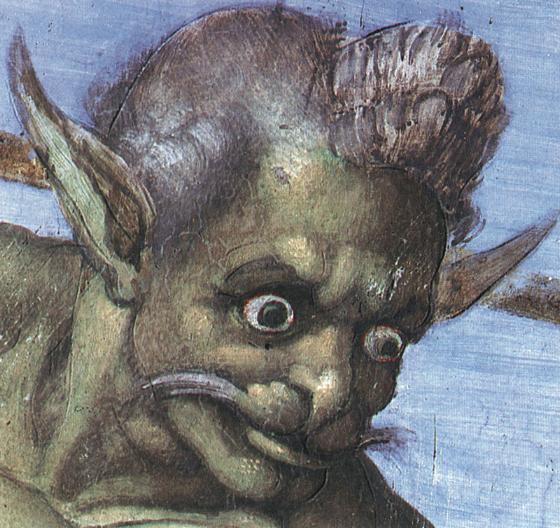
Guardate il volto del mio Caronte e soffermatevi sullo sguardo: gli occhi sono rossi, iniettati di sangue, feroci, privi di qualsiasi sentimento di pietà. È esattamente il Caronte che Dante aveva consegnato alla letteratura e che io volli consegnare alla pittura.
Non c’è compassione nel suo volto e non c’è alcuna possibilità di trattativa per le anime che ha raccolto. Caronte ha il compito di condurle verso l’Inferno e lo svolge con una violenza quasi bestiale, brandendo il grande remo mentre i dannati cercano inutilmente di sottrarsi al destino che li attende.
La barca alata e le anime dannate
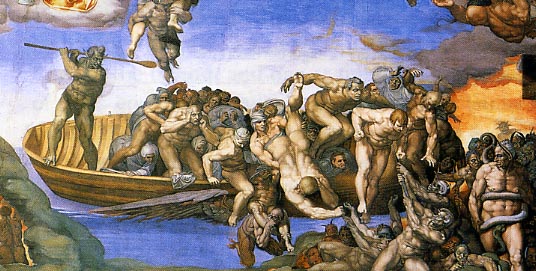
Le anime sono state ammassate sulla barca di Caronte, che nella mia rappresentazione appare quasi come una creatura fantastica, dotata di grandi ali piumate e sospinta verso la bocca dell’Inferno.
Quando l’imbarcazione arriva a destinazione, il traghettatore ordina ai dannati di scendere e, per loro, non esiste più alcuna possibilità di tornare indietro. Ad attenderli sulla riva non ci sono angeli misericordiosi, ma una schiera di demoni dall’aspetto mostruoso che si accaniscono contro le anime e le trascinano con la forza fuori dalla barca.
Ho voluto rendere quella scena brutale, perché nel mio Giudizio Universale la dannazione non è un concetto astratto, ma qualcosa che deve apparire fisicamente, quasi dolorosamente, davanti agli occhi di chi guarda.
Uno dei demoni, particolarmente feroce, arriva persino ad azzannare il polpaccio di un dannato e a trascinarlo via con sé, mentre gli altri utilizzano bastoni e uncini per impedire alle anime di opporre resistenza.

L’alighiero, l’arma dei demoni
Per comprendere ancora meglio la scena bisogna osservare anche gli strumenti utilizzati dai demoni per costringere i dannati a scendere dalla barca.
Tra questi compare il cosiddetto mezzo marinaio, noto anche come alighiero, uno strumento utilizzato nella nautica costituito da una lunga asta di legno che termina con un uncino metallico. Nelle mani dei miei demoni, naturalmente, quello che normalmente sarebbe uno strumento di lavoro diventa un’arma con la quale trascinare brutalmente le anime verso il loro destino.
Tutto nella scena concorre a creare un’immagine di violenza e disperazione: il remo di Caronte, gli uncini, i demoni, i corpi che cercano di resistere e quello sguardo infuocato che sembra già annunciare la condanna eterna.
Ma la storia del Caronte del Giudizio Universale non finisce con me
Eccoci alla parte che forse conoscete meno.
Io terminai il Giudizio Universale nel 1541, ma la storia della grande parete della Cappella Sistina continuò anche dopo la mia morte, avvenuta nel 1564. Il mio affresco, infatti, fu sottoposto a diversi interventi e modifiche, soprattutto dopo che la sensibilità religiosa era profondamente cambiata nel clima successivo al Concilio di Trento.
Al mio caro amico e collaboratore Daniele da Volterra venne imposto di intervenire sulle numerose nudità dell’affresco, realizzando quelle che sarebbero diventate famose come le “braghe” censorie. Il suo intervento contribuì paradossalmente anche a salvare il Giudizio Universale da una sorte molto peggiore, perché in quegli anni si arrivò persino a discutere della possibilità di cancellare completamente la mia opera.
Daniele, però, non mi sopravvisse a lungo e, dopo la sua morte, altri artisti furono chiamati a continuare il lavoro.
Tra questi ci fu Domenico Carnevali, al quale non venne affidato soltanto il compito di proseguire gli interventi sulle nudità, ma anche quello di restaurare alcune parti dell’affresco che, a distanza di pochi decenni dalla loro realizzazione, avevano già cominciato a deteriorarsi.
Fu così che Carnevali mise mano a diverse zone del Giudizio Universale, intervenendo, tra l’altro, sulle trombe degli angeli al di sotto di Cristo Giudice, sulla graticola di San Lorenzo e su altri dettagli della grande parete.
D.C. 1566: la firma sul remo di Caronte
Domenico Carnevali volle infatti lasciare una testimonianza del proprio intervento e scelse un luogo davvero singolare per farlo: la pala del remo di Caronte, una delle parti che aveva rifatto.
Lì appose le proprie iniziali, D.C., accompagnandole con la data 1566.
Pensate un po’: io avevo immaginato Caronte prendendo ispirazione dai versi di Dante, avevo dipinto il suo volto terribile, gli occhi di bragia, la barca alata e il remo con cui il demonio percuote le anime che esitano; venticinque anni dopo la mia morte, un altro pittore intervenne proprio su quella figura e volle lasciare il proprio nome sulla pala del suo remo.
Il mio Caronte è il Caronte di Dante
La parte inferiore del Giudizio Universale è dunque molto più dantesca di quanto si possa immaginare a una prima occhiata.
Dante aveva scritto di “Caron dimonio, con occhi di bragia” e io trasformai quelle parole in un’immagine destinata a diventare una delle più impressionanti rappresentazioni di Caronte nella storia dell’arte.
Il poeta aveva immaginato il demone che raccoglie le anime e le colpisce con il remo quando esitano; io gli diedi un corpo gigantesco, uno sguardo feroce, un’imbarcazione alata e una schiera di demoni pronti a trascinare i dannati nell’Inferno.
La letteratura diventò pittura.
E ancora oggi, quando guardate negli occhi il mio Caronte, potete quasi sentire le parole di Dante.
Per il momento il sempre vostro Michelangelo Buonarroti vi saluta dandovi appuntamento ai prossimi post e sui social.
The hidden signature in The Last Judgment: who signed Charon’s oar?
Did you know that within my Last Judgment there is a signature—not my own—located right on Charon’s oar?
It is a small monogram, accompanied by a date, that tells a little-known story and allows us to trace the history of my great mural long after I had finished painting it.
Hold on—I am not saying that the Last Judgment in the Sistine Chapel is not my work. That, of course, is beyond question. I am telling you something more curious: after my death, when other artists were called in to work on the wall—modifying, restoring, and completing parts of the fresco—one of them wanted to leave a tangible mark of his intervention right next to one of the most terrifying figures I had painted: Charon, the ferryman of damned souls.
And that small signature is found on his oar.
My Charon was born from Dante’s words
When I painted the lower right section of the Last Judgment, I had Dante’s extraordinary description of Charon from Canto III of Inferno clearly in mind. I did not want to simply depict an infernal ferryman; I wanted to give form to the character the poet had imagined—gathering the souls destined for damnation and ferrying them across the boundary separating the world of the living from that of the dead.
Dante writes:
«Caron dimonio, con occhi di bragia
lor accennando, tutte le raccoglie;
batte col remo qualunque s’adagia.»
Those words were before my eyes as I painted: “Eyes like embers.”
Look at the face of my Charon and focus on his gaze: his eyes are red, bloodshot, and ferocious, devoid of any trace of pity. This is precisely the Charon whom Dante gave to literature—and whom I sought to give to painting.
There is no compassion in his face, nor is there any room for negotiation for the souls he has gathered. Charon’s task is to ferry them to Hell, a duty he performs with almost bestial violence, brandishing his great oar as the damned try in vain to escape the fate awaiting them.
The winged boat and the damned souls
The souls are crowded onto Charon’s boat—which, in my depiction, appears almost like a fantastic creature, endowed with great feathered wings and propelled toward the mouth of Hell.
When the vessel reaches its destination, the ferryman orders the damned to disembark; for them, there is no longer any possibility of turning back. Waiting on the shore are no merciful angels, but a host of monstrous demons who set upon the souls, forcibly dragging them from the boat.
I wanted to render the scene brutal, for in my Last Judgment, damnation is not an abstract concept but something that must appear physically—almost painfully—before the viewer’s eyes.
One particularly ferocious demon even sinks his teeth into a damned soul’s calf, dragging him away, while others use clubs and hooks to prevent the souls from resisting. The boat hook: the demons’ weapon
To understand the scene even better, one must also look at the tools the demons use to force the damned to disembark.
Among these is the boat hook—or alighiero—a nautical tool consisting of a long wooden pole tipped with a metal hook. In the hands of my demons, naturally, what would normally be a simple work tool becomes a weapon used to brutally drag souls toward their fate.
Every element of the scene conspires to create an image of violence and despair: Charon’s oar, the hooks, the demons, the bodies struggling to resist, and that fiery gaze that seems to herald eternal damnation.
But the story of the Last Judgment’s Charon does not end with me.
Now we come to the part you may be less familiar with.
I completed the Last Judgment in 1541, but the story of that great wall in the Sistine Chapel continued even after my death in 1564. Indeed, my fresco underwent various interventions and alterations, particularly as religious sensibilities shifted profoundly in the climate following the Council of Trent.
My dear friend and collaborator Daniele da Volterra was ordered to modify the fresco’s numerous nude figures, painting over them with what would become known as the censorial “breeches.” Paradoxically, his intervention helped save the Last Judgment from a far worse fate, as there had even been talk during those years of completely erasing my work.
Daniele, however, did not outlive me by long, and after his death, other artists were called in to continue the work. Among them was Domenico Carnevali, who was entrusted not only with the task of continuing the work of covering the nude figures but also with restoring parts of the fresco that had already begun to deteriorate just a few decades after its completion.
Thus, Carnevali set to work on various sections of The Last Judgment, touching up—among other elements—the trumpets of the angels beneath Christ the Judge, the gridiron of Saint Lawrence, and other details across the vast wall.
D.C. 1566: the signature on Charon’s oar
Domenico Carnevali wished to leave a record of his intervention and chose a truly unique spot to do so: the blade of Charon’s oar—one of the parts he had repainted.
There, he inscribed his initials, D.C., alongside the date 1566.
Just imagine: I had envisioned Charon drawing inspiration from Dante’s verses; I had painted his terrifying face, his eyes like burning coals, the winged boat, and the oar with which the demon strikes the souls who hesitate. Then, twenty-five years after my death, another painter worked on that very figure and chose to leave his name on the blade of his oar.
My Charon is Dante’s Charon
The lower section of The Last Judgment is, therefore, far more “Dantesque” than one might imagine at first glance.
Dante had written of “Charon the demon, with eyes like burning coals,” and I transformed those words into an image destined to become one of the most striking depictions of Charon in the history of art.
The poet had envisioned the demon who gathers souls and strikes them with his oar when they hesitate; I gave him a gigantic body, a fierce gaze, a winged boat, and a host of demons ready to drag the damned into Hell.
Literature became painting.
And even today, when you look into my Charon’s eyes, you can almost hear Dante’s words.
For now, your ever-faithful Michelangelo Buonarroti bids you farewell, looking forward to seeing you in future posts and on social media.

Sostienici – Support Us
Se questo blog ti piace e ti appassiona, puoi aiutarci a farlo crescere sempre più sostenendoci in modo concreto condividendo i post, seguendo le pagine social e con un contributo che ci aiuta ad andare avanti con il nostro lavoro di divulgazione. . ENGLISH: If you like and are passionate about this blog, you can help us make it grow more and more by supporting us in a concrete way by sharing posts, following social pages and with a contribution that helps us to move forward with our dissemination work.
10,00 €
Condividi:


Questo sono io




sostienici

Sostienici - Support Us
Se questo blog ti piace e ti appassiona, puoi aiutarci a farlo crescere sempre più sostenendoci in modo concreto condividendo i post, seguendo le pagine social e con un contributo che ci aiuta ad andare avanti con il nostro lavoro di divulgazione. . ENGLISH: If you like and are passionate about this blog, you can help us make it grow more and more by supporting us in a concrete way by sharing posts, following social pages and with a contribution that helps us to move forward with our dissemination work.
€10,00


