
Il Cristo vivo in croce, per amor di lei
All’amatissima Vittoria Colonna regalai un Crocifisso che viene riconosciuto dalla critica come quello oggi custodito presso il British Museum che di fatto era la trasposizione grafica delle riflessioni religiose degli Spirtuali ai quali ero particolarmente vicino.
Come scrisse il Condivi lo disegnai per amor di lei e raffigura il Cristo ancora vivo e vigoroso inchiodato sulla Croce. Con lo sguardo rivolto verso l’alto sembra stia interpellando il padre chiedendogli “Elì Elì Memà Sabactani”, Dio mio, DIo mio perché mi hai abbandonato.
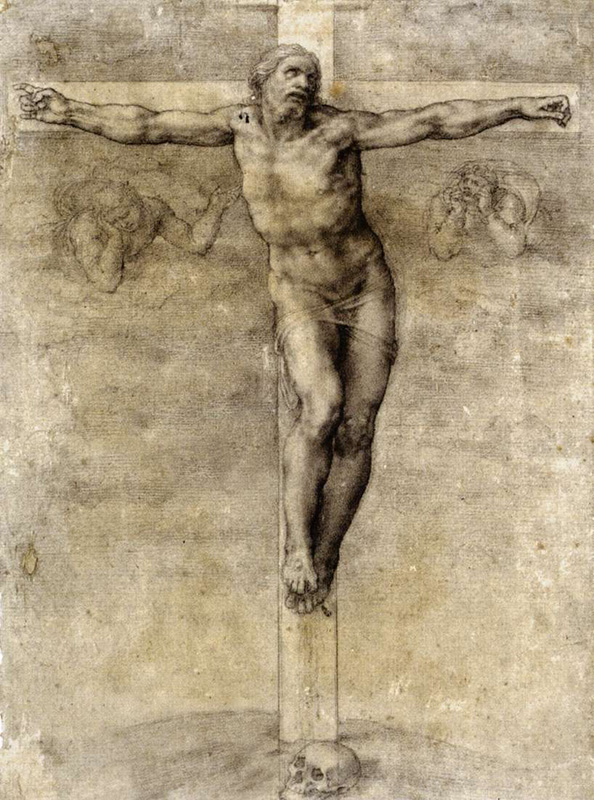
Le gambe posizionate in contrapposto rispetto al busto portano con la mente a una torsione causata dagli spasmi provati da Cristo crocifisso. Qui non c’è l’abbandono del capo tipico delle rappresentazioni precedenti ma la forza e il vigore di chi ha ancora lo spirito nel corpo.
Al ricevere quest’opera, o forse la trasposizione della stessa in un dipinto oggi perduto, la marchesa di Pescara prese carta e penna per scrivermi “Unico Maestro Michelangelo et mi singularissimo amico, ho hauta la vostra et visto il Crucifixo il quale certamente ha crucifixe nella memoria mia quante altre picture viddi mai. Non se po veder più ben fatta, più viva et più finita imagine et certo io non potrei mai exsplicar quanto sottilmente et mirabilmente è fatta…”
Successivamente, nell’agosto del 1556, papa Paolo IV Carafa, proibì categoricamente la rappresentazione del Cristo vivo in croce. Gli spirituali, me compreso, venivano accusati da Paolo IV di essere i principali divulgatori dell’eresia luterana in Italia.
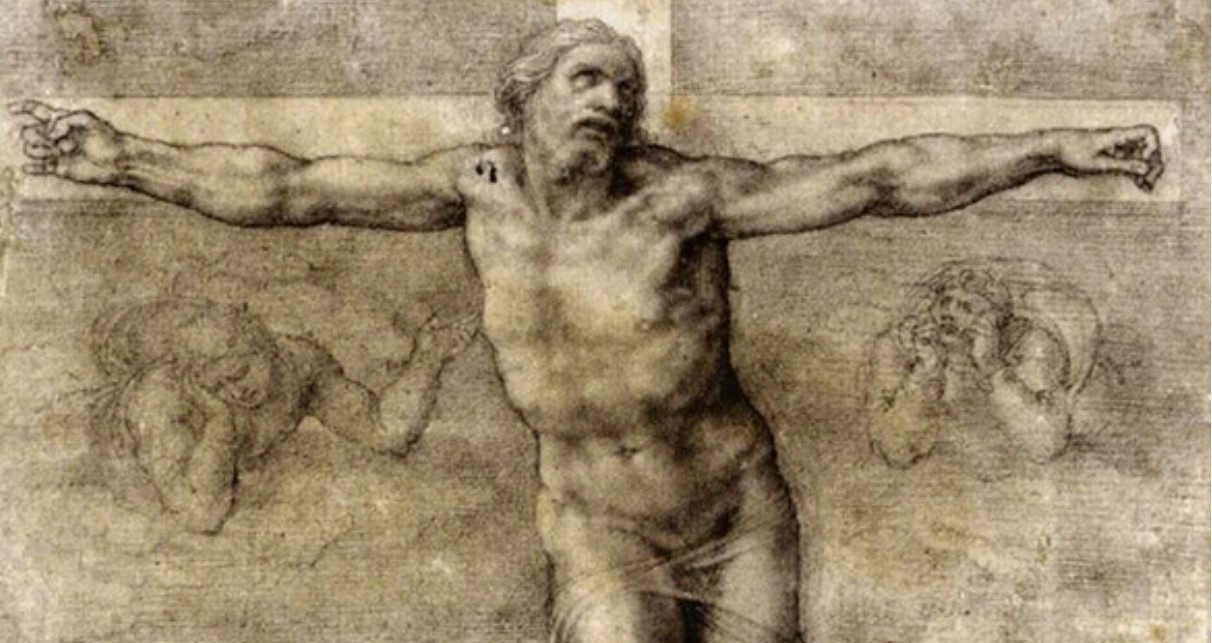
Quel mio lavoro nel frattempo era divenuto molto noto. La sua conoscenza s’era diffusa attraverso incisioni e riproduzioni. Fu così che il mio disegno divenne fuori legge e le copie furono fatte sparire anche se, a distanza di secoli, qualcuna di esse è tornata alla luce.
Per il momento il vostro Michelangelo Buonarroti vi saluta dandovi appuntamento ai prossimi post e sui social.
The living Christ on the cross, designed for her love
I gave a Crucifix to my beloved Vittoria Colonna which was recognized by critics as the one now kept in the British Museum which was in fact the graphic transposition of the religious reflections of the Spirituals to whom I was particularly close.
As Condivi wrote, I drew it for love of her and it depicts Christ still alive and vigorous nailed to the Cross. With his gaze turned upwards he seems to be asking his father “Elì Elì Memà Sabactani”, my God, my God why have you abandoned me.
The legs positioned opposite to the torso lead with the mind to a twist caused by the spasms experienced by the crucified Christ. Here there is not the abandonment of the head typical of previous representations but the strength and vigor of those who still have the spirit in the body.
Upon receiving this work, or perhaps its transposition into a painting now lost, the Marchioness of Pescara took pen and paper to write to me “Only Master Michelangelo and my most singular friend, I have seen yours and seen the Crucifix which certainly has crucifixes in my memory how many other pictures have I ever seen. It is impossible to see a more well-made, more lively and more finished image and certainly I could never explain how subtly and admirably it is made…”
Subsequently, in August 1556, Pope Paul IV Carafa categorically prohibited the representation of the living Christ on the cross. The spiritualists, myself included, were accused by Paul IV of being the main spreaders of the Lutheran heresy in Italy.
In the meantime, my work had become very well known. Knowledge of him had spread through engravings and reproductions. Thus it was that my design became outlawed and the copies were made to disappear even if, centuries later, some of them have come back to light.
For the moment, your Michelangelo Buonarroti greets you and will meet you in future posts and on social media.

Sostienici – Support Us
Se questo blog ti piace e ti appassiona, puoi aiutarci a farlo crescere sempre più sostenendoci in modo concreto condividendo i post, seguendo le pagine social e con un contributo che ci aiuta ad andare avanti con il nostro lavoro di divulgazione. . ENGLISH: If you like and are passionate about this blog, you can help us make it grow more and more by supporting us in a concrete way by sharing posts, following social pages and with a contribution that helps us to move forward with our dissemination work.
10,00 €
-
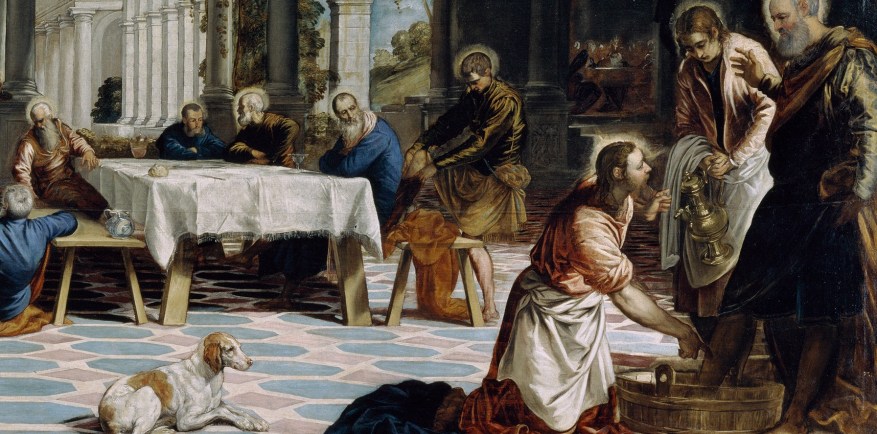
La Lavanda dei Piedi di Tintoretto: Il Capolavoro Veneziano al Prado
🇮🇹Tra i capolavori più affascinanti del Rinascimento veneziano, “La Lavanda dei Piedi” di Jacopo Tintoretto rappresenta un perfetto equilibrio tra spiritualità, innovazione compositiva e straordinaria forza narrativa… 🇬🇧Among the most fascinating masterpieces of the Venetian Renaissance, Jacopo Tintoretto’s “The Washing of the Feet” represents a perfect balance between spirituality, compositional innovation, and extraordinary narrative force…
-
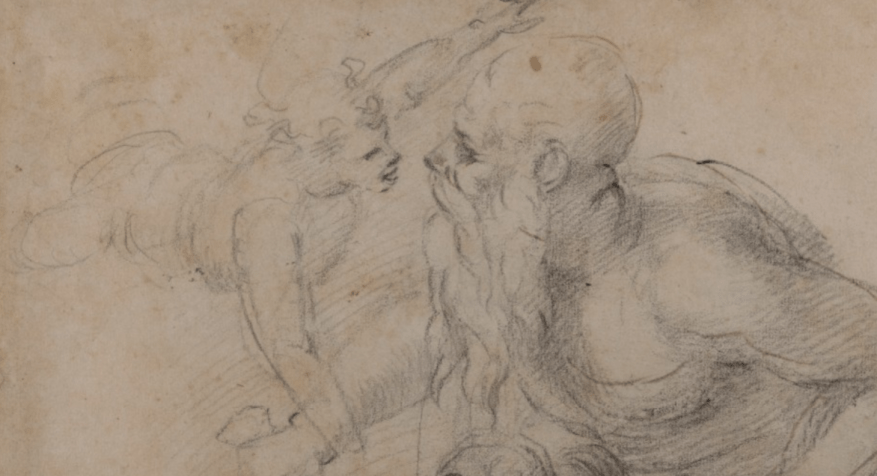
Il Sacrificio di Isacco e quel momento tra la vita e la morte
🇮🇹Oggi voglio raccontarvi alcuni dettagli sul mio disegno del Sacrificio di Isacco, conservato oggi a Casa Buonarroti. Su quel foglio volli tracciare il momento preciso in cui la paura fa spazio al miracolo… 🇬🇧Today I want to tell you some details about my drawing of the Sacrifice of Isaac, now preserved at Casa Buonarroti. On…
-
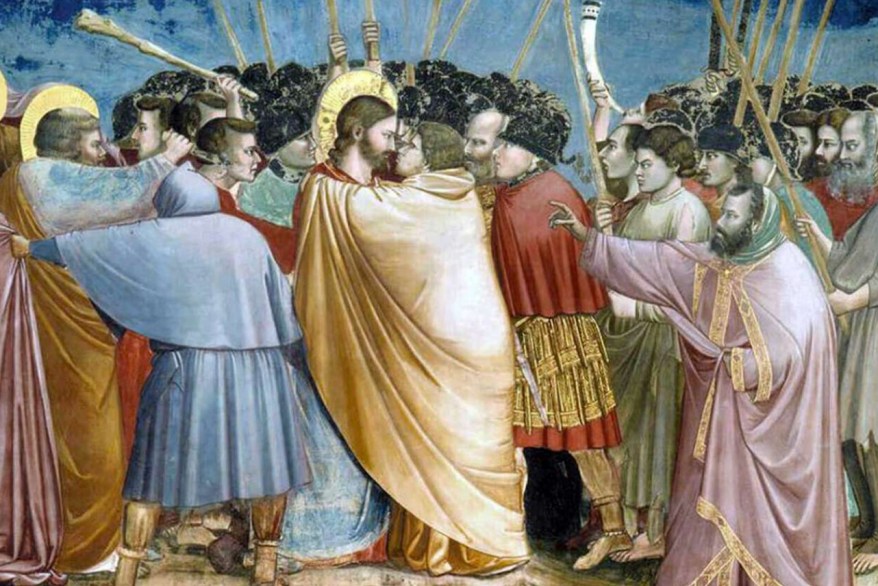
Mercoledì Santo: il giorno del tradimento di Giuda affrescato da Giotto
🇮🇹Il Mercoledì Santo è il giorno del silenzio, della riflessione e del tradimento. È il momento in cui Giuda sceglie di vendere Gesù per trenta denari, segnando uno dei passaggi più dolorosi della Settimana Santa…. 🇬🇧Holy Wednesday is a day of silence, reflection, and betrayal. ✝It is the moment when Judas chooses to sell Jesus…
Condividi:


Questo sono io





sostienici

Sostienici – Support Us
Se questo blog ti piace e ti appassiona, puoi aiutarci a farlo crescere sempre più sostenendoci in modo concreto condividendo i post, seguendo le pagine social e con un contributo che ci aiuta ad andare avanti con il nostro lavoro di divulgazione. . ENGLISH: If you like and are passionate about this blog, you can help us make it grow more and more by supporting us in a concrete way by sharing posts, following social pages and with a contribution that helps us to move forward with our dissemination work.
€10,00


1 commento »