

Halloween nell’arte: le 10 opere più spaventose di sempre, tra mostri, demoni e incubi
Il 31 ottobre è la notte di Halloween, quella in cui fantasmi, streghe, mostri e creature terrificanti diventano protagonisti delle nostre storie. Ma non occorre aspettare che cali il buio per incontrare qualcosa di inquietante. Basta entrare in un museo e soffermarsi davanti ad alcuni capolavori della storia dell’arte.
Nel corso dei secoli, infatti, pittori e scultori hanno dato forma alle paure più profonde dell’essere umano, rappresentando demoni, creature mostruose, scheletri, torture, apparizioni e scene di una violenza impressionante. Alcuni lo hanno fatto per raccontare episodi della Bibbia e della mitologia, altri per riflettere sulla morte, sul male e sulla fragilità della vita.
Ci sono dipinti che sembrano usciti da un film horror, opere popolate da esseri deformi e creature impossibili, ma anche immagini che continuano a inquietare chi le osserva a distanza di secoli.
In occasione di Halloween, ho scelto dieci opere d’arte particolarmente impressionanti, realizzate da grandi maestri di epoche diverse. Un itinerario un po’ insolito nella storia dell’arte, tra incubi, inferni e visioni che difficilmente si dimenticano.
1. Saturno che divora i suoi figli di Francisco Goya: un incubo senza tempo
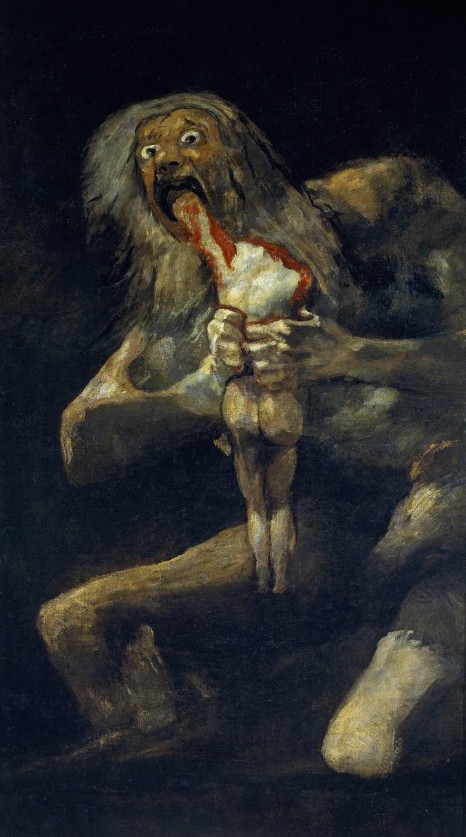
Se esiste un dipinto capace di incarnare l’orrore, è probabilmente Saturno che divora i suoi figli di Francisco Goya.
Realizzato intorno al 1820-1823, il dipinto appartiene alle celebri Pitture Nere, il ciclo di quattordici composizioni che l’artista realizzò sulle pareti della propria abitazione, la Quinta del Sordo, nei pressi di Madrid.
La scena è terrificante: Saturno, il dio romano identificato con il greco Crono, divora uno dei suoi figli. Secondo il mito, aveva appreso che sarebbe stato spodestato da uno di loro e aveva deciso di divorare i propri discendenti appena nati per impedire che la profezia si avverasse.
Goya rappresenta il dio come una figura mostruosa, dagli occhi spalancati e dalla bocca aperta. Le sue mani stringono il corpo martoriato della vittima, mentre il fondo scuro sembra inghiottire ogni cosa.
Non c’è nulla di rassicurante in questa immagine. La violenza è mostrata senza attenuazioni e lo sguardo folle di Saturno continua a colpire chiunque si trovi davanti alla tela.
Oggi l’opera è conservata al Museo del Prado di Madrid ed è una delle immagini più celebri e inquietanti dell’intera produzione di Goya.
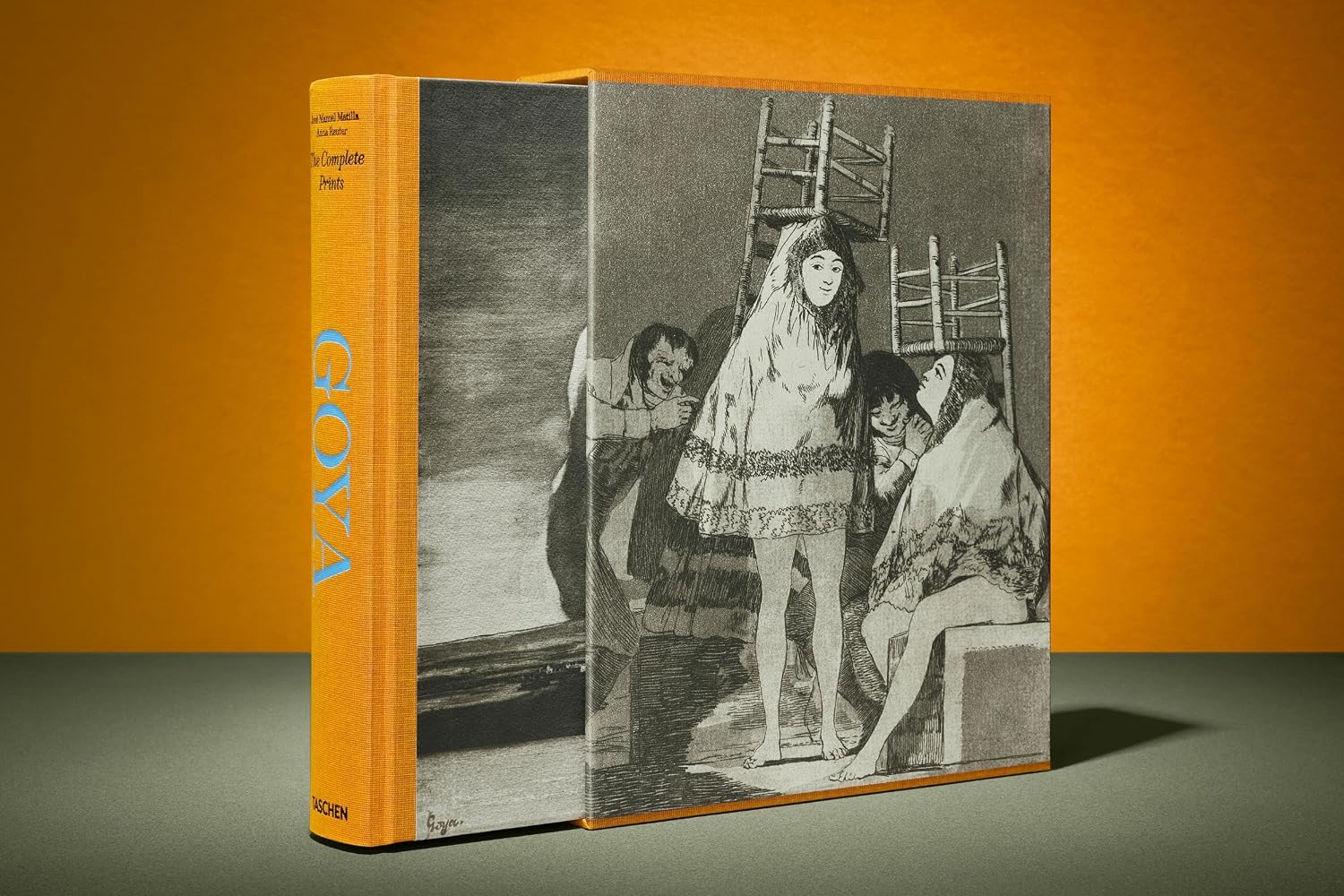
2. Il Giardino delle delizie di Hieronymus Bosch: l’inferno popolato da creature mostruose
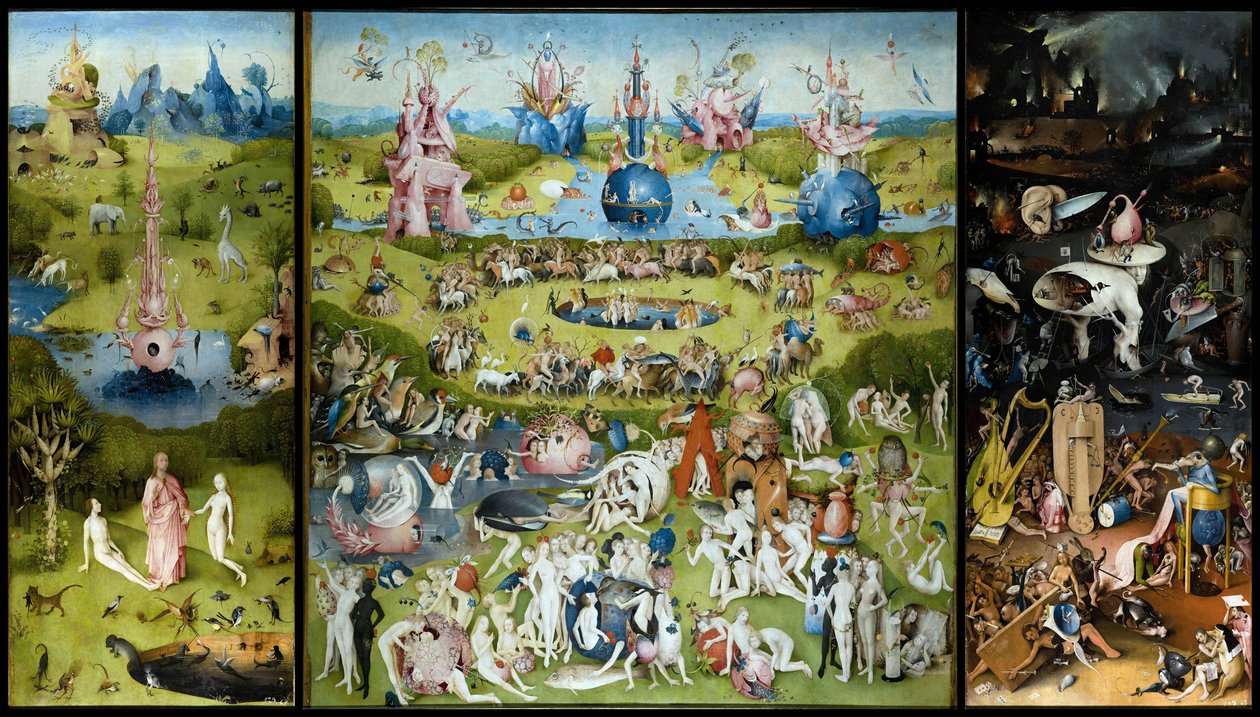
A prima vista potrebbe sembrare un dipinto fantastico, popolato da figure bizzarre, animali curiosi e personaggi impegnati in attività incomprensibili. Ma basta soffermarsi sul pannello di destra per scoprire uno degli inferni più impressionanti mai immaginati da un artista.
È il Giardino delle delizie di Hieronymus Bosch, grande trittico realizzato tra la fine del Quattrocento e i primi anni del Cinquecento, oggi conservato al Museo del Prado.
L’opera racconta un percorso che va dalla Creazione e dal Paradiso terrestre, rappresentati nel pannello di sinistra, fino al mondo delle tentazioni e dei piaceri umani, raffigurato al centro, per arrivare alla punizione infernale sulla destra.
Creature ibride, strumenti musicali trasformati in strumenti di tortura, animali giganteschi e personaggi sottoposti a punizioni assurde popolano una scena nella quale ogni dettaglio sembra nascondere un significato simbolico.
Tra le figure più enigmatiche compare il cosiddetto Uomo-Albero, una creatura dal corpo vuoto che sembra sorreggere una taverna infernale.
L’inferno di Bosch è un universo caotico, popolato da mostri che sembrano provenire dai peggiori incubi. Un’opera nella quale si potrebbe trascorrere un’intera giornata cercando di individuare tutti i particolari più strani.
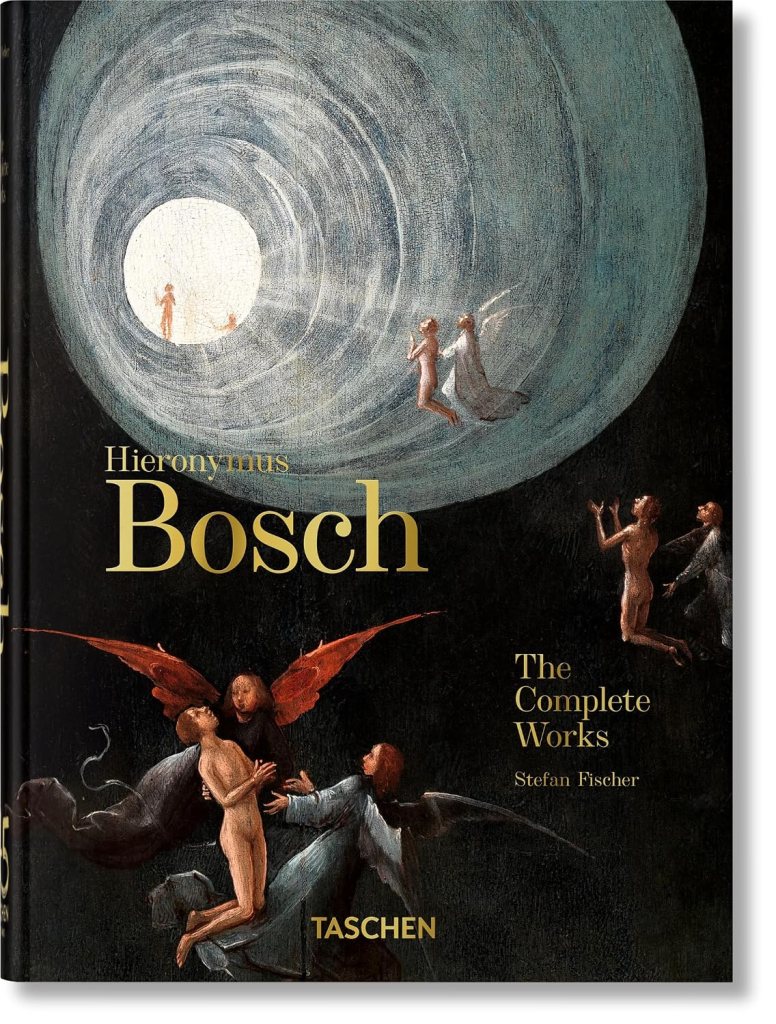
3. L’Incubo di Johann Heinrich Füssli: la creatura che siede sul petto durante il sonno
Hai mai avuto la sensazione di essere osservato mentre dormivi? Oppure di non riuscire a muoverti durante un brutto sogno?
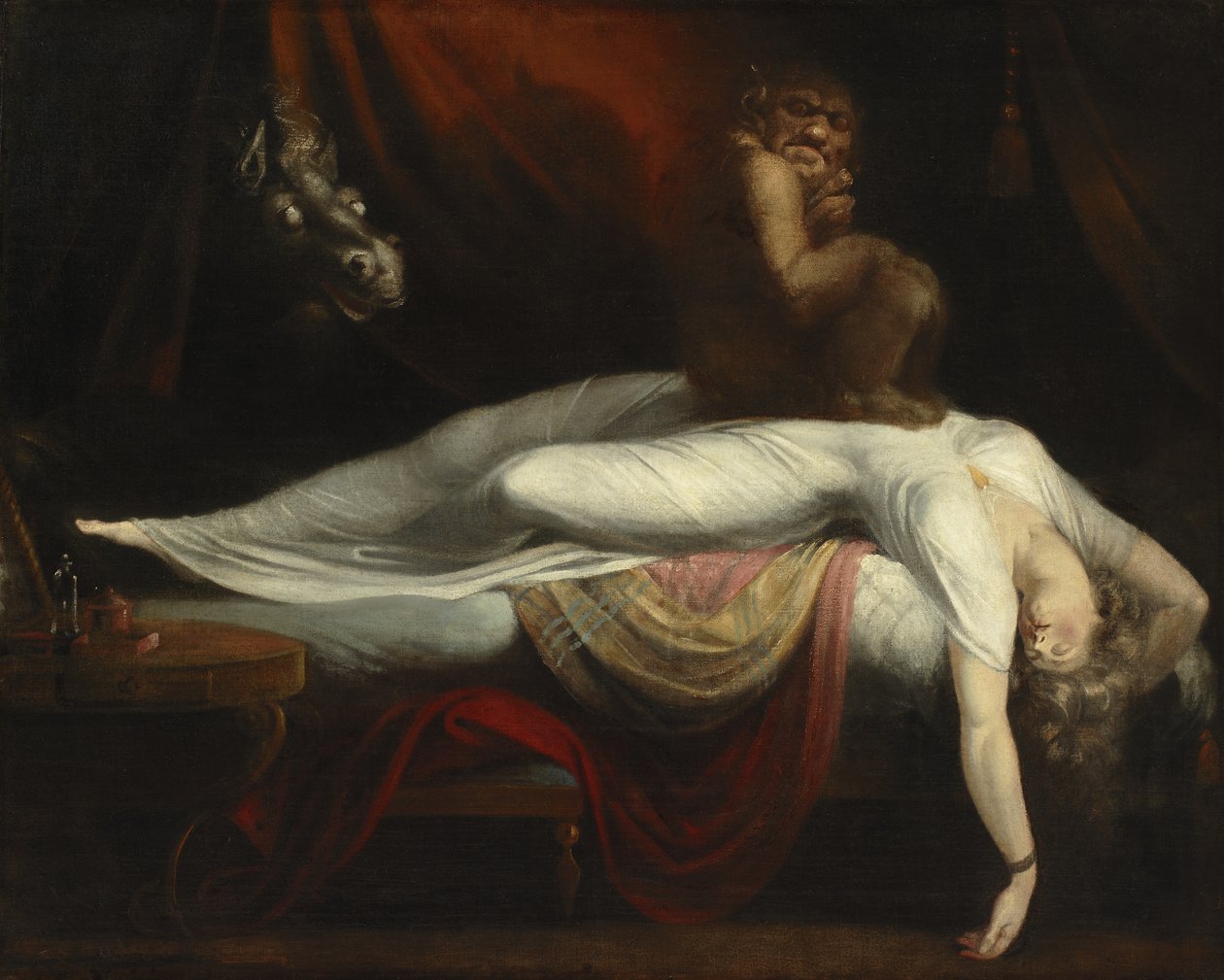
Nel 1781 il pittore svizzero Johann Heinrich Füssli dipinse una delle immagini più inquietanti della storia dell’arte: L’Incubo.
Al centro della composizione troviamo una donna addormentata, riversa sul letto con la testa reclinata all’indietro e un braccio abbandonato oltre il bordo del materasso.
Sul suo petto è accovacciata una creatura demoniaca, mentre alle sue spalle compare una testa equina dagli occhi inquietanti che emerge da una tenda.
La scena è sospesa tra sogno e realtà, sensualità e paura.
Füssli sembra voler rappresentare proprio quella sensazione di oppressione che accompagna alcuni incubi, quando il corpo sembra immobilizzato e la mente è popolata da presenze minacciose.
Il dipinto ebbe un grande successo e contribuì a diffondere l’immaginario gotico nella cultura europea.
La versione originale del 1781 è conservata al Detroit Institute of Arts. Ancora oggi è una delle immagini più riconoscibili quando si parla di arte e paura.
4. Il Trionfo della Morte di Pieter Bruegel il Vecchio: quando gli scheletri conquistano il mondo

Un esercito di scheletri avanza senza lasciare scampo a nessuno. Re, cavalieri, contadini e religiosi vengono travolti da una forza che non distingue tra ricchi e poveri, potenti e persone comuni.
È la scena impressionante dipinta da Pieter Bruegel il Vecchio nel Trionfo della Morte, intorno al 1562.
Conservato al Museo del Prado di Madrid, il dipinto è una delle più potenti rappresentazioni della caducità della vita e dell’inevitabilità della morte.
Il paesaggio è desolato, quasi completamente privo di speranza. Gli scheletri dominano ogni angolo della composizione: alcuni impugnano falci, altri conducono carri pieni di teschi, mentre altri ancora inseguono gli esseri umani.
Non c’è modo di sfuggire alla morte. Persino i potenti, che sembrano circondati da ricchezze e privilegi, sono destinati a soccombere.
Bruegel costruisce una scena affollatissima, nella quale ogni particolare racconta una piccola storia. Osservare questo dipinto significa perdersi in un mondo terribile, dove la morte è diventata la protagonista assoluta.
5. Medusa di Caravaggio: il volto della creatura che pietrificava con lo sguardo
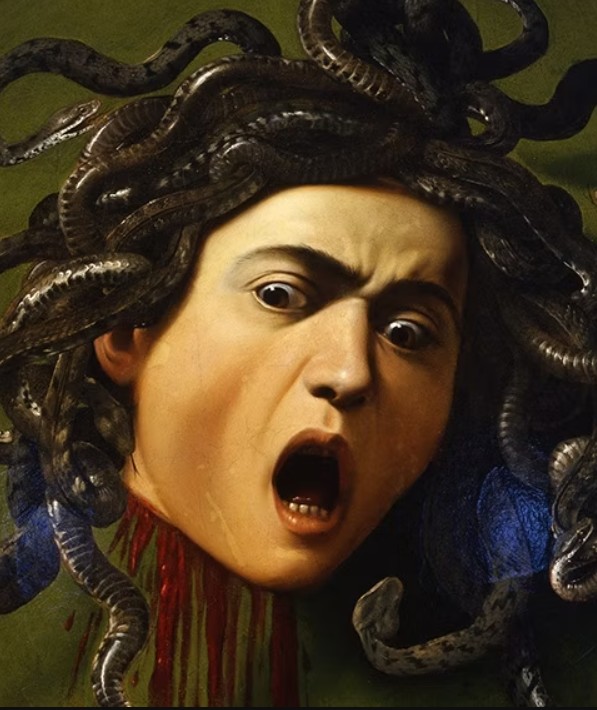
Un volto che urla, serpenti che si agitano al posto dei capelli e uno sguardo terrorizzato. La Medusa di Caravaggio è una delle immagini più celebri e impressionanti della pittura barocca.
Realizzata intorno al 1597, l’opera raffigura la testa recisa della Gorgone della mitologia greca, la creatura mostruosa capace di trasformare in pietra chiunque incrociasse il suo sguardo.
Caravaggio sceglie un momento particolarmente drammatico: Medusa è stata appena decapitata da Perseo e sembra ancora urlare per lo spavento.
Il sangue scende dal collo reciso, mentre i serpenti si contorcono intorno alla testa formando una corona vivente.
Un dettaglio rende l’opera ancora più particolare: il supporto non è una normale tela, ma uno scudo convesso in legno, sul quale il pittore ha realizzato un’immagine capace di creare un effetto sorprendentemente realistico.
La Medusa è conservata alla Galleria degli Uffizi di Firenze. Secondo la tradizione, Caravaggio avrebbe realizzato questo dipinto per Ferdinando I de’ Medici.
6. La Crocifissione della Pala di Isenheim di Matthias Grünewald: il dolore portato all’estremo
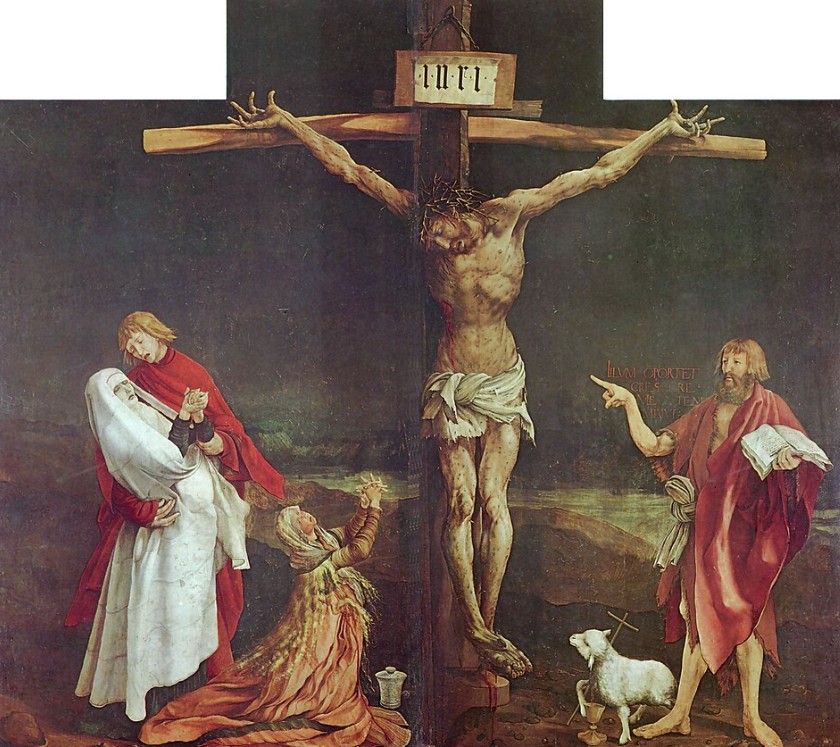
Non tutti i dipinti inquietanti hanno bisogno di mostri e creature fantastiche. A volte è sufficiente rappresentare la sofferenza umana con una forza tale da lasciare senza parole.
È quello che accade davanti alla Crocifissione della Pala di Isenheim, realizzata da Matthias Grünewald tra il 1512 e il 1516.
Cristo appare sulla croce con il corpo profondamente segnato dal supplizio, le mani contratte, la pelle martoriata e il capo reclinato. Accanto a lui si trovano Maria, san Giovanni Evangelista e Maria Maddalena, mentre Giovanni Battista indica il corpo di Cristo.
La rappresentazione è volutamente drammatica e lontana da qualsiasi idealizzazione della sofferenza.
La pala era destinata all’ospedale del monastero di Sant’Antonio a Isenheim, dove venivano curati anche malati affetti da ergotismo, una patologia che provocava lesioni e sofferenze terribili.
Il corpo martoriato di Cristo poteva così diventare un’immagine di condivisione del dolore per chi si trovava ad affrontare la malattia.
Oggi la Pala di Isenheim è conservata al Musée Unterlinden di Colmar, in Francia.
7. Giuditta che decapita Oloferne di Artemisia Gentileschi: la violenza senza filtri
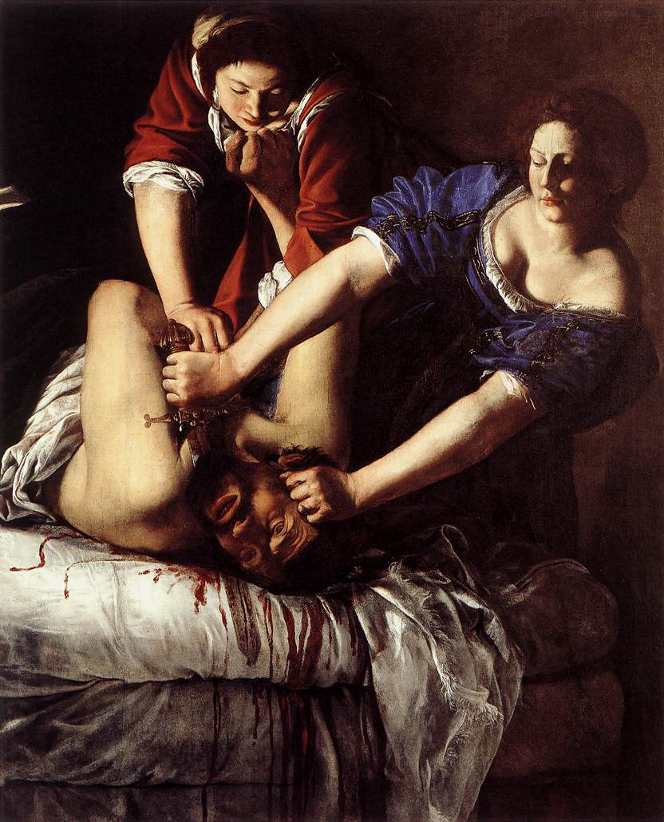
Una donna stringe con decisione la testa di un uomo mentre con l’altra mano impugna una spada. Il sangue schizza sulle lenzuola e la scena si svolge sotto gli occhi di una giovane serva che la aiuta a portare a termine l’impresa.
È Giuditta che decapita Oloferne, uno dei dipinti più celebri di Artemisia Gentileschi, realizzato intorno al 1612-1613 e conservato alle Gallerie degli Uffizi.
L’artista affronta un episodio biblico già molto rappresentato nella storia dell’arte, ma lo fa con una forza visiva straordinaria.
Giuditta è una giovane vedova ebrea che riesce a introdursi nell’accampamento del generale assiro Oloferne e a ucciderlo per salvare il proprio popolo.
Artemisia non addolcisce la scena: mostra la lotta fisica, la tensione dei corpi e la violenza del gesto con un realismo impressionante.
La luce illumina i protagonisti e lascia il resto dell’ambiente nell’oscurità, accentuando il carattere drammatico della composizione.
8. L’Urlo di Edvard Munch: la paura che diventa un’immagine universale

Un volto deformato dalla paura, le mani premute sulle orecchie e una bocca spalancata in un grido silenzioso. Pochissime immagini sono diventate così riconoscibili come L’Urlo di Edvard Munch.
Realizzata nel 1893, l’opera rappresenta una figura umana su un ponte, immersa in un paesaggio attraversato da colori accesi e linee ondulate.
Alle sue spalle si intravedono due persone che continuano a camminare, apparentemente indifferenti alla disperazione del protagonista.
Munch non vuole raccontare un episodio preciso, ma dare forma a un sentimento: l’angoscia.
L’artista aveva annotato nei suoi scritti il ricordo di una passeggiata durante la quale, osservando il cielo infuocato, aveva percepito un grido attraversare la natura.
Da quell’esperienza nacque una delle immagini più potenti dell’arte moderna.
Esistono diverse versioni dell’opera, tra dipinti, pastelli e stampe. Una delle versioni più celebri, realizzata nel 1893, è conservata al Museo Nazionale di Oslo.
Per Halloween, è difficile immaginare un’immagine più adatta a rappresentare la paura.
9. L’Isola dei morti di Arnold Böcklin: un viaggio verso l’aldilà
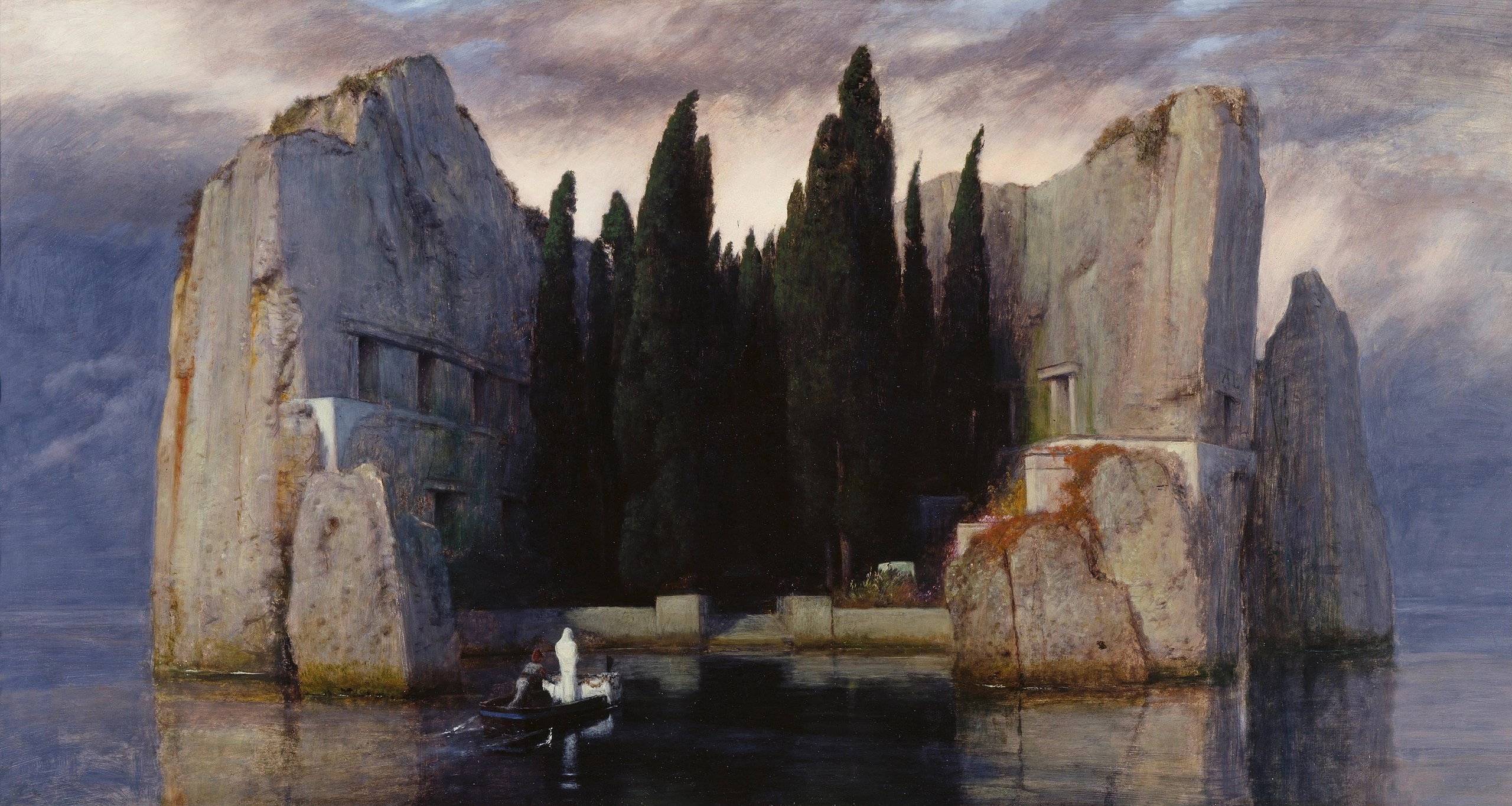
Una piccola imbarcazione avanza lentamente verso un’isola rocciosa. A bordo si intravede una figura bianca, mentre al centro della barca sembra esserci un feretro.
Intorno regna un silenzio assoluto.
È L’Isola dei morti di Arnold Böcklin, una delle opere più misteriose e suggestive del simbolismo ottocentesco.
Il pittore svizzero realizzò diverse versioni del dipinto tra il 1880 e il 1886, tutte caratterizzate dalla presenza di un’isola dominata da alte pareti rocciose e cipressi scuri.
Non si tratta di una scena horror nel senso tradizionale del termine. L’inquietudine nasce piuttosto dall’atmosfera sospesa, dall’assenza di qualsiasi presenza umana riconoscibile e dalla sensazione di trovarsi davanti a un viaggio senza ritorno.
L’isola sembra un luogo separato dal mondo dei vivi, una destinazione misteriosa verso la quale la barca procede senza fretta.
Böcklin non ha mai fornito una spiegazione definitiva dell’immagine, lasciando spazio a diverse interpretazioni.
La prima versione del 1880 è conservata al Kunstmuseum Basel, in Svizzera.
10. La Tentazione di sant’Antonio di Hieronymus Bosch: il terrore delle visioni infernali
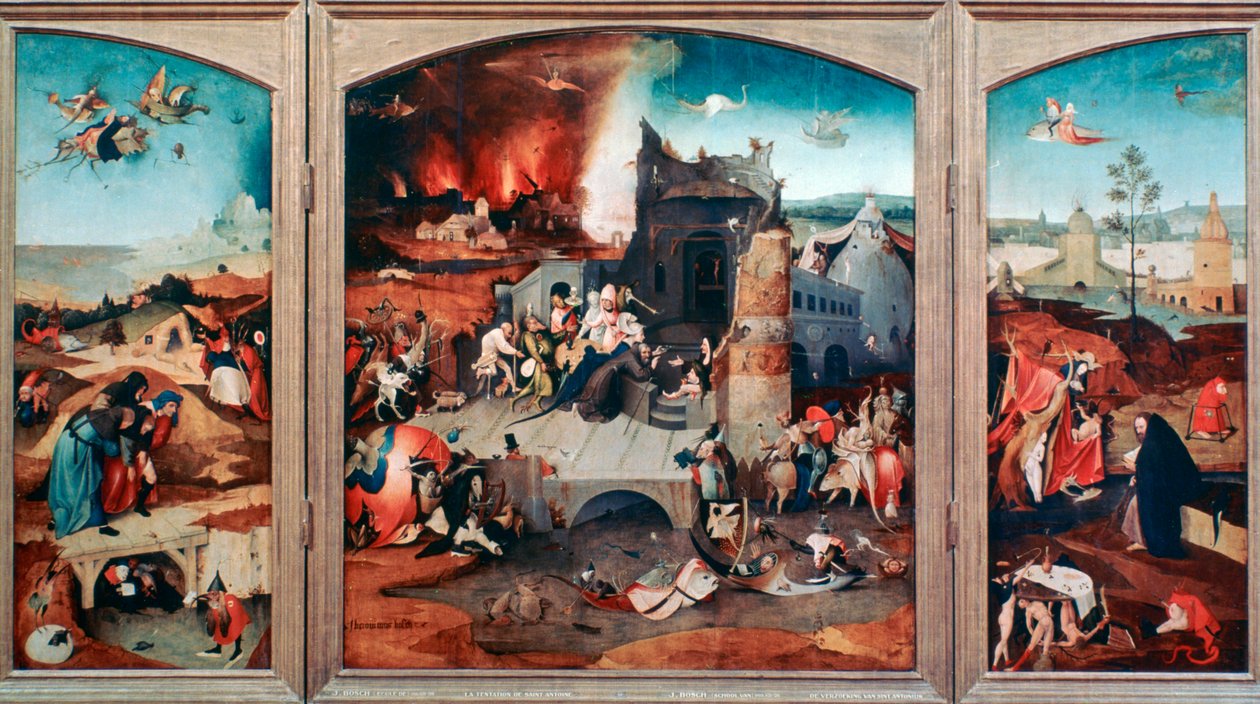
Chiudiamo questo viaggio tra le opere più inquietanti della storia dell’arte tornando a Hieronymus Bosch, il pittore che più di altri sembra aver saputo immaginare creature provenienti da mondi impossibili.
La Tentazione di sant’Antonio, conservata al Museu Nacional de Arte Antiga di Lisbona, è un trittico nel quale il santo viene circondato da visioni demoniache, mostri e figure grottesche.
Secondo la tradizione cristiana, sant’Antonio abate dovette affrontare numerose tentazioni e apparizioni demoniache durante la sua vita eremitica.
Bosch trasforma questi racconti in un universo popolato da creature ibride, esseri deformi e personaggi impegnati in azioni incomprensibili.
Ogni angolo del dipinto nasconde qualcosa di sorprendente: animali che sembrano usciti da un bestiario fantastico, figure umane trasformate in creature mostruose e presenze che rendono difficile distinguere il mondo reale da quello delle visioni.
Il santo, riconoscibile nella composizione, rimane al centro di questo universo caotico, apparentemente indifferente alle tentazioni che lo circondano.
È un’opera che dimostra quanto l’immaginazione di Bosch fosse libera e quanto il confine tra religione, paura e fantasia potesse diventare sottile nella pittura del suo tempo.
Halloween al museo: quando l’arte incontra la paura
Dalle visioni infernali di Bosch alla disperazione di Munch, passando per il Saturno divoratore di Goya e gli scheletri di Bruegel, queste dieci opere dimostrano che la storia dell’arte custodisce un repertorio davvero sorprendente di immagini inquietanti.
Dietro ogni mostro, ogni demone e ogni scena cruenta si nasconde spesso qualcosa di molto più profondo della semplice volontà di spaventare: la paura della morte, il timore dell’ignoto, il senso di colpa, la fragilità umana e il desiderio di dare una forma visibile a ciò che non riusciamo a comprendere.
Per questo Halloween, prima di scegliere un film horror da guardare al buio, potrebbe valere la pena fare un giro tra i musei. Alcuni dei più grandi capolavori della storia dell’arte sanno ancora mettere i brividi, anche dopo centinaia di anni.
Per il momento il sempre vostro Michelangelo Buonarroti vi saluta dandovi appuntamento ai prossimi post e sui social.
Halloween in Art: The 10 Most Terrifying Works Ever—Monsters, Demons, and Nightmares
October 31st is Halloween—the night when ghosts, witches, monsters, and terrifying creatures take center stage in our stories. But you don’t have to wait for darkness to fall to encounter something unsettling; you need only step into a museum and pause before certain masterpieces of art history.
Throughout the centuries, painters and sculptors have given form to humanity’s deepest fears, depicting demons, monstrous creatures, skeletons, acts of torture, apparitions, and scenes of shocking violence. Some did so to illustrate episodes from the Bible or mythology, while others sought to reflect on death, evil, and the fragility of life.
There are paintings that look as though they were plucked from a horror film—works populated by deformed beings and impossible creatures—as well as images that continue to unsettle viewers centuries after they were created.
For Halloween, I have selected ten particularly striking works of art by great masters from various eras. It is an unconventional journey through art history, filled with nightmares, hellscapes, and visions that are not easily forgotten.
Saturn Devouring His Son by Francisco Goya: A Timeless Nightmare
If any painting truly embodies horror, it is surely Saturn Devouring His Son by Francisco Goya.
Created between 1820 and 1823, the painting belongs to the famous Black Paintings—a series of fourteen works that the artist painted directly onto the walls of his own home, the Quinta del Sordo, near Madrid. The scene is terrifying: Saturn—the Roman god identified with the Greek Cronus—is devouring one of his own children. According to the myth, he had learned that he would one day be overthrown by one of his offspring, so he decided to devour his children as soon as they were born to prevent the prophecy from coming true.
Goya depicts the god as a monstrous figure, with wide, staring eyes and an open mouth. His hands clutch the mangled body of his victim, while the dark background seems to swallow everything.
There is nothing reassuring about this image. The violence is presented without any softening, and Saturn’s crazed gaze continues to strike anyone who stands before the canvas.
Today, the work is housed in the Prado Museum in Madrid and remains one of the most famous and unsettling images in Goya’s entire body of work.
The Garden of Earthly Delights by Hieronymus Bosch: a hell populated by monstrous creatures
At first glance, it might appear to be a fantastical painting, filled with bizarre figures, curious animals, and characters engaged in incomprehensible activities. But one need only look closely at the right-hand panel to discover one of the most striking visions of hell ever conceived by an artist.
This is The Garden of Earthly Delights by Hieronymus Bosch—a grand triptych created between the late 15th and early 16th centuries, now held at the Prado Museum.
The work traces a journey: from the Creation and the Garden of Eden, depicted on the left panel, through the world of human temptations and pleasures shown in the center, to the infernal punishment portrayed on the right.
And it is precisely here that Bosch gives free rein to his imagination. Hybrid creatures, musical instruments transformed into torture devices, gigantic animals, and figures subjected to absurd punishments populate a scene in which every detail seems to harbor a symbolic meaning.
Among the most enigmatic figures is the so-called “Tree-Man”—a creature with a hollow body that appears to support an infernal tavern.
Bosch’s hell is a chaotic universe, teeming with monsters that seem to have emerged from one’s worst nightmares—a work in which one could spend an entire day trying to spot every bizarre detail.
The Nightmare by Johann Heinrich Füssli: the creature that sits on one’s chest during sleep
Have you ever had the feeling that you were being watched while you slept? Or perhaps the sensation of being unable to move during a bad dream.
In 1781, the Swiss painter Johann Heinrich Füssli created one of the most unsettling images in the history of art: The Nightmare.
At the center of the composition lies a sleeping woman, sprawled across her bed with her head tilted back and one arm hanging limply over the edge of the mattress.
Crouched upon her chest is a demonic creature, while behind her, the head of a horse—with haunting, unsettling eyes—emerges from behind a curtain.
The scene exists in a space between dream and reality, sensuality and fear.
Füssli appears to be capturing that very sense of oppression that accompanies certain nightmares—a state in which the body feels immobilized, while the mind is haunted by menacing presences.
The painting was a great success and helped popularize Gothic imagery within European culture.
The original 1781 version is housed at the Detroit Institute of Arts. To this day, it remains one of the most recognizable images when discussing the themes of art and fear.
The Triumph of Death by Pieter Bruegel the Elder: When Skeletons Conquer the World
An army of skeletons advances, leaving no escape for anyone. Kings, knights, peasants, and clergy alike are swept away by a force that makes no distinction between rich and poor, the powerful and the common folk.
This is the striking scene depicted by Pieter Bruegel the Elder in The Triumph of Death, painted around 1562.
Housed at the Prado Museum in Madrid, the painting stands as one of the most powerful representations of the transience of life and the inevitability of death.
The landscape is desolate, almost entirely devoid of hope. Skeletons dominate every corner of the composition: some brandish scythes, others pull carts filled with skulls, while still others pursue human beings.
There is no way to escape death. Even the powerful—those seemingly surrounded by wealth and privilege—are destined to succumb.
Bruegel constructs a densely populated scene, in which every detail tells its own small story. To observe this painting is to lose oneself in a terrifying world, where death has become the absolute protagonist.
Medusa by Caravaggio: The Face of the Creature Who Turned People to Stone with a Glance
A screaming face, writhing snakes in place of hair, and a look of sheer terror—Caravaggio’s Medusa is one of the most famous and striking images in Baroque painting.
Created around 1597, the work depicts the severed head of the Gorgon from Greek mythology—a monstrous creature capable of turning anyone who met her gaze into stone. Caravaggio chooses a particularly dramatic moment: Medusa has just been beheaded by Perseus and still appears to be screaming in terror.
Blood pours from her severed neck, while snakes writhe around her head, forming a living crown.
One detail makes the work even more unique: the support is not a standard canvas, but a convex wooden shield, upon which the painter created an image that produces a strikingly realistic effect.
The Medusa is housed in the Uffizi Gallery in Florence. According to tradition, Caravaggio created this painting for Ferdinando I de’ Medici.
The Crucifixion from the Isenheim Altarpiece by Matthias Grünewald: pain taken to the extreme
Not all unsettling paintings require monsters or fantastical creatures. Sometimes, it is enough to depict human suffering with such intensity that it leaves the viewer speechles.
This is the case when standing before the Crucifixion from the Isenheim Altarpiece, created by Matthias Grünewald between 1512 and 1516.
Christ appears on the cross, his body deeply marked by torture, his hands contorted, his skin ravaged, and his head slumped. Beside him are the Virgin Mary, Saint John the Evangelist, and Mary Magdalene, while John the Baptist points toward Christ’s body.
The depiction is intentionally dramatic, devoid of any idealization of suffering.
The altarpiece was intended for the hospital of the Monastery of Saint Anthony in Isenheim, which treated patients suffering from ergotism—a condition that caused horrific lesions and agony.
In this context, Christ’s tormented body could serve as an image of shared suffering for those facing such an illness.
Today, the Isenheim Altarpiece is housed at the Musée Unterlinden in Colmar, France. 7. Judith Beheading Holofernes by Artemisia Gentileschi: Unfiltered Violence
A woman firmly grips a man’s head while wielding a sword in her other hand. Blood splatters across the bedsheets, and the scene unfolds before the eyes of a young maidservant who is assisting her in carrying out the deed.
This is Judith Beheading Holofernes, one of Artemisia Gentileschi’s most famous paintings, created around 1612–1613 and housed in the Uffizi Galleries.
The artist tackles a biblical episode—one frequently depicted throughout the history of art—yet she does so with extraordinary visual power.
Judith is a young Jewish widow who manages to infiltrate the camp of the Assyrian general Holofernes and kill him to save her people.
Artemisia does not soften the scene; she portrays the physical struggle, the tension of the bodies, and the violence of the act with striking realism.
Light illuminates the figures, leaving the rest of the setting in darkness, which heightens the dramatic nature of the composition.
Even today, the painting remains striking for its intensity and its ability to transform a biblical episode into a scene of immense theatrical tension.
The Scream by Edvard Munch: Fear Transformed into a Universal Image
A face distorted by fear, hands pressed against the ears, and a mouth wide open in a silent scream. Few images have become as instantly recognizable as The Scream by Edvard Munch.
Created in 1893, the work depicts a human figure on a bridge, set within a landscape defined by vivid colors and undulating lines.
Behind the figure, two people can be seen continuing their walk, seemingly indifferent to the protagonist’s despair.
Munch’s intention was not to recount a specific event, but rather to give form to an emotion: anguish.
In his writings, the artist recalled a walk during which, while observing a fiery sky, he felt a scream pass through nature itself.
From that experience emerged one of the most powerful images in modern art.
There are several versions of the work, including paintings, pastels, and prints. One of the most famous versions, created in 1893, is held at the National Museum in Oslo.
For Halloween, it is hard to imagine an image better suited to represent fear.
Isle of the Dead by Arnold Böcklin: A Journey to the Afterlife
A small boat moves slowly toward a rocky island. A white-clad figure can be seen on board, while a coffin appears to rest in the center of the vessel.
Absolute silence reigns all around.
This is Isle of the Dead by Arnold Böcklin—one of the most mysterious and evocative works of 19th-century Symbolism.
The Swiss painter created several versions of the painting between 1880 and 1886, all featuring an island dominated by towering rock faces and dark cypress trees.
It is not a horror scene in the traditional sense. Rather, the sense of unease arises from the suspended atmosphere, the absence of any recognizable human presence, and the feeling that one is witnessing a journey from which there is no return. The island appears to be a place apart from the world of the living—a mysterious destination toward which the boat travels, unhurried.
Böcklin never provided a definitive explanation for the image, leaving room for various interpretations.
The first version, dating from 1880, is held at the Kunstmuseum Basel, in Switzerland.
The Temptation of Saint Anthony by Hieronymus Bosch: The Terror of Infernal Visions
We conclude this journey through some of the most unsettling works in art history by returning to Hieronymus Bosch—the painter who, perhaps more than any other, possessed the ability to conceive of creatures from impossible worlds.
The Temptation of Saint Anthony, housed at the Museu Nacional de Arte Antiga in Lisbon, is a triptych in which the saint is surrounded by demonic visions, monsters, and grotesque figures.
According to Christian tradition, Saint Anthony the Great faced numerous temptations and demonic apparitions during his life as a hermit.
Bosch transforms these accounts into a universe populated by hybrid creatures, deformed beings, and figures engaged in incomprehensible actions.
Every corner of the painting conceals something surprising: animals that seem to have stepped out of a fantastical bestiary, human figures transformed into monstrous entities, and presences that make it difficult to distinguish the real world from the realm of visions.
The saint—identifiable within the composition—remains at the center of this chaotic universe, seemingly indifferent to the temptations that surround him.
It is a work that demonstrates the boundless nature of Bosch’s imagination, and how thin the line between religion, fear, and fantasy could become in the painting of his era. Halloween at the Museum: When Art Meets Fear
From the infernal visions of Bosch to the despair of Munch—not to mention Goya’s devouring Saturn or the skeletons of Bruegel—these ten works demonstrate that the history of art holds a truly surprising repertoire of unsettling imagery.
Behind every monster, every demon, and every gruesome scene, there often lies something far deeper than a simple desire to frighten: the fear of death, the dread of the unknown, a sense of guilt, human fragility, and the urge to give a visible form to that which we cannot comprehend.
This Halloween, before you settle in to watch a horror movie in the dark, it might be worth taking a tour through some museums. Some of the greatest masterpieces in the history of art are still capable of sending shivers down your spine, even centuries later.
For now, yours truly, Michelangelo Buonarroti, bids you farewell—until the next post, or until we meet again on social media.

Sostienici – Support Us
Se questo blog ti piace e ti appassiona, puoi aiutarci a farlo crescere sempre più sostenendoci in modo concreto condividendo i post, seguendo le pagine social e con un contributo che ci aiuta ad andare avanti con il nostro lavoro di divulgazione. . ENGLISH: If you like and are passionate about this blog, you can help us make it grow more and more by supporting us in a concrete way by sharing posts, following social pages and with a contribution that helps us to move forward with our dissemination work.
10,00 €

Sostienici – Support Us
Se questo blog ti piace e ti appassiona, puoi aiutarci a farlo crescere sempre più sostenendoci in modo concreto condividendo i post, seguendo le pagine social e con un contributo che ci aiuta ad andare avanti con il nostro lavoro di divulgazione. . ENGLISH: If you like and are passionate about this blog, you can help us make it grow more and more by supporting us in a concrete way by sharing posts, following social pages and with a contribution that helps us to move forward with our dissemination work.
10,00 €
Condividi:


Questo sono io





sostienici

Sostienici – Support Us
Se questo blog ti piace e ti appassiona, puoi aiutarci a farlo crescere sempre più sostenendoci in modo concreto condividendo i post, seguendo le pagine social e con un contributo che ci aiuta ad andare avanti con il nostro lavoro di divulgazione. . ENGLISH: If you like and are passionate about this blog, you can help us make it grow more and more by supporting us in a concrete way by sharing posts, following social pages and with a contribution that helps us to move forward with our dissemination work.
€10,00


