

Il tesoro nascosto della Venaria Reale: il Bucintoro dei Savoia, la reggia galleggiante unica al mondo
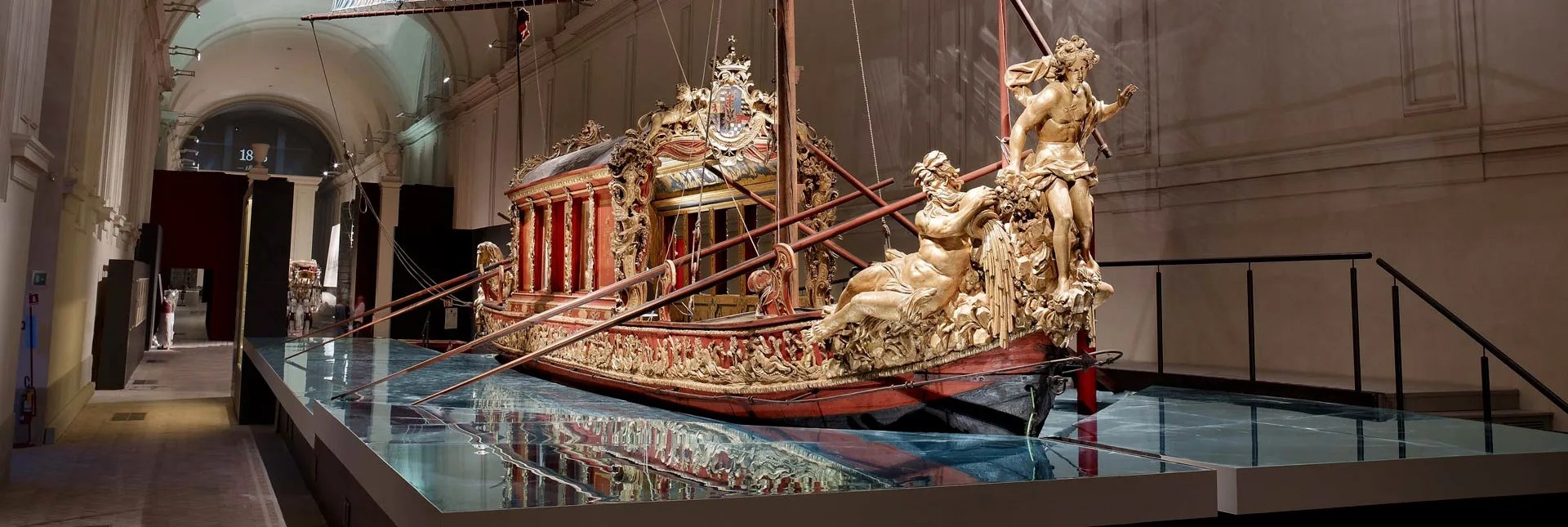
Il Bucintoro dei Savoia, oggi custodito alla Reggia di Venaria è una vera e propria reggia galleggiante, simbolo della magnificenza della Casa Savoia e unico esemplare originale superstite delle spettacolari imbarcazioni cerimoniali costruite nel Settecento.
Visitare la Scuderia Grande della Venaria Reale significa trovarsi davanti a un capolavoro assoluto dell’arte navale, della scultura lignea e dell’arte decorativa barocca.
Nessun altro Bucintoro settecentesco è sopravvissuto: quello dei Dogi di Venezia, al quale si ispira, fu infatti distrutto nel 1798 dopo la caduta della Serenissima.
Perché Vittorio Amedeo II fece costruire il Bucintoro dei Savoia
La storia del Bucintoro inizia nel 1729, quando Vittorio Amedeo II decide di commissionare ai migliori maestri veneziani un’imbarcazione destinata a stupire l’Europa.
Il sovrano aveva appena conquistato un nuovo prestigio internazionale. Dopo essere stato proclamato Re di Sicilia nel 1713 e, successivamente, Re di Sardegna nel 1720, la dinastia sabauda aveva finalmente ottenuto quel tanto desiderato accesso al mare che ne sanciva il definitivo ingresso tra le grandi monarchie europee.
Per celebrare questo nuovo rango, il re volle un simbolo capace di rappresentare la sua autorità anche sulle acque. Nacque così quello che già all’epoca veniva chiamato “Bucintoro torinese”, un nome che evocava immediatamente il celebre Bucintoro dei Dogi veneziani, simbolo della potenza della Serenissima.
L’imbarcazione doveva essere molto più di un mezzo di trasporto: era un palazzo navigante destinato alle feste di corte, alle cerimonie ufficiali e agli spettacoli organizzati sul Po.
Costruito a Venezia e trainato fino a Torino in un viaggio lungo oltre un mese
Il Bucintoro fu realizzato tra il 1729 e il 1731 negli storici squeri veneziani, gli antichi cantieri navali della laguna, prendendo come modello la tradizionale “peota”, elegante imbarcazione a fondo piatto adatta alla navigazione fluviale.
Una volta completato, iniziò una delle imprese logistiche più sorprendenti del XVIII secolo.
Per raggiungere Torino fu necessario un viaggio di circa trentadue giorni, durante il quale l’imbarcazione venne trainata lungo il Po con la forza animale, attraversando centinaia di chilometri fino ad approdare il 4 settembre 1731 alla darsena del Castello del Valentino.
L’investimento economico fu enorme. Secondo le stime attuali, il costo della sua costruzione corrisponderebbe a circa nove milioni di euro, una cifra che testimonia quanto il progetto fosse concepito come una manifestazione di prestigio politico prima ancora che artistico.
Un capolavoro del Barocco tra sculture dorate e pitture allegoriche
Il Bucintoro impressiona ancora oggi per le sue dimensioni e per la ricchezza della decorazione.
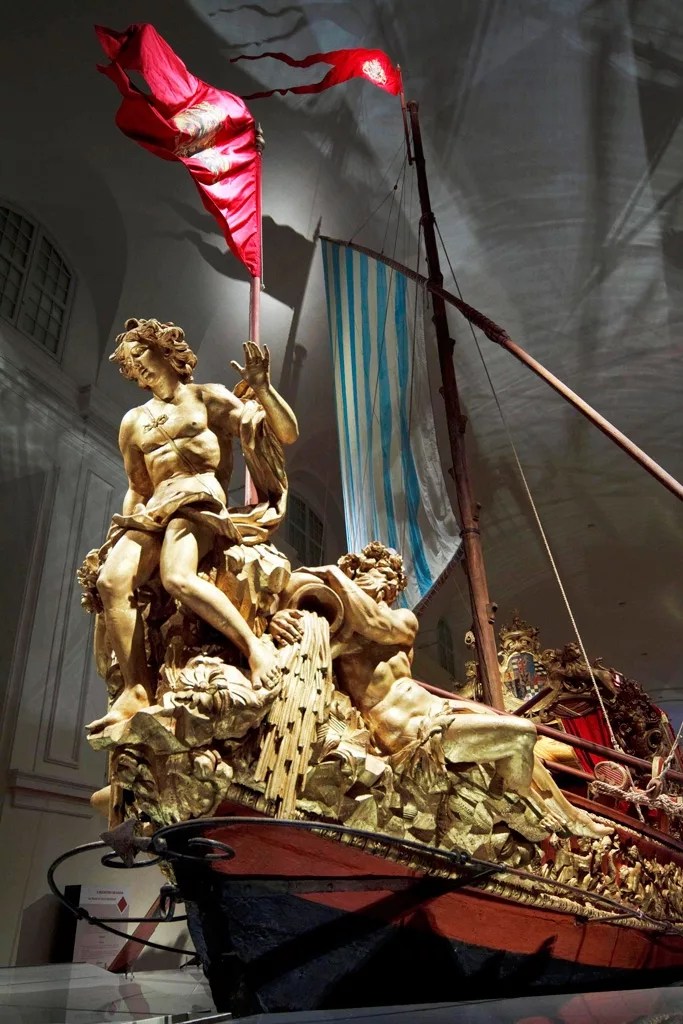
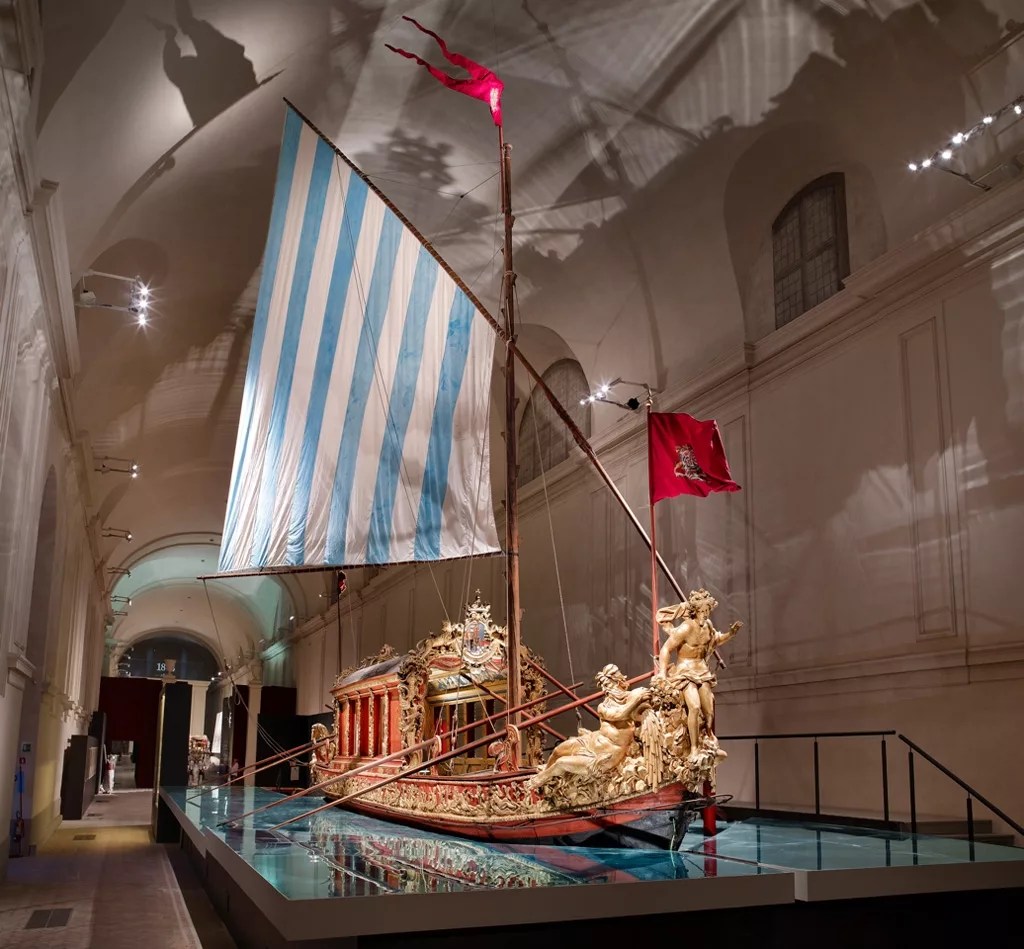
Lungo quasi sedici metri, largo oltre due metri e mezzo e con un albero alto più di dodici metri, pesa circa sei tonnellate ed è dotato di otto remi. Ma ciò che lo rende davvero unico sono gli straordinari apparati decorativi.
La prua e la poppa sono impreziosite da complessi gruppi scultorei intagliati e dorati, mentre il “tiemo”, la cabina destinata agli ospiti illustri, conserva preziose pitture allegoriche che celebrano la monarchia sabauda e le sue ambizioni politiche.
Ogni dettaglio è studiato per stupire, trasformando l’imbarcazione in un perfetto esempio di arte barocca applicata all’architettura navale.
La reggia galleggiante dei Savoia sul fiume Po
Dal giorno del suo arrivo a Torino, il Bucintoro divenne il protagonista assoluto delle celebrazioni reali.
Le cronache raccontano che l’8 settembre 1731 Carlo Emanuele III e la regina Polissena d’Assia salirono per la prima volta a bordo dell’imbarcazione, suscitando l’entusiasmo della popolazione accorsa lungo le rive del Po.
Il fiume si trasformava in un grande teatro all’aperto, mentre il Bucintoro avanzava lentamente tra musica, feste, giochi d’acqua e spettacoli, offrendo una rappresentazione spettacolare del potere della monarchia.
Per oltre un secolo accompagnò la storia della dinastia sabauda, diventando parte integrante dell’immagine ufficiale della corte.
Da Vittorio Emanuele II al museo: come il Bucintoro è arrivato fino a noi
Nel 1869 Vittorio Emanuele II, primo Re d’Italia, donò il Bucintoro alla città di Torino.
Pochi anni dopo, nel 1873, l’imbarcazione entrò a far parte delle collezioni del Museo Civico, abbandonando definitivamente le acque del Po.
Quella scelta si rivelò decisiva per la sua conservazione.
Mentre il Bucintoro dei Dogi veneziani era stato distrutto dalle truppe francesi nel 1798, quello dei Savoia venne preservato e trasformato in una straordinaria testimonianza storica e artistica.
Oggi rappresenta l’unico Bucintoro originale del XVIII secolo giunto integro fino ai nostri giorni.
Il restauro che ha restituito splendore al capolavoro
Negli ultimi anni il Bucintoro è stato protagonista di un importante intervento conservativo realizzato dai laboratori del Centro Conservazione e Restauro “La Venaria Reale”, grazie al sostegno della Consulta per la Valorizzazione dei Beni Artistici e Culturali di Torino.
Il delicato restauro ha permesso di recuperare la brillantezza delle dorature, consolidare le strutture lignee e riportare alla luce le preziose decorazioni pittoriche, restituendo al pubblico un capolavoro che appare oggi vicino allo splendore ammirato dalla corte sabauda nel Settecento.
Dove vedere oggi il Bucintoro dei Savoia
Il Bucintoro è oggi esposto nella monumentale Scuderia Grande della Reggia di Venaria, uno degli ambienti più spettacolari del complesso progettato da Filippo Juvarra tra il 1722 e il 1727.
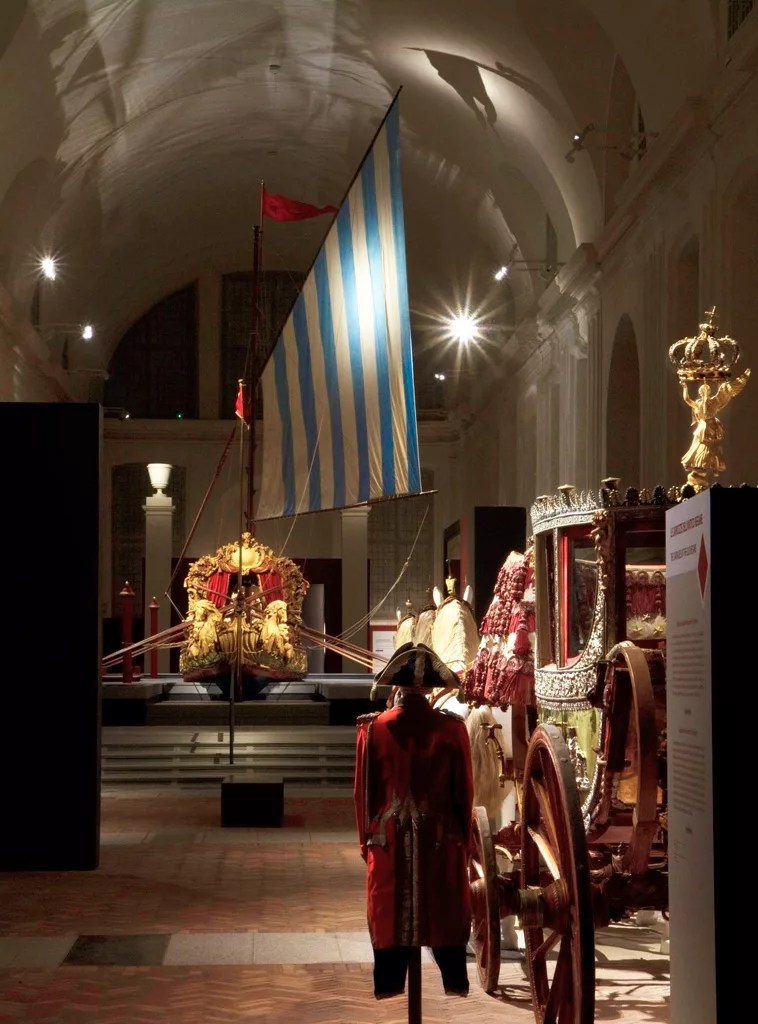
L’allestimento, intitolato “La Regia Scuderia”, riunisce il Bucintoro insieme alle carrozze di gala e alle portantine della corte sabauda, offrendo un percorso immersivo nella magnificenza della monarchia piemontese.
L’ampiezza della Scuderia consente di ammirare l’imbarcazione nella sua interezza, con l’albero, le vele, i remi e le decorazioni originali, permettendo di cogliere tutta la grandiosità di quella che fu una delle più straordinarie macchine scenografiche del Barocco europeo.
Perché il Bucintoro della Venaria è un’opera unica al mondo
Il Bucintoro dei Savoia è il simbolo di un’epoca in cui arte, politica e spettacolo si fondevano per celebrare il potere assoluto delle monarchie europee.
Essendo l’unico Bucintoro originale sopravvissuto, costituisce una testimonianza irripetibile della maestria dei cantieri veneziani e dell’ambizione della Casa Savoia. La sua presenza alla Reggia di Venaria rende il complesso piemontese una meta imprescindibile per chi desidera scoprire uno dei tesori meno conosciuti ma più straordinari del patrimonio artistico italiano.
Per il momento il sempre vostro Michelangelo Buonarroti vi saluta dandovi appuntamento ai prossimi post e sui social.
The hidden treasure of Venaria Reale: the Bucintoro of Savoy, a unique floating palace
The Bucintoro of Savoy, now housed at the Royal Palace of Venaria, is a true floating palace, a symbol of the magnificence of the House of Savoy and the only surviving original example of the spectacular ceremonial vessels built in the 18th century.
Visiting the Scuderia Grande of Venaria Reale means standing before an absolute masterpiece of naval art, wooden sculpture, and Baroque decorative art.
No other 18th-century Bucintoro has survived: the one of the Doges of Venice, which inspired it, was destroyed in 1798 after the fall of the Serenissima.
Why Victor Amadeus II built the Bucintoro of Savoy
The history of the Bucintoro begins in 1729, when Victor Amadeus II decided to commission the best Venetian masters to build a vessel destined to amaze Europe.
The sovereign had just achieved new international prestige. After being proclaimed King of Sicily in 1713 and, subsequently, King of Sardinia in 1720, the Savoy dynasty had finally obtained the long-desired access to the sea, marking its definitive entry into the ranks of the great European monarchies.
To celebrate this new rank, the king desired a symbol capable of representing his authority even on the waters. Thus was born what was already known at the time as the “Turin Bucintoro,” a name that immediately evoked the famous Bucintoro of the Venetian Doges, a symbol of the power of the Serenissima.
The vessel was intended to be much more than a means of transportation: it was a floating palace intended for court celebrations, official ceremonies, and performances on the Po.
Built in Venice and towed to Turin on a journey lasting over a month
The Bucintoro was built between 1729 and 1731 in the historic Venetian squeri, the lagoon’s ancient shipyards, modeled after the traditional “peota,” an elegant flat-bottomed vessel suitable for river navigation.
Once completed, one of the most astonishing logistical feats of the 18th century began.
Reaching Turin required a journey of approximately thirty-two days, during which the vessel was towed along the Po using animal power, crossing hundreds of kilometers until it landed at the dock of Valentino Castle on September 4, 1731.
The financial investment was enormous. According to current estimates, the cost of its construction would correspond to approximately nine million euros, a figure that demonstrates how the project was conceived as a manifestation of political prestige even before an artistic one.
A Baroque masterpiece, with gilded sculptures and allegorical paintings
The Bucintoro still impresses today with its size and rich decoration.
Almost sixteen meters long, over two and a half meters wide, and with a mast over twelve meters tall, it weighs approximately six tons and is equipped with eight oars. But what makes it truly unique are its extraordinary decorative features.
The bow and stern are embellished with intricately carved and gilded sculptures, while the “tiemo,” the cabin reserved for illustrious guests, houses precious allegorical paintings celebrating the Savoy monarchy and its political ambitions.
Every detail is designed to amaze, transforming the vessel into a perfect example of Baroque art applied to naval architecture.
The floating palace of the Savoys on the Po River
From the day of its arrival in Turin, the Bucintoro became the undisputed star of royal celebrations.
Chronicles recount that on September 8, 1731, Charles Emmanuel III and Queen Polyxena of Hesse boarded the vessel for the first time, sparking enthusiasm among the people who had gathered along the banks of the Po.
The river was transformed into a vast open-air theater, as the Bucintoro slowly advanced amidst music, festivities, water games, and performances, offering a spectacular display of the monarchy’s power.
For over a century, it accompanied the history of the Savoy dynasty, becoming an integral part of the court’s official image.
From Victor Emmanuel II to the museum: how the Bucintoro came to us
In 1869, Victor Emmanuel II, the first King of Italy, donated the Bucintoro to the city of Turin.
A few years later, in 1873, the vessel became part of the collections of the Civic Museum, definitively abandoning the waters of the Po.
That decision proved crucial to its preservation.
While the Bucintoro of the Venetian Doges was destroyed by French troops in 1798, the Savoy Bucintoro was preserved and transformed into an extraordinary historical and artistic monument.
Today, it represents the only original 18th-century Bucintoro still intact today.
The restoration that restored the masterpiece to its former glory
In recent years, the Bucintoro has undergone significant conservation work carried out by the laboratories of the “La Venaria Reale” Conservation and Restoration Center, thanks to the support of the Council for the Valorization of Artistic and Cultural Heritage of Turin.
The delicate restoration has restored the brilliance of the gilding, consolidated the wooden structures, and brought to light the precious pictorial decorations, restoring to the public a masterpiece that today appears close to the splendor admired by the Savoy court in the 18th century.
Where to see the Savoy Bucintoro today
The Bucintoro is currently on display in the monumental Scuderia Grande of the Royal Palace of Venaria, one of the most spectacular spaces in the complex designed by Filippo Juvarra between 1722 and 1727.
The exhibition, entitled “The Royal Scuderia,” brings together the Bucintoro with the gala carriages and sedan chairs of the Savoy court, offering an immersive journey into the magnificence of the Piedmontese monarchy.
The spacious Scuderia allows visitors to admire the vessel in its entirety, complete with mast, sails, oars, and original decorations, allowing them to grasp the full grandeur of what was one of the most extraordinary scenographic machines of the European Baroque.
Why the Bucintoro of Venaria is a unique work of art
The Bucintoro of Savoy is the symbol of an era when art, politics, and entertainment merged to celebrate the absolute power of the European monarchies.
As the only surviving original Bucintoro, it represents an unparalleled testament to the mastery of Venetian shipyards and the ambition of the House of Savoy. Its presence at the Royal Palace of Venaria makes the Piedmontese complex an essential destination for those wishing to discover one of the lesser-known yet most extraordinary treasures of Italy’s artistic heritage.
For now, yours truly, Michelangelo Buonarroti bids you farewell and invites you to join him in future posts and on social media.

Sostienici – Support Us
Se questo blog ti piace e ti appassiona, puoi aiutarci a farlo crescere sempre più sostenendoci in modo concreto condividendo i post, seguendo le pagine social e con un contributo che ci aiuta ad andare avanti con il nostro lavoro di divulgazione. . ENGLISH: If you like and are passionate about this blog, you can help us make it grow more and more by supporting us in a concrete way by sharing posts, following social pages and with a contribution that helps us to move forward with our dissemination work.
10,00 €
Articoli

Condividi:


Questo sono io




sostienici

Sostienici – Support Us
Se questo blog ti piace e ti appassiona, puoi aiutarci a farlo crescere sempre più sostenendoci in modo concreto condividendo i post, seguendo le pagine social e con un contributo che ci aiuta ad andare avanti con il nostro lavoro di divulgazione. . ENGLISH: If you like and are passionate about this blog, you can help us make it grow more and more by supporting us in a concrete way by sharing posts, following social pages and with a contribution that helps us to move forward with our dissemination work.
€10,00


Qui ci sono stato, meraviglioso 👍👍👍👍👌👌👏👏👏👏👏👏👏
"Mi piace""Mi piace"