

Un mio disegno giovanile: origine, stile e attribuzione
Nel Giardino di San Marco, dove Lorenzo il Magnifico aveva raccolto una straordinaria collezione di modelli e disegni, ebbi modo di studiare opere del passato e dei maestri del Quattrocento.
Il mio caro amico Giorgio Vasari ricorda come lì fossero custoditi preziosi fogli e cartoni di Donatello, Masaccio, Paolo Uccello, Filippo Lippi, Fra Angelico, accanto a lavori di artisti ‘paesani e forestieri’. Un contesto formativo importante che lasciò un’impronta profonda e duratura nel mio linguaggio artistico.

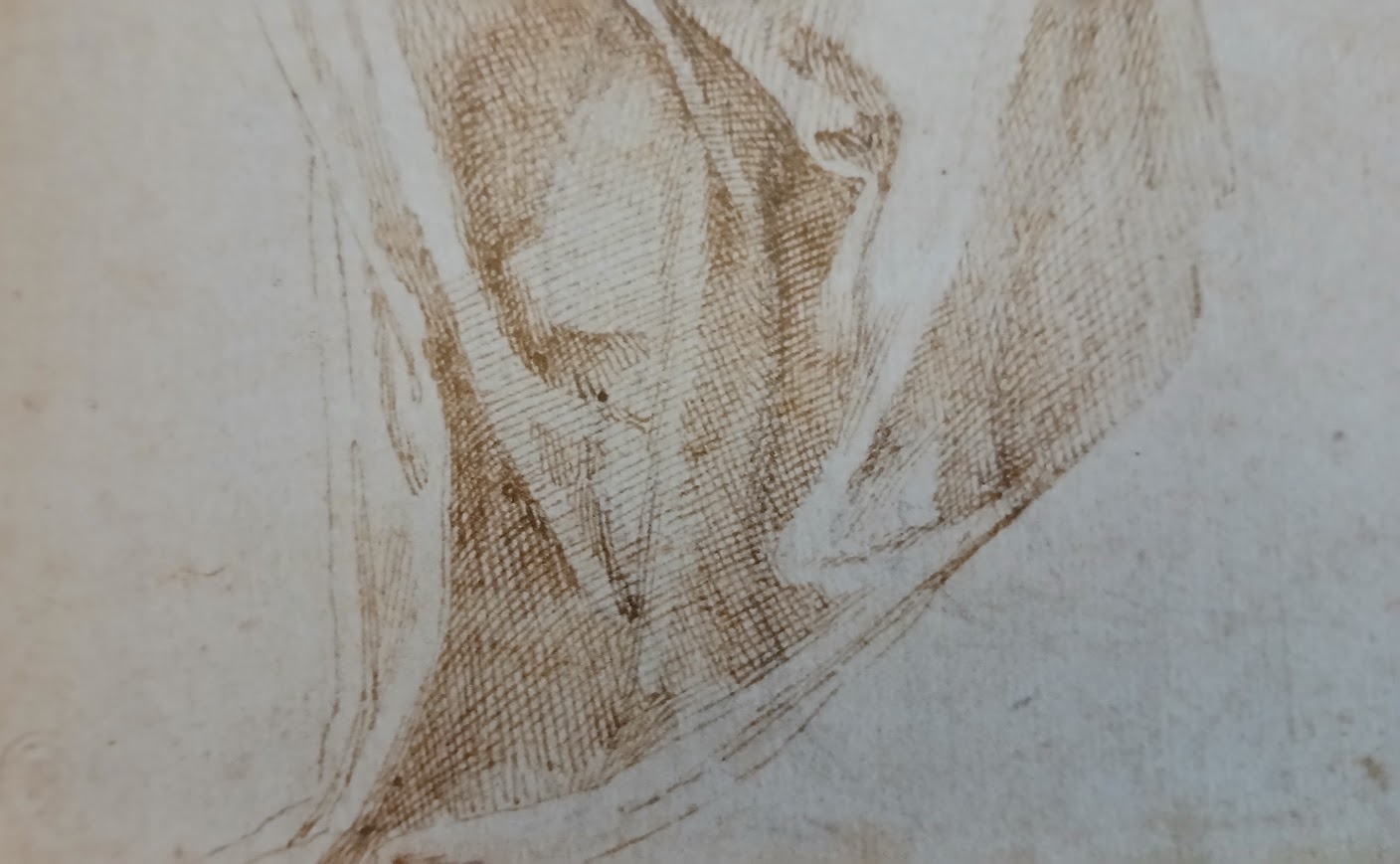
Il disegno oggi noto come “39 F” appartenente a Casa Buonarroti, costituisce un esempio emblematico di questo debito precoce. Realizzato con un fitto tratteggio incrociato, memore della tradizione fiorentina quattrocentesca, il foglio mostra una padronanza tecnica sorprendente, maturata già durante l’apprendistato presso la bottega del Ghirlandaio.
Una figura sospesa tra nudo e panneggio
La figura, rappresentata di profilo verso destra, con entrambe le braccia divaricate, inizialmente la tracciai a matita nera.
In un secondo momento tornai sul disegno, avvolgendo il bacino in un ampio panneggio tracciato a penna e inchiostro bruno. Il segno leggero della matita resta comunque visibile nella testa, nel busto e nelle braccia, delineando un nudo verosimilmente femminile, mentre le gambe, l’una sollevata e appoggiata a un basamento, l’altra saldamente a terra, emergono solo parzialmente sotto il successivo tratteggio.

Il panneggio, massiccio e serrato, non è un semplice elemento accessorio: diventa il vero campo di sperimentazione luministica.
Qui la penna si muove con grande raffinatezza, costruendo un reticolo chiaro scuro che si infittisce nelle ombre profonde delle pieghe e si dissolve gradualmente nelle zone di maggiore luce, seguendo il turgore della muscolatura che copre ma senza celare, come fu spesso mia abitudine fare in altri disegni così come negli affreschi e nelle sculture.
Un soggetto ancora senza nome
Dal punto di vista iconografico, la figura resta enigmatica. Nel Corpus dei disegni, Charles de Tolnay avanzò l’ipotesi, poi giudicata problematica dagli studiosi successivi, che si trattasse della Maddalena inclinata verso Cristo per un Noli me tangere.
Secondo questa lettura, il disegno sarebbe un’idea precoce poi rielaborata nel cartone oggi perduto, che avevo realizzato nel 1531 per la tavola commissionata da Alfonso d’Avalos che poi ricevette la Marchesa di Pescara Vittoria Colonna.
Più recentemente, John T. Spike ha proposto un confronto, seppur dubitativo, con la Madonna del Giudizio universale della Cappella Sistina, sottolineando affinità formali con alcuni studi compositivi per il celebre affresco. Tuttavia, l’assenza di corrispondenze stringenti rende chiaro come le finalità del foglio restino tuttora ignote.
Un’attribuzione discussa, ma sempre più convincente
Anche l’attribuzione a me è stata a lungo oggetto di dibattito. Alcuni studiosi hanno individuato nella parte a matita nera le tipiche vibrazioni del modellato mio, caratterizzato da un andamento ondulato e ritmato. Altri hanno invece puntato sul panneggio, riconoscendo nel tratteggio a reticolo un tratto distintivo mio periodo giovanile.
Già Johannes Wilde, nel 1953, notava una somiglianza con lo studio per la Sibilla Eritrea della volta sistina, proponendo una datazione tra il 1506 e il 1508. Più in generale, lo stile minuto e controllato avvicina il foglio ai numerosi disegni che realizzai tra la fine del XV e l’inizio del XVI secolo.
Un foglio che racconta la nascita di un linguaggio
Al di là delle questioni attributive e iconografiche, il disegno in questione rimane una preziosa testimonianza della mia formazione e del dialogo continuo con i maestri del passato.
Per il momento il sempre vostro Michelangelo Buonarroti vi saluta dandovi appuntamento ai prossimi post e sui social.

An Early Drawing of Mine: Origin, Style, and Attribution
In the Garden of San Marco, where Lorenzo the Magnificent had assembled an extraordinary collection of models and drawings, I had the opportunity to study works from the past and by fifteenth-century masters.
My dear friend Giorgio Vasari recalls how precious drawings and cartoons by Donatello, Masaccio, Paolo Uccello, Filippo Lippi, and Fra Angelico were kept there, alongside works by artists from both the local area and foreign countries. This was an important formative context that left a profound and lasting impression on my artistic language.
The drawing now known as “39 F,” belonging to Casa Buonarroti, is an emblematic example of this early debt. Created with dense cross-hatching, reminiscent of the fifteenth-century Florentine tradition, the drawing displays a surprising technical mastery, developed during my apprenticeship in Ghirlandaio’s workshop.
A figure suspended between nude and drapery
The figure, depicted in profile to the right, with both arms outstretched, was initially drawn in black pencil.
I later returned to the drawing, enveloping the pelvis in ample drapery drawn in pen and brown ink. The light pencil strokes remain visible in the head, torso, and arms, delineating a seemingly female nude, while the legs, one raised and resting on a plinth, the other firmly on the ground, emerge only partially beneath the subsequent hatching.
The drapery, massive and tight, is not a mere accessory: it becomes the true field of experimentation with light.
Here the pen moves with great refinement, constructing a chiaroscuro grid that thickens in the deep shadows of the folds and gradually dissolves in the areas of greatest light, following the turgidity of the muscles that it covers but does not conceal, as I often did in other drawings as well as in frescoes and sculptures.
A still unnamed subject
From an iconographic perspective, the figure remains enigmatic. In the Corpus of Drawings, Charles de Tolnay advanced the hypothesis, later deemed problematic by subsequent scholars, that it was the Magdalene leaning toward Christ in a Noli me tangere.
According to this interpretation, the drawing was an early idea later reworked in the now-lost cartoon I created in 1531 for the panel commissioned by Alfonso d’Avalos, who later received the Marchioness of Pescara Vittoria Colonna.
More recently, John T. Spike has proposed a comparison, albeit a tentative one, with the Madonna of the Last Judgement in the Sistine Chapel, emphasizing formal affinities with some compositional studies for the famous fresco. However, the lack of conclusive correspondences makes it clear that the purpose of the drawing remains unknown.
A controversial, but increasingly convincing, attribution
The attribution to me has also long been a subject of debate. Some scholars have identified in the black pencil portion the typical vibrations of my modeling, characterized by a wavy and rhythmic movement. Others have instead focused on the drapery, recognizing the grid-like hatching as a distinctive feature of my early period.
Johannes Wilde, in 1953, noted a similarity to the study for the Erythraean Sibyl on the Sistine Chapel ceiling, suggesting a dating between 1506 and 1508. More generally, the minute and controlled style aligns the sheet with the numerous drawings I made between the late 15th and early 16th centuries.
A sheet that recounts the birth of a language
Beyond questions of attribution and iconography, the drawing in question remains a precious testimony to my training and ongoing dialogue with the masters of the past.
For now, yours truly, Michelangelo Buonarroti bids you farewell and invites you to future posts and social media.

Sostienici – Support Us
Se questo blog ti piace e ti appassiona, puoi aiutarci a farlo crescere sempre più sostenendoci in modo concreto condividendo i post, seguendo le pagine social e con un contributo che ci aiuta ad andare avanti con il nostro lavoro di divulgazione. . ENGLISH: If you like and are passionate about this blog, you can help us make it grow more and more by supporting us in a concrete way by sharing posts, following social pages and with a contribution that helps us to move forward with our dissemination work.
10,00 €
Condividi:


Questo sono io





sostienici

Sostienici – Support Us
Se questo blog ti piace e ti appassiona, puoi aiutarci a farlo crescere sempre più sostenendoci in modo concreto condividendo i post, seguendo le pagine social e con un contributo che ci aiuta ad andare avanti con il nostro lavoro di divulgazione. . ENGLISH: If you like and are passionate about this blog, you can help us make it grow more and more by supporting us in a concrete way by sharing posts, following social pages and with a contribution that helps us to move forward with our dissemination work.
€10,00


