

25 gennaio: la Conversione di San Paolo nella storia dell’arte
Oggi 25 gennaio la liturgia cattolica ricorda la Conversione di San Paolo. Per questa occasione voglio proporvi alcune delle opere d’arte che reputo più belle che narrano per immagini questo episodio.
Da quale inizio? Dalla Conversione di San Paolo che affrescai nella Cappella Paolina, la cappella privata del papa.
La mia Conversione di Saulo
Il papa in carica celebrava il giorno della Conversione di Saulo nella Basilica di San Paolo fuori le Mura fino all’anno 1439. Il 25 gennaio del 1540 papa Paolo III Farnese volle consacrare la cappella privata fatta realizzare da Sangallo il Giovane nel Palazzo Pontificio a questo santo da cui fra l’altro aveva preso pure il nome. Lì veniva conservato il Santissimo Sacramento , cosa che accade anche oggi.
Nel momento della consacrazione le pareti erano spoglie. Il papa sentiva la necessità di farla decorare in modo degno e si rivolse a me. A papa Paolo III non potevo dire di no. Certo risalire sui ponteggi quando l’età e la renella mi davano delle grane non era cosa facile ma accettai e mi misi al lavoro.

Prima cominciai ad affrescare la Conversione di Saulo poi passai alla Crocifissione di San Pietro. Nella conversione San Paolo giace a terra sconvolto portandosi la mano sinistra al volto. Sembra si voglia riparare dal fascio luminoso che Cristo in volo gli sta scagliando addosso.
Tutt’intorno c’è una grande agitazione e anche il cavallo che ha appena disarcionato Saulo, gira le chiappe verso lo spettatore mentre imbizzarrito se ne scappa via. Un palafreniere tenta di trattenerlo ma dall’immagine che si vede non sembra che avrà poi la meglio.
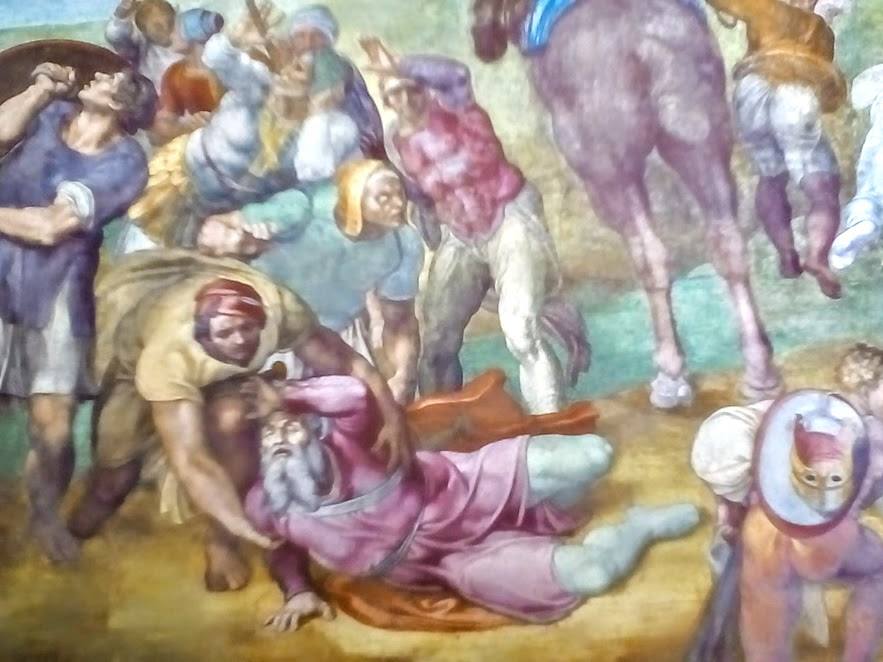
“Però mi pare che Michelagnolo mancasse assai nel Cristo che appare à San Paolo ne la sua conversione; il quale fuori d’ogni gravità, e d’ogni decoro; par che si precipiti dal cielo con atto poco honorato, dovendo fare quella apparizione con gravità, e maestà tale, quale appartiene al Re del Cielo et de la terra, e ad un figliuolo di Dio“
Così scrisse monsignore Andrea Gillo nel 1564, facendo riferimento proprio all’affresco della Conversione di Saulo. Ebbene sì, anche gli affreschi della Cappella Paolina fecero discutere assai. Nemmeno quelli furono immuni alle censure dopo la mia dipartita dal vostro mondo.
La Conversione di Saulo nella cappella Palatina del Palazzo dei Normanni
All’interno della preziosa Cappella Palatina del Palazzo dei Normanni, a Palermo, nella destra furono raffigurate a mosaico le storie di Paolo. La prima raffigurazione visibile parzialmente a sinistra è proprio il momento della sua conversione.
Manca l’elemento che poi diverrà tipico di quel momento ovvero la presenza del cavallo. C’è da dire che le fonti non menzionano il quadrupede: San Paolo infatti fu scaraventato a terra dall’urto del fulmine tant’è che divenne proverbiale la frase “Folgorato sulla via di Damasco”.
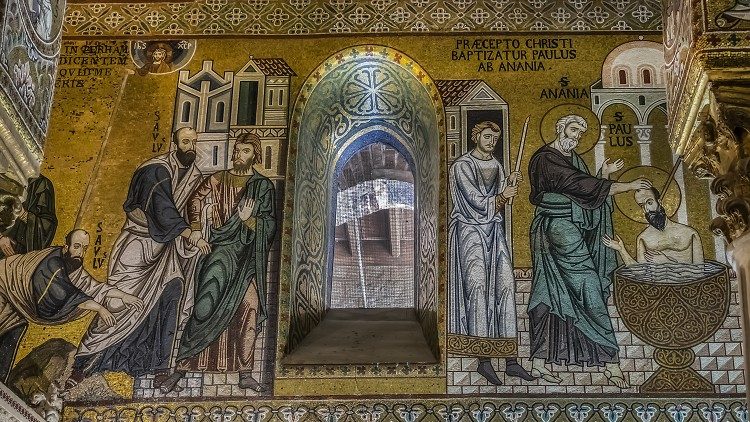
Nel mosaico si vede cadere a terra colpito da un fulmine mandato da Cristo affacciato da un oblò che si apre nel cielo. Il fulmine viene viene raffigurato come un dardo d’oro impugnato con la mano destra da Nostro Signore.
La Conversione di San Paolo del Caravaggio
Anche Caravaggio si confrontò con la Conversione di San Paolo, oggi visibile nella Cappella Cerasi della Basilica di Santa Maria del Popolo a Roma. Nel luglio del 1600, un tal Monsignor Tiberio Cerasi ovvero l’allora tesoriere di papa Clemente VIII, acquistò una cappella in Santa Maria del Popolo nella quale avrebbero riposato poi le sue spoglie terrene.
Prima la fece ristrutturare a Carlo Maderno e poi commissionò al Caracci la pala d’altare con l’Assunta. Il 24 settembre dello stesso anno, Cerasi chiese a Caravaggio la realizzazione di due dipinti da sistemare alle pareti laterali: la Crocifissione di San Pietro e la Conversione di San Paolo.
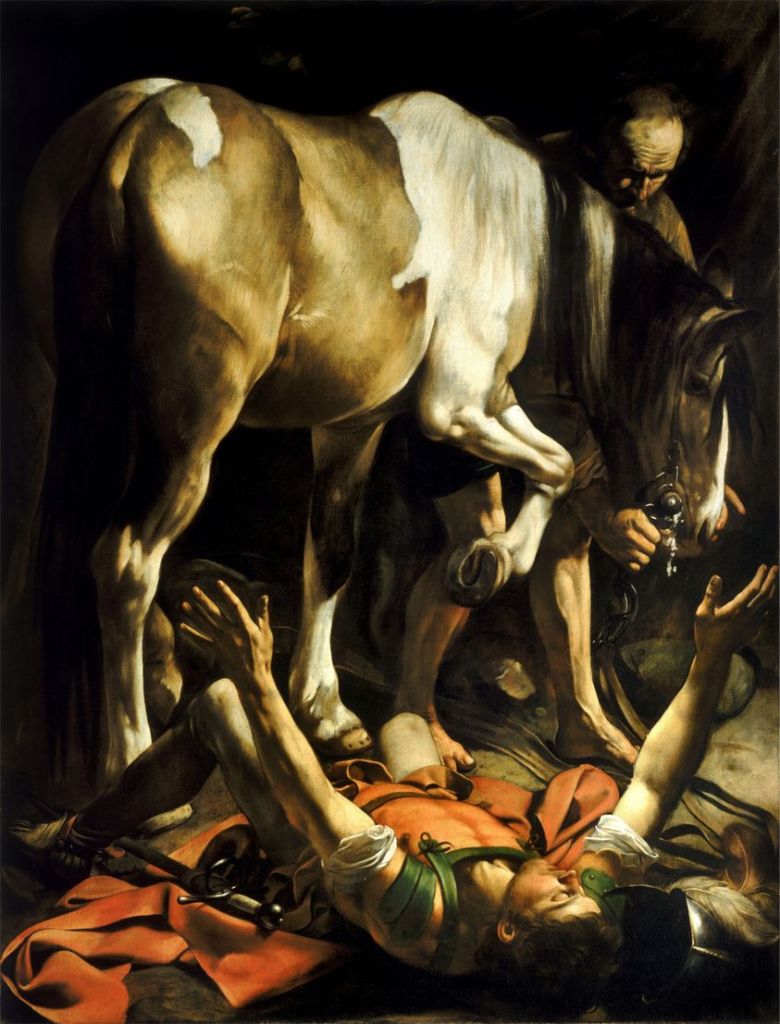
San Paolo, anche qui disarcionato, viene illuminato da Cristo sulla via per Damasco. Non si vede come nella mia Cristo in volo ma quello che sta accadendo viene descritto dalla luce e da Saulo disteso a terra con gli occhi chiusi e le braccia aperte.
Qualche critico malignamente la chiama la Conversione del Cavallo in quanto il bestione tenuto dall’anziano palafreniere occupa gran parte della scena.

Per il momento il vostro Michelangelo Buonarroti vi saluta dandovi appuntamento ai prossimi post e sui social.
January 25: the Conversion of Saint Paul in the history of art
Today January 25th the Catholic liturgy remembers the Conversion of Saint Paul. For this occasion I want to offer you some of the works of art that I consider the most beautiful that narrate this episode in images.
From what beginning? From the Conversion of Saint Paul which I frescoed in the Cappella Paolina, the pope’s private chapel.
Today, January 25, the Catholic liturgy commemorates the Conversion of Saint Paul. For this occasion I want to offer you two of the works of art that I consider the most beautiful that narrate this episode in images. Which? Mine and that of Caravaggio’s Cerasi. From what beginning? From the Conversion of Saint Paul which I frescoed in the Cappella Paolina, the pope’s private chapel.
My Conversion of Saul
The Pope in office celebrated the day of the Conversion of Saul in the Basilica of San Paolo Fuori le Mura until the year 1439. On 25 January 1540 Pope Paul III Farnese wanted to consecrate the private chapel built by Sangallo the Younger in the Papal Palace to this saint from whom among other things he also took his name. The Blessed Sacrament was kept there, which also happens today.
At the moment of the consecration the walls were bare. The Pope felt the need to have it decorated in a worthy way and turned to me. I couldn’t say no to Pope Paul III. Of course, climbing back onto the scaffolding when age and gravel were giving me trouble was not easy but I accepted and got to work.
First I began to fresco the Conversion of Saul, then I moved on to the Crucifixion of St. Peter. In the conversion Saint Paul lies on the ground shocked, holding his left hand to his face. It seems he wants to protect himself from the light beam that Christ in flight is throwing at him.
All around there is great agitation and even the horse that has just unseated Saul turns its butt towards the spectator while in a panic it runs away. A groom tries to hold him back but from the image we see it doesn’t look like he will prevail.
“But it seems to me that Michelagnolo was very lacking in Christ appearing to Saint Paul during his conversion; which is beyond all gravity and all decorum; it seems that he falls from heaven with a little honorable act, having to make that appearance with gravity and majesty such as belongs to the King of Heaven and earth, and to a son of God.”
Thus wrote Monsignor Andrea Gillo in 1564, referring precisely to the fresco of the Conversion of Saul. Well yes, even the frescoes in the Pauline Chapel caused a lot of discussion. Even those were not immune to censure after my departure from your world.
The Conversion of Saul in the Palatine chapel of the Norman Palace
Inside the precious Palatine Chapel of the Norman Palace in Palermo, the stories of Paul were depicted in mosaic on the right. The first depiction visible partially on the left is precisely the moment of his conversion.
The element that would later become typical of that moment, the presence of the horse, is missing. It must be said that the sources do not mention the quadruped: Saint Paul was in fact thrown to the ground by the impact of the lightning, so much so that the phrase “Struck on the road to Damascus” became proverbial.
In the mosaic he is seen falling to the ground struck by lightning sent by Christ looking out of a porthole opening into the sky. The thunderbolt is depicted as a golden dart held in the right hand of Our Lord.
The Conversion of Saint Paul by Caravaggio
Caravaggio also compared himself with the Conversion of Saint Paul, today visible in the Cerasi Chapel of the Basilica of Santa Maria del Popolo in Rome. In July 1600, a certain Monsignor Tiberio Cerasi, the then treasurer of Pope Clement VIII, purchased a chapel in Santa Maria del Popolo in which his earthly remains would later rest.
First he had Carlo Maderno renovate it and then commissioned the altarpiece with the Assumption from Caracci. On 24 September of the same year, Cerasi asked Caravaggio to create two paintings to be placed on the side walls: the Crucifixion of Saint Peter and the Conversion of Saint Paul.
Saint Paul, also unhorsed here, is enlightened by Christ on the road to Damascus. You can’t see Christ in flight like in mine but what is happening is described by the light and by Saul lying on the ground with his eyes closed and his arms open.
Some critics maliciously call it the Conversion of the Horse as the beast held by the elderly groom occupies much of the scene.
For the moment, your Michelangelo Buonarroti greets you and will meet you in future posts and on social media.

Sostienici – Support Us
Se questo blog ti piace e ti appassiona, puoi aiutarci a farlo crescere sempre più sostenendoci in modo concreto condividendo i post, seguendo le pagine social e con un contributo che ci aiuta ad andare avanti con il nostro lavoro di divulgazione. . ENGLISH: If you like and are passionate about this blog, you can help us make it grow more and more by supporting us in a concrete way by sharing posts, following social pages and with a contribution that helps us to move forward with our dissemination work.
10,00 €
-
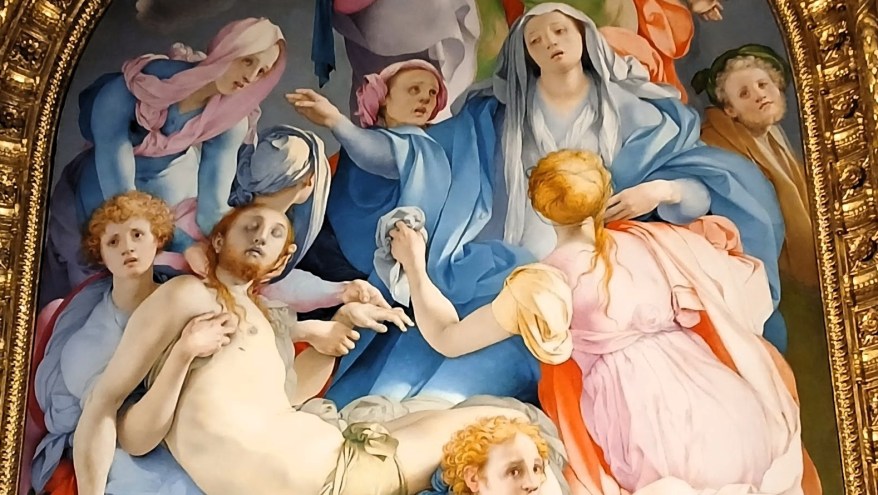
La Deposizione del Pontormo: il capolavoro dell’artista
🇮🇹Ti coinvolge. Ti mette a disagio. Ti costringe a sentire. E’ la Deposizione dalla Croce, dipinta da Jacopo Pontormo tra il 1525 e il 1528 per la Cappella Capponi… 🇬🇧It draws you in. It makes you uncomfortable. It forces you to feel. It’s the Deposition from the Cross, painted by Jacopo Pontormo between 1525 and…
-
Non chiamatelo Braghettone: il 4 aprile del 1566 muore Daniele da Volterra, l’artista che salvò il Giudizio Universale
🇮🇹Braghettone? No, molto di più. Il 4 aprile 1566 moriva Daniele da Volterra, il mio allievo più fedele, l’uomo che mi rimase accanto fino all’ultimo respiro e che salvò il mio Giudizio Universale dalla distruzione… 🇬🇧Braghettone? No, much more. On April 4, 1566, Daniele da Volterra died, my most faithful student, the man who remained…
-
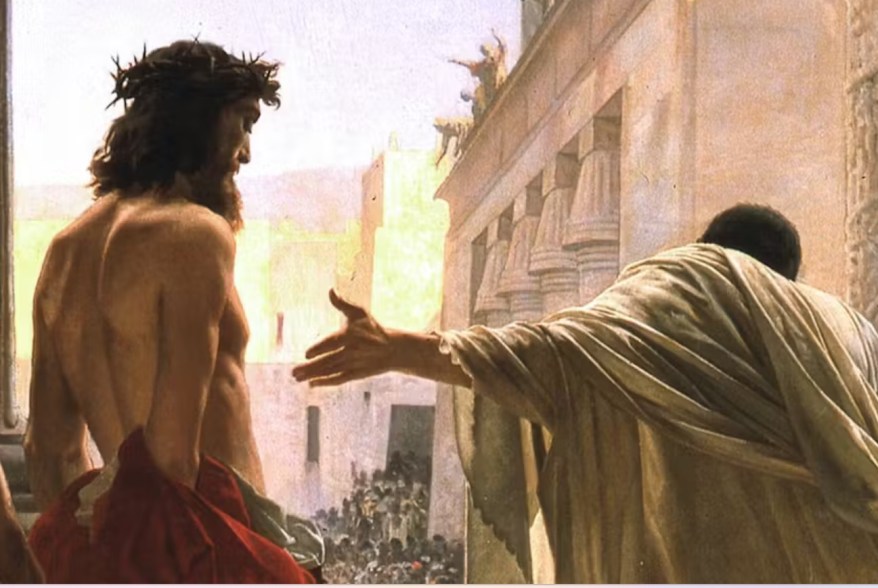
Venerdì Santo: gli “Ecce Homo” più intensi della storia dell’arte
🇮🇹Ecce Homo. Da Antonello da Messina a Tintoretto, fino al sorprendente capolavoro di Antonio Ciseri, questo soggetto ha attraversato i secoli raccontando dolore, umanità e coscienza… 🇬🇧Ecce Homo. From Antonello da Messina to Tintoretto, to Antonio Ciseri’s astonishing masterpiece, this subject has spanned the centuries, recounting pain, humanity, and conscience…
Condividi:


Questo sono io





sostienici

Sostienici – Support Us
Se questo blog ti piace e ti appassiona, puoi aiutarci a farlo crescere sempre più sostenendoci in modo concreto condividendo i post, seguendo le pagine social e con un contributo che ci aiuta ad andare avanti con il nostro lavoro di divulgazione. . ENGLISH: If you like and are passionate about this blog, you can help us make it grow more and more by supporting us in a concrete way by sharing posts, following social pages and with a contribution that helps us to move forward with our dissemination work.
€10,00


