
La Scultura del giorno: il Busto di Cosimo I del Cellini
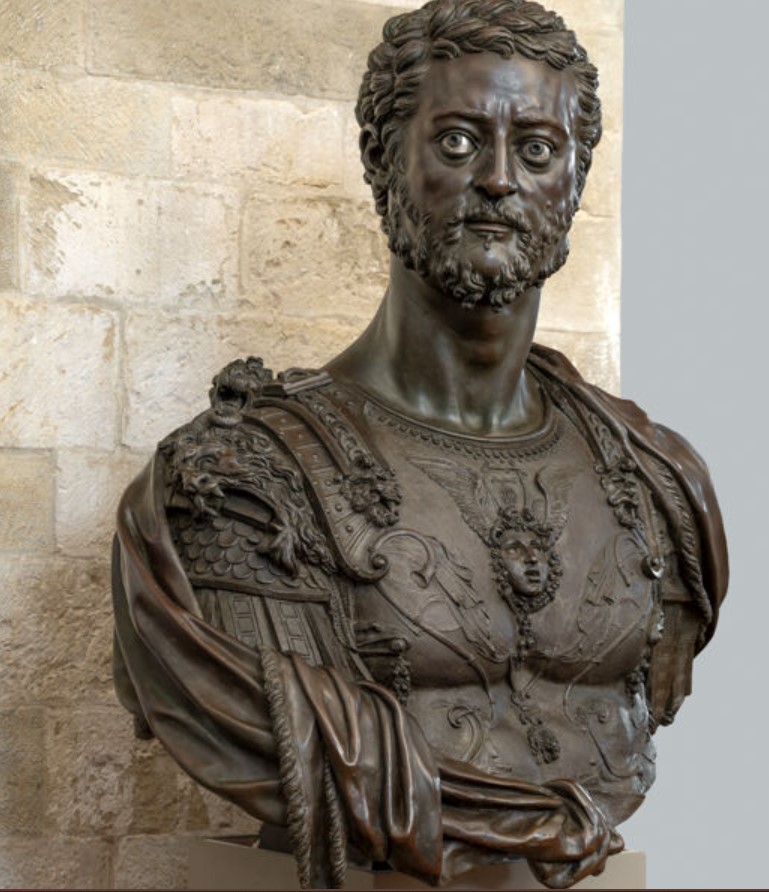
La scultura del giorno che vi propongo oggi è il Busto in bronzo di Cosimo I de’ Medici realizzato da Benvenuto Cellini fra il 1545 e il 1548.
L’arista si mise al lavoro sull’opera negli stessi anni in cui stava lavorando al celeberrimo Perseo. La sua fusione è documentata nell’anno 1546 mentre per attendere la completa nettatura si dovrà attendere il febbraio del 1547.

Il 15 novembre del 1557 l’opera fu posizionata nella nicchia sopra la porta d’ingresso del Forte Stella di Portoferraio dove rimase fino al 2 maggio 1781, quando per volere di Leopoldo I fu trasferita alla Galleria degli Uffizi e successivamente al Bargello dove tutt’oggi è visibile.
Probabilmente in origine l’opera non era destinata ad essere esposta all’esterno perché nel febbraio del 1548 alcuni dettagli del busto furono dorati con la stesura a freddo. Le dorature fatte in questo modo all’aperto si deteriorarono rapidamente e oggi non ne rimane traccia se non nei documenti.
Il Cellini volle realizzare il busto del duca alla maniera dei ritratti imperiali, con quel loro portamento fiero e altero. Non solo ne curò l’espressività del volto ma pose particolare attenzione agli ornamenti della corazza, dimostrando tutta la sua abilità di orafo.

Al centro del petto si vede il volto di Medusa, considerato un simbolo rinascimentale del potere sia divino che militare.
Sempre sul petto è ben visibile il Toson d’Oro, la prestigiosa onorificenza cavalleresca che Carlo V aveva conferito a Cosimo I nel 1545.
Gli spallacci invece sono decorati con teste di leone, mascheroni, borchie e squame.
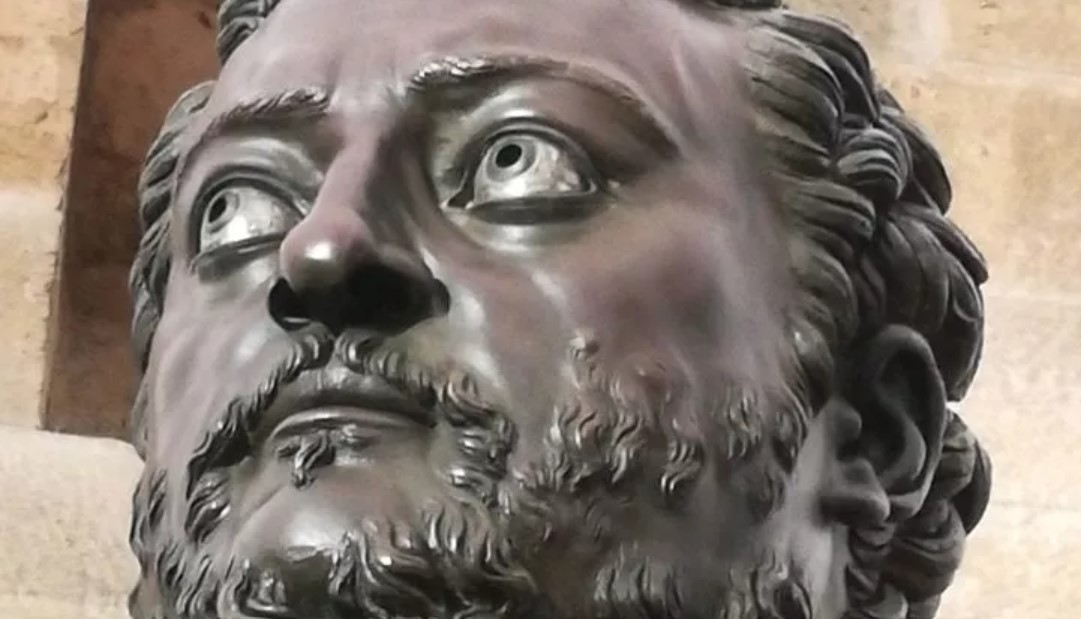
Durante il restauro dell’opera terminato nel maggio del 2021, la restauratrice Ludovica Nicolai assieme alla dottoressa Ilaria Ciseri, curatrice delle collezioni del Bargello, in base a un’ipotesi proposta dalla critica, hanno voluto effettuare un saggio sulla superficie degli occhi di Cosimo I per verificare se realmente fossero stati realizzati in argento.
Così poco a poco sotto lo strato scuro è riemerso il colore originario del metallo degli occhi. A tutti gli effetti il Cellini, rifacendosi a una tecnica adoperata già in antichità, ha reso più prezioso il volto del duca inserendo delle lamine d’argento per far risplendere gli occhi.
Per il momento il vostro Michelangelo Buonarroti vi saluta dandovi appuntamento ai prossimi post e sui social.
Sculpture of the day: Cellini’s Bust of Cosimo I
The sculpture of the day that I propose to you today is the bronze bust of Cosimo I de’ Medici created by Benvenuto Cellini between 1545 and 1548.
The artist began working on the work in the same years in which he was working on the famous Perseus. Its fusion is documented in the year 1546 while to wait for complete cleaning we will have to wait until February 1547.
On 15 November 1557 the work was positioned in the niche above the entrance door of the Forte Stella in Portoferraio where it remained until 2 May 1781, when at the behest of Leopold I it was transferred to the Uffizi Gallery and subsequently to the Bargello where all today it is visible.
The work was probably not originally intended to be exhibited outdoors because in February 1548 some details of the bust were gilded by cold application. The gilding done
and in this way they rapidly deteriorated in the open and today no trace remains of them except in documents.
Cellini wanted to create the bust of the duke in the manner of imperial portraits, with their proud and haughty bearing. He not only took care of the expressiveness of the face but paid particular attention to the ornaments of the armor, demonstrating all his skill as a goldsmith.
In the center of his chest we see the face of Medusa, considered a Renaissance symbol of both divine and military power.
Also clearly visible on the chest is the Golden Fleece, the prestigious chivalric honor that Charles V had conferred on Cosimo I in 1545.
The shoulder straps are decorated with lion heads, masks, studs and scales.
During the restoration of the work completed in May 2021, the restorer Ludovica Nicolai together with Dr. Ilaria Ciseri, curator of the Bargello collections, based on a hypothesis proposed by the critics, wanted to carry out an essay on the surface of Cosimo I’s eyes to check if they were actually made of silver.
So little by little the original color of the metal of the eyes re-emerged under the dark layer. To all intents and purposes, Cellini, referring to a technique already used in antiquity, made the duke’s face more precious by inserting silver sheets to make his eyes shine.
For the moment, your Michelangelo Buonarroti greets you and will meet you in future posts and on social media.

Sostienici – Support Us
Se questo blog ti piace e ti appassiona, puoi aiutarci a farlo crescere sempre più sostenendoci in modo concreto condividendo i post, seguendo le pagine social e con un contributo che ci aiuta ad andare avanti con il nostro lavoro di divulgazione. . ENGLISH: If you like and are passionate about this blog, you can help us make it grow more and more by supporting us in a concrete way by sharing posts, following social pages and with a contribution that helps us to move forward with our dissemination work.
10,00 €
-
La Deposizione del Pontormo: il capolavoro dell’artista
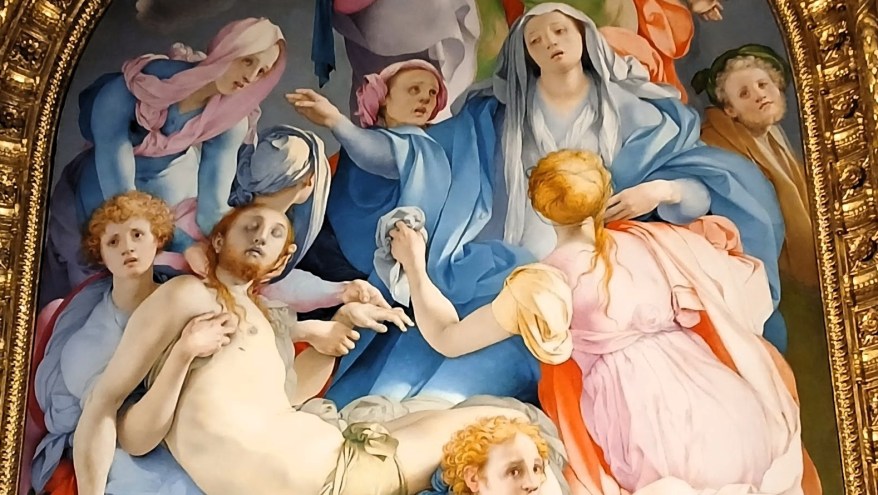
🇮🇹Ti coinvolge. Ti mette a disagio. Ti costringe a sentire. E’ la Deposizione dalla Croce, dipinta da Jacopo Pontormo tra il 1525 e il 1528 per la Cappella Capponi… 🇬🇧It draws you in. It makes you uncomfortable. It forces you to feel. It’s the Deposition from the Cross, painted by Jacopo Pontormo between 1525 and…
-
Non chiamatelo Braghettone: il 4 aprile del 1566 muore Daniele da Volterra, l’artista che salvò il Giudizio Universale
🇮🇹Braghettone? No, molto di più. Il 4 aprile 1566 moriva Daniele da Volterra, il mio allievo più fedele, l’uomo che mi rimase accanto fino all’ultimo respiro e che salvò il mio Giudizio Universale dalla distruzione… 🇬🇧Braghettone? No, much more. On April 4, 1566, Daniele da Volterra died, my most faithful student, the man who remained…
-
Venerdì Santo: gli “Ecce Homo” più intensi della storia dell’arte
🇮🇹Ecce Homo. Da Antonello da Messina a Tintoretto, fino al sorprendente capolavoro di Antonio Ciseri, questo soggetto ha attraversato i secoli raccontando dolore, umanità e coscienza… 🇬🇧Ecce Homo. From Antonello da Messina to Tintoretto, to Antonio Ciseri’s astonishing masterpiece, this subject has spanned the centuries, recounting pain, humanity, and conscience…
Condividi:


Questo sono io





sostienici

Sostienici – Support Us
Se questo blog ti piace e ti appassiona, puoi aiutarci a farlo crescere sempre più sostenendoci in modo concreto condividendo i post, seguendo le pagine social e con un contributo che ci aiuta ad andare avanti con il nostro lavoro di divulgazione. . ENGLISH: If you like and are passionate about this blog, you can help us make it grow more and more by supporting us in a concrete way by sharing posts, following social pages and with a contribution that helps us to move forward with our dissemination work.
€10,00


