

Autunno nei dipinti: 12 capolavori da vedere almeno una volta
L’autunno arriva quasi senza fare rumore. Cambia la luce, l’aria si fa più fresca, gli alberi si accendono di giallo, rosso e arancio e le foglie cominciano lentamente a cadere. È una stagione fatta di trasformazioni e contrasti: abbondanza e malinconia, calore e freddo, vita e declino.
Non sorprende quindi che l’autunno abbia conquistato per secoli la fantasia dei pittori.
C’è chi lo ha trasformato in un paesaggio pieno di luce, chi lo ha usato per raccontare il trascorrere del tempo e chi, come Giuseppe Arcimboldo, ne ha fatto addirittura un volto umano composto da frutti e foglie.
Dalle foreste di Gustave Courbet ai pioppi di Vincent van Gogh, dalle rive della Senna dipinte da Claude Monet ai boschi di Gustav Klimt, l’autunno nella storia dell’arte non ha mai avuto un solo colore.
Perché l’autunno affascina tanto i pittori?
A differenza della primavera, associata alla nascita e alla rinascita, l’autunno porta con sé un significato più complesso. È il momento della raccolta e dell’abbondanza, ma anche quello in cui la natura comincia a spogliarsi.
Per questo motivo, nei dipinti autunnali possiamo trovare paesaggi luminosissimi accanto a immagini malinconiche, alberi ancora pieni di foglie accanto a boschi ormai quasi nudi. Il colore diventa protagonista.
Giallo, ocra, arancio, rosso, marrone e verde si mescolano sulla tela creando quella particolare tavolozza che ancora oggi associamo immediatamente all’autunno.
1. Giuseppe Arcimboldo, Autunno: quando la stagione diventa un volto
Cominciamo da uno dei dipinti più sorprendenti della storia dell’arte: l’Autunno di Giuseppe Arcimboldo. Realizzato nel Cinquecento, il dipinto appartiene alla celebre serie delle Quattro Stagioni. Arcimboldo costruisce il volto utilizzando frutti, foglie, rami e prodotti della terra.
L’autunno diventa una persona. È un’immagine giocosa e allo stesso tempo estremamente sofisticata, nella quale il pittore trasforma gli elementi della natura in parti anatomiche.
L’idea è geniale perché permette di osservare la stagione da una prospettiva completamente diversa: non più soltanto un paesaggio, ma una vera e propria allegoria dell’autunno.

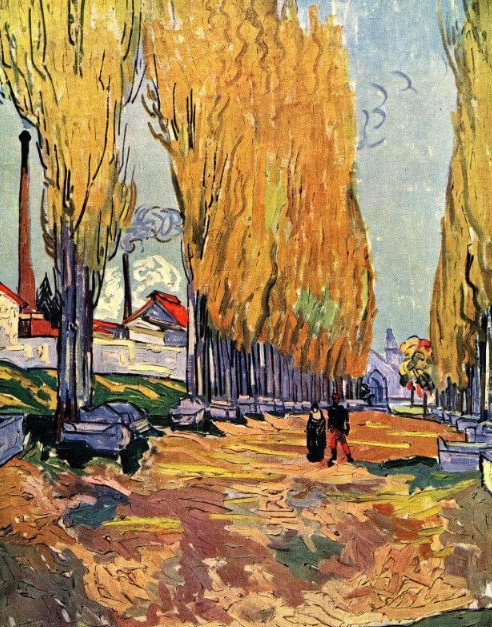
2. Vincent van Gogh, Viale con cipressi ad Arles in autunno
Quando si pensa a Van Gogh vengono immediatamente in mente girasoli, cieli stellati e campi di grano. Ma anche l’autunno occupò un posto importante nella sua pittura. Nel 1888, ad Arles, Van Gogh dipinse alcune vedute autunnali degli Alyscamps, l’antica necropoli romana della città.
Le foglie cadute formano quasi un tappeto sul terreno mentre i tronchi degli alberi scandiscono lo spazio.
È un autunno particolarmente intenso, nel quale il giallo e l’arancio delle foglie contrastano con le tonalità più fredde del paesaggio. Van Gogh stesso, in una lettera, descrisse una delle sue tele autunnali parlando delle foglie che cadevano “come fiocchi di neve”.
3. Claude Monet, Autunno sulla Senna ad Argenteuil
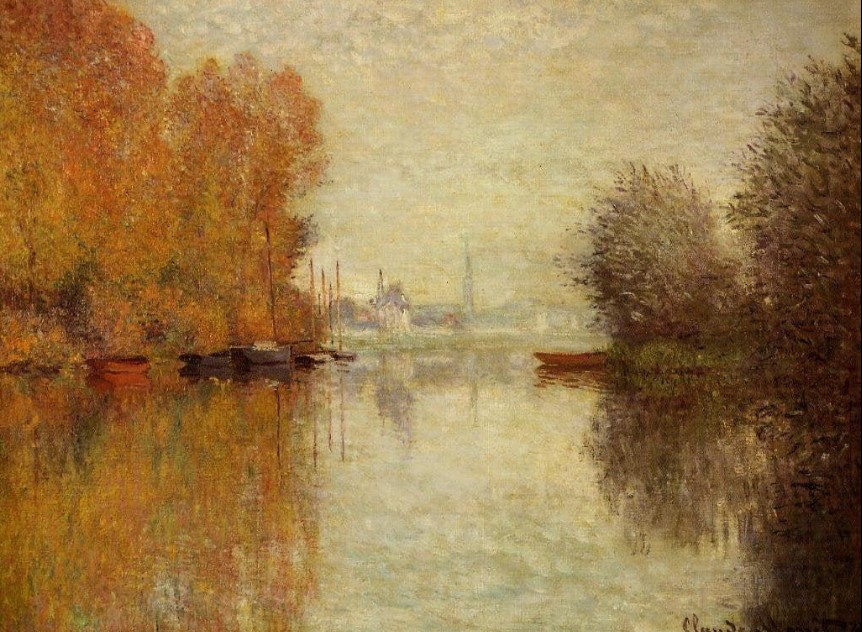
Con Claude Monet l’autunno diventa soprattutto una questione di luce. Nel dipinto del 1873 dedicato alla Senna ad Argenteuil, gli alberi dai colori autunnali si riflettono nell’acqua creando un gioco di corrispondenze tra paesaggio reale e riflesso.
Il rosso, il giallo e il marrone della vegetazione non sono semplicemente colori locali: cambiano attraverso la luce e l’acqua.
È una delle caratteristiche più affascinanti della pittura impressionista: non raccontare soltanto ciò che vediamo, ma il modo in cui lo vediamo.
L’opera è oggi conservata all’High Museum of Art di Atlanta.
4. Vincent van Gogh, Paesaggio autunnale con quattro alberi
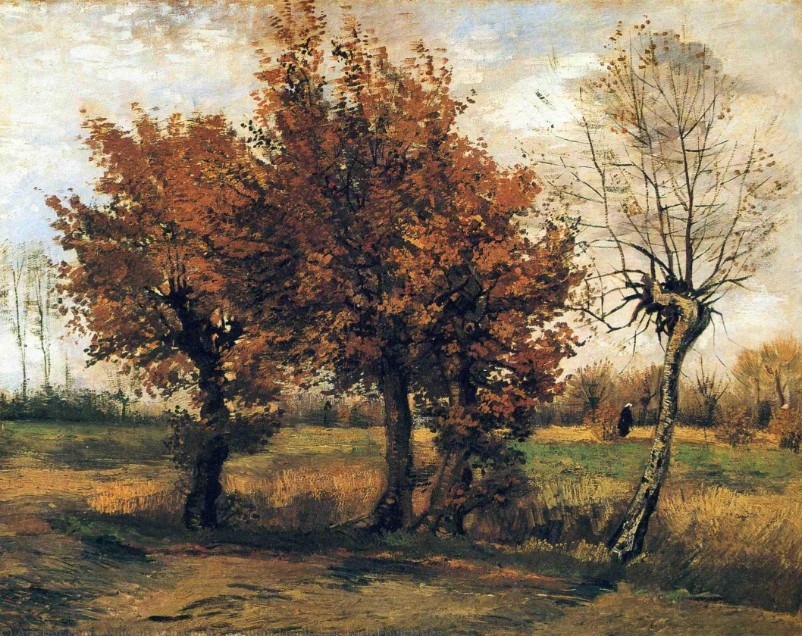
Nel 1885 Van Gogh torna ancora una volta a confrontarsi con l’autunno. In Paesaggio autunnale con quattro alberi gli alberi dominano la composizione e diventano quasi una quinta teatrale.
Le tonalità della vegetazione trasformano il paesaggio in una scena di grande intensità cromatica.
È interessante osservare quanto l’artista riesca a fare con un soggetto apparentemente semplice: quattro alberi diventano il centro emotivo dell’intera composizione.
L’opera è conservata al Kröller-Müller Museum nei Paesi Bassi.
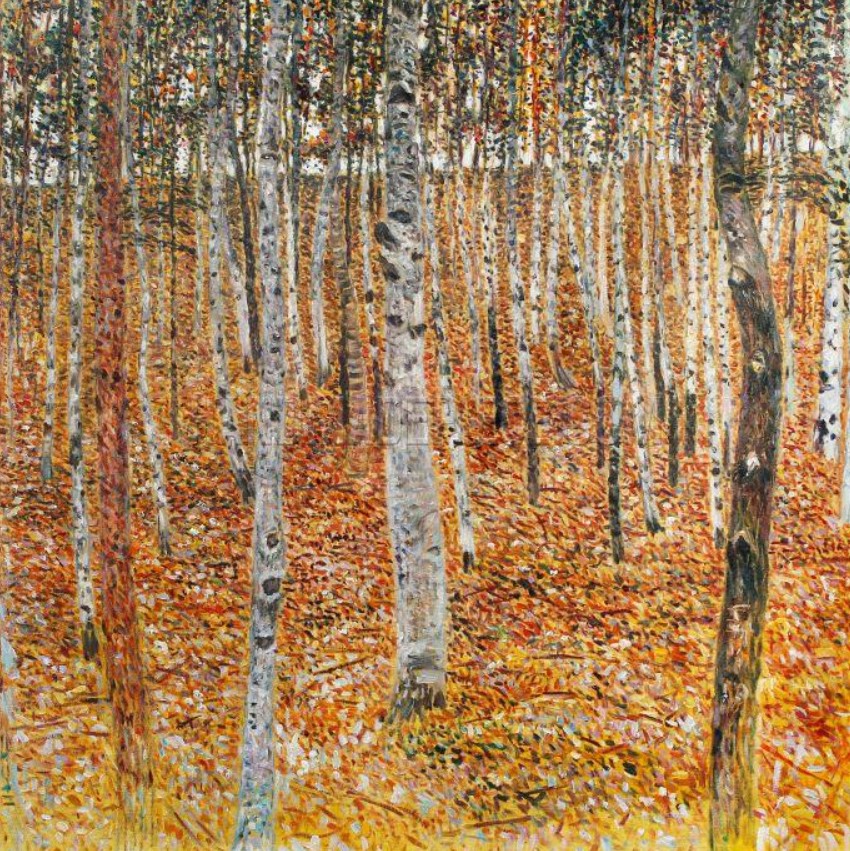
5. Gustav Klimt e il bosco che sembra un mosaico
Se c’è un artista capace di trasformare la natura in una superficie decorativa, quello è Gustav Klimt. Nei suoi paesaggi boschivi gli alberi diventano verticali, le foglie si moltiplicano e il terreno si trasforma in un tappeto di colori.
Il suo autunno non è necessariamente quello della malinconia. È un’esplosione di gialli, aranci, verdi e bruni, organizzati sulla superficie come tessere di un enorme mosaico.
La natura sembra perdere profondità per diventare quasi un motivo ornamentale.
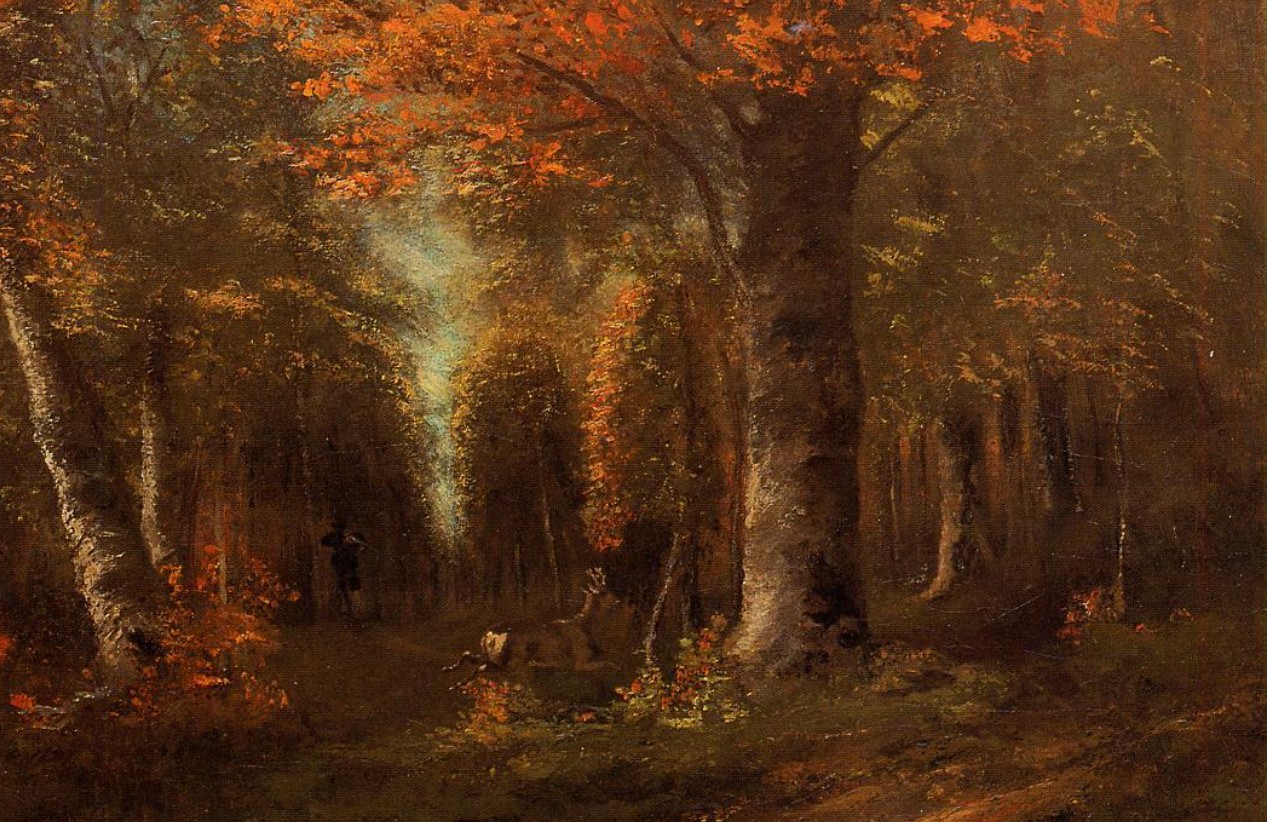
6. Gustave Courbet, la foresta in autunno
Con Gustave Courbet entriamo in un autunno completamente diverso. Nella sua pittura il paesaggio non è un semplice sfondo, ma diventa il vero protagonista. La foresta, gli alberi, il terreno e l’acqua costruiscono una scena concreta, quasi fisica.
Il pittore francese guarda alla natura senza idealizzarla e porta sulla tela una materia fatta di tronchi, foglie, rocce e terra. È un autunno più silenzioso rispetto a quello di Van Gogh e meno luminoso rispetto a quello di Monet, ma proprio per questo capace di trasmettere una forte sensazione di immersione nella natura.
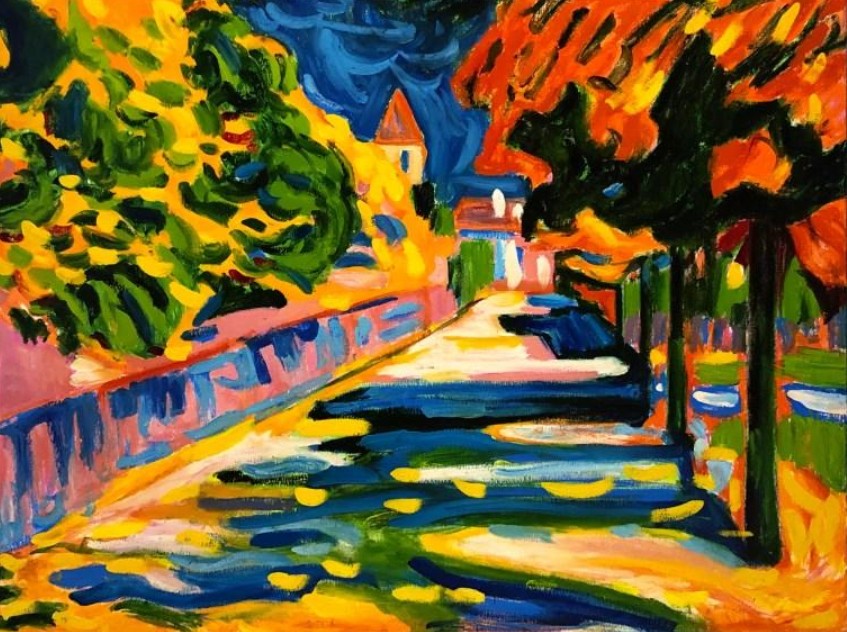
7. Kandinsky racconta l’autunno in Baviera
Con Vasilij Kandinskij l’autunno comincia invece ad allontanarsi dalla semplice rappresentazione del paesaggio. In Autunno in Baviera del 1908, il colore acquista una forza sempre maggiore.
La stagione non è soltanto qualcosa da osservare: diventa una possibilità per sperimentare rapporti cromatici, forme e atmosfere.
È uno dei passaggi che conducono verso quella progressiva liberazione dalla rappresentazione naturalistica che caratterizzerà la pittura di Kandinskij.
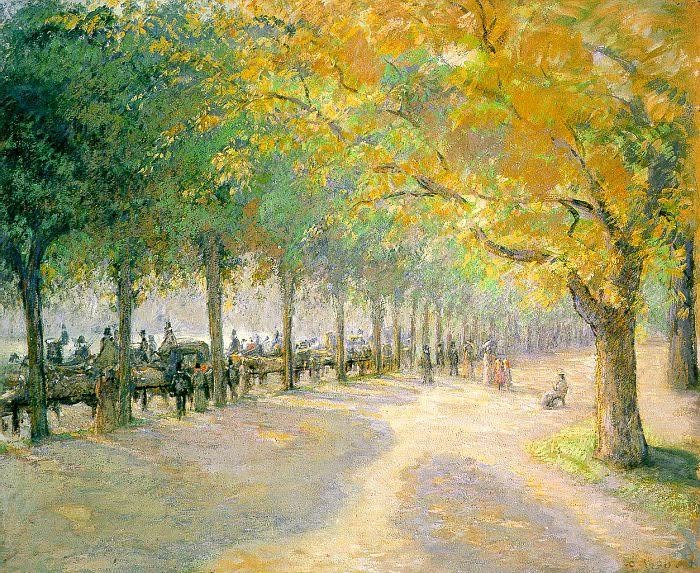
8. Camille Pissarro e l’autunno a Hyde Park
Anche Camille Pissarro si confrontò con i colori dell’autunno. Nel suo Hyde Park a Londra, il paesaggio urbano viene immerso in una luce stagionale fatta di tonalità calde e vegetazione.
Pissarro utilizza pennellate che dissolvono i contorni senza però perdere la struttura dello spazio. Il viale, gli alberi e le figure conducono lo sguardo all’interno della scena.
È un autunno vissuto all’aperto, nel quale la natura e la città convivono.
9. L’autunno nella pittura giapponese
L’autunno non appartiene soltanto alla tradizione pittorica europea. Nella cultura giapponese il cambiamento delle stagioni ha avuto un’importanza enorme e le foglie autunnali sono diventate un soggetto artistico ricorrente.
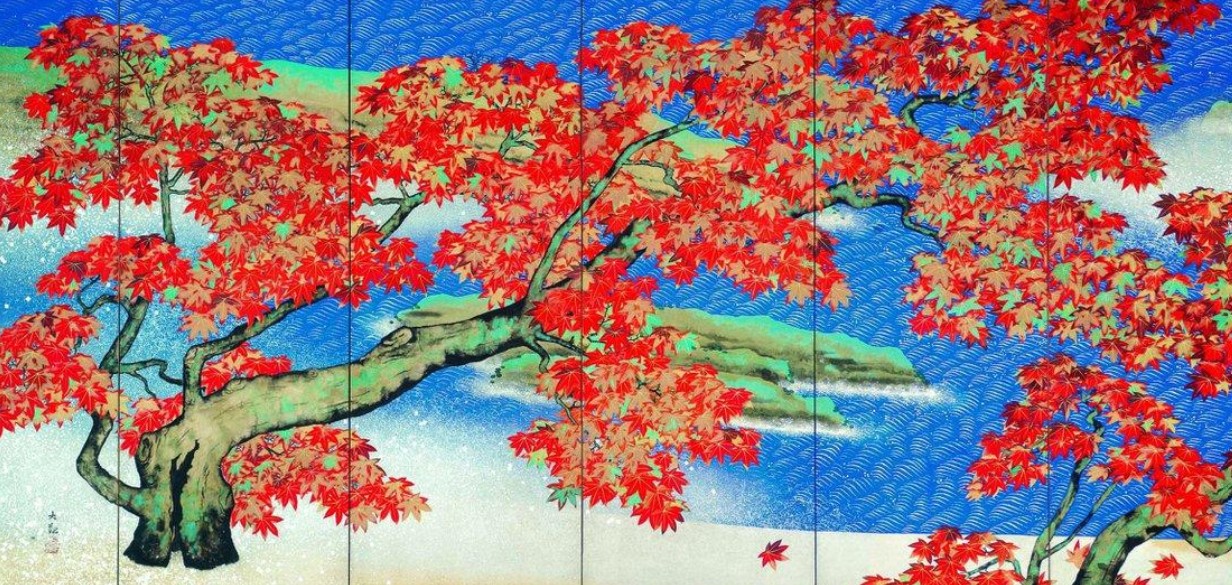
Un esempio particolarmente suggestivo è Autumn Leaves di Yokoyama Taikan, realizzato nel 1931. Qui il rosso delle foglie emerge contro una composizione dominata da tonalità fredde, creando un contrasto potentissimo.
È un autunno molto diverso da quello occidentale, ma ugualmente basato sull’idea di contemplare la trasformazione della natura.
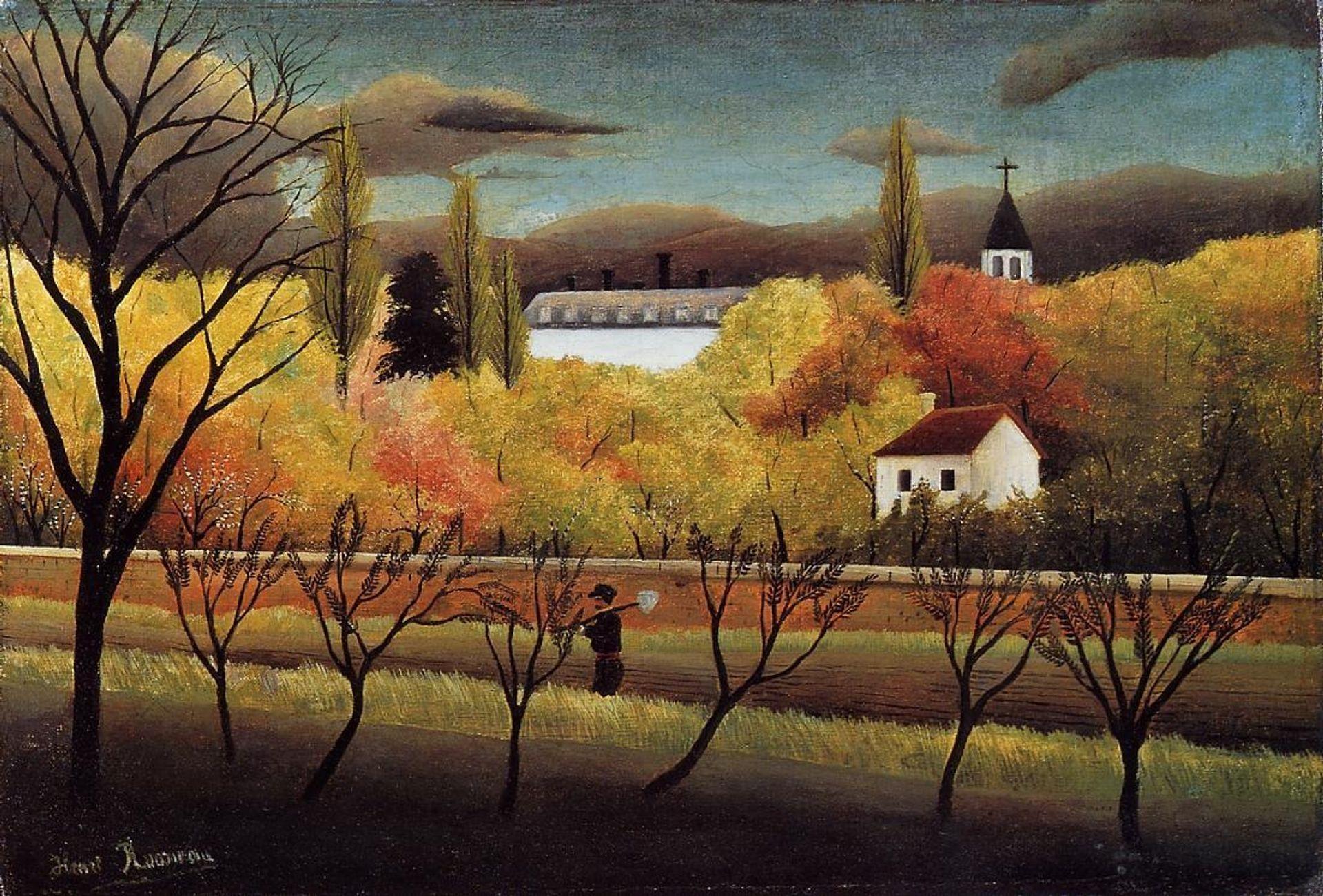
10. Henri Rousseau – Paesaggio con alberi
Henri Rousseau ci porta in una natura fiabesca. Le sue foreste sembrano appartenere contemporaneamente al mondo reale e a quello dei sogni. Gli alberi diventano quinte scenografiche e la vegetazione acquista una forza quasi fantastica.
Anche quando non rappresenta esplicitamente una stagione con i suoi simboli più evidenti, Rousseau dimostra quanto il paesaggio possa diventare un luogo mentale, oltre che geografico.
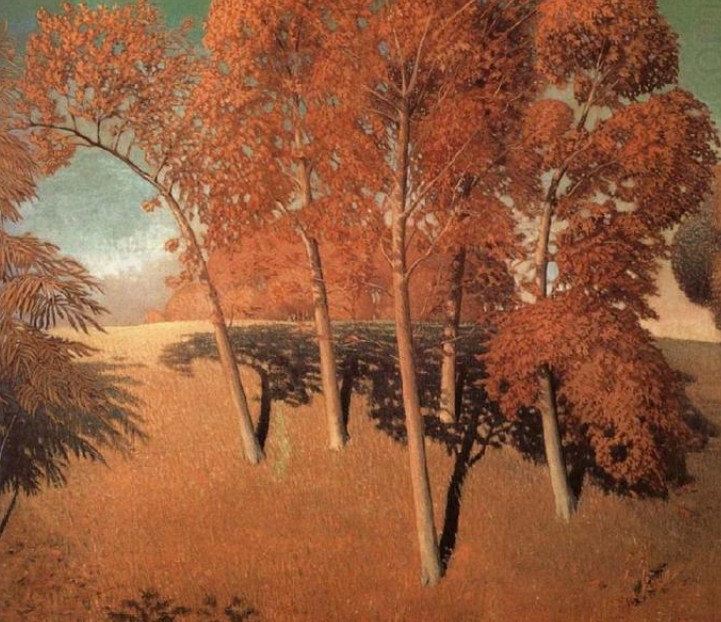
11. Grant Wood – Foglie d’autunno
L’autunno americano entra nella pittura di Grant Wood attraverso la campagna del Midwest. I suoi paesaggi sono ordinati, quasi geometrici, e raccontano un rapporto profondissimo tra uomo, terra e lavoro.
Le tonalità autunnali trasformano la campagna in una composizione fatta di campi, alberi e linee sinuose. È un autunno molto diverso da quello europeo: più ampio, agricolo, legato al paesaggio rurale americano.
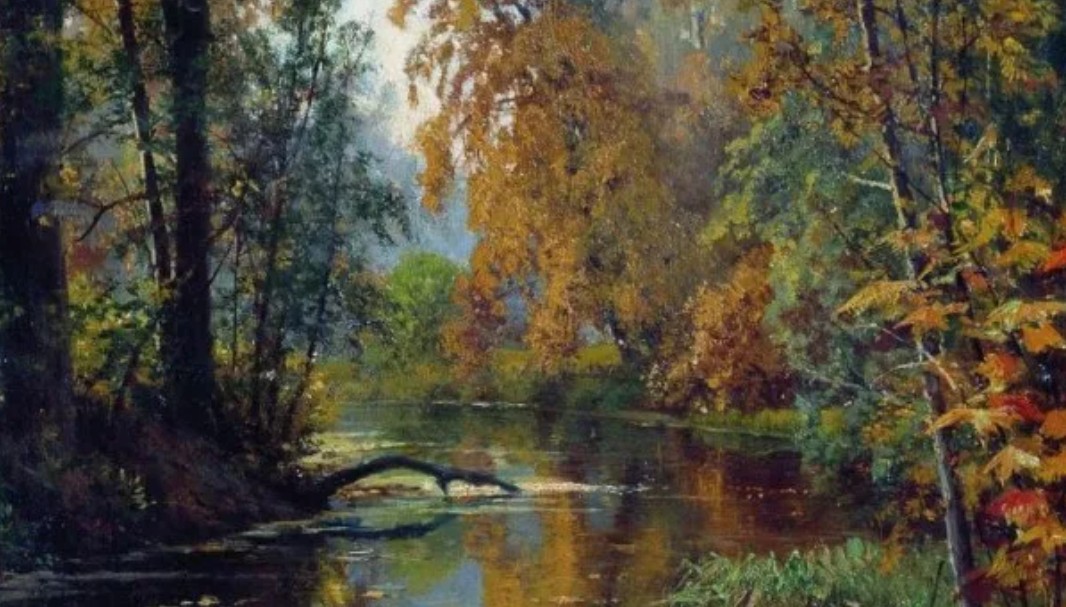
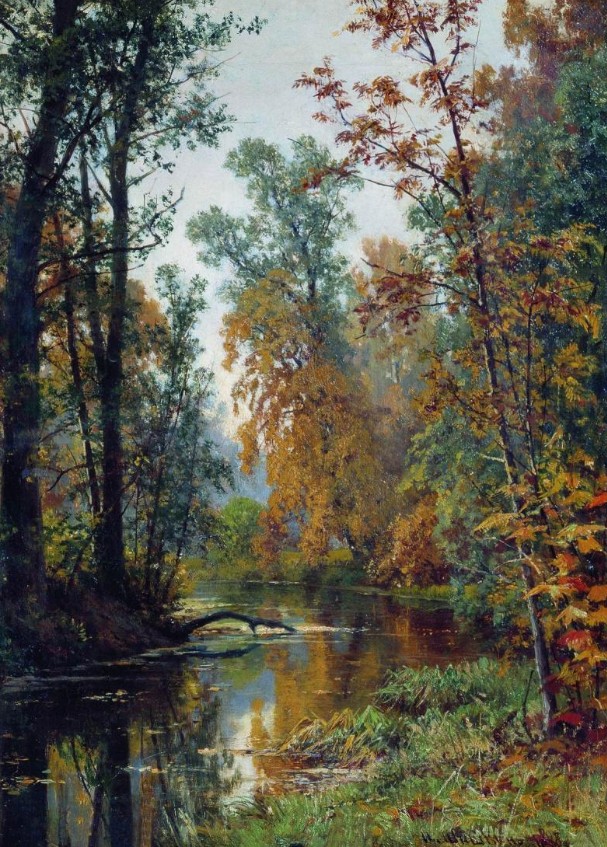
12. Ivan Šiškin – Bosco d’autunno
Chiudiamo il nostro viaggio con Ivan Šiškin, uno dei più importanti paesaggisti russi dell’Ottocento. La foresta è uno dei grandi protagonisti della sua pittura.
Gli alberi, il sottobosco, la luce filtrata tra i rami: tutto viene osservato con una precisione straordinaria. Nel suo bosco autunnale la natura appare immensa e allo stesso tempo silenziosa.
È forse uno degli aspetti più affascinanti dell’autunno dipinto dagli artisti: la capacità di farci sentire piccoli davanti alla grandezza del paesaggio.
Dodici artisti, dodici autunni completamente diversi
Arcimboldo ha trasformato l’autunno in un volto mentre Van Gogh lo ha acceso di giallo e arancio. Monet lo ha fatto riflettere nell’acqua e Klimt lo ha trasformato in un mosaico.
Constable lo ha osservato nella campagna inglese, Munch ne ha raccontato la malinconia e Kandinsky lo ha utilizzato per liberare il colore.
Cézanne ne ha studiato le forme e Schiele ha dato agli alberi un’anima inquieta. Rousseau lo ha portato dentro una natura quasi fiabesca mentre Grant Wood lo ha legato alla campagna americana e Šiškin lo ha trasformato in una foresta monumentale.
Dodici modi diversi di guardare la stessa stagione perchè davanti allo stesso autunno, ogni artista vede qualcosa che gli altri non hanno visto.
L‘autunno in fondo non è soltanto una stagione: è un colore, un ricordo, un’emozione e, per un pittore, una storia tutta da raccontare.
Per il momento il sempre vostro Michelangelo Buonarroti vi saluta dandovi appuntamento ai prossimi post e sui social.

Autumn in Paintings: 12 Masterpieces to See at Least Once
Autumn arrives almost without a sound. The light changes, the air grows cooler, the trees ignite with yellow, red, and orange, and the leaves slowly begin to fall. It is a season of transformation and contrast: abundance and melancholy, warmth and cold, life and decline.
It is hardly surprising, then, that autumn has captivated the imaginations of painters for centuries.
Some have transformed it into a landscape filled with light; others have used it to depict the passage of time; and some—like Giuseppe Arcimboldo—have even turned it into a human face composed of fruit and leaves.
From the forests of Gustave Courbet to the poplars of Vincent van Gogh, from the banks of the Seine painted by Claude Monet to the woods of Gustav Klimt, autumn in art history has never had just one color.
Why does autumn fascinate painters so much?
Unlike spring, which is associated with birth and rebirth, autumn carries a more complex meaning. It is a time of harvest and abundance, yet also a time when nature begins to shed its foliage.
For this reason, autumn paintings may feature brilliant, light-filled landscapes alongside melancholic scenes, or trees still heavy with leaves beside woods that are nearly bare. Color takes center stage.
Yellow, ochre, orange, red, brown, and green blend on the canvas, creating that distinctive palette we still instantly associate with autumn.
Giuseppe Arcimboldo, Autumn: When the Season Becomes a Face
Let us begin with one of the most striking paintings in art history: Autumn by Giuseppe Arcimboldo. Created in the 16th century, the painting is part of the famous Four Seasons series. Arcimboldo constructs the face using fruits, leaves, branches, and produce from the earth.
Autumn becomes a person. It is a playful yet highly sophisticated image, in which the painter transforms elements of nature into anatomical features.
The concept is brilliant because it allows us to view the season from a completely different perspective: no longer just a landscape, but a true allegory of autumn.
Vincent van Gogh, Avenue with Cypresses in Arles in Autumn
When one thinks of Van Gogh, sunflowers, starry skies, and wheat fields immediately come to mind. Yet autumn also held an important place in his work. In 1888, in Arles, Van Gogh painted several autumn views of the Alyscamps, the city’s ancient Roman necropolis.
Fallen leaves form a carpet-like layer on the ground, while the tree trunks punctuate the space.
It is a particularly intense autumn scene, where the yellow and orange of the leaves contrast with the cooler tones of the landscape. In a letter, Van Gogh himself described one of his autumn canvases, noting how the leaves fell “like snowflakes.”
Claude Monet, Autumn on the Seine at Argenteuil
With Claude Monet, autumn becomes primarily a matter of light. In his 1873 painting of the Seine at Argenteuil, trees displaying autumn colors are reflected in the water, creating an interplay between the actual landscape and its reflection.
The reds, yellows, and browns of the foliage are not merely local colors; they shift and change through the effects of light and water.
This is one of the most fascinating characteristics of Impressionist painting: it captures not just what we see, but the way we see it.
The work is currently housed at the High Museum of Art in Atlanta. 4. Vincent van Gogh, Autumn Landscape with Four Trees
In 1885, Van Gogh once again engaged with the theme of autumn. In Autumn Landscape with Four Trees, the trees dominate the composition, acting almost like theatrical scenery.
The hues of the foliage transform the landscape into a scene of intense color.
It is fascinating to see what the artist achieves with a seemingly simple subject: four trees become the emotional heart of the entire composition.
The work is housed at the Kröller-Müller Museum in the Netherlands.
Gustav Klimt and the forest that resembles a mosaic
If there is an artist capable of transforming nature into a decorative surface, it is Gustav Klimt. In his woodland landscapes, trees become vertical forms, leaves multiply, and the ground turns into a carpet of color.
His autumn is not necessarily one of melancholy. It is an explosion of yellows, oranges, greens, and browns, arranged across the surface like the tiles of a vast mosaic.
Nature seems to lose its depth, becoming almost an ornamental pattern.
Gustave Courbet, the forest in autumn
With Gustave Courbet, we enter a completely different kind of autumn. In his painting, the landscape is not merely a backdrop; it becomes the true protagonist. The forest, trees, ground, and water create a tangible, almost physical scene.
The French painter looks at nature without idealizing it, bringing to the canvas a substance composed of trunks, leaves, rocks, and earth. It is an autumn quieter than Van Gogh’s and less luminous than Monet’s, yet precisely for this reason, it conveys a powerful sense of immersion in nature.
Kandinsky depicts autumn in Bavaria
With Wassily Kandinsky, however, the depiction of autumn begins to move away from simple landscape representation. In Autumn in Bavaria (1908), color takes on increasing intensity.
The season is not merely something to be observed; it becomes an opportunity to experiment with chromatic relationships, forms, and atmospheres.
This marks one of the steps leading toward the progressive liberation from naturalistic representation that would come to define Kandinsky’s painting.
Camille Pissarro and autumn in Hyde Park
Camille Pissarro also engaged with the colors of autumn. In his Hyde Park, London, the urban landscape is bathed in a seasonal light composed of warm tones and foliage.
Pissarro employs brushstrokes that dissolve outlines without sacrificing spatial structure. The avenue, the trees, and the figures draw the viewer’s gaze into the scene.
It is an autumn experienced outdoors, where nature and the city coexist.
Autumn in Japanese painting
Autumn is not exclusive to the European painting tradition. In Japanese culture, the changing of the seasons holds immense significance, and autumn leaves have become a recurring artistic subject.
A particularly evocative example is Yokoyama Taikan’s Autumn Leaves (1931). Here, the red of the leaves stands out against a composition dominated by cool tones, creating a powerful contrast.
It is an autumn very different from the Western version, yet equally rooted in the contemplation of nature’s transformation.
Henri Rousseau – Landscape with Trees
Henri Rousseau transports us into a fairytale-like natural world. His forests seem to belong simultaneously to the real world and the realm of dreams. The trees act as theatrical backdrops, and the vegetation takes on an almost fantastical power.
Even when he does not explicitly depict a season through its most obvious symbols, Rousseau demonstrates how a landscape can become a mental space as well as a geographical one.
Grant Wood – Autumn Leaves
The American autumn enters Grant Wood’s paintings through the landscapes of the Midwest. His scenes are orderly—almost geometric—and tell the story of a profound relationship between humanity, the land, and labor.
Autumnal hues transform the countryside into a composition of fields, trees, and sinuous lines. It is an autumn very different from the European one: vast, agricultural, and deeply rooted in the American rural landscape.
Ivan Shishkin – Autumn Forest
We conclude our journey with Ivan Shishkin, one of the most important Russian landscape painters of the 19th century. The forest is a central figure in his work.
The trees, the undergrowth, and the light filtering through the branches are all observed with extraordinary precision. In his autumn forest, nature appears both immense and silent.
This is perhaps one of the most fascinating aspects of autumn as depicted by artists: its ability to make us feel small in the face of the landscape’s grandeur.
Twelve artists, twelve completely different autumns
Arcimboldo transformed autumn into a face, while Van Gogh set it ablaze with yellow and orange. Monet captured its reflection in the water, and Klimt turned it into a mosaic.
Constable observed it in the English countryside, Munch conveyed its melancholy, and Kandinsky used it to liberate color. Cézanne studied its forms, while Schiele gave the trees a restless soul. Rousseau placed it within a near-fairytale landscape, whereas Grant Wood linked it to the American countryside, and Shishkin transformed it into a monumental forest.
Twelve different ways of viewing the same season—because, faced with the very same autumn, each artist sees something that others have missed.
Ultimately, autumn is not merely a season: it is a color, a memory, an emotion, and—for a painter—a story waiting to be told.
For now, yours truly, Michelangelo Buonarroti, bids you farewell and looks forward to seeing you in future posts and on social media.

Sostienici – Support Us
Se questo blog ti piace e ti appassiona, puoi aiutarci a farlo crescere sempre più sostenendoci in modo concreto condividendo i post, seguendo le pagine social e con un contributo che ci aiuta ad andare avanti con il nostro lavoro di divulgazione. . ENGLISH: If you like and are passionate about this blog, you can help us make it grow more and more by supporting us in a concrete way by sharing posts, following social pages and with a contribution that helps us to move forward with our dissemination work.
10,00 €
-
Pietrasanta: un museo per Fernando Botero
🇮🇹Pietrasanta prepara un museo dedicato a Fernando Botero con circa 90 bozzetti a Palazzo Panichi. Il legame con la città che lo nominò cittadino onorario nel 2001… 🇬🇧Pietrasanta is preparing a museum dedicated to Fernando Botero, featuring around 90 sketches at Palazzo Panichi. This reflects his connection to the city, which named him an honorary…
-
Il ritratto enigmatico di Petrus Christus
🇮🇹Chi è la giovane ritratta da Petrus Christus? Un volto misterioso, abiti preziosi e la luce del capolavoro fiammingo del 1470… 🇬🇧Who is the young woman portrayed by Petrus Christus? A mysterious face, exquisite attire, and the light of a Flemish masterpiece from 1470…
-
Pentagono, danneggiato il mappamondo legato a Eisenhower: era destinato all’ufficio di Hegseth
🇮🇹Il mappamondo di Eisenhower, cimelio della Seconda guerra mondiale conservato al Pentagono, è stato danneggiato durante un tentativo di trasferimento nell’ufficio di Pete Hegseth… 🇬🇧Eisenhower’s globe, a World War II relic kept at the Pentagon, was damaged during an attempt to move it to Pete Hegseth’s office…
Condividi:


Questo sono io




sostienici

Sostienici – Support Us
Se questo blog ti piace e ti appassiona, puoi aiutarci a farlo crescere sempre più sostenendoci in modo concreto condividendo i post, seguendo le pagine social e con un contributo che ci aiuta ad andare avanti con il nostro lavoro di divulgazione. . ENGLISH: If you like and are passionate about this blog, you can help us make it grow more and more by supporting us in a concrete way by sharing posts, following social pages and with a contribution that helps us to move forward with our dissemination work.
€10,00


L’autunno conquista anche i fotografi oltre che i pittori, i suoi colori sanno davvero affascinare, bellissimi i dipinti che hai postato 👏👏👏👏👏👌👌👌👍👍👍😉😉😊
"Mi piace"Piace a 1 persona
grazie, l’autunno è una stagione meravigliosa con le tonalità di colore che offre la natura e quelle temperature più miti che arrivano dopo la canicola estiva
"Mi piace"Piace a 1 persona
Amo l’autunno: il mio lavoro finiva e io tornavo a casa.
"Mi piace"Piace a 1 persona
Mica male :-*. Un abbraccio
"Mi piace"Piace a 1 persona