

Opimia di Emilio Franceschi: la vestale romana che nasconde nel marmo una tempesta dell’anima
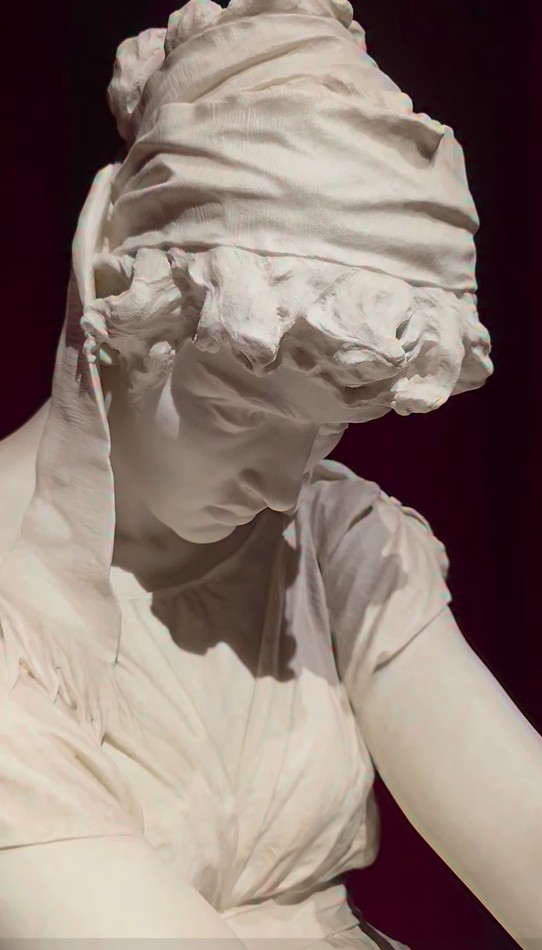
Al Museo e Real Bosco di Capodimonte di Napoli, tra le opere che raccontano la vivacità della scultura italiana dell’Ottocento, Opimia di Emilio Franceschi colpisce per la straordinaria capacità di trasformare una vicenda dell’antica Roma in un dramma profondamente umano, nel quale il marmo candido sembra dare forma concreta al dolore, alla rabbia, alla solitudine e alla disperazione di una donna condannata dal proprio tempo e dalle proprie scelte.
Realizzata in marmo e presentata alla III Mostra Nazionale di Napoli del 1877, l’opera appartiene a quella stagione della cultura figurativa italiana nella quale gli artisti cominciarono a confrontarsi sempre più intensamente con il rapporto tra tradizione classica, osservazione del vero ed espressione dei sentimenti, trasformando anche i soggetti ispirati all’antichità in occasioni per raccontare passioni, conflitti interiori e drammi capaci di parlare direttamente alla sensibilità dell’uomo moderno.
Opimia, la vestale che sfida il destino
La protagonista della scultura è Opimia, una vestale romana alla quale la tradizione attribuisce una vicenda drammatica, segnata dalla trasgressione del voto di castità imposto alle sacerdotesse di Vesta e dall’amore per un uomo considerato nemico di Roma.
Secondo il racconto tramandato, nel 216 a.C. Opimia e Floronia furono accusate di aver violato il voto di castità e vennero condannate alla terribile pena prevista per le vestali colpevoli di questo reato, cioè la sepoltura viva, una punizione che aveva anche un forte significato simbolico perché la sacerdotessa, considerata custode del fuoco sacro della città, non poteva essere sottoposta a una morte pubblica come gli altri condannati.
Floronia affrontò il supplizio, mentre Opimia riuscì a sottrarsi a quella terribile sorte togliendosi la vita prima di essere sepolta viva; anche il suo amante, Lucio Cantilio, segretario del pontefice massimo, ebbe una fine tragica e morì sotto i colpi delle verghe, trasformando così la vicenda della giovane vestale in una storia nella quale amore, trasgressione, condanna e morte si intrecciano in modo indissolubile.
La donna di marmo che sembra trattenere la rabbia
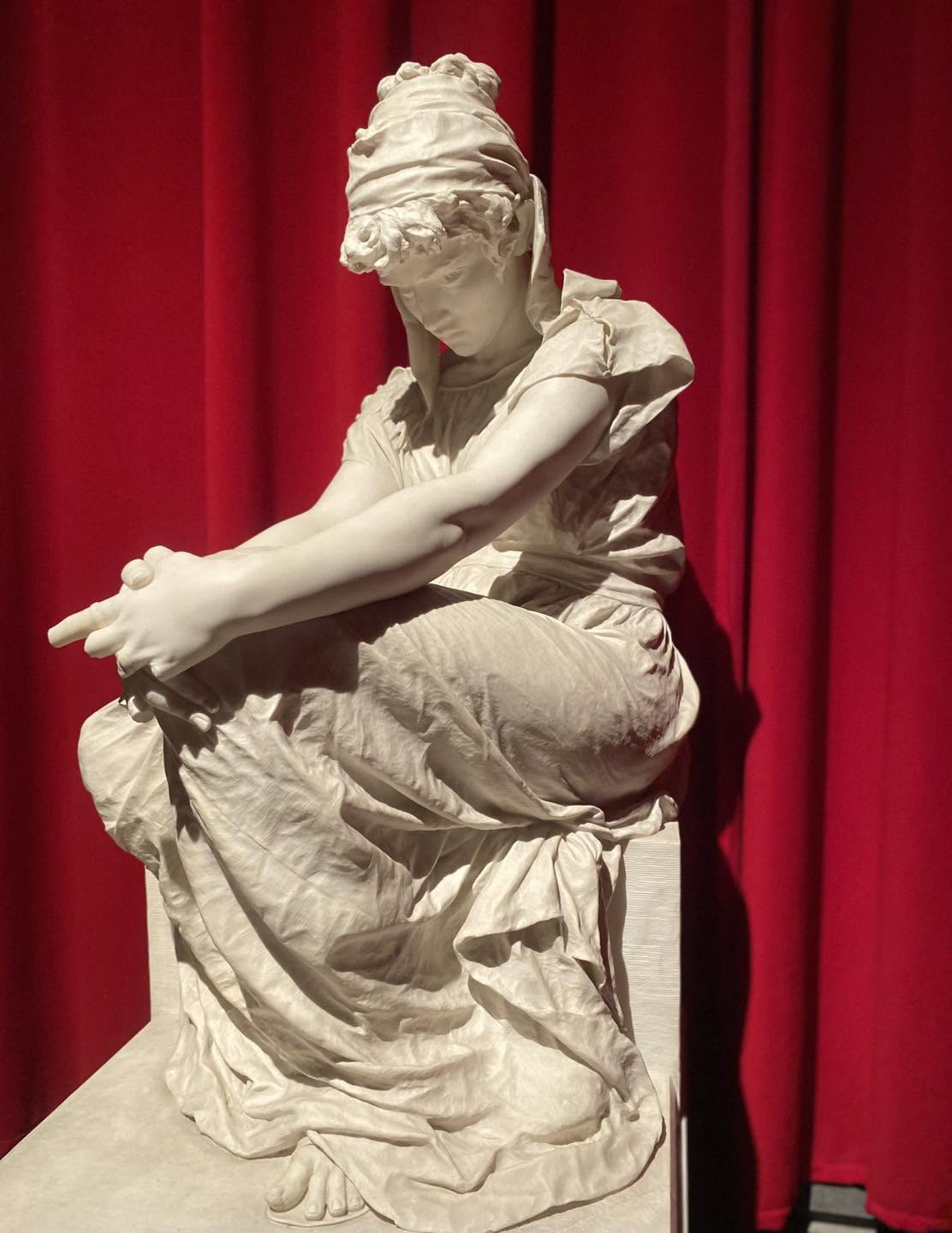
Emilio Franceschi sceglie però di non rappresentare il momento più spettacolare della vicenda e non mostra né la condanna né il supplizio, preferendo concentrarsi sull’immagine di una donna che sembra essere stata improvvisamente isolata dal mondo e costretta a confrontarsi con un destino dal quale non riesce più a fuggire.
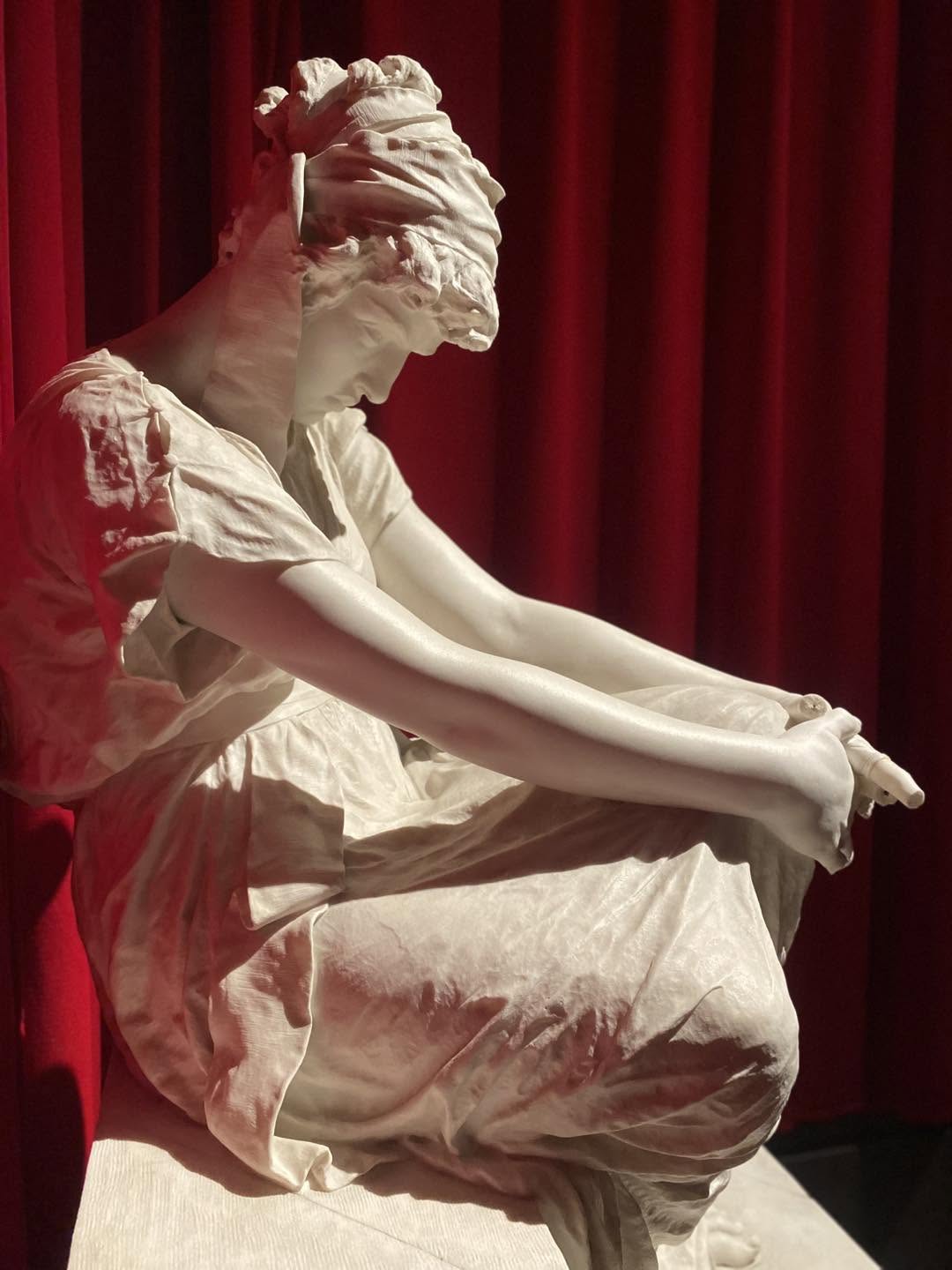
Opimia è raffigurata a grandezza naturale, seduta sopra un semplice cubo, con il corpo avvolto in un’ampia veste caratterizzata da un panneggio attentamente studiato e con i capelli raccolti da larghe fasce che richiamano l’abbigliamento delle sacerdotesse romane. Tutti questi elementi permettono di riconoscere immediatamente il personaggio, ma non impediscono all’artista di trasformare la vestale in una figura sorprendentemente vicina alla sensibilità moderna.
Il volto è inclinato verso il basso, mentre le braccia sono distese e raccolte attorno a un ginocchio in un gesto apparentemente semplice, ma capace di trasmettere una forte sensazione di chiusura e di tensione, quasi come se la giovane donna cercasse di contenere dentro di sé una rabbia che non può più trasformarsi in azione.
La posa è statica, ma l’emozione non lo è.
Emilio Franceschi e il verismo nella scultura italiana
Nato a Firenze il 16 marzo 1839 e morto a Napoli il 2 giugno 1890, Emilio Franceschi sviluppò la propria attività artistica soprattutto nell’ambiente napoletano, dove entrò in contatto con una cultura figurativa particolarmente sensibile al rapporto tra arte e realtà.
Nella sua produzione assume infatti un ruolo importante quella tendenza verso un verismo della descrizione fisica e psicologica che permette alla figura scolpita di abbandonare progressivamente l’ideale di una bellezza astratta e assoluta per confrontarsi con la concretezza dell’esistenza e con la complessità delle emozioni.
In Opimia questo atteggiamento è evidente soprattutto nella volontà di rendere credibile non soltanto il corpo della protagonista, ma anche il suo stato d’animo. Franceschi non sembra interessato a mostrarci semplicemente una bella vestale dell’antichità, quanto piuttosto una giovane donna che sta vivendo uno dei momenti più drammatici della propria esistenza.
L’antichità diventa una storia contemporanea
L’antichità diventa lo specchio del presente, secondo una modalità molto diffusa nella cultura artistica dell’Ottocento, quando la Roma antica, la Grecia e il mondo classico venivano frequentemente utilizzati per raccontare passioni e conflitti che appartenevano anche alla società contemporanea.
Opimia è quindi una vestale romana soltanto in apparenza, perché il suo dolore può essere compreso anche senza conoscere la sua storia e senza possedere particolari strumenti per interpretare l’arte dell’Ottocento.
Il volto chino e il dramma psicologico
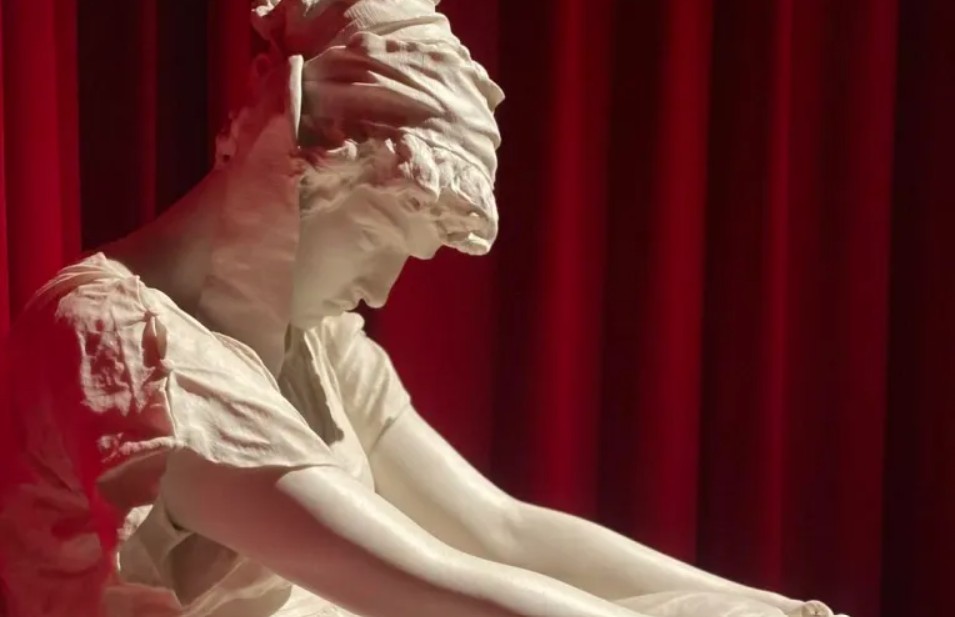
Guardando attentamente la figura, è difficile non soffermarsi sul volto abbassato, che diventa uno degli elementi fondamentali dell’intera composizione, perché impedisce alla protagonista di stabilire un contatto diretto con chi osserva e la trasforma quasi in una persona completamente immersa nei propri pensieri.
Non c’è un gesto teatrale, non c’è un’espressione esasperata e non c’è una scena di morte da osservare.
C’è soltanto una donna che sembra aver già compreso il proprio destino.
La sua immobilità non comunica tranquillità, ma piuttosto l’impossibilità di reagire.
Dalla Mostra Nazionale di Napoli a Capodimonte
Opimia fu presentata alla III Mostra Nazionale di Napoli del 1877, uno degli appuntamenti più importanti per il confronto tra gli artisti italiani dell’epoca, e proprio in seguito alla sua esposizione entrò nelle raccolte legate alla Casa Reale.
La sua presenza al Museo e Real Bosco di Capodimonte assume quindi un significato particolare anche dal punto di vista della storia delle collezioni, perché testimonia quella progressiva attenzione verso la produzione artistica moderna che avrebbe contribuito a fare di Capodimonte non soltanto un luogo dedicato ai grandi maestri del passato, ma anche uno spazio capace di raccontare le trasformazioni artistiche dell’Ottocento.
Opimia non urla, non si agita e non cerca di attirare l’attenzione. Rimane seduta nella potenza del silenzio.
Per il momento il sempre vostro Michelangelo Buonarroti vi saluta dandovi appuntamento ai prossimi post e sui social.
Opimia by Emilio Franceschi: the Roman Vestal Virgin Who Hides a Storm of the Soul in Marble
At the Museo e Real Bosco di Capodimonte in Naples, among the works that showcase the vitality of 19th-century Italian sculpture, Opimia by Emilio Franceschi is striking for its extraordinary ability to transform an ancient Roman story into a profoundly human drama, in which the pure white marble seems to give concrete form to the pain, anger, loneliness, and desperation of a woman condemned by her time and her own choices.
Crafted in marble and presented at the Third National Exhibition of Naples in 1877, the work belongs to that period of Italian figurative culture in which artists began to increasingly engage with the relationship between classical tradition, observation of reality, and the expression of emotions, transforming subjects inspired by antiquity into opportunities to narrate passions, internal conflicts, and dramas capable of speaking directly to the sensibilities of modern man.
Opimia, the Vestal Virgin Who Defied Fate
The sculpture’s protagonist is Opimia, a Roman Vestal Virgin to whom tradition attributes a dramatic story, marked by her transgression of the vow of chastity imposed on the priestesses of Vesta and her love for a man considered an enemy of Rome.
According to the traditional tale, in 216 BC, Opimia and Floronia were accused of violating their vow of chastity and sentenced to the terrible punishment prescribed for Vestals guilty of this crime: burial alive. This punishment also had a strong symbolic meaning because the priestess, considered the guardian of the city’s sacred fire, could not be subjected to a public death like the other condemned prisoners.
Floronia faced the torture, while Opimia managed to escape that terrible fate by taking her own life before being buried alive. Her lover, Lucius Cantilius, secretary to the Pontifex Maximus, also met a tragic end and was beaten to death by rods, thus transforming the story of the young Vestal Virgin into one in which love, transgression, condemnation, and death are inextricably intertwined.
The Marble Woman Who Seems to Restrain Her Anger
Emilio Franceschi, however, chooses not to depict the most spectacular moment of the story and shows neither the condemnation nor the torture, preferring to focus on the image of a woman who appears to have been suddenly isolated from the world and forced to confront a fate from which she can no longer escape.
Opimia is depicted life-size, seated on a simple cube, her body wrapped in a loose robe characterized by carefully designed drapery, and her hair gathered in wide bands reminiscent of the attire of Roman priestesses. All these elements allow the sitter to be immediately recognized, but do not prevent the artist from transforming the Vestal Virgin into a figure surprisingly close to modern sensibilities.
The face is tilted downward, while the arms are outstretched and gathered around one knee in a seemingly simple gesture, yet one capable of conveying a strong sense of closure and tension, almost as if the young woman were trying to contain an anger that can no longer be transformed into action.
The pose is static, but the emotion is not.
Emilio Franceschi and Verism in Italian Sculpture
Born in Florence on March 16, 1839, and died in Naples on June 2, 1890, Emilio Franceschi developed his artistic career primarily in the Neapolitan environment, where he came into contact with a figurative culture particularly sensitive to the relationship between art and reality.
In fact, a key aspect of his work is the tendency toward a realism of physical and psychological description, which allows the sculpted figure to gradually abandon the ideal of an abstract and absolute beauty to confront the concreteness of existence and the complexity of emotions.
In Opimia, this attitude is evident above all in the desire to make credible not only the protagonist’s body, but also her state of mind. Franceschi doesn’t seem interested in simply showing us a beautiful vestal virgin from antiquity, but rather a young woman experiencing one of the most dramatic moments of her life.
Antiquity Becomes a Contemporary Story
Antiquity becomes a mirror of the present, in a manner widespread in nineteenth-century artistic culture, when ancient Rome, Greece, and the classical world were frequently used to narrate passions and conflicts that also pertained to contemporary society.
Opimia is therefore a Roman vestal virgin only in appearance, because her pain can be understood even without knowing her history and without possessing specific tools for interpreting the art of the The 19th century.
The bowed face and psychological drama
Looking closely at the figure, it’s hard not to linger on the lowered face, which becomes one of the key elements of the entire composition, preventing the protagonist from establishing direct contact with the viewer and transforming her almost into someone completely immersed in her own thoughts.
There is no theatrical gesture, no exasperated expression, and no scene of death to be observed.
There is only a woman who seems to have already grasped her fate.
Her immobility does not convey tranquility, but rather the inability to react.
From the National Exhibition of Naples to Capodimonte
Opimia was presented at the Third National Exhibition of Naples in 1877, one of the most important events for the exchange of ideas among Italian artists of the time, and following its exhibition, it entered the collections of the Royal House.
Her presence at the Museum and Royal Wood of Capodimonte therefore takes on a special significance also from the perspective of the collections’ history, as it testifies to the progressive attention paid to modern artistic production that would contribute to making Capodimonte not only a place dedicated to the great masters of the past, but also a space capable of recounting the artistic transformations of the 19th century.
Opimia doesn’t shout, she doesn’t get agitated, or try to attract attention. She remains seated in the power of silence.
For now, yours truly, Michelangelo Buonarroti, bids you farewell and invites you to join him in future posts and on social media.

Sostienici – Support Us
Se questo blog ti piace e ti appassiona, puoi aiutarci a farlo crescere sempre più sostenendoci in modo concreto condividendo i post, seguendo le pagine social e con un contributo che ci aiuta ad andare avanti con il nostro lavoro di divulgazione. . ENGLISH: If you like and are passionate about this blog, you can help us make it grow more and more by supporting us in a concrete way by sharing posts, following social pages and with a contribution that helps us to move forward with our dissemination work.
10,00 €
Condividi:


Questo sono io




sostienici

Sostienici – Support Us
Se questo blog ti piace e ti appassiona, puoi aiutarci a farlo crescere sempre più sostenendoci in modo concreto condividendo i post, seguendo le pagine social e con un contributo che ci aiuta ad andare avanti con il nostro lavoro di divulgazione. . ENGLISH: If you like and are passionate about this blog, you can help us make it grow more and more by supporting us in a concrete way by sharing posts, following social pages and with a contribution that helps us to move forward with our dissemination work.
€10,00


Bravo
"Mi piace""Mi piace"