

La Scultura del giorno: la Vestale Tuccia del Corradini
La scultura del giorno che vi propongo oggi è la stupenda Vestale Tuccia scolpita da Antonio Corradin, tra il 1743 e il 1747.
Corradini, scultore di corte a Vienna, cambiò aria quando l’imperatore Carlo V morì e decise di aprire un proprio studio a Roma, presso Palazzo Barberini.
Era il 1743 e, senza perdere tempo, iniziò a lavorare alla Vestale Tuccia, come documenta una caricatura dell’epoca realizzata da Giuseppe Ghezzi.
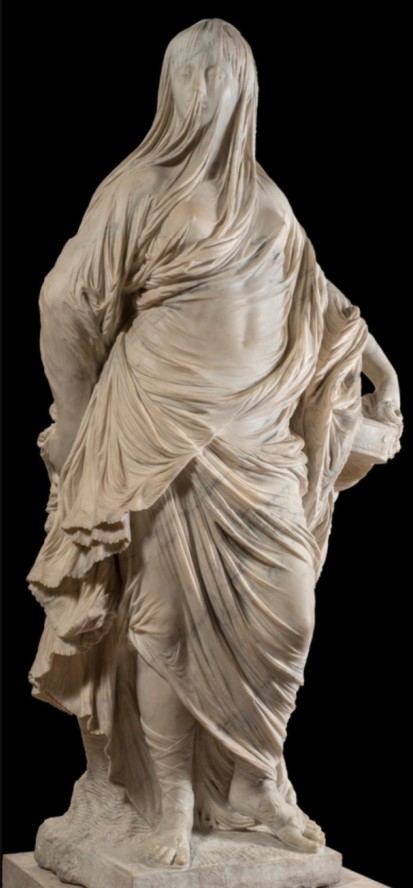
L’opera fin da subito apparve straordinaria e fu quella che per prima diede la fama a Corradini.
Giacomo III Stuart, pretendente al trono d’Inghilterra, venuto a sapere dell’esistenza di questa scultura così diversa da tutte le altre, si recò di persona nello studio dell’artista per poterla ammirare.
Corradini, con la Vestale Tuccia, fece parlare di sé in tutte le corti d’Europa.
Il virtuosismo dello scultore è lampante. Non è solo la padronanza tecnica a lasciare a bocca aperta ma anche quella resa incredibile del panneggio bagnato che aderisce alla pelle della donna mettendone in evidenza le forme.

E’ proprio il panneggio che allude all’identità della donna, riconducibile per l’appunto alla Vestale Tuccia, ingiustamente accusata di aver infranto il voto di castità imposto a tutte le vestali. Leggenda narra che la Vestale Tuccia, sospettata di aver violato le regole, fu sottoposta a giudizio.
L’imputata allora si appellò al giudizio divino: se fosse riuscita a raccogliere l’acqua dal Tevere adoperando un setaccio, le sarebbe stata risparmiata la vita. La Vestale si chinò sulle acque del Tevere per provare a farle rimanere nel setaccio e miracolosamente si gelarono rimanendo al suo interno.
Ecco perché la Vestale scolpita da Corradini tiene nella stessa mano il setaccio e una rosa, simbolo della sua purezza.

La scultura della Vestale Tuccia fu messa all’asta nel 1774 per la cifra di 4mila scudi ma rimase invenduta a Palazzo Barberini fino a quando, nel 1952, fu acquistata dallo Stato Italiano e oggi è esposta a Palazzo Barberini.
Antonio Corradini, dopo aver lavorato nel suo studio Romano, tra il 1747 e il 1748 si trasferì a Napoli dove lavorò per Raimondo di Sangro, principe di Sansevero. Memore della Vestale Tuccia, Corradini scolpirà la Pudicizia Velata che ha molto in comune con la scultura precedente.
Progetterà anche il Cristo Velato come testimonia il bozzetto costudito nel Museo di San Martino. Corradini morirà nel 1752 e il Cristo Velato sarà scolpito da Giuseppe Sanmartino.

Per il momento il sempre vostro Michelangelo Buonarroti vi saluta dandovi appuntamento ai prossimi post e sui social.

Sculpture of the day: the Vestal Tuccia by Corradini
The sculpture of the day that I propose to you today is the wonderful Vestal Tuccia sculpted by Antonio Corradini between 1743 and 1747.
Corradini, court sculptor in Vienna, changed air when the emperor Charles V died and decided to open his own studio in Rome, at Palazzo Barberini. It was 1743 and, without wasting time, he began working on the Vestal Tuccia, as documented by a caricature of the time made by Giuseppe Ghezzi.
The work immediately appeared extraordinary and was the one that first brought fame to Corradini. James III Stuart, pretender to the throne of England, having learned of the existence of this sculpture so different from all the others, went in person to the artist’s studio to admire it.
Corradini, with the Vestal Tuccia, made people talk about him in all the courts of Europe.
The sculptor’s virtuosity is evident. It is not only the technical mastery that leaves you speechless but also the incredible rendering of the drapery that seems wet and adheres to the woman’s skin highlighting her curves.
It is precisely the drapery that alludes to the identity of the woman, attributable precisely to the Vestal Tuccia, unjustly accused of having broken the vow of chastity imposed on all vestals. Legend has it that the Vestal Tuccia, suspected of having violated the rules, was put on trial.
The accused then appealed to divine judgment: if she had managed to collect water from the Tiber using a sieve, her life would have been spared. The Vestal bent over the waters of the Tiber to try to make them remain in the sieve and miraculously they froze and remained inside.
This is why the Vestal sculpted by Corradini holds the sieve and a rose in the same hand, symbol of her purity.
The sculpture of the Vestal Tuccia was auctioned in 1774 for the sum of 4 thousand scudi but remained unsold at Palazzo Barberini until, in 1952, it was purchased by the Italian State and is now exhibited at Palazzo Barberini.
Antonio Corradini, after working in his Roman studio, moved to Naples between 1747 and 1748 where he worked for Raimondo di Sangro, Prince of Sansevero. Mindful of the Vestal Tuccia, Corradini sculpted the Veiled Modesty which has much in common with the previous sculpture and designed the Veiled Christ as evidenced by the sketch kept in the Museum of San Martino. Corradini died in 1752 and the Veiled Christ was sculpted by Giuseppe Sanmartino.
For the moment, yours truly Michelangelo Buonarroti bids you farewell and looks forward to seeing you in the next posts and on social media.
Articoli
Condividi:


Questo sono io




sostienici

Sostienici – Support Us
Se questo blog ti piace e ti appassiona, puoi aiutarci a farlo crescere sempre più sostenendoci in modo concreto condividendo i post, seguendo le pagine social e con un contributo che ci aiuta ad andare avanti con il nostro lavoro di divulgazione. . ENGLISH: If you like and are passionate about this blog, you can help us make it grow more and more by supporting us in a concrete way by sharing posts, following social pages and with a contribution that helps us to move forward with our dissemination work.
€10,00


che scultura incredibile!!!! 👏👏👏👏👏👏👏👏👏👏👏👏
"Mi piace"Piace a 1 persona
si, bellissima. Un capolavoro
"Mi piace"Piace a 1 persona