

Il Dipinto del giorno: Medusa di Caravaggio
L’opera del giorno che vi propongo oggi è la celebre testa di Medusa dipinta da Caravaggio a olio su tela poi applicata su uno scudo di pioppo da parata tra il 1597 e il 1598.
Il dipinto fu commissionato all’artista dal cardinale Francesco Maria del Monte per farne dono al Granduca Ferdinando de’ Medici.
Il Granduca aveva messo un piedi una nuova armeria e quel pezzo singolare avrebbe contribuito significativamente ad arricchirla. Lo scudo fu registrato negli inventari granducali il 7 settembre del 1598.

Una trentina d’anni dopo, negli inventari si legge che lo scudo di Medusa fu adoperato per una messinscena. Fu infatti fatto indossare a una sagoma assieme all’armatura di gala che lo stesso granduca aveva ricevuto in dono nel 1601 dallo scià di Persia.
La raffigurazione della testa di Medusa era un tema ricorrente negli scudi da parata del Cinquecento e del Seicento.
Caravaggio, con la sua indiscutibile maestria, fermò sulla tela l’istante in cui Medusa fu decapitata da Perseo che, per sfuggire al suo sguardo pietrificante, osservò le sue movenze proprio nel riflesso sullo scudo.
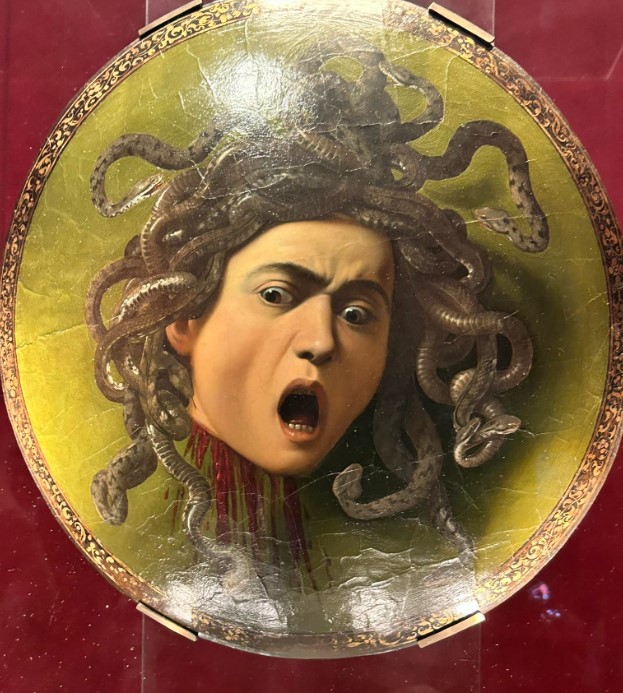
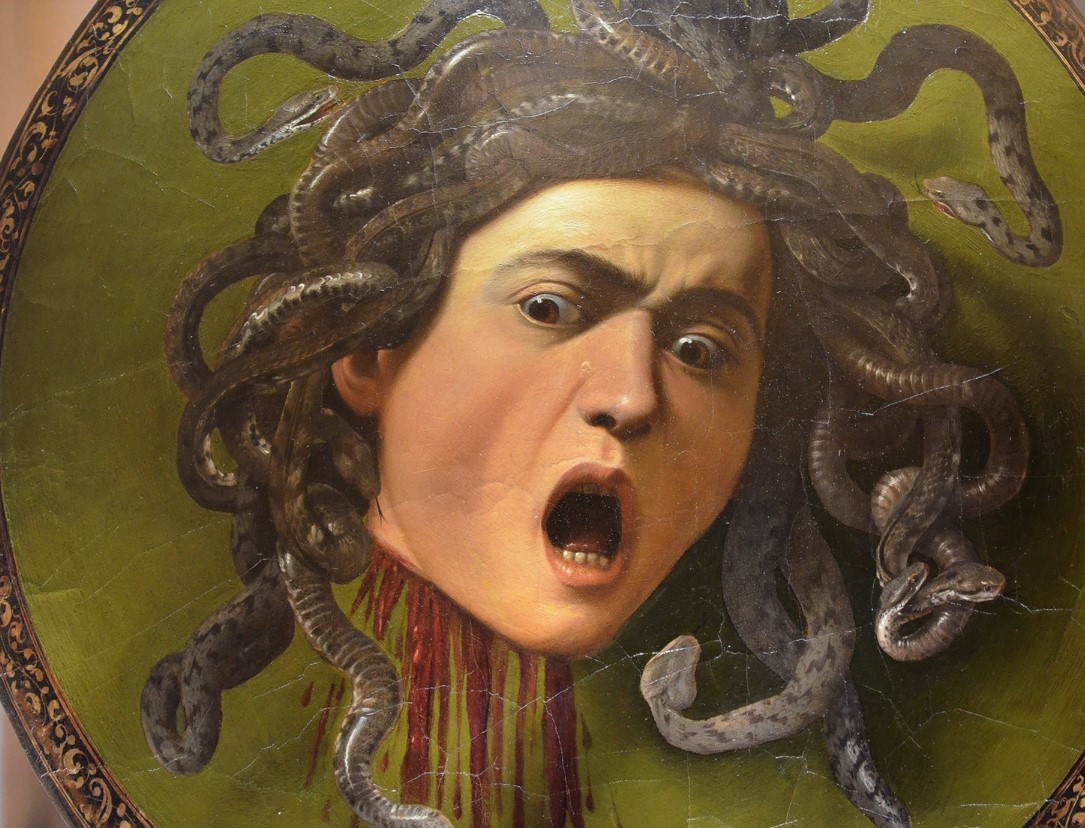
Gli occhi e la bocca della gorgone mostrano tutto l’orrore di quel momento mentre fiotti di sangue le sgorgano dal collo.
La resa del volto sfigurato dal dolore è ripresa dal vero così come deve aver studiato dal vero le forme dei serpenti che sembrano così reali nelle loro movenze e nell’aspetto.
Sembra che Caravaggio, per rendere ancor più realistico il terrore mostrato da Medusa, abbia studiato a lungo il suo volto allo specchio assumendo quella posa.
Sapete, Gianbattista Marino volle descrivere quest’opera di Caravaggio nel madrigale “La testa di Medusa in una rotella di Michelangelo da Caravaggio nella Galleria del G.D: di Toscana” facendo riferimento alle virtù del Granduca.
Se volete vedere con i vostri occhi questa straordinaria opera, non vi rimane che visitare la Galleria degli Uffizi a Firenze.
Per il momento il sempre vostro Michelangelo Buonarroti vi saluta dandovi appuntamento ai prossimi post e sui social.
© Riproduzione riservata

Painting of the Day: Medusa by Caravaggio
The work of the day that I propose to you today is the famous head of Medusa painted by Caravaggio in oil on canvas then applied to a poplar parade shield between 1597 and 1598.
The painting was commissioned to the artist by Cardinal Francesco Maria del Monte as a gift to the Grand Duke Ferdinando de’ Medici.
The Grand Duke had set up a new armory and that singular piece would have contributed significantly to enriching it. The shield was registered in the grand ducal inventories on September 7, 1598.
About thirty years later, the inventories state that the Medusa shield was used for a staging. In fact, it was worn by a figure together with the gala armor that the Grand Duke himself had received as a gift in 1601 from the Shah of Persia.
The depiction of Medusa’s head was a recurring theme in the parade shields of the sixteenth and seventeenth centuries.
Caravaggio, with his unquestionable mastery, captured on canvas the moment in which Medusa was beheaded by Perseus who, to escape her petrifying gaze, observed her movements in the reflection of the shield.
The eyes and mouth of the gorgon show all the horror of that moment while streams of blood flow from her neck.
The rendering of the face disfigured by pain is taken from life just as he must have studied from life the shapes of the snakes that seem so real in their movements and appearance.
It seems that Caravaggio, to make the terror shown by Medusa even more realistic, studied her face for a long time in the mirror assuming that pose.
You know, Gianbattista Marino wanted to describe this work by Caravaggio in the madrigal “The Head of Medusa in a Wheel by Michelangelo da Caravaggio in the Galleria del G.D: di Toscana” referring to the virtues of the Grand Duke.
If you want to see this extraordinary work with your own eyes, all you have to do is visit the Uffizi Gallery in Florence.
For the moment, your ever-present Michelangelo Buonarroti bids you farewell, making an appointment with you in the next posts and on social media.
© All rights reserved

Sostienici – Support Us
Se questo blog ti piace e ti appassiona, puoi aiutarci a farlo crescere sempre più sostenendoci in modo concreto condividendo i post, seguendo le pagine social e con un contributo che ci aiuta ad andare avanti con il nostro lavoro di divulgazione. . ENGLISH: If you like and are passionate about this blog, you can help us make it grow more and more by supporting us in a concrete way by sharing posts, following social pages and with a contribution that helps us to move forward with our dissemination work.
10,00 €
-
La Pietà di Tincolini: a Pontedera l’arte torna a fare domande scomode
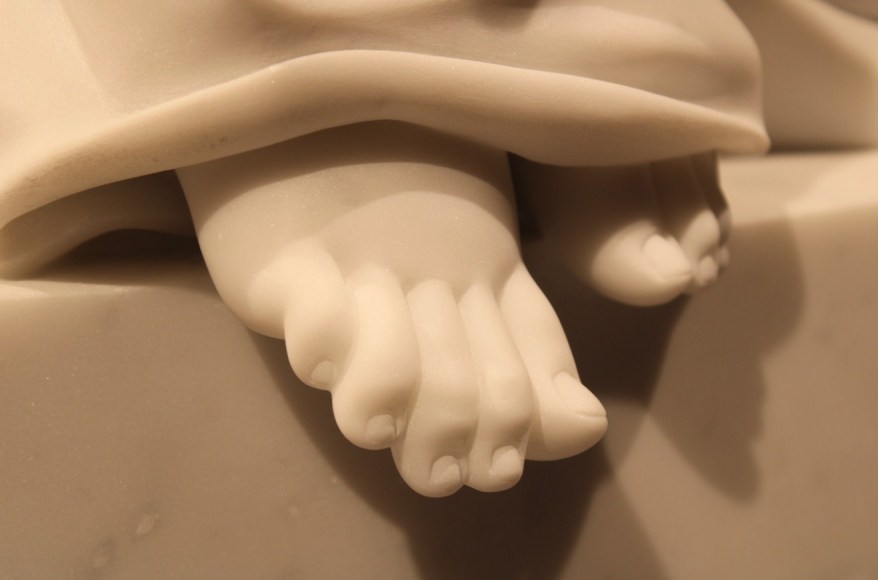
🇮🇹“Pietà”, la scultura di Filippo Tincolini, insieme alle parole di Federico Quaranta e Andrea Pezzi, non è stato solo uno spettacolo. È stata una domanda lanciata in faccia al pubblico, impossibile da evitare: siamo ancora capaci di provare pietà? 🇬🇧 “Pietà,” Filippo Tincolini’s sculpture, along with the words of Federico Quaranta and Andrea Pezzi, wasn’t…
-
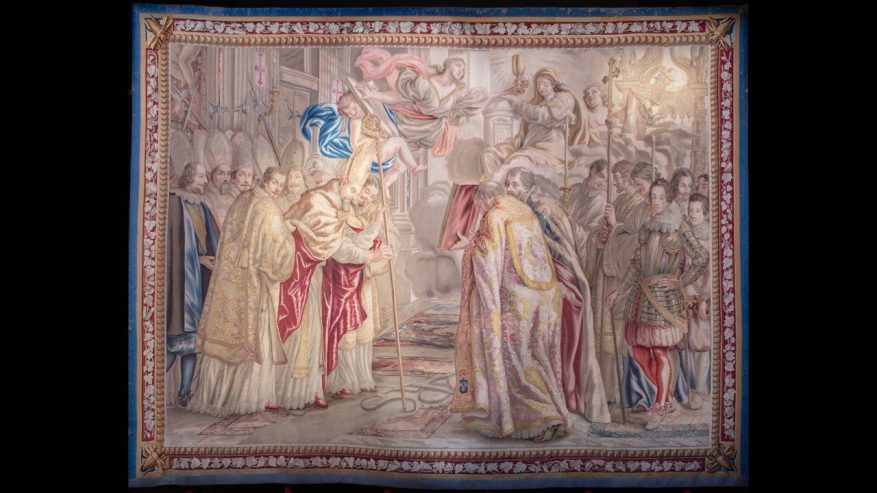
Ai Musei Vaticani i fasti barocchi di Urbano VIII: in mostra gli arazzi della manifattura Barberini
🇮🇹A quattro secoli dalla consacrazione della Basilica di San Pietro, i Musei Vaticani dedicano una mostra all’Arazzeria Barberini, simbolo di una cultura visiva capace di fondere magnificenza estetica e affermazione politica… 🇬🇧Four centuries after the consecration of St. Peter’s Basilica, the Vatican Museums are dedicating an exhibition to the Barberini Tapestry Factory, a symbol of…
-
Le Opere della Pasqua: come la Resurrezione ha ispirato Arte e Cultura
🇮🇹La Pasqua, oltre ad essere una ricorrenza religiosa è un momento in cui la storia, l’arte e la spiritualità si intrecciano per raccontare il fulcro della fede cristiana: la resurrezione di Cristo. .. 🇬🇧Easter, beyond being a religious holiday, is a moment when history, art, and spirituality intertwine to recount the core of the Christian…
Condividi:


Questo sono io





sostienici

Sostienici – Support Us
Se questo blog ti piace e ti appassiona, puoi aiutarci a farlo crescere sempre più sostenendoci in modo concreto condividendo i post, seguendo le pagine social e con un contributo che ci aiuta ad andare avanti con il nostro lavoro di divulgazione. . ENGLISH: If you like and are passionate about this blog, you can help us make it grow more and more by supporting us in a concrete way by sharing posts, following social pages and with a contribution that helps us to move forward with our dissemination work.
€10,00


