
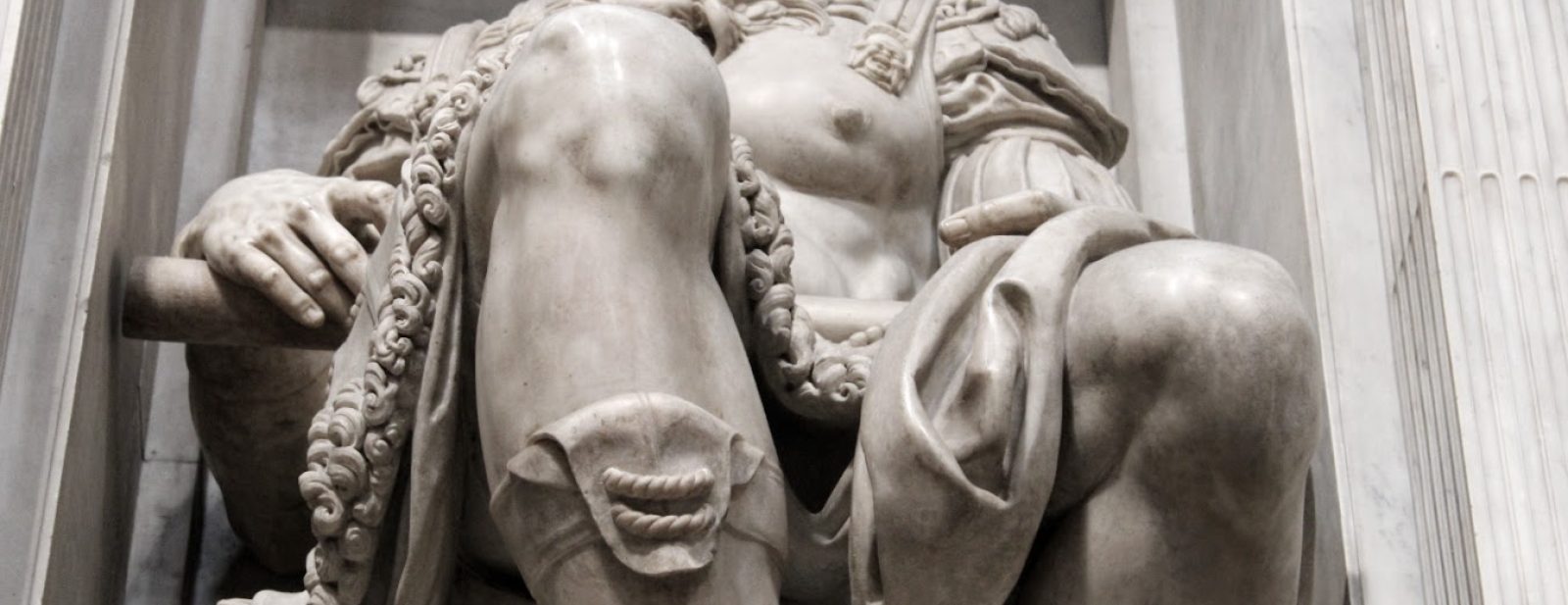
Cristo Crocifisso e la Madonna con le mani al petto, come nelle Annunciazioni
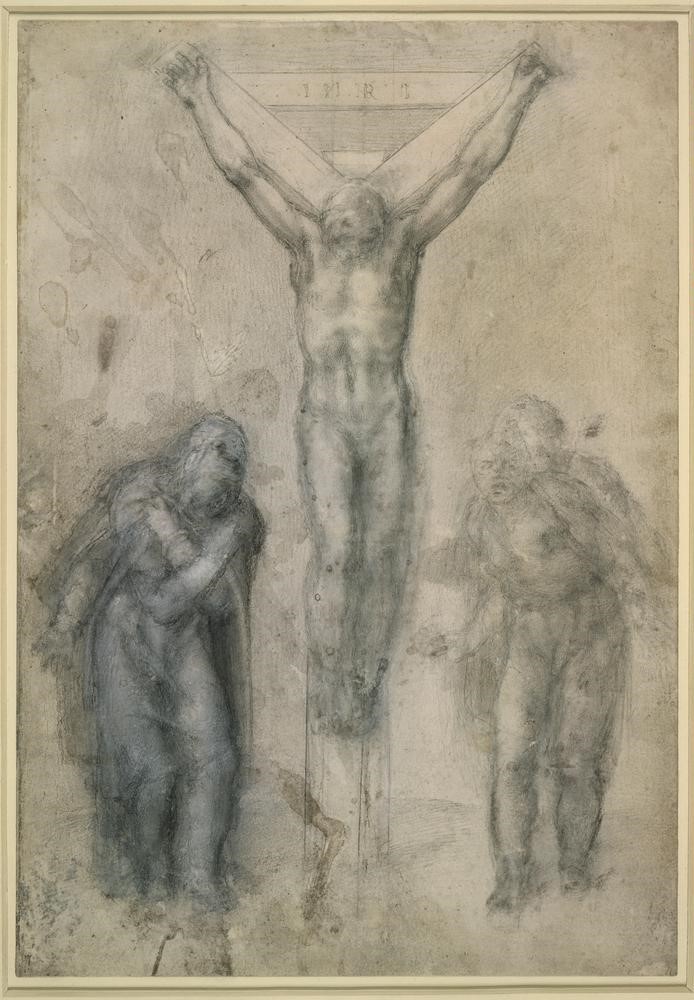
Oggi, con l’avvicinarsi del periodo pasquale, voglio proporvi un mio disegno in cui volli raffigurare Cristo in croce fra la Vergine e San Giovanni, datato fra il 1555 e il 1564.
L’opera grafica in questione appartiene alle collezioni del British Museum ed è uno di quei fogli che fu acquistato da Wicar da Casa Buonarroti.
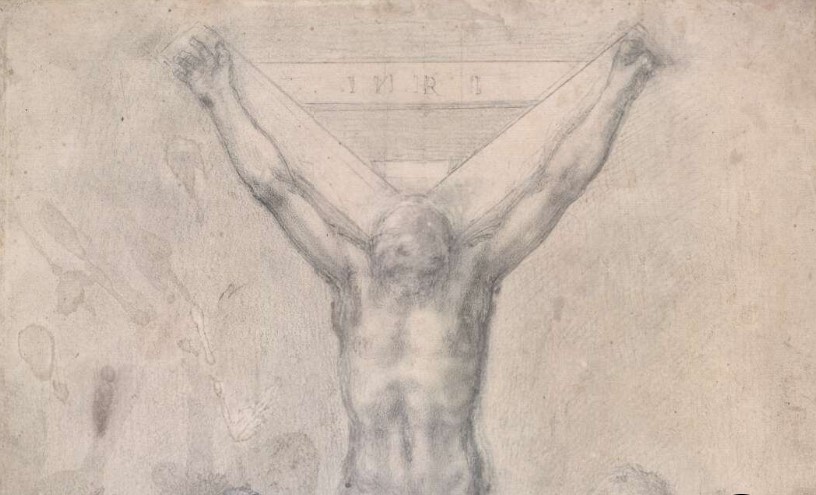
Nel disegno è evidente lo stile tipico dei miei ultimi anni di vita. Al centro del foglio è posizionato Cristo sulla croce mentre ai lati si vedono accovacciate la Vergine a sinistra e San Giovanni a destra, leggermente più avanzate rispetto al piano occupato da Cristo.
La Madre di Dio ha le braccia incrociate all’atezza del petto in un gesto tipico che indica l’accettazione senza condizioni della volontà divina. Questa posa è tipica della raffigurazione dell’Annunciazione, quando la Madonna accetta quello che Dio gli chiede.
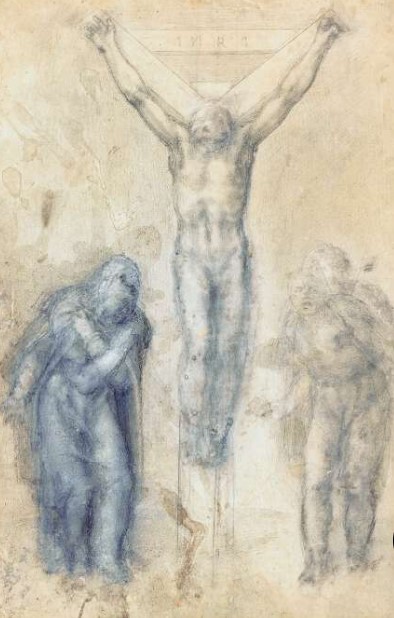
Mentre non tracciai il volto della Madonna in modo dettagliato, lo feci per San Giovanni che mostra un’espressione di sgomento e dolore rivolta verso lo spettatore.
Alla stregua dei miei ultimi disegni delle Crocifissioni, anche in questo caso disegnai la croce con bordi decisi e dritti. E’ a forma di Y e pare assecondare la posizione del corpo di Cristo. Se ci fate caso, noterete che la traversa che sostiene le estremità della Y e porta l’Iscrizione, è vista prospetticamente dal basso.
Proprio la forma della croce è arcaica e il Condivi ne fa menzione in una descrizione di un disegno che realizzai per la mia cara amica Vittoria Colonna. Quel tipo di croce l’avevo vista a Santa Croce a Firenze, in un Crocifisso che era stato portato dai Bianchi ovvero penitenti vestiti di bianco, che aveva transitato per la città alla fine del XIV secolo.
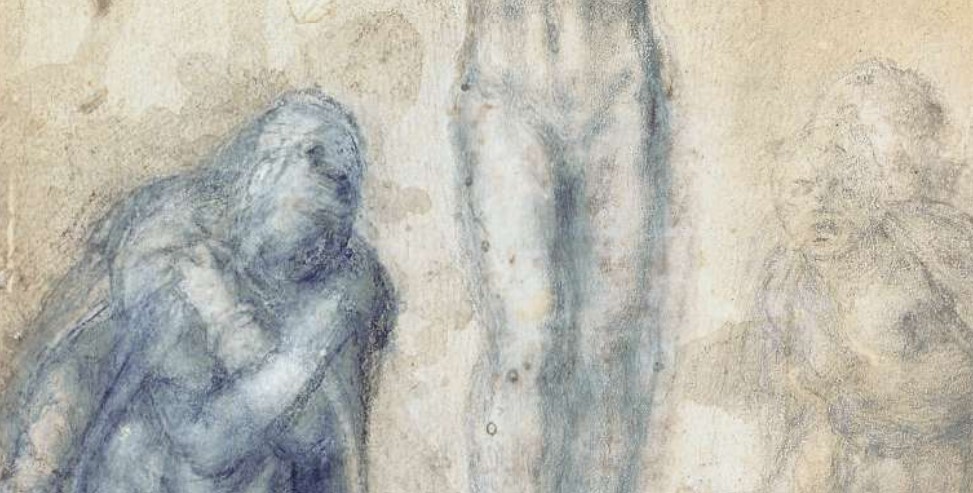
Sul disegno sono evidenti numerosi pentimenti come quelli riscontrabili nella testa di Cristo chinata verso il basso.
Osservate la perfetta anatomia anche in un disegno che a prima vista potrebbe sembrare erroneamente sommario. Il torso del Cristo è allungato con il diaframma incavato reso tale proprio dalla crocifissione.
Per il momento il sempre vostro Michelangelo Buonarroti vi saluta dandovi appuntamento ai prossimi post e sui social.
Crucified Christ and the Madonna with her hands on her chest, as in the Annunciations
Today, as the Easter period approaches, I want to offer you a drawing of mine in which I wanted to depict Christ on the cross between the Virgin and Saint John, dated between 1555 and 1564.
The graphic work in question belongs to the collections of the British Museum and is one of those sheets that was purchased by Wicar from Casa Buonarroti.
The typical style of my last years of life is evident in the drawing. Christ is positioned on the cross in the center of the sheet while on the sides we see the Virgin crouching on the left and Saint John on the right, slightly further forward than the plane occupied by Christ.
The Mother of God has her arms crossed at her chest level in a typical gesture that indicates unconditional acceptance of the divine will. This pose is typical of the depiction of the Annunciation, when the Madonna accepts what God asks of her.
While I did not trace the Madonna’s face in detail, I did for St. John who shows an expression of dismay and pain turned towards the viewer.
Like my latest drawings of the Crucifixions, also in this case I drew the cross with strong and straight edges. It is Y-shaped and seems to follow the position of the body of Christ. If you pay attention, you will notice that the crosspiece that supports the ends of the Y and carries the Inscription is seen perspectively from below.
The shape of the cross itself is archaic and Condivi mentions it in a description of a drawing I made for my dear friend Vittoria Colonna. I had seen that type of cross at Santa Croce in Florence, in a Crucifix that had been carried by the Whites, or penitents dressed in white, who had passed through the city at the end of the 14th century.
Numerous repentances are evident on the drawing, such as those found in the head of Christ bowed downwards.
Observe the perfect anatomy even in a drawing that at first glance might seem mistakenly summary. Christ’s torso is elongated with a sunken diaphragm made so by the crucifixion.
For the moment, your always Michelangelo Buonarroti greets you and will meet you in the next posts and on social media.

Sostienici – Support Us
Se questo blog ti piace e ti appassiona, puoi aiutarci a farlo crescere sempre più sostenendoci in modo concreto condividendo i post, seguendo le pagine social e con un contributo che ci aiuta ad andare avanti con il nostro lavoro di divulgazione. . ENGLISH: If you like and are passionate about this blog, you can help us make it grow more and more by supporting us in a concrete way by sharing posts, following social pages and with a contribution that helps us to move forward with our dissemination work.
8,00 €
-
La Giuditta: eroina nella Cappella Sistina
🇮🇹Quando salii sui ponteggi della Cappella Sistina, chiamato da Papa Giulio II, non immaginavo quanto quella volta avrebbe catturato la mia anima… 🇬🇧When I climbed the scaffolding of the Sistine Chapel, summoned by Pope Julius II, I had no idea how much that moment would capture my soul…
-
Domenica delle Palme: Giotto e l’Ingresso a Gerusalemme nella Cappella degli Scrovegni
🇮🇹C’è un momento, nella Domenica delle Palme, in cui la gioia incontra il destino. Nell’Ingresso a Gerusalemme di Giotto, la folla acclama, si muove, si agita ma Cristo è già altrove. Il suo sguardo è lontano. immerso in un silenzio che nessuno intorno sembra percepire… 🇬🇧There’s a moment, on Palm Sunday, when joy meets destiny.…
-
Festival Puccini 2026: Jackie Chan firma la Turandot a Torre del Lago
🇮🇹🎭✨ Festival Puccini 2026 Dalla rivoluzionaria Turandot firmata da Jackie Chan ai grandi ritorni di Tosca, La bohème e Madama Butterfly, fino a gala imperdibili con Jonas Kaufmann e Plácido Domingo…. 🇬🇧🎭✨ Puccini Festival 2026 From Jackie Chan’s revolutionary Turandot to the grand returns of Tosca, La Bohème, and Madama Butterfly, to unmissable galas with…
Condividi:


Questo sono io





sostienici

Sostienici - Support Us
Se questo blog ti piace e ti appassiona, puoi aiutarci a farlo crescere sempre più sostenendoci in modo concreto condividendo i post, seguendo le pagine social e con un contributo che ci aiuta ad andare avanti con il nostro lavoro di divulgazione. . ENGLISH: If you like and are passionate about this blog, you can help us make it grow more and more by supporting us in a concrete way by sharing posts, following social pages and with a contribution that helps us to move forward with our dissemination work.
€10,00


