
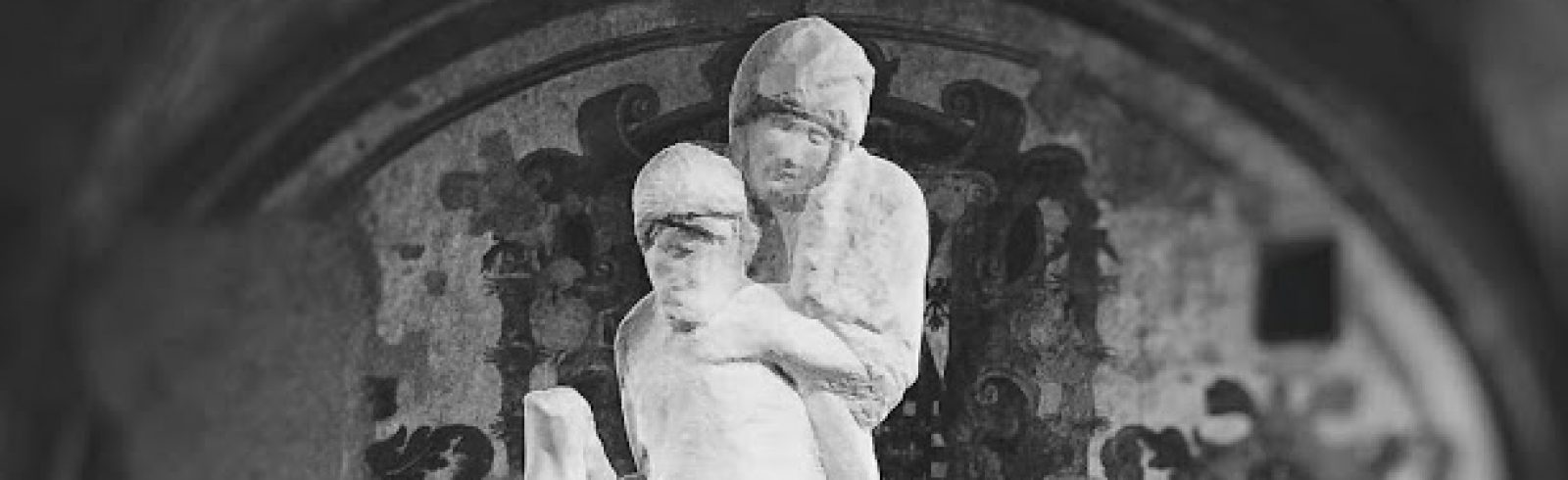
9 maggio, Sant’Isaia: il profeta che dipinsi nella Volta della Sistina
Oggi 9 maggio la Chiesa cattolica ricorda Isaia, il più grande fra i profeti d’Israele, colui che preannunciò la venuta del Messia e la speranza della redenzione per l’umanità.
Per questo volli dargli un posto d’onore nella Volta della Cappella Sistina, accanto agli altri profeti e alle sibille.

Isaia era figlio di Amos e nacque attorno al 765 avanti Cristo. Visse in un tempo tormentato, segnato da tensioni sociali e dalla minaccia dell’invasione assira. Le sue profezie ebbero inizio nel 740 a.C., nell’anno della morte del re Ozia, quando il Signore gli apparve in visione e lo chiamò alla sua missione.
Per oltre quarant’anni Isaia parlò al popolo di Israele, ammonendo i potenti e richiamando tutti al culto dell’unico Dio. Quando sul regno di Giuda regnò Manasse, corrotto dagli idoli e dalla violenza, Isaia fu mandato ancora una volta dal Signore per ricondurlo sulla via della verità. Ma il re, accecato dalla ferocia, lo condannò a una morte atroce.
Eppure la sua voce non si spense.
“Lo spirito del Signore Dio è su di me
perché il Signore mi ha consacrato con l’unzione;
mi ha mandato a portare il lieto annunzio ai miseri,
a fasciare le piaghe dei cuori spezzati,
a proclamare la libertà degli schiavi.”
— Isaia 61,1
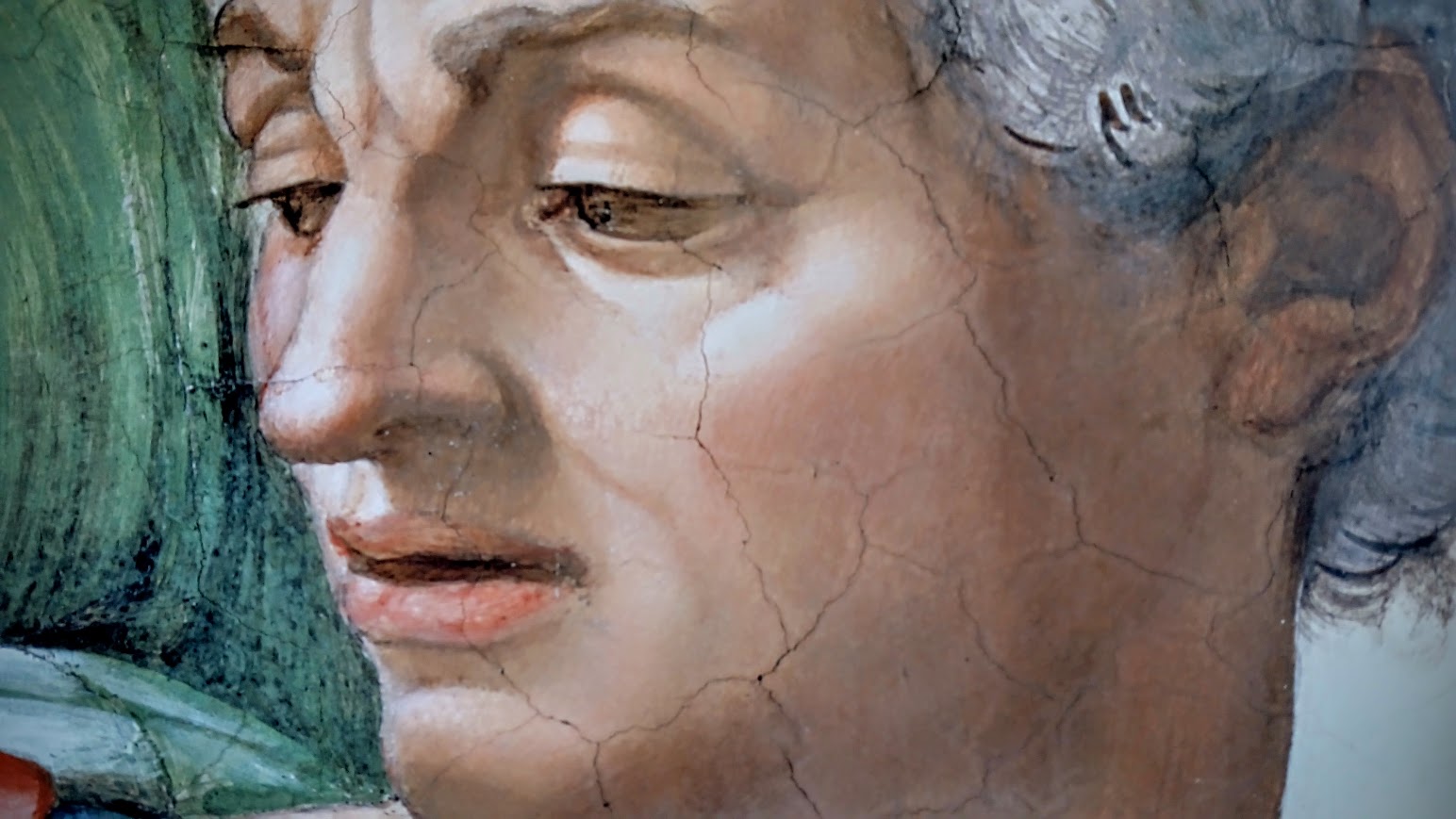
Quando mi trovai ad affrescare la Sistina, non persi mai di vista ciò che le Sacre Scritture narravano di lui. Volli raffigurare Isaia forte e mansueto insieme, pieno di autocontrollo, immerso nell’ascolto della parola divina.
Isaia nella Volta della Cappella Sistina
Osservate bene il profeta che dipinsi sulla volta.
Isaia è colto nell’istante della rivelazione. Prima stava consultando il grande libro delle profezie dalla copertina in smaltino; per non perdere il segno, infila fra le pagine le dita della mano sinistra. Ma all’improvviso il giovane alle sue spalle lo richiama con una voce misteriosa.
Volge il capo.
Da quel movimento nasce una torsione che attraversa tutto il corpo, una spirale viva che dona forza e dinamismo alla figura. È quella posa contrapposta che tanto amai usare nelle mie sculture e nei miei dipinti, perché nulla nell’uomo è immobile quando Dio parla.
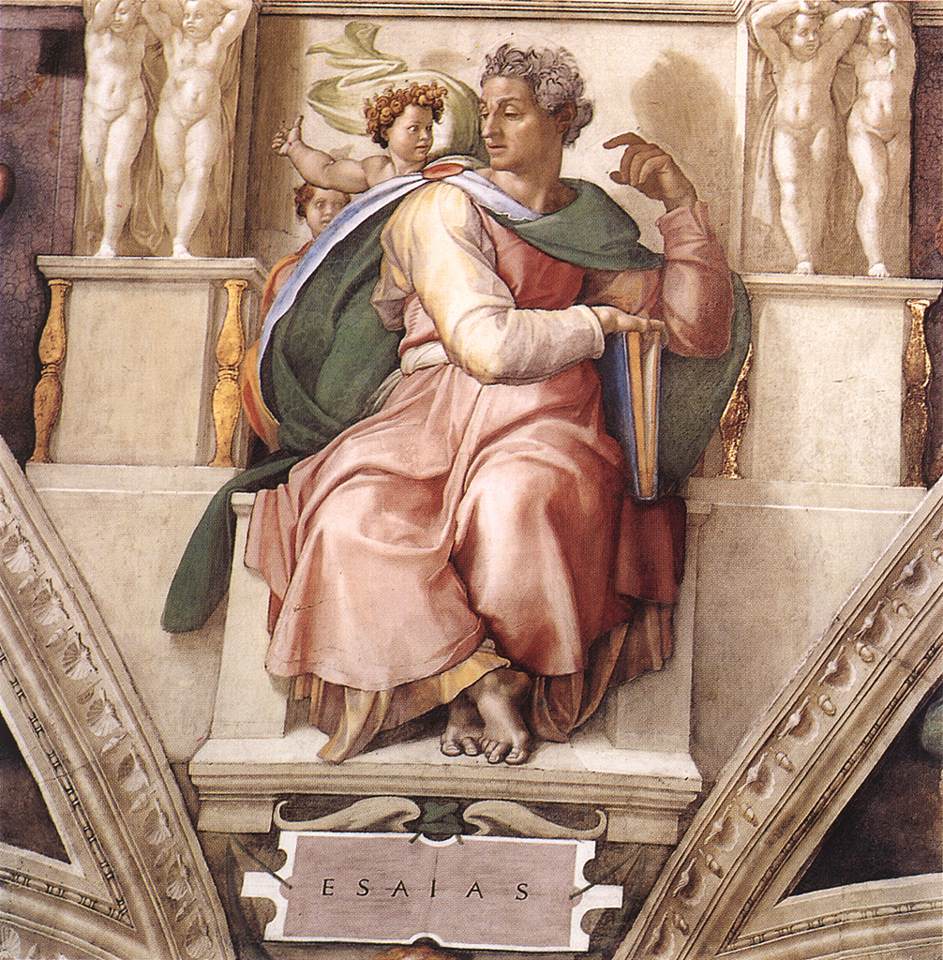
Isaia non grida. Ascolta.
Il suo volto mostra concentrazione profonda, non turbamento. In lui convivono la sapienza e la fortezza. Non una forza violenta, ma interiore, composta, spirituale.
Perfino i capelli partecipano a questo movimento dell’anima. Per dare maggiore vigore alla chioma, aggiunsi pennellate brune molto scure alla massa grigia, la stessa soluzione che adoperai per Dio Padre nei riquadri centrali della volta. Il vento scompiglia i capelli del profeta e il panneggio verde dell’assistente alle sue spalle, quasi a rendere visibile il soffio dello Spirito.
I Sette Doni dello Spirito Santo nei miei profeti
Dipingendo i sette profeti della Sistina, attribuii a ciascuno uno dei Sette Doni dello Spirito Santo che proprio Isaia menzionò per primo: sapienza, intelletto, consiglio, fortezza, conoscenza, pietà e timore di Dio.
Nei loro volti e nei loro gesti volli far trasparire queste qualità divine.
In Isaia cercai soprattutto di esprimere la sapienza che ascolta e la fortezza che sostiene. È il profeta dell’attesa messianica, colui che annuncia la luce futura quando ancora il mondo è immerso nell’ombra.
Che cosa gli sussurra il giovane alle spalle? Forse proprio il mistero dell’Incarnazione. Forse l’annuncio del Cristo venturo.
Non volli dare una risposta precisa. Desideravo che fosse lo spettatore a sentirsi chiamato dentro quel silenzio.
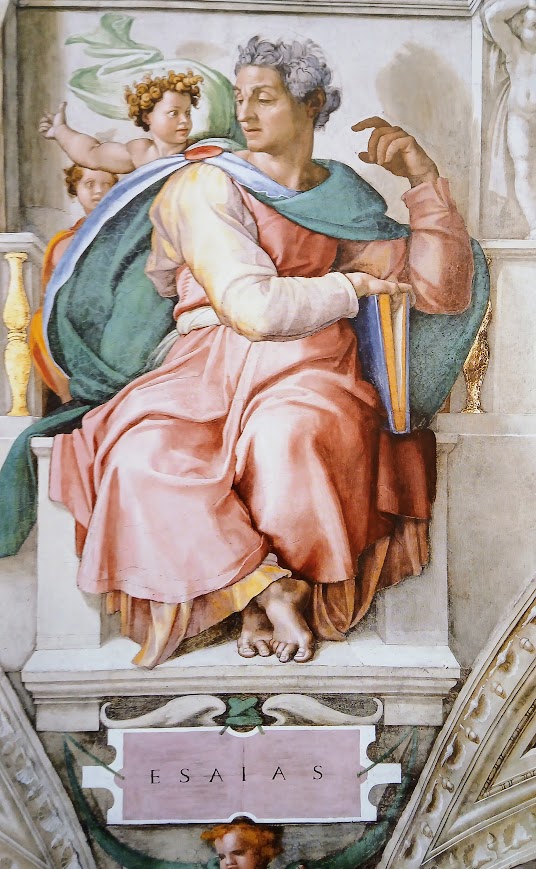
L’attimo in cui l’uomo ascolta Dio
Se vi fermate sotto Isaia nella Cappella Sistina e alzate lo sguardo, comprenderete ciò che cercai di dipingere: l’istante esatto in cui l’uomo interrompe ogni cosa per ascoltare Dio.
Isaia è sospeso tra silenzio e parola, tra terra e cielo, tra attesa e compimento.
Ed è proprio in quell’ascolto che nasce la speranza dell’umanità: la promessa del Salvatore, la misericordia che si fa carne, la luce dell’era messianica.
Per il momento il sempre vostro Michelangelo Buonarroti vi saluta dandovi appuntamento ai prossimi post e sui social.
May 9, Saint Isaiah: the prophet I painted on the Sistine Chapel Ceiling
Today, May 9, the Catholic Church commemorates Isaiah, the greatest of Israel’s prophets, the one who foretold the coming of the Messiah and the hope of redemption for humanity.
For this reason, I wanted to give him a place of honor in the Sistine Chapel Ceiling, alongside the other prophets and the sibyls.
Isaiah was the son of Amos and was born around 765 BC. He lived in a troubled time, marked by social tensions and the threat of Assyrian invasion. His prophecies began in 740 BC, the year of King Uzziah’s death, when the Lord appeared to him in a vision and called him to his mission.
For over forty years, Isaiah spoke to the people of Israel, admonishing the powerful and calling all to the worship of the one God. When Manasseh reigned over the kingdom of Judah, corrupted by idols and violence, Isaiah was sent once again by the Lord to lead them back to the path of truth. But the king, blinded by ferocity, condemned him to a cruel death.
Yet his voice did not cease.
“The spirit of the Lord God is upon me
because the Lord has anointed me;
he has sent me to bring good news to the afflicted,
to bind up the brokenhearted,
to proclaim liberty to the captives.”
— Isaiah 61:1
When I found myself frescoing the Sistine Chapel, I never lost sight of what the Sacred Scriptures told of him. I wanted to depict Isaiah as both strong and meek, full of self-control, immersed in listening to the divine word.
Isaiah in the Sistine Chapel Ceiling
Look carefully at the prophet I painted on the ceiling.
Isaiah is captured in the moment of revelation. He was previously consulting the great book of prophecies with its enameled cover; to avoid losing his place, he slips the fingers of his left hand between the pages. But suddenly, the young man behind him calls out to him with a mysterious voice.
He turns his head.
From that movement, a twist arises that runs through the entire body, a living spiral that gives strength and dynamism to the figure. It is that contrasting pose that I so loved to use in my sculptures and paintings, because nothing in man is still when God speaks.
Isaiah does not shout. He listens.
His face shows deep concentration, not agitation. Wisdom and fortitude coexist within him. Not a violent force, but an interior, composed, spiritual one.
Even the hair participates in this movement of the soul. To give it greater vigor, I added very dark brown brushstrokes to the gray mass, the same solution I used for God the Father in the central panels of the vault. The wind ruffles the prophet’s hair and the green drapery of the assistant behind him, almost as if to make the breath of the Spirit visible.
The Seven Gifts of the Holy Spirit in my prophets
In painting the seven prophets of the Sistine Chapel, I attributed to each one one of the Seven Gifts of the Holy Spirit, which Isaiah himself first mentioned: wisdom, understanding, counsel, fortitude, knowledge, piety, and fear of God.
In their faces and gestures, I wanted to convey these divine qualities.
In Isaiah, I sought above all to express the wisdom that listens and the fortitude that sustains. He is the prophet of messianic expectation, the one who announces the future light when the world is still immersed in darkness.
What is the young man whispering behind him? Perhaps the mystery of the Incarnation itself. Perhaps the announcement of the coming Christ.
I didn’t want to give a precise answer. I wanted the viewer to feel drawn into that silence.
The moment when man listens to God
If you pause beneath Isaiah in the Sistine Chapel and look up, you will understand what I tried to paint: the exact moment when man stops everything to listen to God.
Isaiah is suspended between silence and word, between earth and heaven, between expectation and fulfillment.
And it is precisely in that listening that humanity’s hope is born: the promise of the Savior, mercy made flesh, the light of the messianic era.
For now, yours truly, Michelangelo Buonarroti bids you farewell and invites you to join him in future posts and on social media.

Sostienici – Support Us
Se questo blog ti piace e ti appassiona, puoi aiutarci a farlo crescere sempre più sostenendoci in modo concreto condividendo i post, seguendo le pagine social e con un contributo che ci aiuta ad andare avanti con il nostro lavoro di divulgazione. . ENGLISH: If you like and are passionate about this blog, you can help us make it grow more and more by supporting us in a concrete way by sharing posts, following social pages and with a contribution that helps us to move forward with our dissemination work.
10,00 €
Articoli
Condividi:


Questo sono io




sostienici

Sostienici – Support Us
Se questo blog ti piace e ti appassiona, puoi aiutarci a farlo crescere sempre più sostenendoci in modo concreto condividendo i post, seguendo le pagine social e con un contributo che ci aiuta ad andare avanti con il nostro lavoro di divulgazione. . ENGLISH: If you like and are passionate about this blog, you can help us make it grow more and more by supporting us in a concrete way by sharing posts, following social pages and with a contribution that helps us to move forward with our dissemination work.
€10,00


