

La Pentecoste nel mondo dell’arte
Oggi si celebra la Pentecoste, momento in cui si ricorda la discesa dello Spirito Santo su Maria e gli apostoli riuniti assieme nel Cenacolo. E’ l’inizio dell’atto missionario della Chiesa ed è una delle feste più solenni di tutto il calendario cristiano.
“Mentre stava compiendosi il giorno della Pentecoste, si trovavano tutti insieme nello stesso luogo. Venne all’improvviso dal cielo un fragore, quasi un vento che si abbatte impetuoso, e riempì tutta la casa dove stavano. Apparvero loro lingue come di fuoco, che si dividevano, e si posarono su ciascuno di loro, e tutti furono colmati di Spirito Santo e cominciarono a parlare in altre lingue, nel modo in cui lo Spirito dava loro il potere di esprimersi”. – dagli Atti degli Apostoli.
Come è stato raffigurato questo momento nel corso dei secoli dagli artisti?
La Pentecoste di Giotto
Giotto affrontò il tema tra il 1303 e il 1305, in uno dei riquadri del ciclo della Cappella degli Scrovegni a Padova. I dodici apostoli sono riuniti in cerchio e siedono su panche di legno al di sotto di un loggiato sorretto da colonne sottili.
Sulle loro teste si vedono le sottili lingue di fuoco che dall’alto ricadono su di loro. Mentre alcuni sembrano parlare serenamente tra di loro, altri mostrano un’espressione stupita.

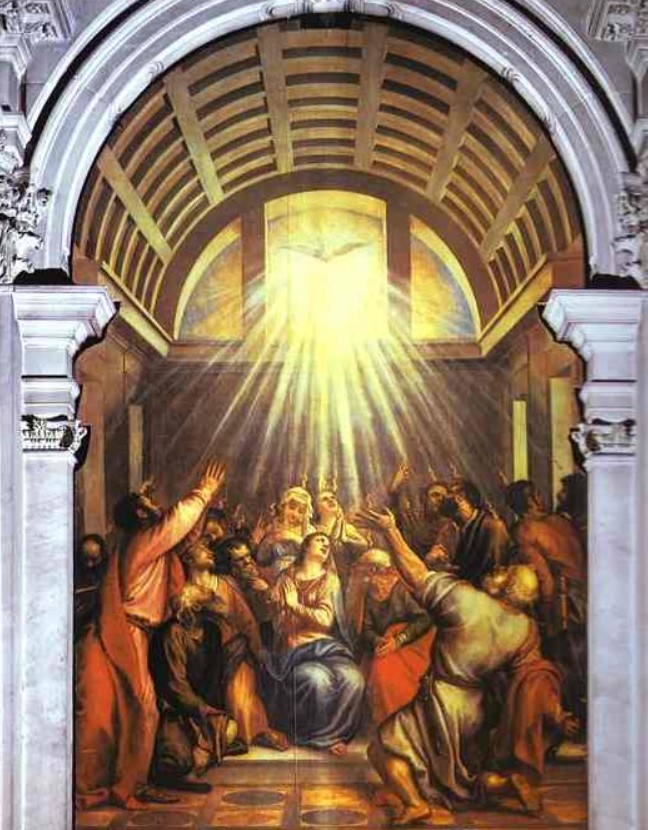
La Pentecoste di Tiziano
Tiziano dipinse a olio la grande tela della Discesa dello Spirito Santo tra il 1545 e i 1546 per la Basilica di Santa Maria della Salute, a Venezia.
Al di sotto della volta a botte, si vede la colomba, simbolo dello Spirito Santo. Da lei si dipartono i raggi di luce che si diffondono sulla Vergine al centro della composizione e sugli apostoli che la circondano.
Dietro la Madonna si vedono due figure femminili, forse due delle cosiddette tre Marie ovvero Maria Maddalena, Maria di Cleofa e Maria Salome.
La Pentecoste di El Greco
El Greco dipinse durante il suo ultimo periodo trascorso a Toledo la Pentecoste, tra il 1597 e il 1660.
Oggi esposto al Museo del Prado di Madrid, il dipinto apparteneva al gruppo della pala d’altare di Doña María de Aragón. Fu l’opera meglio pagata dell’artista, retribuita più di 60milla Reais.
La scena è tutta incentrata sulla discesa dello Spirito Santo sugli Apostoli sottoforma di fiammelle. Le figure allungate molto si discostano dalla bellezza più classica dell’epoca.

Per il momento il sempre vostro Michelangelo Buonarroti vi saluta dandovi appuntamento ai prossimi post e sui social.
Pentecost in the world of art
Today we celebrate Pentecost, a moment in which we remember the descent of the Holy Spirit upon Mary and the apostles gathered together in the Cenacle. It is the beginning of the missionary act of the Church and is one of the most solemn feasts of the entire Christian calendar.
“When the day of Pentecost had come, they were all together in one place. Suddenly there came a sound from heaven like the rushing of a mighty wind, and it filled the entire house where they were sitting. And there appeared to them tongues as of fire, distributed, and a rest on each of them. And they were all filled with the Holy Spirit and began to speak in other tongues, as the Spirit gave them utterance.” – from the Acts of the Apostles.
How has this moment been depicted over the centuries by artists?
Giotto’s Pentecost
Giotto addressed the theme between 1303 and 1305, in one of the panels of the cycle of the Scrovegni Chapel in Padua. The twelve apostles are gathered in a circle and sit on wooden benches under a loggia supported by thin columns.
Above their heads you can see the thin tongues of fire that fall on them from above. While some seem to be talking calmly among themselves, others show an astonished expression.
Titian’s Pentecost
Titian painted the large canvas of the Descent of the Holy Spirit in oil between 1545 and 1546 for the Basilica of Santa Maria della Salute, in Venice.
Beneath the barrel vault, you can see the dove, symbol of the Holy Spirit. From it, rays of light spread out on the Virgin at the center of the composition and on the apostles surrounding her.
Behind the Madonna you can see two female figures, perhaps two of the so-called three Marys, namely Mary Magdalene, Mary of Cleophas and Mary Salome.
El Greco’s Pentecost
El Greco painted Pentecost during his last period spent in Toledo, between 1597 and 1660.
Today exhibited at the Museo del Prado in Madrid, the painting belonged to the group of the altarpiece of Doña María de Aragón. It was the artist’s best-paid work, paid more than 60 thousand Reais.
The scene is all centered on the descent of the Holy Spirit on the Apostles in the form of flames. The elongated figures are very different from the more classical beauty of the time.
For the moment, the ever-yours Michelangelo Buonarroti bids you farewell, making an appointment with you in the next posts and on social media.

Sostienici – Support Us
Se questo blog ti piace e ti appassiona, puoi aiutarci a farlo crescere sempre più sostenendoci in modo concreto condividendo i post, seguendo le pagine social e con un contributo che ci aiuta ad andare avanti con il nostro lavoro di divulgazione. . ENGLISH: If you like and are passionate about this blog, you can help us make it grow more and more by supporting us in a concrete way by sharing posts, following social pages and with a contribution that helps us to move forward with our dissemination work.
10,00 €
Condividi:


Questo sono io





sostienici

Sostienici – Support Us
Se questo blog ti piace e ti appassiona, puoi aiutarci a farlo crescere sempre più sostenendoci in modo concreto condividendo i post, seguendo le pagine social e con un contributo che ci aiuta ad andare avanti con il nostro lavoro di divulgazione. . ENGLISH: If you like and are passionate about this blog, you can help us make it grow more and more by supporting us in a concrete way by sharing posts, following social pages and with a contribution that helps us to move forward with our dissemination work.
€10,00


