
Basilica di San Pietro: la storia delle sculture di San Pietro e Paolo
Ai piedi del sagrato della basilica di San Pietro, proprio al termine della sontuosa scalinata, si ergono le due grandi sculture di San Pietro e San Paolo che accolgono i fedeli prima dell’ingresso in Basilica.
Queste due opere vennero commissionate da papa Gregorio XVI per arricchire la nuova basilica di San Paolo fuori le Mura, ricostruita dopo l’incendio del 1823 che l’aveva devastata.
San Pietro fu scolpito da Giuseppe de Fabris mentre San Paolo da Adamo Tadolini. Entrambe altre 5,55 metri, le grandi opere finirono però nei magazzini della basilica fino a quando, nel marzo del 1847, furono collocate davanti a San Pietro dove tutt’oggi le potete ammirare, grazie all’intervento di papa Pio IX.
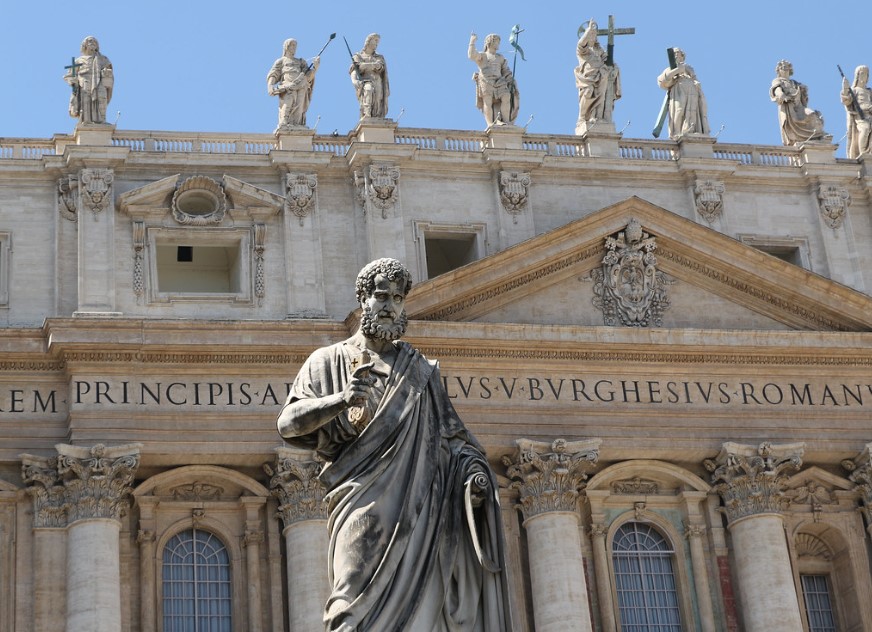
San Pietro
San Paolo è opera di Giuseppe de Fabris e sostituì di fatto la scultura precedente di analogo soggetto ma di inferiori dimensioni, scolpita tra il 1461 e il 1462 .
Papa Pio IX volle che la nuova scultura di San Pietro fosse posizionata al di sopra di un alto basamento che riportasse lungo i lati un’iscrizione a ricordo della traslazione dell’opera, con le sue insegne papali racchiuse dentro ghirlande d’alloro e l’emblema della Reverenda Fabbrica di San Pietro indicata con le lettere R.F.S.P.
Come iconografia vuole, San Pietro stringe nella destra due chiavi. Nel Vangelo di Matteo Gesù gli dice: “A te darò le chiavi del regno dei cieli, e tutto ciò che legherai sulla terra sarà legato nei cieli, e tutto ciò che scioglierai sulla terra sarà sciolto nei cieli” (Mt 16,19).
Proprio quella Chiave è il simbolo del potere papale.
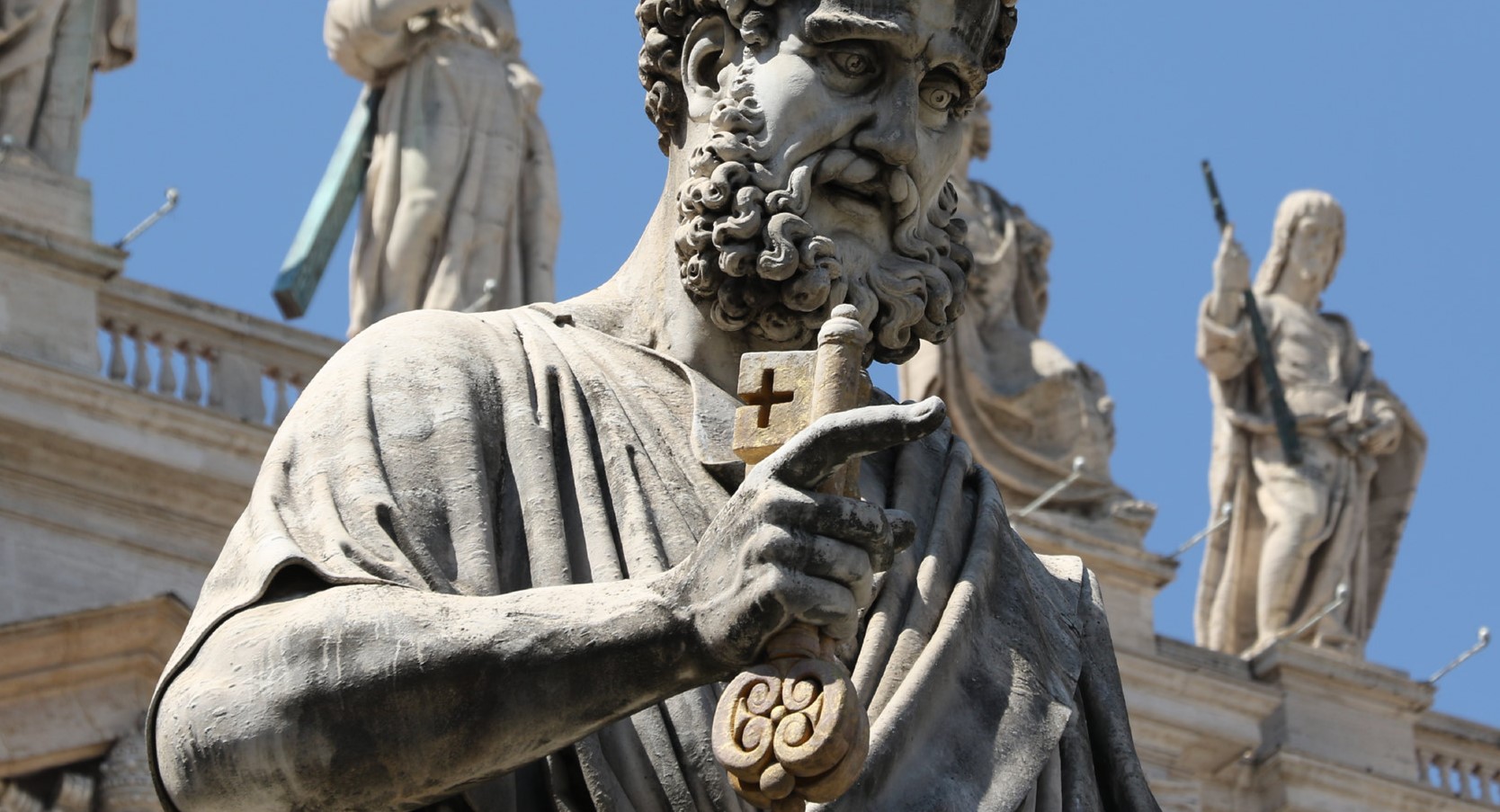
Nella sinistra invece tiene un cartiglio con la scritta “ET TIBI DABO CLAVES REGNI COELORUM” ovvero “Ti darò le chiavi del regno dei cieli” (Mt. 16,19).
Papa Pio IX regalò il modello in gesso dell’opera, usato poi per dar forma alla scultura in marmo di Carrara, alla chiesa di San Carlo ai Catinari. Lì venne collocato in una nicchia dell’abside.
San Paolo
La scultura di San Paolo fu collocata ai piedi della scalinata nel 1847 e impugna con la mano destra una spada lunga ben 2,29 metri.
L’opera fu scolpita dall’artista bolognese Adamo Tadolini, accolto da Canova nel suo studio a Roma a partire dal 1813. Come la precedente scultura di San Pietro, fu commissionata nello stesso periodo sempre da papa Gregorio XVI.

La spada non è solo il simbolo del suo martirio ma ha anche un altro significato. In alcune delle sue lettere la cita diverse volte e in particolare si legge: “Infatti la parola di Dio è viva, efficace e più tagliente di ogni spada a doppio taglio; essa penetra fino al punto di divisione dell’anima e dello spirito, delle giunture e delle midolla e scruta i sentimenti e i pensieri del cuore” (Ef 4,12).
Il cartiglio che il Santo tiene con la mano opposta alla spada riporta l’iscrizione in caratteri ebraici “in Dio, mia forza, tutto posso” (Fil. 4,13).

Per il momento il sempre vostro Michelangelo Buonarroti vi saluta dandovi appuntamento ai prossimi post e sui social.
St. Peter’s Basilica: the history of the sculptures of St. Peter and St. Paul
At the foot of the churchyard of Saint Peter’s Basilica, right at the end of the sumptuous staircase, stand the two large sculptures of Saint Peter and Saint Paul that welcome the faithful before entering the Basilica.
These two works were commissioned by Pope Gregory XVI to enrich the new Basilica of Saint Paul Outside the Walls, rebuilt after the fire of 1823 that had devastated it.
Saint Peter was commissioned to Giuseppe de Fabris while Saint Paul to Adamo Tadolini. Both 5.55 meters high, the large works ended up in the basilica’s warehouses until, in March 1847, they were placed in front of Saint Peter’s where you can still admire them today, thanks to the intervention of Pope Pius IX.
Saint Peter
Saint Paul is the work of Giuseppe de Fabris and effectively replaced the previous sculpture of a similar subject but smaller in size, sculpted between 1461 and 1462.
Pope Pius IX wanted the new sculpture of Saint Peter to be positioned above a high base that bore an inscription along the sides commemorating the translation of the work, with his papal insignia enclosed within laurel wreaths and the emblem of the Reverenda Fabbrica di San Pietro indicated with the letters R.F.S.P.
As iconography dictates, Saint Peter holds two keys in his right hand. In the Gospel of Matthew, Jesus says to him: “I will give you the keys to the kingdom of heaven, and whatever you bind on earth will be bound in heaven, and whatever you loose on earth will be loosed in heaven” (Mt 16:19).
That very Key is the symbol of papal power.
In his left hand he holds a scroll with the inscription “ET TIBI DABO CLAVES REGNI COELORUM” [“I will give you the keys to the kingdom of heaven”] (Mt. 16,19).
Pope Pius IX donated the plaster model of the work, which was then used to shape the sculpture in Carrara marble, to the church of San Carlo ai Catinari. There it was placed in a niche in the apse.
Saint Paul
The sculpture of Saint Paul was placed at the foot of the steps in 1847 and holds a 2.29-meter-long sword in his right hand.
The work was sculpted by the Bolognese artist Adamo Tadolini, welcomed by Canova in his studio in Rome starting in 1813. Like the previous sculpture of Saint Peter, it was commissioned in the same period by Pope Gregory XVI.
The sword is not only the symbol of his martyrdom but also another meaning. In some of his letters he mentions it several times and in particular we read: “For the word of God is living and active and sharper than any two-edged sword, piercing even to the division of soul and spirit, of joints and marrow, and discerning the thoughts and intentions of the heart” (Eph 4:12).
The scroll that the Saint holds with the hand opposite the sword bears the inscription in Hebrew characters “in God, my strength, I can do all things” (Phil. 4:13).
For the moment, yours ever Michelangelo Buonarroti greets you and gives you an appointment for the next posts and on social media.

Sostienici – Support Us
Se questo blog ti piace e ti appassiona, puoi aiutarci a farlo crescere sempre più sostenendoci in modo concreto condividendo i post, seguendo le pagine social e con un contributo che ci aiuta ad andare avanti con il nostro lavoro di divulgazione. . ENGLISH: If you like and are passionate about this blog, you can help us make it grow more and more by supporting us in a concrete way by sharing posts, following social pages and with a contribution that helps us to move forward with our dissemination work.
10,00 €
Condividi:


Questo sono io





sostienici

Sostienici – Support Us
Se questo blog ti piace e ti appassiona, puoi aiutarci a farlo crescere sempre più sostenendoci in modo concreto condividendo i post, seguendo le pagine social e con un contributo che ci aiuta ad andare avanti con il nostro lavoro di divulgazione. . ENGLISH: If you like and are passionate about this blog, you can help us make it grow more and more by supporting us in a concrete way by sharing posts, following social pages and with a contribution that helps us to move forward with our dissemination work.
€10,00


