
La potenza del Genio della Vittoria
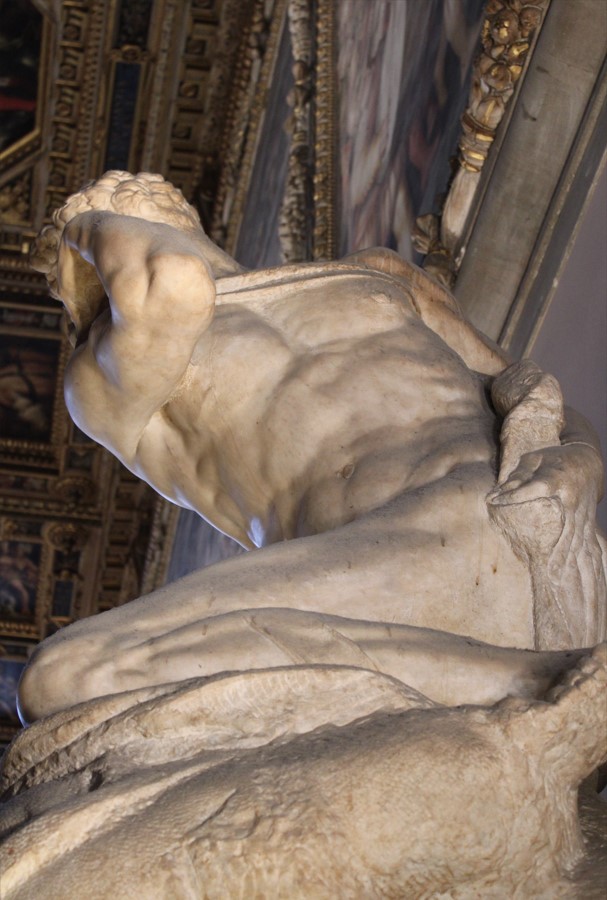
Nell’immensità del Salone de’ Cinquecento, il Genio della Vittoria quasi scompare eppure, osservandolo a distanza ravvicinata, mostra una potenza che le altre sculture lì presenti non hanno.
Alcune soffrono magari di gigantismo e perdono di armonia nel loro sfoggio di muscolature esagerate. Talune hanno muscoli laddove il corpo umano non ne ha o addirittura presenta avvallamenti e hanno volti sfigurati dallo sforzo o dal poco talento di chi gli diede forma.

Il Genio della Vittoria invece, con quella mirabile torsione del busto, fa sfoggio di un’impeccabile struttura anatomica, vibra di vita propria.
Diverso da tutti gli altri, anche da chi provò a imitarlo, prese vita giorno dopo giorno nel mio stanzone di Via Mozza a Firenze, che allora occupava una superficie di circa 4.300 metri quadrati.
Faceva parte del secondo progetto della Tomba di Giulio II e lo avrei terminato e spedito a Roma se solo gli eredi di Giulio II non avessero ridotto di volta in volta quella sontuosa impresa.
Lo stanzone Via Mozza a Firenze, prima del 1534, anno della mia partenza definitiva per Roma, era divenuto il fulcro della mia attività lavorativa dopo il momento in cui papa Leone X sciolse il contratto per la realizzazione della facciata della Basilica di San Lorenzo.
Dopo quel passaggio di proprietà forzato, l’opera pare fosse stata affidata nelle mani di Vincenzo Danti affinché ne portasse a termine l’esecuzione, lasciata allo stato di non finito.
Sebbene gli esperti non siano tutti d’accordo su ciò, durante il restauro eseguito fra il 1998 il 1999, è stata evidenziata una lavorazione successiva non di mia mano su tutto il capo del vincitore, probabilmente sui capelli del vinto.

Danti, grande estimatore delle mie opere e abile scultore, non si sarebbe fatto certo pregare per poter metter mano a un’opera mia.
Per il momento il sempre vostro Michelangelo Buonarroti vi saluta dandovi appuntamento ai prossimi post e sui social.
The Power of the Genius of Victory
In the immensity of the Salone de’ Cinquecento, the Genius of Victory almost disappears and yet, observing it from a close distance, it shows a power that the other sculptures present there do not have.
Some perhaps suffer from gigantism and lose harmony in their display of exaggerated musculature. Some have muscles where the human body does not have any or even has depressions and show faces disfigured by the effort or lack of talent of those who gave them shape.
The Genius of Victory, on the other hand, with that wonderful torsion of the torso, shows an impeccable anatomical structure, vibrates with a life of its own.
Different from all the others, even from those who tried to imitate it, it came to life day after day in my large room on Via Mozza in Florence, which at the time occupied a surface area of about 4,300 square meters.
It was part of the second project of the Tomb of Julius II and I would have finished it and sent it to Rome if only the heirs of Julius II had not reduced that sumptuous undertaking from time to time.
The large room on Via Mozza in Florence, before 1534, the year of my definitive departure for Rome, had become the hub of my work after Pope Leo X dissolved the contract for the construction of the facade of the Basilica of San Lorenzo.
After that forced transfer of ownership, the work seems to have been entrusted to Vincenzo Danti so that he could complete the execution, left in an unfinished state.
Although experts do not all agree on this, during the restoration carried out between 1998 and 1999, subsequent work not by my hand was highlighted on the entire head of the winner, probably on the hair of the loser.
Danti, a great admirer of my works and a skilled sculptor, certainly would not have waited to be asked to put his hand to one of my works.
For the moment, yours truly Michelangelo Buonarroti bids you farewell and invites you to the next posts and on social media.

Sostienici – Support Us
Se questo blog ti piace e ti appassiona, puoi aiutarci a farlo crescere sempre più sostenendoci in modo concreto condividendo i post, seguendo le pagine social e con un contributo che ci aiuta ad andare avanti con il nostro lavoro di divulgazione. . ENGLISH: If you like and are passionate about this blog, you can help us make it grow more and more by supporting us in a concrete way by sharing posts, following social pages and with a contribution that helps us to move forward with our dissemination work.
10,00 €
Condividi:


Questo sono io





sostienici

Sostienici – Support Us
Se questo blog ti piace e ti appassiona, puoi aiutarci a farlo crescere sempre più sostenendoci in modo concreto condividendo i post, seguendo le pagine social e con un contributo che ci aiuta ad andare avanti con il nostro lavoro di divulgazione. . ENGLISH: If you like and are passionate about this blog, you can help us make it grow more and more by supporting us in a concrete way by sharing posts, following social pages and with a contribution that helps us to move forward with our dissemination work.
€10,00


