

Il dipinto del giorno: l’Ultima Cena con la saliera rovesciata del Franciabigio
Il dipinto che vi propongo oggi è l’Ultima Cena Cena affrescata dal Franciabigio nel 1514 per quello che un tempo era il monastero di San Giovanni della Calza, a Firenze.
Noto anche come il Cenacolo della Calza, è l’unico cenacolo presente a Firenze che abbia ripreso nell’idea l’Ultima Cena di Leonardo da Vinci, realizzata dall’artista a Milano.

Il Franciabigio, al secolo Francesco di Cristofano, probabilmente non vide mai con i suoi occhi quel capolavoro e mai si recò nella città lombarda ma copie e incisioni di quell’opera erano iniziate a circolare fin da subito.
Il Franciabigio proseguì pittoricamente la stanza del refettorio inserendo tre finestre che si aprono al di sotto delle rispettive arcate. Si intravedono dalle stesse scorci della Firenze di inizio Cinquecento con i palazzi dietro i piccioni appollaiati sui cornicioni e quella che potrebbe benissimo essere l’antica Porta Romana, vicino al convento.

Cristo è al centro della tavola e ha sei apostoli da una parte e sei dall’altra. Come di consueto Giuda è seduto dalla parte opposta del tavolo, separato fisicamente dagli altri.
Come accade nell’Ultima Cena di Leonardo, anche in questa del Franciabigio gli apostoli vengono rappresentati nel momento in cui si interrogano su chi quella notte fra di loro tradirà Cristo.

San Giovanni, appoggiato alla spalla destra di Gesù, dorme mentre Pietro con il dito alzato si interroga sul traditore.
Fra gli apostoli che appare più sconvolto degli altri c’è Giuda che si alza all’improvviso facendo quasi cadere lo sgabello all’indietro e rovesciando con il braccio destro la saliera sul tavolo.
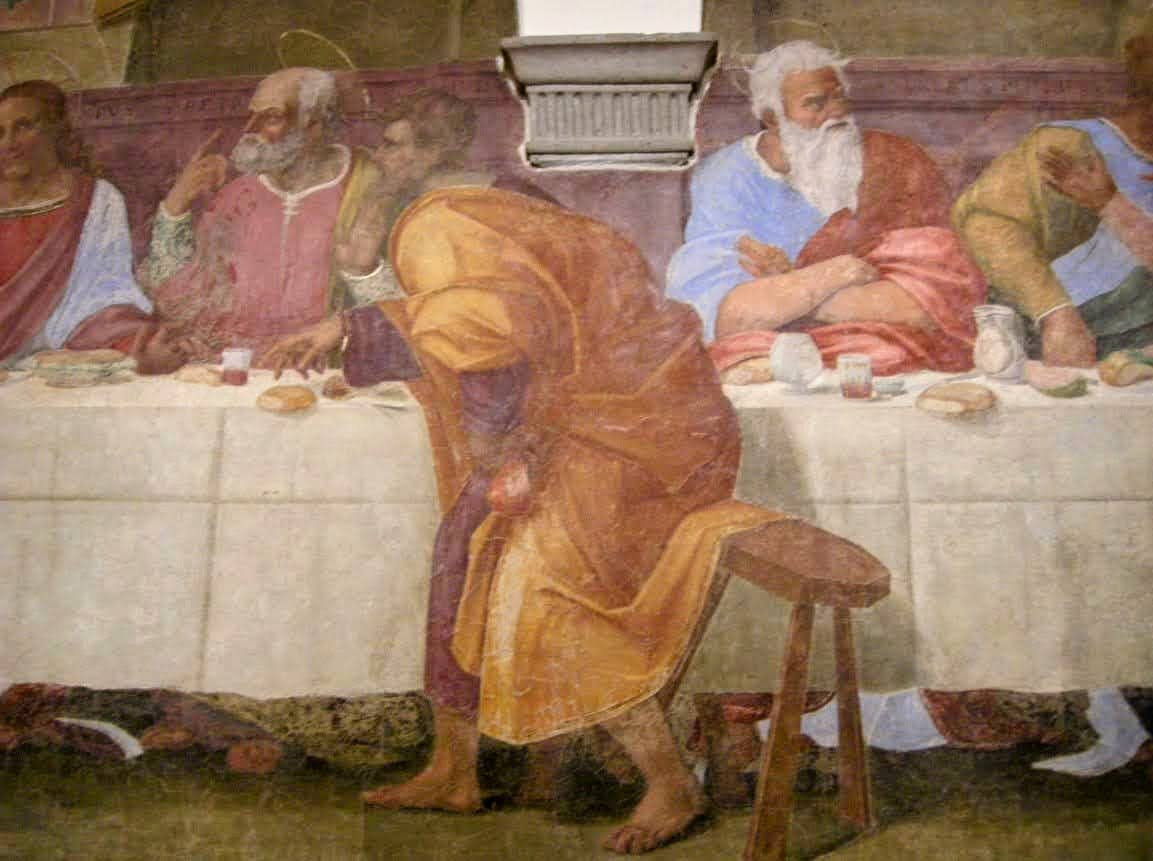
Le credenze popolari tutt’oggi in voga, sostengono che il sale rovesciato sia un gesto che richiama la malasorte. Anche nel Cinquecento, quando il sale aveva un costo accessibile solo alle famiglie più facoltose, rovesciarlo era qualcosa di disdicevole e preannunciava qualcosa di nefasto.
Quel gesto accidentale fatto da Giuda mette in chiaro chi sarà l’apostolo che tradirà Cristo.

Sebbene il Franciabigio si sia ispirato direttamente alla narrazione mostrata da Leonardo da VInci, per riprodurre quei corpi possenti preferì optare per il mio modo di dipingere. Osservate per esempio il corpo possente di Sant’Andrea che incrocia le braccia, mettendo in evidenza ancora di più la propria muscolatura, accentuata dalle tonalità azzurre della tunica che le ricopre.
Come faccio a sapere che quell’apostolo rappresentato sia proprio Sant’Andrea? Ebbene, l’artista per evitare fraintendimenti scrisse i nomi di ciascuno sulla spalliera.

L’artista lasciò il proprio monogramma e la data di realizzazione dell’affresco su un gambo di uno sgabello che spunta al di sotto della tovaglia.
Per il momento il sempre vostro michelangelo Buonarroti vi saluta dandovi appuntamento ai prossimi post e sui social.
Painting of the day: The Last Supper with the overturned salt shaker by Franciabigio
The painting I propose to you today is the Last Supper frescoed by Franciabigio in 1514 for what was once the monastery of San Giovanni della Calza, in Florence.
Also known as the Cenacolo della Calza, it is the only cenacle in Florence that has taken up the idea of Leonardo da Vinci’s Last Supper, created by the artist in Milan.
Franciabigio, born Francesco di Cristofano, probably never saw that masterpiece with his own eyes and never went to the Lombard city but copies and engravings of that work began to circulate immediately.
Franciabigio pictorially continued the refectory room by inserting three windows that open below the respective arches. From the same views you can glimpse early sixteenth century Florence with the buildings behind the pigeons perched on the cornices and what could very well be the ancient Porta Romana, near the convent.
Christ is in the center of the table and has six apostles on one side and six on the other. As usual, Judas is sitting on the opposite side of the table, physically separated from the others.
As happens in Leonardo’s Last Supper, also in this one by Franciabigio the apostles are represented at the moment in which they question themselves about who among them will betray Christ that night.
Saint John, leaning on Jesus’ right shoulder, sleeps while Peter, with his finger raised, questions the traitor.
Among the apostles who appears more upset than the others is Judas who suddenly stands up, almost causing the stool to fall backwards and overturning the salt shaker on the table with his right arm.
Popular beliefs still in vogue today maintain that spilled salt is a gesture that recalls bad luck. Even in the sixteenth century, when salt was affordable only to the wealthiest families, spilling it was something unbecoming and heralded something nefarious.
That accidental gesture made by Judas makes it clear who will be the apostle who will betray Christ.
Although Franciabigio was directly inspired by the narrative shown by Leonardo da Vinci, to reproduce those powerful bodies he preferred to opt for my way of painting. Observe for example the powerful body of Saint Andrew who crosses his arms, highlighting his muscles even more, accentuated by the blue shades of the tunic that covers them.
How do I know that the apostle represented is really Saint Andrew? Well, to avoid misunderstandings, the artist wrote the names of each person on the backrest.
The artist left his monogram and the date of creation of the fresco on the stem of a stool that sticks out from underneath the tablecloth.
For the moment, your always Michelangelo Buonarroti greets you and will meet you in the next posts and on social media.

Sostienici – Support Us
Se questo blog ti piace e ti appassiona, puoi aiutarci a farlo crescere sempre più sostenendoci in modo concreto condividendo i post, seguendo le pagine social e con un contributo che ci aiuta ad andare avanti con il nostro lavoro di divulgazione. . ENGLISH: If you like and are passionate about this blog, you can help us make it grow more and more by supporting us in a concrete way by sharing posts, following social pages and with a contribution that helps us to move forward with our dissemination work.
10,00 €
-
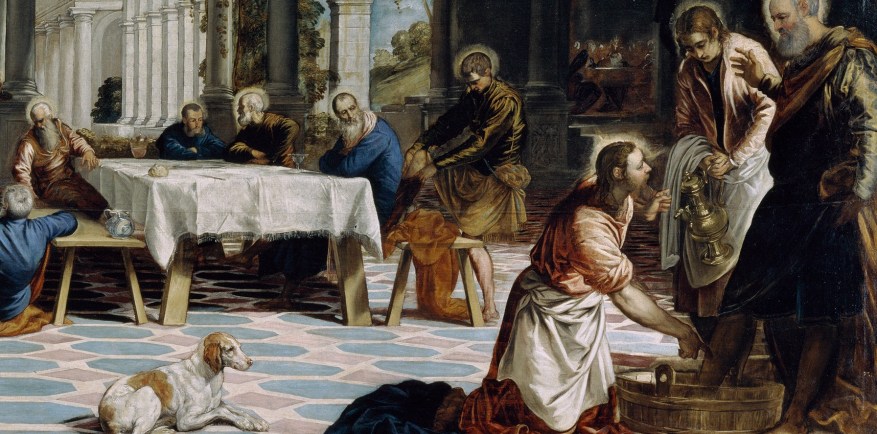
La Lavanda dei Piedi di Tintoretto: Il Capolavoro Veneziano al Prado
🇮🇹Tra i capolavori più affascinanti del Rinascimento veneziano, “La Lavanda dei Piedi” di Jacopo Tintoretto rappresenta un perfetto equilibrio tra spiritualità, innovazione compositiva e straordinaria forza narrativa… 🇬🇧Among the most fascinating masterpieces of the Venetian Renaissance, Jacopo Tintoretto’s “The Washing of the Feet” represents a perfect balance between spirituality, compositional innovation, and extraordinary narrative force…
-
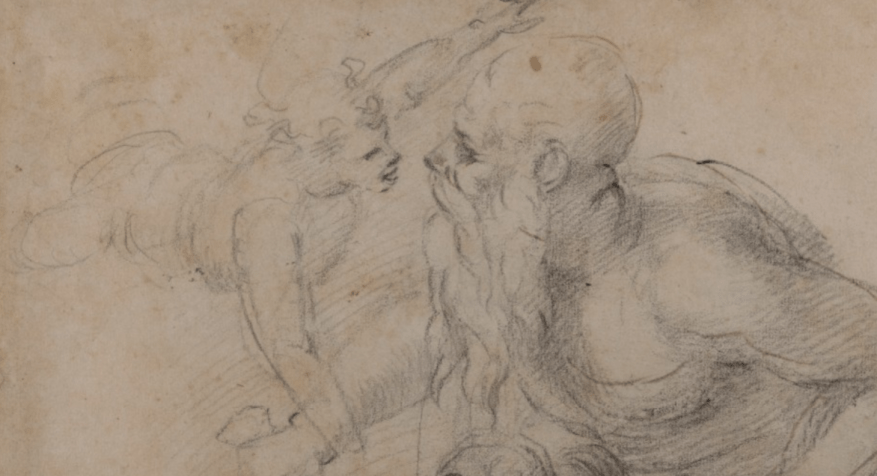
Il Sacrificio di Isacco e quel momento tra la vita e la morte
🇮🇹Oggi voglio raccontarvi alcuni dettagli sul mio disegno del Sacrificio di Isacco, conservato oggi a Casa Buonarroti. Su quel foglio volli tracciare il momento preciso in cui la paura fa spazio al miracolo… 🇬🇧Today I want to tell you some details about my drawing of the Sacrifice of Isaac, now preserved at Casa Buonarroti. On…
-
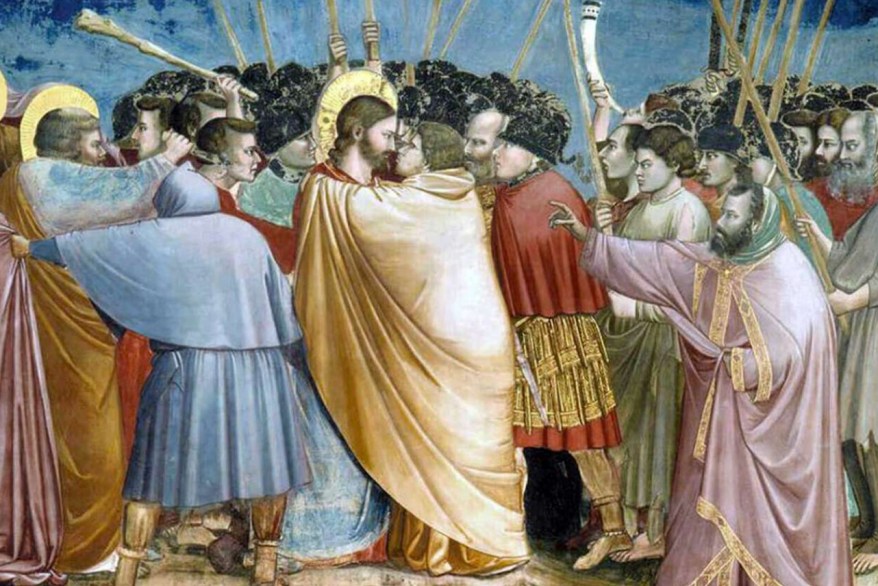
Mercoledì Santo: il giorno del tradimento di Giuda affrescato da Giotto
🇮🇹Il Mercoledì Santo è il giorno del silenzio, della riflessione e del tradimento. È il momento in cui Giuda sceglie di vendere Gesù per trenta denari, segnando uno dei passaggi più dolorosi della Settimana Santa…. 🇬🇧Holy Wednesday is a day of silence, reflection, and betrayal. ✝It is the moment when Judas chooses to sell Jesus…
Condividi:


Questo sono io





sostienici

Sostienici - Support Us
Se questo blog ti piace e ti appassiona, puoi aiutarci a farlo crescere sempre più sostenendoci in modo concreto condividendo i post, seguendo le pagine social e con un contributo che ci aiuta ad andare avanti con il nostro lavoro di divulgazione. . ENGLISH: If you like and are passionate about this blog, you can help us make it grow more and more by supporting us in a concrete way by sharing posts, following social pages and with a contribution that helps us to move forward with our dissemination work.
€10,00


1 commento »