

Il dipinto del giorno: l’Ultima Cena con gatto del Ghirlandaio
Il dipinto del giorno che vi propongo oggi a tema pasquale è l’Ultima Cena affrescata da Domenico Ghirlandaio nel Museo di San Marco a Firenze nel quale si vede in primo piano, dietro le spalle di Giuda, un gatto che guarda negli occhi lo spettatore.
Furono i frati domenicani del convento a commissionare l’opera all’artista, oramai arrivato all’apice della sua prolifica carriera, per decorare il cosiddetto refettorio piccolo, dove ero solite consumare i pasti le persone che venivano accolte all’interno della struttura.
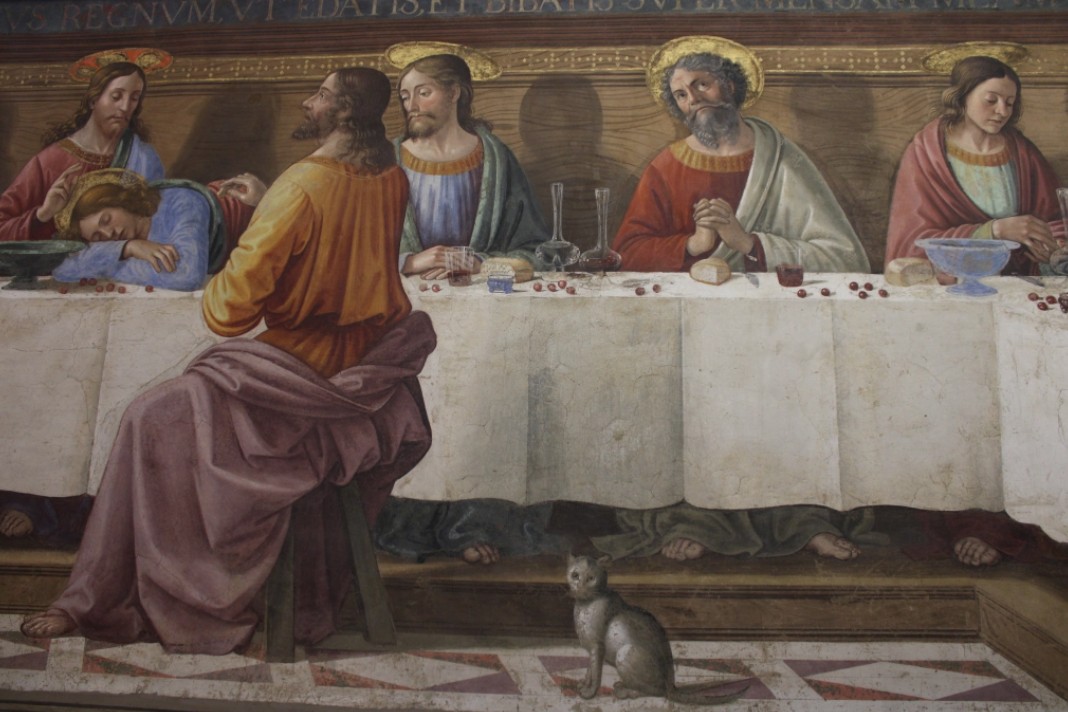
E’ l’ultimo cenacolo dei tre che il Ghirlandaio dipinse. Il primo risale al 1476 ed è quello della Badia di Passignano mentre il secondo del 1480 è quello di Ognissanti.
Gli esperti sono propensi a pensare che, oberato dal tanto lavoro, il Ghirlandaio abbia eseguito solo il disegno con un’impostazione paragonabile a quella dell’Ultima Cena di Ognissanti, affidando l’esecuzione pittorica al fratello Davide e a Sebastiano Mainardi, suo cognato. Insomma, un affresco fatto in famiglia.
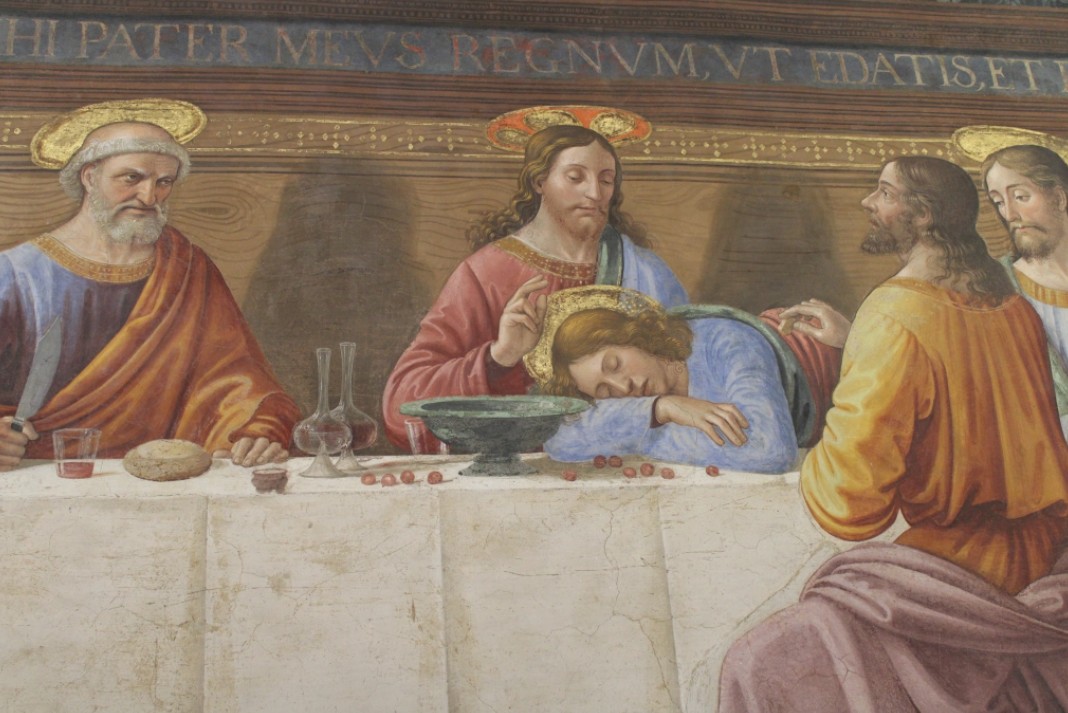
Il Girlandaio volle prolungare visivamente la struttura architettonica del refettorio stesso e pose al centro un tavolo a ferro di cavallo.
Oltre la spalliera, si vede un loggiato che si apre su un rigoglioso giardino, con alberi di aranci e uccelli che volano. Un pavone posato sopra la finestra sembra osservare la scena che si sta svolgendo sotto i suoi occhi.

Come accade nella maggior parte delle Ultime Cene, Giuda viene raffigurato da solo, seduto dalla parte opposta occupata dagli altri apostoli. Nella mano destra levata ha il pezzo di pane che gli ha appena offerto Cristo e di lì a qualche istante dopo lo intingerà nel suo piatto, così come riportano le Sacre Scritture.
Il momento di disperazione che interessa gli apostoli quando Gesù gli dice che sarà uno di loro a tradirlo, sembra già sfociato nella rassegnazione.

Alle spalle di Giuda, in primo piano, Ghirlandaio affrescò un gatto. Apparentemente sembra che stia aspettando che cada qualcosa da mangiare dal tavolo ma è il simbolo del male.
Ecco perché si trova proprio nei pressi del traditore e perchè guarda dritto negli occhi lo spettatore, come per volerlo mettere in guardia.
Ghirlandaio pose un’attenzione incredibile ai dettagli. I singoli oggetti vengono riprodotti fedelmente: basta osservare le bottiglie di vetro con vino e acqua che si trovano sulla tavola, con quei riflessi che le rendono così reali, le coppe ma anche il pane, i formaggi e i diversi frutti.
Alcuni brani di pittura sono dei veri e propri virtuosismi come le mani degli apostoli che si vedono al di là delle caraffe in vetro o il cerchio rosso che rimane nei bicchieri oramai svuotati del vino che contenevano.
Se aguzzate la vista riuscirete a vedere anche le ciliegie che con la loro colorazione rosso rubino evocano simbolicamente il sangue di Cristo.

Al di sopra dei commensali si legge la scritta “Ego dispono vobis sicut disposuit mihi pater meus regnum ut edatis et bibatis super mensa meam in regno meo” ovvero “preparo per voi il regno come il padre mio lo preparò per me affinché mangiate e beviate alla mia mensa nel mio regno”. E’ una frase che viene adoperata anche durante la messa che allude alla trasmigrazione al regno dei Cieli.
Per il momento il sempre vostro Michelangelo Buonarroti vi saluta dandovi apputamento ai prossimi post e sui social.

Painting of the day: The Last Supper with a cat by Ghirlandaio
The painting of the day that I propose to you today with an Easter theme is the Last Supper frescoed by Domenico Ghirlandaio in the San Marco Museum in Florence in which you can see in the foreground, behind Judas’s shoulders, a cat looking into the eyes of the spectator.
It was the Dominican friars of the convent who commissioned the work to the artist, who had now reached the peak of his prolific career, to decorate the so-called small refectory, where the people who were welcomed into the structure used to eat their meals.
It is the last cenacle of the three that Ghirlandaio painted. The first dates back to 1476 and is that of the Badia di Passignano while the second of 1480 is that of Ognissanti.
Experts are inclined to think that, overwhelmed by so much work, Ghirlandaio only executed the drawing with an approach comparable to that of the Last Supper of All Saints, entrusting the pictorial execution to his brother Davide and Sebastiano Mainardi, his brother-in-law. In short, a fresco made in the family.
The Girlandaio wanted to visually extend the architectural structure of the refectory itself and placed a horseshoe table in the center.
Beyond the backrest, you can see a loggia that opens onto a lush garden with orange trees and flying birds. The peacock sitting above the window seems to be observing the scene that is unfolding before his eyes.
As happens in most of the Last Suppers, Judas is depicted alone, sitting on the opposite side occupied by the other apostles. In his raised right hand he has the piece of bread that Christ has just offered him and a few moments later he will dip it into his plate, as the Holy Scriptures report.
The moment of desperation that affects the apostles when Jesus tells them that one of them will be the one to betray him already seems to have led to resignation.
Behind Judas, in the foreground, Ghirlandaio frescoed a cat. Apparently he seems to be waiting for something to eat to fall off the table but it is the symbol of evil.
This is why he is right next to the traitor and why he looks the viewer straight in the eyes, as if wanting to warn him.
Ghirlandaio paid incredible attention to detail. The individual objects are faithfully reproduced: just look at the glass bottles with wine and water that are on the table, with those reflections that make them so real, the cups but also the bread, the cheeses and the various fruits. Some pieces of painting are true virtuosities such as the hands of the apostles that can be seen beyond the glass jugs or the red circle that remains in the glasses now emptied of the wine they contained.
If you sharpen your eyes you will also be able to see the cherries which, with their ruby red colour, symbolically evoke the blood of Christ.
Above the guests we read the writing “Ego dispono vobis sicut disposuit mihi pater meus regnum ut edatis et bibatis super mensa meam in Regno meo” or “I prepare the kingdom for you as my father prepared it for me so that you may eat and drink at my table in my kingdom.” It is a phrase that is also used during mass which alludes to the transmigration to the kingdom of Heaven.
For the moment, your always Michelangelo Buonarroti greets you and looks forward to future posts and on social media.

Sostienici – Support Us
Se questo blog ti piace e ti appassiona, puoi aiutarci a farlo crescere sempre più sostenendoci in modo concreto condividendo i post, seguendo le pagine social e con un contributo che ci aiuta ad andare avanti con il nostro lavoro di divulgazione. . ENGLISH: If you like and are passionate about this blog, you can help us make it grow more and more by supporting us in a concrete way by sharing posts, following social pages and with a contribution that helps us to move forward with our dissemination work.
10,00 €
Condividi:


Questo sono io





sostienici

Sostienici - Support Us
Se questo blog ti piace e ti appassiona, puoi aiutarci a farlo crescere sempre più sostenendoci in modo concreto condividendo i post, seguendo le pagine social e con un contributo che ci aiuta ad andare avanti con il nostro lavoro di divulgazione. . ENGLISH: If you like and are passionate about this blog, you can help us make it grow more and more by supporting us in a concrete way by sharing posts, following social pages and with a contribution that helps us to move forward with our dissemination work.
€10,00


1 commento »