

La Scultura del giorno: il Busto della Velata attribuito a Monti
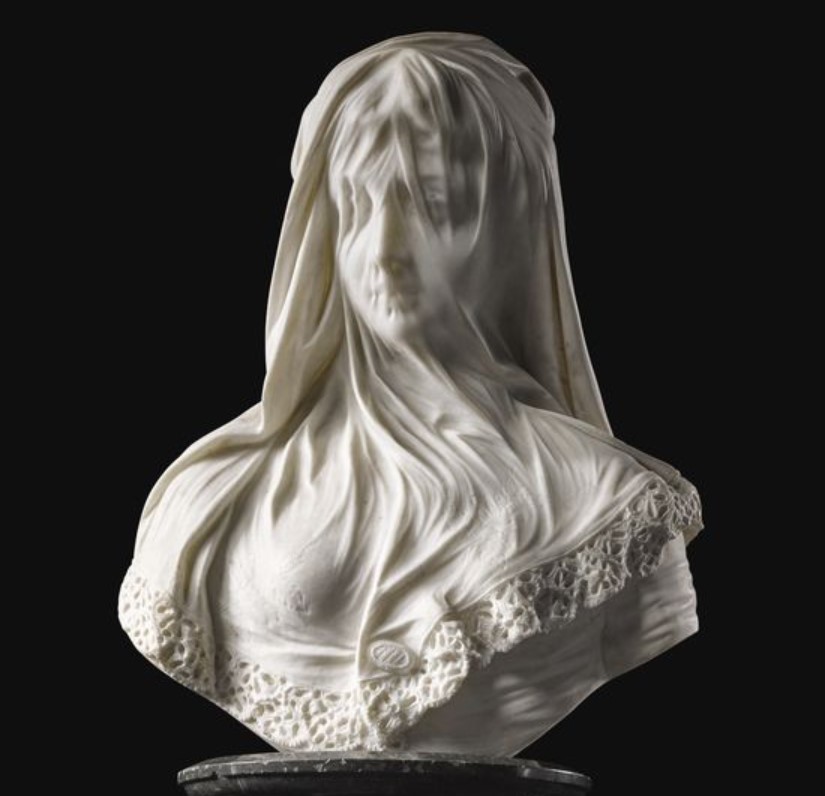
La scultura del giorno che vi propongo oggi è il Busto della Velata, opera ottocentesca attribuita a Raffaele Monti, oggi appartenente a una collezione privata.
Il busto fu venduto all’asta non molti anni fa da Sotherby’s a un collezionista rimasto anonimo e raffigura una giovane donna coperta da un velo accuratamente riprodotto, bordato da un pizzo realizzato con il trapano.
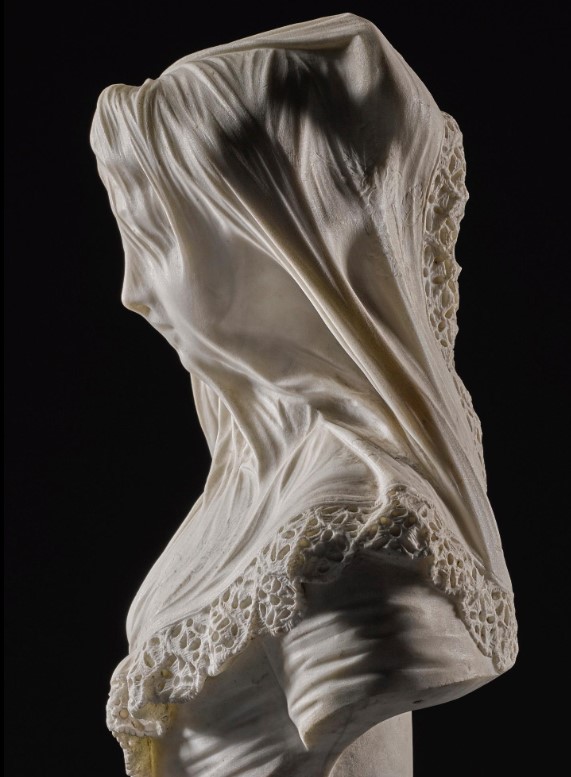
I lineamenti della giovane si intravedono al di sotto di quello che sembra un impalpabile velo, alla stregua di quelli di colore nero che le donne erano obbligate a indossare entrando in chiesa fino a non troppi anni fa.
Per evitare che camminando si possa aprire e lasciare il volto scoperto, il velo è fissato con una semplice spilla all’altezza del petto.
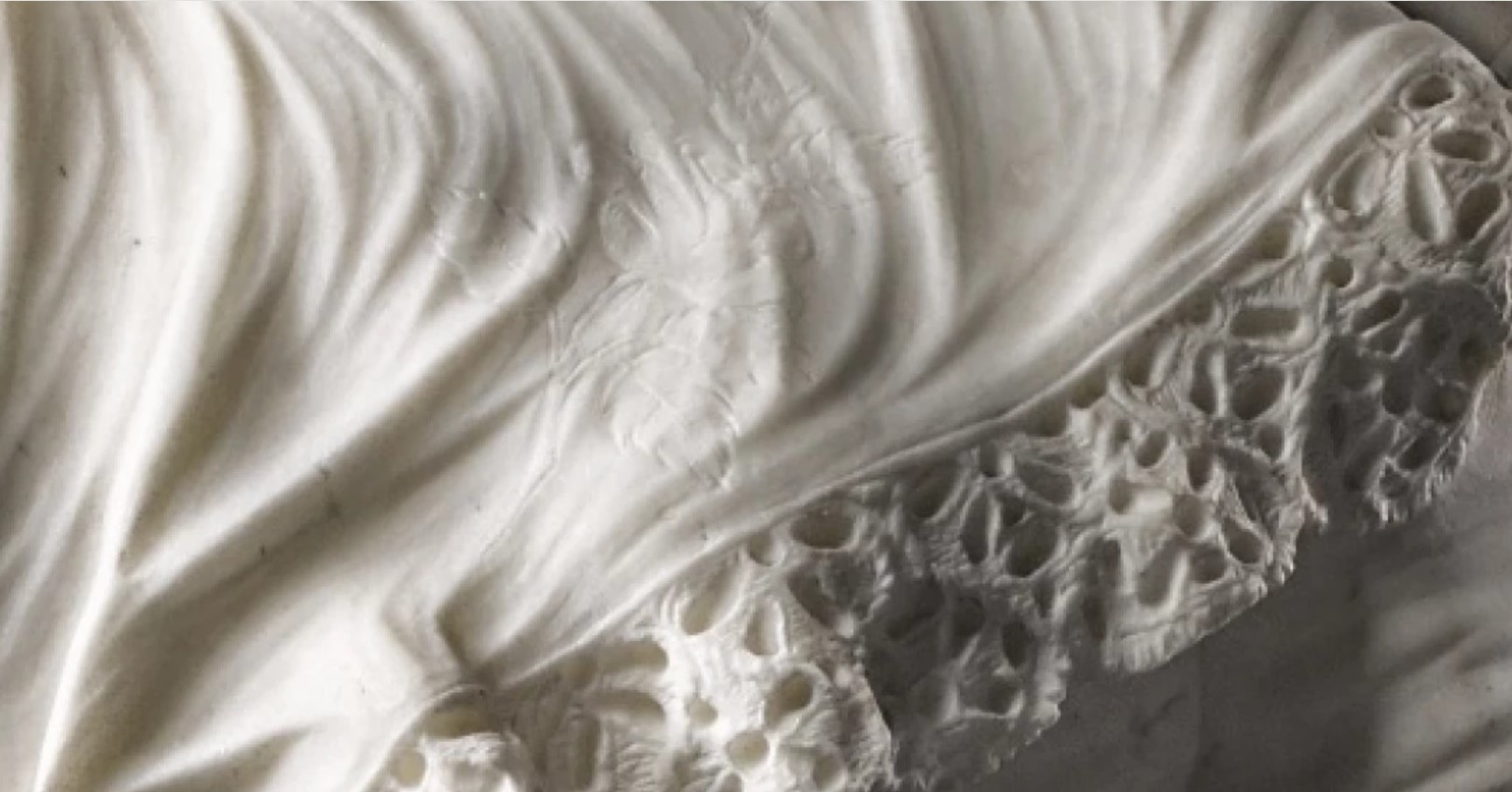
Osservando a distanza ravvicinata l’opera, si nota che il tessuto ha dei delicati ricami di foglie e fiori.
Lo scultore Raffaele Monti nacque a Milano nel 1818 o, secondo altre fonti, a Iseo o Ticino. Studiò scultura presso l’Imperiale Regia Accademia di Belle Arti a Milano, dove ebbe suo padre come mentore.
Già da giovane vinse una medaglia d’oro per due gruppi esposti nel 1838 e successivamente si unì alla scuola lombarda insieme a Pietro Magni e Vincenzo Vela, come reazione al rigore del neoclassicismo dominante all’epoca.
Monti ebbe la possibilità di recarsi a Vienna dopo aver ricevuto la medaglia dall’Accademia, dove studiò per quattro anni e successivamente si trasferì a Budapest per lavorare al Museo nazionale ungherese sotto Ludwig Schaller. Tornò poi a Milano nel 1842.
Tra il 1846 e il 1847 Monti si recò in Inghilterra per scolpire l’opera che gli era stata commissionata: La vestale velata. Poco dopo però ritornò in Italia a causa dei moti popolari, arruolandosi e diventando ufficiale della Guardia Nazionale milanese. Nel 1848, di fronte al fallimento dei moti rivoluzionari, decise di tornare in Inghilterra, dove trascorse il resto della sua vita.
Stabilì uno studio in Great Marlborough Street al numero 45 e iniziò a ricevere numerose commissioni per monumenti funebri.

La sua straordinaria abilità nel rappresentare figure velate come la Vergine vestale o la Schiava circassa contribuì notevolmente alla sua fama e alla grande richiesta delle sue opere.
Negli ultimi anni della sua vita si interessò alla galvanoplastica e lavorò presso la Elkington & Co., un’azienda di Birmingham. Le sue condizioni economiche divennero assai precarie e morì in indigenza il 16 ottobre del 1881 lasciando però capolavori straordinari.
Per il momento il vostro Michelangelo Buonarroti vi saluta dandovi appuntamento ai prossimi post e sui social.


Sostienici – Support Us
Se questo blog ti piace e ti appassiona, puoi aiutarci a farlo crescere sempre più sostenendoci in modo concreto condividendo i post, seguendo le pagine social e con un contributo che ci aiuta ad andare avanti con il nostro lavoro di divulgazione. . ENGLISH: If you like and are passionate about this blog, you can help us make it grow more and more by supporting us in a concrete way by sharing posts, following social pages and with a contribution that helps us to move forward with our dissemination work.
8,00 €
Sculpture of the day: the bust of the Velata attributed to Monti
The sculpture of the day that I propose to you today is the Busto della Velata, a nineteenth-century work attributed to Raffaele Monti, today belonging to a private collection.
The bust was sold at auction not many years ago by Sotherby’s to an anonymous collector and depicts a young woman covered in a carefully reproduced veil, edged with drilled lace.
The young woman’s features can be seen beneath what appears to be an impalpable veil, like the black ones that women were forced to wear when entering church until not too many years ago.
To prevent her from opening up while walking and leaving her face uncovered, her veil is fixed with a simple pin at chest height.
Looking at the work at close range, you notice that the fabric has delicate embroidery of leaves and flowers. Lots of accuracy and research into detail
The sculptor Raffaele Monti was born in Milan in 1818 or, according to other sources, in Iseo or Ticino. He studied sculpture at the Imperial Royal Academy of Fine Arts in Milan, where he had his father as a mentor.
Already as a young man he won a gold medal for two groups exhibited in 1838 and subsequently joined the Lombard school together with Pietro Magni and Vincenzo Vela, as a reaction to the rigor of the neoclassicism dominant at the time.
Monti had the opportunity to travel to Vienna after receiving the medal from the Academy, where he studied for four years and subsequently moved to Budapest to work at the Hungarian National Museum under Ludwig Schaller. He then returned to Milan in 1842.
Between 1846 and 1847 Monti went to England to sculpt the work he had been commissioned to do: The Veiled Vestal Virgin. Shortly afterwards, however, he returned to Italy due to the popular uprisings, enlisting and becoming an officer in the Milanese National Guard. In 1848, faced with the failure of the revolutionary movements, he decided to return to England, where he spent the rest of his life.
He established a practice in 45 Great Marlborough Street and began to receive numerous commissions for funerary monuments.
In the last years of his life he became interested in electroplating and worked at Elkington & Co., a firm in Birmingham. His economic conditions became very precarious and he died in poverty on 16 October 1881, however leaving behind extraordinary masterpieces.
For the moment, your Michelangelo Buonarroti greets you and will meet you in future posts and on social media.
Sostienici – Support Us
Se questo blog ti piace e ti appassiona, puoi aiutarci a farlo crescere sempre più sostenendoci in modo concreto condividendo i post, seguendo le pagine social e con un contributo che ci aiuta ad andare avanti con il nostro lavoro di divulgazione. . ENGLISH: If you like and are passionate about this blog, you can help us make it grow more and more by supporting us in a concrete way by sharing posts, following social pages and with a contribution that helps us to move forward with our dissemination work.
8,00 €
-
Trinità di Masaccio: concluso il restauro durato tre anni
🇮🇹La Trinità di Masaccio torna visibile a Santa Maria Novella dopo tre anni di restauro: tecniche innovative e interventi strutturali per salvare il capolavoro rinascimentale… 🇬🇧Masaccio’s Trinity returns to Santa Maria Novella after three years of restoration: innovative techniques and structural interventions to save the Renaissance masterpiece…
-
Quando l’anima illumina il corpo: il sonetto che scrissi Tommaso de’ Cavalieri
🇮🇹Se dovessi dar voce oggi a quel fuoco antico che mi prese per Tommaso Cavalieri, direi che non fu amore di carne soltanto, ma contemplazione dell’anima che in lui discese come luce divina… 🇬🇧If I had to give voice today to that ancient fire that gripped me for Tommaso Cavalieri, I would say that it…
-
24 aprile 1503: la promessa dei dodici apostoli per Firenze
🇮🇹24 aprile 1503: in questo giorno la potente corporazione dell’Arte della Lana mi affidò l’incarico di dare vita a dodici apostoli per il Duomo di Firenze… 🇬🇧April 24, 1503: on this day, the powerful Wool Guild entrusted me with the task of creating twelve apostles for the Florence Cathedral…
Condividi:


Questo sono io





sostienici

Sostienici – Support Us
Se questo blog ti piace e ti appassiona, puoi aiutarci a farlo crescere sempre più sostenendoci in modo concreto condividendo i post, seguendo le pagine social e con un contributo che ci aiuta ad andare avanti con il nostro lavoro di divulgazione. . ENGLISH: If you like and are passionate about this blog, you can help us make it grow more and more by supporting us in a concrete way by sharing posts, following social pages and with a contribution that helps us to move forward with our dissemination work.
€10,00


straordinario!! 👏👏👏👏👏👏👏👏👏👏👏
"Mi piace"Piace a 1 persona
davvero, opera sublime
"Mi piace"Piace a 1 persona