
L’Inclinazione di Artemisia Gentileschi: restauro a porte aperte a Casa Buonarroti
A Casa Buonarroti è appena stato avviato il restauro dell’Allegoria dell’Inclinazione: un’opera dipinta da Artemisia Gentileschi nel 1616 su commissione del mio pronipote Michelangelo Buonarroti il Giovane.
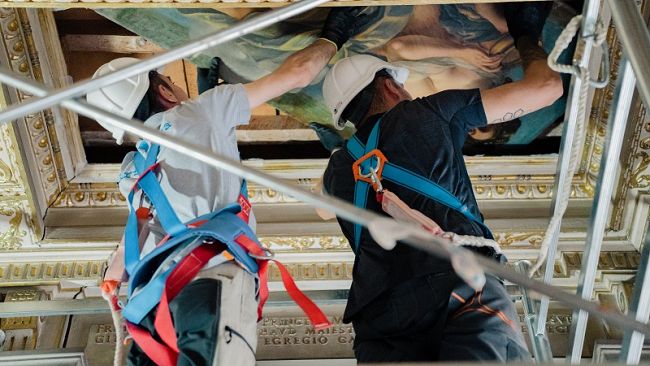
Per effettuare l’intervento di restauro, la tela è stata rimossa dalla sua abituale collocazione a soffitto e i visitatori di Casa Buonarroti avranno l’opportunità di vederla da vicino durante tutte le fasi dell’intervento.

Artemisia Gentileschi era arrivata in quel di Firenze direttamente da Roma nel 1613, dopo il terribile processo per stupro che subì. Stuprata dall’amico del padre e pittore Agostino Tassi, fu processata e torturata per comprovare l’attendibilità della sua testimonianza.
L’Inclinazione è una delle sue prime opere fiorentine e le fu commissionata dal mio pronipote per decorare, assieme ad altre opere che raccontano la vita mia, la Galleria.
Michelangelo Buonarroti il Giovane era molto amico di Artemisia e la stimava talmente tanto che le pagò quel lavoro tre volte in più delle altre opere facenti parte della stessa serie. Tutta questa generosità probabilmente è dovuta anche al fatto che il mio pronipote ben conosceva le precarie condizioni economiche in cui versava allora Artemisia.
Artemisia dipinse l’Allegoria dell’Inclinazione totalmente nuda e, attorno al 1680, il Volterrani al secolo Baldassarre Franceschini, la censurò con un panneggio e dei veli.
Il Volterrani non agì certo di propria iniziativa ma su commissione di Lionardo Buonarroti, nipote di Michelangelo Buonarroti il Giovane. Lionardo viveva nel palazzo e suo avviso era meglio coprire quei nudi per tutelare il decoro della sua famiglia. Il restauro sarà mirato a scoprire anche cosa quei panneggi hanno celato per tutto questo tempo e a valutare le condizioni in cui versa l’opera.
Il progetto di restauro “Artemisia Unveiled / Artemisia Svelata” è sostenuto dell’ente no profit inglese Calliope Arts e del collezionista e filantropo Christian Levett. A seguito del restauro verrà allestita presso Casa Buonarroti un’esposizione dell’opera che consentirà di vederla ad altezza d’occhi dal settembre del 2023 fino al gennaio del 2024.

Il medesimo progetto prevede anche la ristrutturazione di alcune aree specifiche del museo e la progettazione di una nuova illuminazione.
Restauro aperto
Fino ad aprile del 2023, chi visiterà Casa Buonarroti, potrà vedere con i propri occhi l’opera in restauro all’interno dello spazio appositamente predisposto allo scopo, nella Sala del Modello dove è esposto anche il modello della facciata della Basilica di San Lorenzo.
Non è finita qua: tutti i venerdì la restauratrice che si occupa della tela risponderà ai quesiti del pubblico.
Per il momento il vostro Michelangelo Buonarroti vi saluta dandovi appuntamenti ai prossimi post e sui social.
The inclination of Artemisia Gentileschi: open door restoration at Casa Buonarroti
At Casa Buonarroti the restoration of the Allegory of the Inclination has just begun: a work painted by Artemisia Gentileschi in 1616 commissioned by my great-grandson Michelangelo Buonarroti the Younger.
To carry out the restoration, the canvas was removed from its usual location on the ceiling and visitors to Casa Buonarroti will have the opportunity to see it up close during all phases of the intervention.
Artemisia Gentileschi had arrived in Florence directly from Rome in 1613, after the terrible rape trial she suffered. She was raped by her father’s friend and painter Agostino Tassi, she was tried and tortured to prove the reliability of her testimony.
The Inclination is one of her first Florentine works and was commissioned by my great-grandson to decorate the Gallery, along with other works that tell of my life.
Michelangelo Buonarroti the Younger was a very good friend of Artemisia and he esteemed her so much that he paid her for that work three times more than her other works in the same series. All this generosity is probably also due to the fact that my great-grandson was well aware of the precarious economic conditions in which Artemisia was at the time.
Artemisia painted the Allegory of the Inclination totally naked and, around 1680, Volterrani, aka Baldassarre Franceschini, censored it with drapery and veils.
Volterrani certainly did not act on his own initiative but on the commission of Lionardo Buonarroti, nephew of Michelangelo Buonarroti the Younger. Lionardo lived in the palace and in his opinion it was better to cover those nudes to protect the dignity of his family. The restoration will also be aimed at discovering what those draperies have hidden all this time and at evaluating the conditions in which the work is located.
The restoration project “Artemisia Unveiled / Artemisia Svelata” is supported by the English non-profit organization Calliope Arts and by the collector and philanthropist Christian Levett. Following the restoration, an exhibition of the work will be set up at Casa Buonarroti that will allow you to see it at eye level from September 2023 until January 2024.
The same project also includes the renovation of some specific areas of the museum and the design of new lighting.
Open restoration
Until April 2023, those who visit Casa Buonarroti will be able to see with their own eyes the work being restored within the space specially prepared for this purpose, in the Model Room where the model of the facade of the Basilica of San Lorenzo is also exhibited.
That’s not all: every Friday the restorer who takes care of the canvas will answer questions from the public.
For the moment your Michelangelo Buonarroti greets you by giving you appointments to the next posts and on social networks.

Sostienici – Support Us
Se questo blog ti piace e ti appassiona, puoi aiutarci a farlo crescere sempre più sostenendoci in modo concreto condividendo i post, seguendo le pagine social e con un contributo che ci aiuta ad andare avanti con il nostro lavoro di divulgazione. . ENGLISH: If you like and are passionate about this blog, you can help us make it grow more and more by supporting us in a concrete way by sharing posts, following social pages and with a contribution that helps us to move forward with our dissemination work.
5,00 €
-
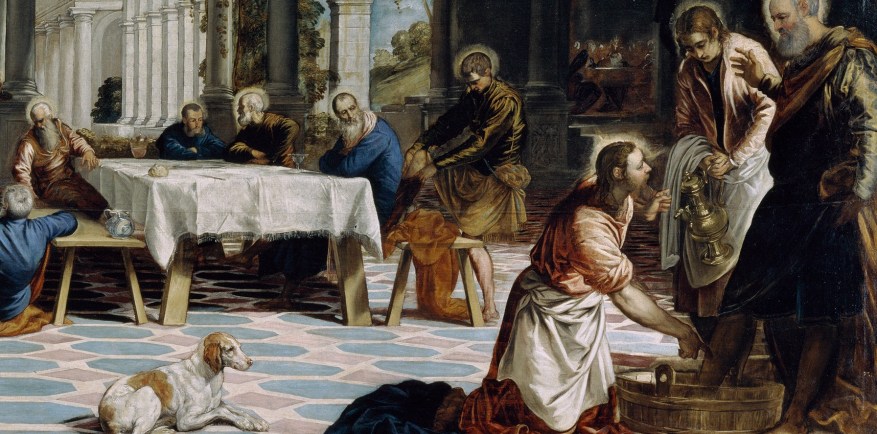
La Lavanda dei Piedi di Tintoretto: Il Capolavoro Veneziano al Prado
🇮🇹Tra i capolavori più affascinanti del Rinascimento veneziano, “La Lavanda dei Piedi” di Jacopo Tintoretto rappresenta un perfetto equilibrio tra spiritualità, innovazione compositiva e straordinaria forza narrativa… 🇬🇧Among the most fascinating masterpieces of the Venetian Renaissance, Jacopo Tintoretto’s “The Washing of the Feet” represents a perfect balance between spirituality, compositional innovation, and extraordinary narrative force…
-
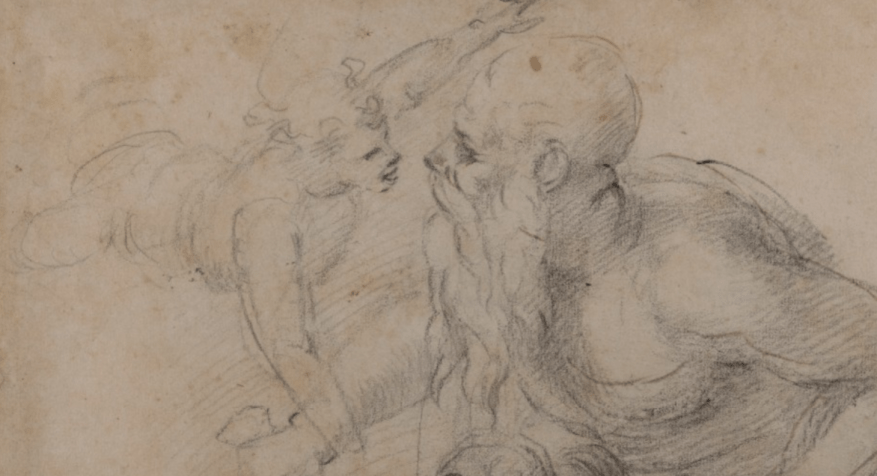
Il Sacrificio di Isacco e quel momento tra la vita e la morte
🇮🇹Oggi voglio raccontarvi alcuni dettagli sul mio disegno del Sacrificio di Isacco, conservato oggi a Casa Buonarroti. Su quel foglio volli tracciare il momento preciso in cui la paura fa spazio al miracolo… 🇬🇧Today I want to tell you some details about my drawing of the Sacrifice of Isaac, now preserved at Casa Buonarroti. On…
-
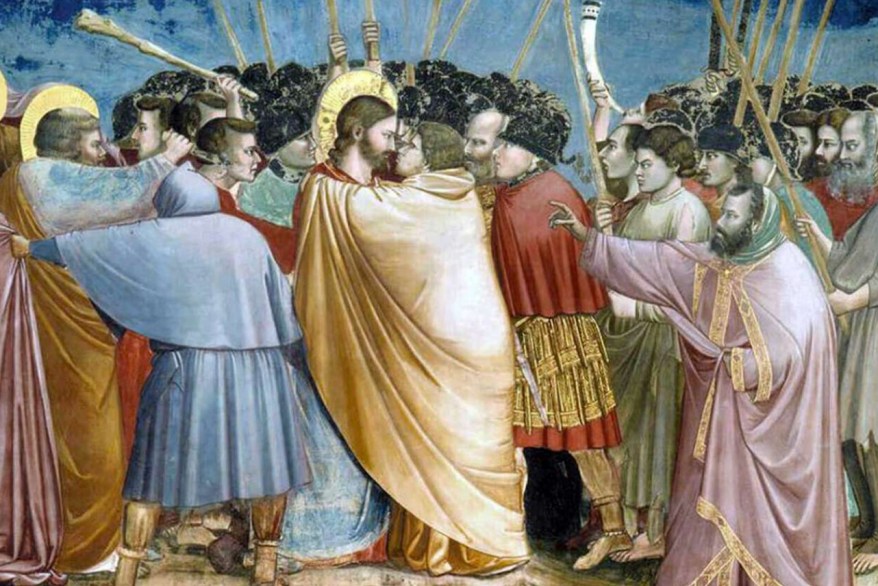
Mercoledì Santo: il giorno del tradimento di Giuda affrescato da Giotto
🇮🇹Il Mercoledì Santo è il giorno del silenzio, della riflessione e del tradimento. È il momento in cui Giuda sceglie di vendere Gesù per trenta denari, segnando uno dei passaggi più dolorosi della Settimana Santa…. 🇬🇧Holy Wednesday is a day of silence, reflection, and betrayal. ✝It is the moment when Judas chooses to sell Jesus…
Condividi:


Questo sono io





sostienici

Sostienici – Support Us
Se questo blog ti piace e ti appassiona, puoi aiutarci a farlo crescere sempre più sostenendoci in modo concreto condividendo i post, seguendo le pagine social e con un contributo che ci aiuta ad andare avanti con il nostro lavoro di divulgazione. . ENGLISH: If you like and are passionate about this blog, you can help us make it grow more and more by supporting us in a concrete way by sharing posts, following social pages and with a contribution that helps us to move forward with our dissemination work.
€10,00


