

8 novembre: i Quattro Santi Coronati di Nanni di Banco
Oggi 8 novembre la Chiesa Cattolica ricorda i Quattro Santi Coronati: Casorio, Claudio, Sempronio e Nicostrato, scultori martirizzati durante le persecuzioni di Diocleziano.
Si narra che i Santi si rifiutarono di erigere una scultura per onorare il dio Esculapio su commissione dell’imperatore. Vennero prima perseguitati e poi brutalmente uccisi. Sono i protettori degli scultori e degli architetti e a Firenze a loro è dedicato un posto d’onore.

Il gruppo dei Quattro Santi Coronati fu scolpito nel marmo da Nanni di Banco tra il 1409 3 il 1416 su commissione dell’Arte dei Maestri di Pietra e Legname e collocato in una delle nicchie esterne della Chiesa di Orsanmichele.
L’opera originale è stata rimossa dalla collocazione nella nicchia nel 1999 durante le operazioni di restauro eseguite dall‘Opificio delle Pietre Dure. Successivamente è stata collocata all’interno del Museo di Orsanmichele per ragioni conservative mentre la nicchia oggi è occupata da una replica più recente.

Nanni di Banco diede forma a un gruppo di quattro figure che occupano tutto lo spazio disponibile e che interagiscono tra di loro. Indossano toghe all’antica e i loro volti sembrano ispirati direttamente ai ritratti dei busti romani. Disposti a semicerchio pare quasi discutano tra di loro, consultandosi su un lavoro che stanno facendo.
Il Vasari nelle vite cita l’opera di Nanni di Banco con un curioso aneddoto relativo alla grandezza delle quattro sculture: «Dicesi che, avendoli finiti tutti tondi e spiccati l’un da l’altro e murata la nicchia, che a mala fatica non ve ne entravano dentro se non tre, avendo egli nelle attitudini loro ad alcuni aperte le braccia, perché disperato e mal contento andò a trovar Donato (Donatello), e contandoli la disgrazia e poca acortezza sua, rise Donato di questo caso e disse: “Se tu mi paghi una cena con tutti i miei giovani di bottega, mi dà il core di farli entrar nella nicchia senza fastidio nessuno”.
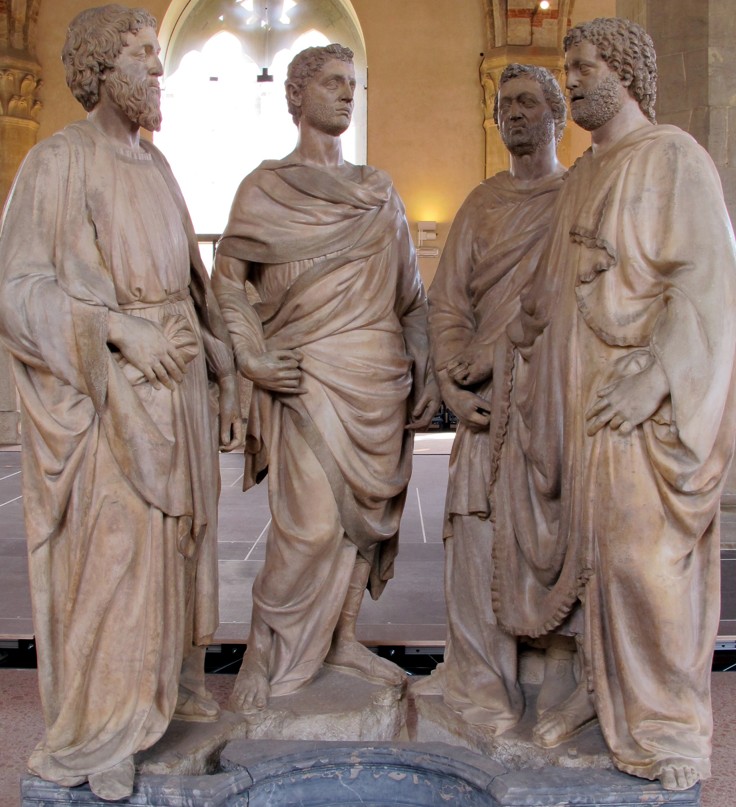
E così convenutosi, lo mandò a Prato a pigliare alcune misure, dove aveva d’andare esso Donato. E così Nanni partito e Donato preso i discepoli andatosene al lavoro, scantonò a quelle statue a chi le spalle et a chi le braccia talmente, che facendo luogo l’una all’altra, le accostò insieme, facendo apparire una mano sopra le spalle di una di loro. E le commesse così unite, che co’ ‘l savio giudizio suo ricoperse lo errore di Nanni di maniera che, murate ancora in quel luogo, mostrano indizii manifestissimi di concordia e di fratellanza; e chi non sa la cosa, non si accorge di quello errore. Nanni trovato nel suo ritorno che Donato aveva corretto il tutto e rimediato ad ogni disordine, gli rendette grazie infinite, et a lui insieme con suoi creati pagò la cena, la quale lietamente e con grandissime risa fu da loro finita.»
L’aneddoto però trova pochi riscontri nella realtà perché durante il restauro le due sculture che dovrebbero essere state avvicinate da Donatello, sono invece scolpite in un solo blocco di marmo.
Per il momento il sempre vostro Michelangelo Buonarroti e i suoi racconti vi saluta dandovi appuntamento ai prossimi post e sui social.
November 8: The Four Crowned Saints by Nanni di Banco
Today, November 8, the Catholic Church commemorates the Four Crowned Saints: Casorio, Claudio, Sempronio, and Nicostrato, sculptors martyred during the Diocletianic persecutions.
It is said that the Saints refused to erect a sculpture to honor the god Aesculapius for the emperor and were first persecuted and then brutally murdered. They are the protectors of sculptors and architects, and in Florence a place of honor is dedicated to them.
The group of the Four Crowned Saints was sculpted in marble by Nanni di Banco between 1409 and 1416, commissioned by the Guild of Master Stone and Woodworkers, and placed in one of the external niches of the Church of Orsanmichele.
The original work was removed from its niche in 1999 during restoration work carried out by the Opificio delle Pietre Dure. It was later placed inside the Orsanmichele Museum for conservation reasons, while the niche is now occupied by a more recent replica.
Nanni di Banco created a group of four figures that fill the entire available space and interact with each other. They wear ancient togas, and their faces seem directly inspired by Roman busts. Arranged in a semicircle, they almost seem to be discussing something they are doing.
Vasari mentions Nanni di Banco’s work in his Lives with a curious anecdote regarding the size of the four sculptures: “It is said that, having finished them all in the round and separated from one another, and having walled up the niche, so that only three could fit in with difficulty, he, in their poses, opened his arms to some of them. Desperate and discontented, he went to visit Donato (Donatello), and when he told him of his misfortune and his lack of forethought, Donato laughed at this and said: ‘If you pay me for a dinner with all my young men from the shop, it will give me the courage to fit them into the niche without anyone being inconvenienced.'”
And so, having agreed, he sent him to Prato to take some measurements of where Donato was going. And so Nanni left, and Donato, taking his disciples, went to work. He unbent the shoulders of those statues, some the arms, some the arms, so much so that, making room for one another, he placed them together, revealing a hand on the shoulder of one of them. And he joined them so closely that with his wise judgment he covered up Nanni’s error in such a way that, even when they are walled up in that place, they display very clear signs of harmony and brotherhood; and anyone who does not know this does not notice that error. Upon his return, Nanni found that Donato had corrected everything and remedied every mess, gave him infinite thanks, and paid for the dinner, which they finished happily and with great laughter.
The anecdote, however, has little basis in reality because during the restoration, the two sculptures that should have been brought together by Donatello were instead carved from a single block of marble.
For now, yours truly, Michelangelo Buonarroti and his stories bid you farewell, and we’ll see you in our next posts and on social media.

Sostienici – Support Us
Se questo blog ti piace e ti appassiona, puoi aiutarci a farlo crescere sempre più sostenendoci in modo concreto condividendo i post, seguendo le pagine social e con un contributo che ci aiuta ad andare avanti con il nostro lavoro di divulgazione. . ENGLISH: If you like and are passionate about this blog, you can help us make it grow more and more by supporting us in a concrete way by sharing posts, following social pages and with a contribution that helps us to move forward with our dissemination work.
10,00 €
Condividi:


Questo sono io





sostienici

Sostienici – Support Us
Se questo blog ti piace e ti appassiona, puoi aiutarci a farlo crescere sempre più sostenendoci in modo concreto condividendo i post, seguendo le pagine social e con un contributo che ci aiuta ad andare avanti con il nostro lavoro di divulgazione. . ENGLISH: If you like and are passionate about this blog, you can help us make it grow more and more by supporting us in a concrete way by sharing posts, following social pages and with a contribution that helps us to move forward with our dissemination work.
€10,00


