

La Sibilla Persica nell’incisione di Giulio Bonasone
Giulio Bonasone, attorno alla metà del Cinquecento, volle riprodurre un una dettagliata incisione la Sibilla Persica che avevo affrescato non molto tempo prima nella volta della Cappella Sistina.
In basso al centro si legge la firma dell’artista ‘IBonaso’.
La Persica è la più antica delle Sibille. La sua esistenza fu infatti menzionata da Nicarone, lo stesso autore che narrò le imprese di Alessandro Magno. Nei secoli a seguire viene fatta coincidere da diversi scrittori con la Caldea o Ebrea e rinominata Sambetta.

Dovete sapere che iniziai a metter mano alle giornate dell’affresco per la Sibilla Persica dopo il 1511, posizionandola in corrispondenza della settima campata, a partire dalla porta d’entrata della Sistina.
Alla stregua della Sibilla Cumana, volli darle un aspetto attempato e le feci piegare la schiena curvandola con un’evidente gobba che si percepisce al di sotto del mantello rosato.
China in avanti, la Sibilla sta leggendo il libro degli oracoli tentando di dare un’interpretazione plausibile a ciò che vede per interpretare il futuro.
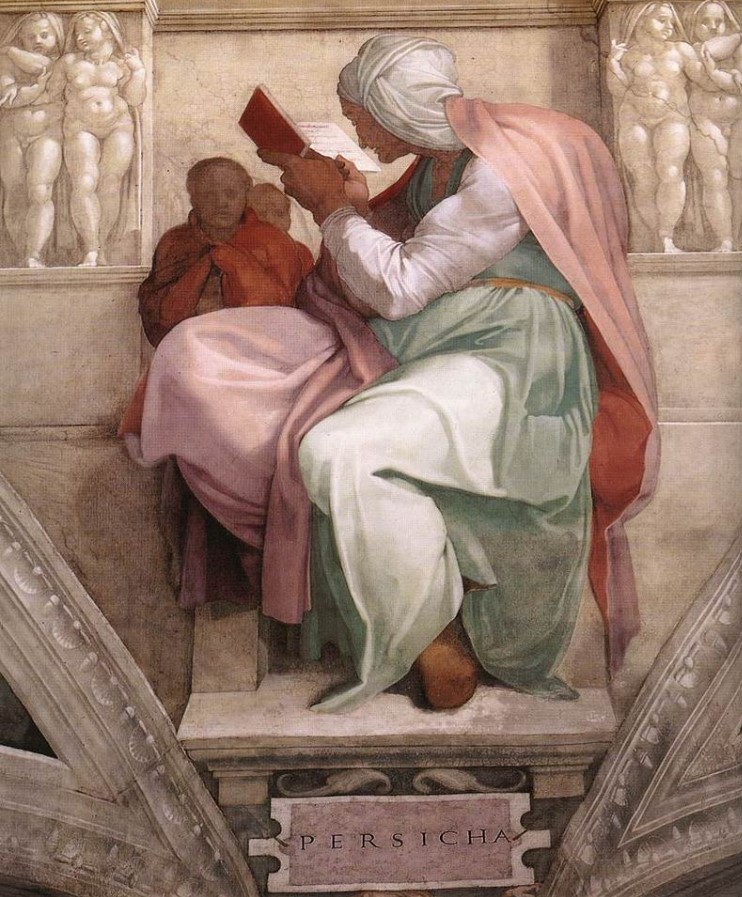
La Sibilla Persica sembra avere problemi di vista dovuti probabilmente all’età avanzata. Avvicina in modo evidente il libro al volto per tentare di vedere meglio ciò che riporta fra le sue pagine.
Ha il capo coperto da un fazzoletto bianco e un mantello rosa che le copre le spalle e parte della gamba destra. La veste verde le lascia scoperta una scarpa in cuoio ed è stretta in vita da una sottile cintura gialla.

L’incisione della Persica di Bonasone appartiene alle collezioni del British Museum.
Per il momento il sempre vostro Michelangelo Buonarroti vi saluta dandovi appuntamento ai prossimi post e sui social.
The Persian Sibyl in Giulio Bonasone’s Engraving
Giulio Bonasone, around the mid-16th century, wanted to reproduce in a detailed engraving the Persian Sibyl that I had frescoed not long before on the Sistine Chapel vault.
At the bottom center is the artist’s signature, “IBonaso.”
The Persian Sibyl is the oldest of the Sibyls. Its existence was, in fact, mentioned by Nicaro, the same author who recounted the exploits of Alexander the Great. In the centuries that followed, various writers identified it with the Chaldean or Hebrew Sibyl and renamed it Sambetta.
You should know that I began working on the fresco for the Persian Sibyl after 1511, positioning it in the seventh bay, starting from the entrance doors of the Sistine Chapel.
Like the Cumaean Sibyl, I wanted to give her an elderly appearance, so I made her bend her back, with a noticeable hunch visible beneath her pink cloak.
Leaning forward, the Sibyl is reading the book of oracles, attempting to give a plausible interpretation to what she sees in order to predict the future.
The Persian Sibyl appears to have poor eyesight, probably due to her advanced age. She is clearly holding the book close to her face to try to better see what lies within its pages.
Her head is covered by a white kerchief, and a pink cloak covers her shoulders and part of her right leg. Her green dress leaves one leather shoe uncovered and is cinched at the waist with a thin yellow belt.
The engraving of Bonasone’s Persian Sibyl belongs to the British Museum collections.
For now, yours truly, Michelangelo Buonarroti bids you farewell, and we’ll see you in future posts and on social media.

Sostienici – Support Us
Se questo blog ti piace e ti appassiona, puoi aiutarci a farlo crescere sempre più sostenendoci in modo concreto condividendo i post, seguendo le pagine social e con un contributo che ci aiuta ad andare avanti con il nostro lavoro di divulgazione. . ENGLISH: If you like and are passionate about this blog, you can help us make it grow more and more by supporting us in a concrete way by sharing posts, following social pages and with a contribution that helps us to move forward with our dissemination work.
10,00 €
Articoli
Condividi:


Questo sono io





sostienici

Sostienici – Support Us
Se questo blog ti piace e ti appassiona, puoi aiutarci a farlo crescere sempre più sostenendoci in modo concreto condividendo i post, seguendo le pagine social e con un contributo che ci aiuta ad andare avanti con il nostro lavoro di divulgazione. . ENGLISH: If you like and are passionate about this blog, you can help us make it grow more and more by supporting us in a concrete way by sharing posts, following social pages and with a contribution that helps us to move forward with our dissemination work.
€10,00


