

21 giugno 1527 muore Machiavelli: ecco la scultura che lo ricorda
Oggi, 21 giugno, ricorre l’anniversario della morte di Niccolò Machiavelli, che morì a Firenze il 21 giugno 1527, all’età di 58 anni.
Nato a Firenze nel 1469, Machiavelli visse in un’epoca di grandi sconvolgimenti politici. Funzionario di spicco della Repubblica fiorentina per quasi quindici anni, ricopri il ruolo di Segretario della Seconda Cancelleria e del Consiglio dei Dieci, incarichi che lo portarono a svolgere importanti missioni diplomatiche in Italia, in Francia, Germania e presso Cesare Borgia.

Con il ritorno dei Medici a Firenze nel 1512 e la fine della Repubblica, Machiavelli fu allontanato dalla vita pubblica, accusato di congiura e persino imprigionato e torturato. In quel periodo di forzata inattività in cui visse nella sua tenuta di Sant’Andrea in Percussina, fu fecondo dal punto di vista intellettuale.
Scrisse infatti la sua opera più celebre, “Il Principe”: un trattato che analizza le modalità attraverso cui un principe può conquistare e mantenere il potere. “Il Principe” è considerato un testo fondamentale della scienza politica moderna perché per la prima volta la politica viene studiata nella sua autonomia, separata dalla morale o dalla religione.
Il suo realismo e la sua analisi disincantata della natura umana e delle dinamiche del potere hanno reso celebre l’espressione “machiavellico”, spesso associata a una visione cinica e spregiudicata della politica, anche se in realtà l’intento di Machiavelli era quello di offrire strumenti pratici per la stabilità dello Stato.

La scultura di Machiavelli
A Firenze, nel cortile degli Uffizi, tra gli altri uomini illustri che osservano dall’alto i passanti, c’è anche quella che raffigura Niccolò Machiavelli.
L’opera fu scolpita da Lorenzo Bartolini e venne inaugurata nel 1846, nel giorno di San Giovanni assieme alle statue di Cosimo Pater Patriae e di Amerigo Vespucci.
Collocata nella tredicesima nicchia del loggiato di levante, come scrisse in una lettera lo stesso scultore Bartolini, rappresenta Machiavelli mentre ragiona sulla triste sorte dell’Italia, con un evidente parallelismo all’età in cui viveva l’artista che la realizzò.
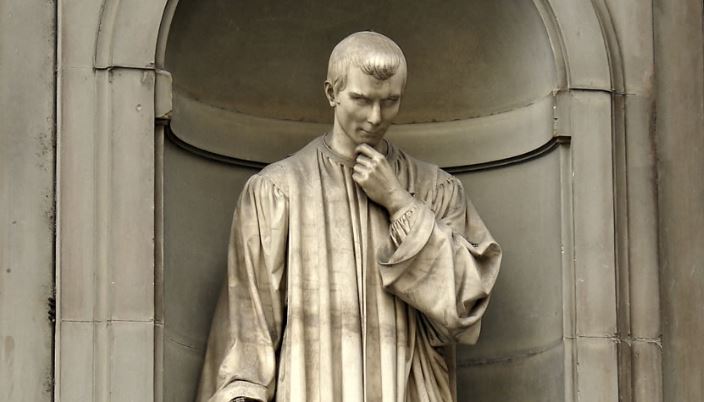
Poggia il libro del ‘Principe’ su una colonna che allude sia alla decadenza dell’Impero Romano che dell’Italia. Alla base ha due rami di quercia che però risultano essere secchi.
Per il momento il sempre vostro Michelangelo Buonarroti vi saluta dandovi appuntamento ai prossimi post e sui social.
June 21, 1527 Machiavelli dies: here is the sculpture that commemorates him
Today, June 21, is the anniversary of the death of Niccolò Machiavelli, who died in Florence on June 21, 1527, at the age of 58.
Born in Florence in 1469, Machiavelli lived in an era of great political upheaval. A prominent official of the Florentine Republic for almost fifteen years, he held the role of Secretary of the Second Chancellery and of the Council of Ten, positions that led him to carry out important diplomatic missions in Italy, France, Germany and to Cesare Borgia.
With the return of the Medici to Florence in 1512 and the end of the Republic, Machiavelli was removed from public life, accused of conspiracy and even imprisoned and tortured. During that period of forced inactivity in which he lived on his estate in Sant’Andrea in Percussina, he was intellectually fertile.
In fact, he wrote his most famous work, “The Prince”: a treatise that analyzes the ways in which a prince can conquer and maintain power. “The Prince” is considered a fundamental text of modern political science because for the first time politics was studied in its autonomy, separate from morality or religion.
His realism and his disenchanted analysis of human nature and the dynamics of power have made the expression “Machiavellian” famous, often associated with a cynical and unprejudiced vision of politics, even if in reality Machiavelli’s intent was to offer practical tools for the stability of the State.
The sculpture of Machiavelli
In Florence, in the courtyard of the Uffizi, among other illustrious men who observe passers-by from above, there is also one depicting Niccolò Machiavelli.
The work was sculpted by Lorenzo Bartolini and was inaugurated in 1846, on the day of San Giovanni together with the statues of Cosimo Pater Patriae and Amerigo Vespucci.
Placed in the thirteenth niche of the eastern loggia, as the sculptor Bartolini himself wrote in a letter, it represents Machiavelli while he thinks about the sad fate of Italy, with an evident parallel to the age in which the artist who created it lived.
The book of the ‘Prince’ rests on a column that alludes to both the decadence of the Roman Empire and of Italy. At the base there are two oak branches that, however, appear to be dry.
For the moment, the ever-your Michelangelo Buonarroti bids you farewell, making an appointment with you in the next posts and on social media.

Sostienici – Support Us
Se questo blog ti piace e ti appassiona, puoi aiutarci a farlo crescere sempre più sostenendoci in modo concreto condividendo i post, seguendo le pagine social e con un contributo che ci aiuta ad andare avanti con il nostro lavoro di divulgazione. . ENGLISH: If you like and are passionate about this blog, you can help us make it grow more and more by supporting us in a concrete way by sharing posts, following social pages and with a contribution that helps us to move forward with our dissemination work.
10,00 €
Condividi:


Questo sono io





sostienici

Sostienici – Support Us
Se questo blog ti piace e ti appassiona, puoi aiutarci a farlo crescere sempre più sostenendoci in modo concreto condividendo i post, seguendo le pagine social e con un contributo che ci aiuta ad andare avanti con il nostro lavoro di divulgazione. . ENGLISH: If you like and are passionate about this blog, you can help us make it grow more and more by supporting us in a concrete way by sharing posts, following social pages and with a contribution that helps us to move forward with our dissemination work.
€10,00


