
9 giugno 1889: inaugurato il monumento a Giordano Bruno a Campo de’ Fiori
Era il 9 giugno del 1889 quando venne inaugurata la scultura in bronzo che ritrae Giordano Bruno a Campo de’ Fiori, a Roma.
Posizionata laddove il filosofo fu arso vivo dal Sant’Uffizio il 17 febbraio del 1600, l’opera venne realizzata da Ettore Ferrari. Detta così sembra una cosa semplice, quasi scontata, ma quell’opera ha alle spalle una storia complessa quanto quella dell’uomo che raffigura, legata a doppia mandata al contesto politico-culturale dell’Italia post-unitaria.

Cenni storici
Giordano Bruno, filosofo, matematico, poeta e finanche cosmologo domenicano ma soprattutto libero pensatore, fu bruciato vivo sul rogo a Campo de’ Fiori il 17 febbraio 1600, condannato dall’Inquisizione per eresia. La sua esecuzione avvenne in quel preciso luogo, che all’epoca era un’area destinata alle esecuzioni pubbliche, trasformando Campo de’ Fiori in un simbolo del libero pensiero e della lotta contro l’intolleranza.
La nascita del monumento a Giordano Bruno
L’idea di erigere un monumento al filosofo nolano iniziò a farsi spazio a partire dal 1918, quando fu completato il processo dell’unificazione dell’Italia. Una prima scultura venne eretta nel 1849, durante la breve esperienza della Repubblica Romana governata da Carlo Armellini, Giuseppe Mazzini e Aurelio Saffi.
Durò poco. Al ritorno del potere pontificio venne abbattuta e non ne rimase traccia se non nei documenti.

L’idea di una scultura che potesse ricordare il libero pensatore tornò in auge nel 1876, quando un gruppo di studenti universitari de “La Sapienza” costituì un Comitato per promuovere una sottoscrizione universitaria internazionale per raccogliere i fondi necessari per realizzare una statua in onore di Giordano Bruno. Questa iniziativa fu interpretata come un segno di sfida alla Chiesa e al potere temporale del Papa, che aveva dominato Roma per secoli.
Difficoltà e polemiche
Papa Leone XIII in primis e altre autorità ecclesiastiche si opposero con fermezza all’idea di erigere una statua quello che consideravano un eretico in un luogo così significativo come era il luogo del suo martirio. La questione divenne un vero e proprio scontro tra il mondo laico e liberale, sostenitore del libero pensiero e della libertà di coscienza, e la Chiesa cattolica.

Nonostante le pressioni, il Comitato continuò dritto per la sua strada raccogliendo fondi e ottenendo contributi dall’estero. Le elezioni del giugno 1888, in cui la questione del monumento ebbe un ruolo rilevante, videro la vittoria dei liberali sui filoclericali, spianando la strada alla realizzazione dell’opera.
La realizzazione e l’inaugurazione del monumento a Giordano Bruno
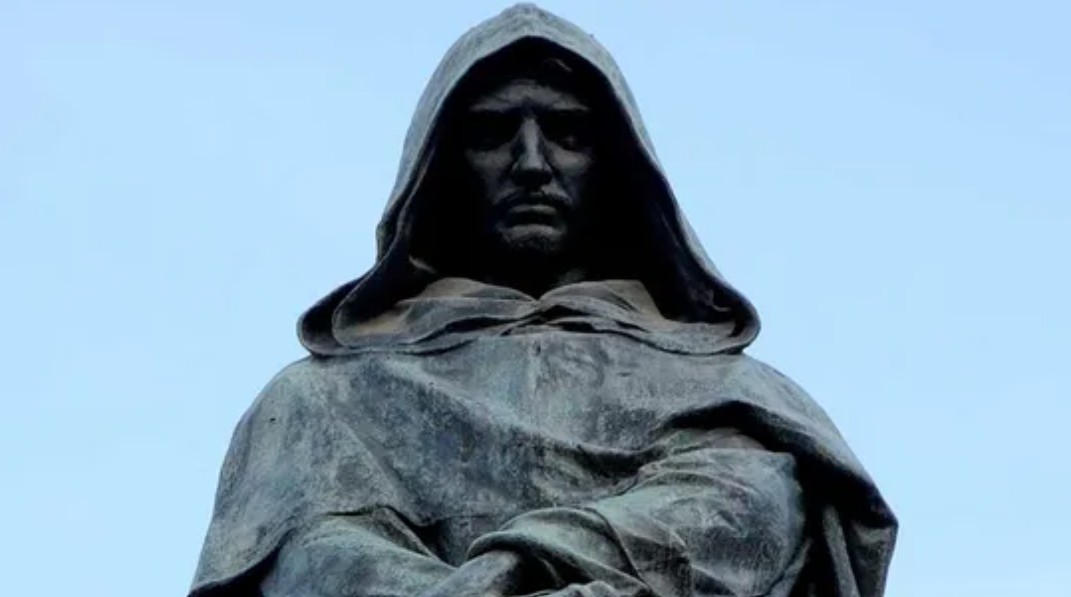
L’opera fu progettata dallo scultore Ettore Ferrari, un artista anti clericale e Gran Maestro della Massoneria dal 1904. Ferrari scelse di rappresentare Bruno con un’espressione severa e uno sguardo fisso, con le mani incrociate sul petto e il cappuccio del mantello che ne ombreggia il viso.
Dopo un primo progetto ideato nel 1879 e respinto perché giudicato troppo polemico nei confronti della Chiesa, la seconda versione che vediamo tutt’oggi venne inaugurata il 9 giugno 1889. Il posizionamento dell’opera non fu affatto casuale. Il volto di Giordano Bruno è rivolto in direzione della Basilica di San Pietro in Vaticano, in segno di ammonimento.
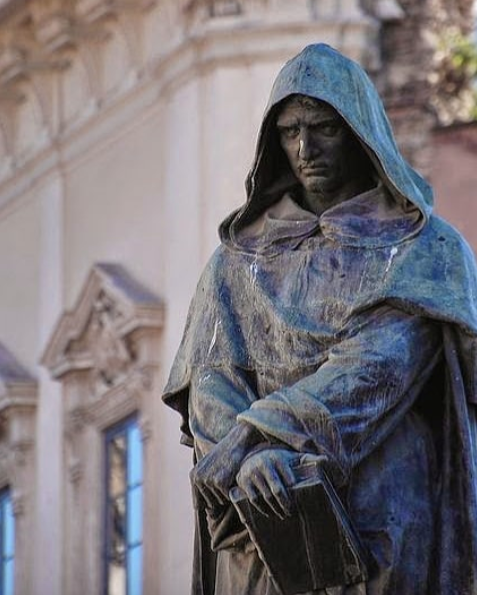
L’opera, gli otto medaglioni in bronzo che decorano il basamento in granito rosa e i tre bassorilievi vennero fusi nella fonderia Crescenzi di Roma.
L’iscrizione sul basamento recita: “A BRUNO – IL SECOLO DA LUI DIVINATO – QUI DOVE IL ROGO ARSE”, sottolineando il carattere profetico del suo pensiero e il luogo del suo martirio.
Collocata laddove Giordano Bruno venne arso vivo, l’opera ebbe una grande risonanza e il giorno dell’inaugurazione la piazza era piena di persone, pronte a celebrare l’inizio di una nuova era per l’Italia e sostenere il libero pensiero.
Per il momento il sempre vostro Michelangelo Buonarroti vi saluta dandovi appuntamento ai prossimi post e sui social.

June 9, 1889: the monument to Giordano Bruno was inaugurated in Campo de’ Fiori
It was June 9, 1889 when the bronze sculpture portraying Giordano Bruno was inaugurated in Campo de’ Fiori, in Rome.
Positioned where the philosopher was burned alive by the Holy Office on February 17, 1600, the work was created by Ettore Ferrari. Said like that it seems like a simple thing, almost obvious, but that work has a history behind it as complex as that of the man it depicts, doubly tied to the political and cultural context of post-unification Italy.
Historical notes
Giordano Bruno, philosopher, mathematician, poet and even Dominican cosmologist but above all a free thinker, was burned alive at the stake in Campo de’ Fiori on February 17, 1600, condemned by the Inquisition for heresy. His execution took place in that precise place, which at the time was an area designated for public executions, transforming Campo de’ Fiori into a symbol of free thought and the fight against intolerance.
The birth of the monument to Giordano Bruno
The idea of erecting a monument to the philosopher from Nola began to gain ground starting in 1918, when the process of Italian unification was completed. A first sculpture was erected in 1849, during the brief experience of the Roman Republic governed by Carlo Armellini, Giuseppe Mazzini and Aurelio Saffi.
It did not last long. Upon the return of papal power it was demolished and no trace of it remained except in documents.
The idea of a sculpture that could commemorate the free thinker returned to prominence in 1876, when a group of university students from “La Sapienza” formed a Committee to promote an international university subscription to raise the funds necessary to create a statue in honor of Giordano Bruno. This initiative was interpreted as a sign of challenge to the Church and the temporal power of the Pope, who had dominated Rome for centuries.
Difficulties and controversies
Pope Leo XIII first and other ecclesiastical authorities firmly opposed the idea of erecting a statue of what they considered a heretic in such a significant place as the place of his martyrdom. The issue became a real clash between the secular and liberal world, supporters of free thought and freedom of conscience, and the Catholic Church.
Despite the pressure, the Committee continued straight on its path, raising funds and obtaining contributions from abroad. The elections of June 1888, in which the question of the monument played a significant role, saw the victory of the liberals over the pro-clericals, paving the way for the realization of the work.
The creation and inauguration of the monument to Giordano Bruno
The work was designed by the sculptor Ettore Ferrari, an anticlerical artist and Grand Master of Freemasonry since 1904. Ferrari chose to represent Bruno with a stern expression and a fixed gaze, with his hands crossed on his chest and the hood of his cloak shading his face.
After an initial project conceived in 1879 and rejected because it was deemed too polemical towards the Church, the second version that we see today was inaugurated on June 9, 1889. The positioning of the work was not at all random. Giordano Bruno’s face is turned in the direction of St. Peter’s Basilica in the Vatican, as a sign of warning.
The work, the eight bronze medallions that decorate the pink granite base and the three bas-reliefs were cast in the Crescenzi foundry in Rome.
The inscription on the base reads: “TO BRUNO – THE CENTURY HE DIVINED – HERE WHERE THE STONE BURNED”, underlining the prophetic nature of his thought and the place of his martyrdom.
Placed where Giordano Bruno was burned alive, the work had a great resonance and on the day of the inauguration the square was full of people, ready to celebrate the beginning of a new era for Italy and support free thought.
For the moment, your ever Michelangelo Buonarroti bids you farewell, making an appointment with you in the next posts and on social media.

Sostienici – Support Us
Se questo blog ti piace e ti appassiona, puoi aiutarci a farlo crescere sempre più sostenendoci in modo concreto condividendo i post, seguendo le pagine social e con un contributo che ci aiuta ad andare avanti con il nostro lavoro di divulgazione. . ENGLISH: If you like and are passionate about this blog, you can help us make it grow more and more by supporting us in a concrete way by sharing posts, following social pages and with a contribution that helps us to move forward with our dissemination work.
10,00 €
Condividi:


Questo sono io





sostienici

Sostienici – Support Us
Se questo blog ti piace e ti appassiona, puoi aiutarci a farlo crescere sempre più sostenendoci in modo concreto condividendo i post, seguendo le pagine social e con un contributo che ci aiuta ad andare avanti con il nostro lavoro di divulgazione. . ENGLISH: If you like and are passionate about this blog, you can help us make it grow more and more by supporting us in a concrete way by sharing posts, following social pages and with a contribution that helps us to move forward with our dissemination work.
€10,00


